
.webp)
Post Summary
Your district manager calls at 2 PM asking about Store #47's morning checklist.
You pull up your phone. Two taps later, you see it's done. Temperature logs? Complete. Safety walk? Finished at 9:15 am. Equipment maintenance? Scheduled for Thursday.
That's what operational efficiency looks like in 2026.
Most operations teams are still playing phone tag, checking emails, and waiting for updates. But the companies winning right now? They've built systems that make information instant and accessible.
This guide shows you exactly how to increase efficiency of operations across your locations. Real steps. Real results. No fluff.
.svg)

Priced on per user or per location basis
Available on iOS, Android and Web


What Does "Increase Efficiency of Operations" Actually Mean?
Operational efficiency is simple. It means getting the right work done at the right time with the right information.
This is the foundation of what operational excellence means in practice, not some theoretical framework, but how work actually flows through your organization.
For restaurants, retail stores, convenience stores, and facilities teams, here's what that looks like:
- Tasks completed consistently across every location
- Issues resolved quickly with full visibility
- Real-time performance data instead of waiting for reports
- Managers spending time on people and results, not paperwork
- Clear accountability from task assignment to completion
A McKinsey study found something interesting. Companies that optimize frontline workflows see 20-50% improvements in task completion speed.
That's not a small gain. That's transformative.
When you define operational excellence in your context, it starts with these efficiency fundamentals. You can't achieve operational excellence without first mastering operational efficiency.
The 7 Steps to Increase Operational Efficiency
.webp)
Understanding operational excellence roles and responsibilities starts with building efficient systems. Let's get into the practical framework.
Step 1: Map Your Current Frontline Value Stream
You need to see what's actually happening before you can improve it.
This is one of the 4 pillars of operational excellence: understanding your current state before designing your future state.
Pick one common task. The morning opening checklist works great for this.
Document every step:
- How does the manager access the checklist?
- Where do they record their observations?
- How do photos get captured and stored?
- Where does the completed information go?
- How does the district manager review it?
- What happens if there's an issue?
Write it all down. Every handoff. Every system. Every delay point.
Most companies discover their "simple" 10-minute checklist actually takes 30 minutes when you count all the admin work around it.
That's your opportunity.
Step 2: Automate Data Collection
Manual data entry is where time disappears.
Someone completes a task on paper. Later, they type it into a spreadsheet. Then someone copies that into a report. Then it gets emailed around.
Each step adds time. Each handoff creates an opportunity for information to get lost.
The solution is capturing information once, at the source.
Modern operations management software works like this:
- Manager opens the app on their phone
- Completes the checklist right there
- Uploads photos with two taps
- Submits it
- Everyone who needs that information has it instantly
Step 3: Standardize with Smart Templates
Consistency matters when you're running multiple locations. But every location is a little different.
The answer? Smart templates that adapt.
Shucking Good Hospitality runs restaurants in three cities. Different health departments. Different requirements.
Instead of managing three separate checklists, they built one master template using checklists and SOPs software. When a manager selects their location, the relevant requirements appear automatically.
The benefits:
- Update once, improve everywhere
- No confusion about which checklist to use
- Easier training for new managers
- Guaranteed consistency across locations
This approach supports the operational excellence strategy by making standards easy to maintain and enforce.
Step 4: Enable Real-Time Visibility
"How are we doing today?" should have an instant answer.
Real-time tracking means you see what's happening as it happens. Not tomorrow. Not next week. Right now.
What real-time visibility gives you:
**
What You Need to Know, How You See It
Are tasks getting completed on time?, Live completion dashboard
Which locations need support?, Automatic alerts for overdue items
Are there any safety issues?, Instant notifications when logged
Is equipment being maintained?, Upcoming maintenance calendar
What trends are emerging?, AI-powered pattern analysis
**
The key is smart alerts, not information overload.
You don't need to know every single task. You need to know what requires your attention.
Example alerts that matter:
- Temperature log hasn't been completed in 6 hours → Alert shift lead
- Safety inspection due tomorrow → Remind store manager
- Equipment maintenance in 3 days → Notify facilities team
- Task consistently late at one location → Flag for DM review
This is where AI becomes genuinely useful. It spots patterns humans would miss.
Like noticing that one location completes closing procedures 30% faster than others. That's worth investigating. Maybe they've found a better process that everyone else should use.
Modern task management platforms build this intelligence into daily workflows.
Step 5: Create Clear Resolution Pathways
Finding issues is the easy part. Making sure they get resolved is where systems matter.
Every issue that gets logged should have a clear path to resolution.
The complete resolution pathway:
- Issue identified and logged (by anyone, anywhere)
- Automatically routed to the right person based on type and location
- Owner assigned with clear responsibility
- Target date set based on priority and type
- Progress tracked with status updates
- Reminders sent if approaching deadline
- Resolution verified with photo evidence or confirmation
- Automatically closed and logged for records
Here's what this looks like in practice.
A store manager walks past the back door during closing. The lock feels loose. She pulls out her phone, logs in 30 seconds with a quick photo and voice note.
The system instantly routes it to the facilities team. Creates a work order. Assign it to the technician who covers that area. Sets a 48-hour target based on the priority level.
The technician gets a notification. Shows up. Fixes the lock. Takes a photo of the completed work. Closes the ticket.
The store manager gets an automatic notification that it's done. The DM can see the whole history if they need it.
Nobody made a phone call. Nobody sent an email. Nobody wondered if it got handled.
That's operational efficiency through corrective actions software that works.
Step 6: Connect Operations, Maintenance, and Safety
Here's something most companies get wrong. They treat operations, maintenance, and safety as separate things.
But in the real world, they're completely connected.
How these functions overlap:
**
Situation, Operations Impact, Maintenance Impact, Safety Impact
Walk-in cooler running warm, Food quality risk - potential waste, Equipment needs service, Food safety compliance
Wet floor in back area, Slows down workflow, Possible plumbing issue, Slip and fall hazard
Broken door lock, Security concern - can't close properly, Facilities repair needed, Building security risk
Lighting fixture out, Poor customer experience, Electrical work required, Safety visibility issue
**
When these systems talk to each other, everything works better.
Xenia is an all-in-one platform that integrates maintenance, safety, and operations in one view. When a manager logs anything, everyone who needs that information has it immediately.
A spill gets logged? Operations sees it as a cleaning task. Safety sees it as a hazard. Facilities sees it as a potential plumbing issue to investigate.
One entry. Complete visibility. No extra coordination needed.
Step 7: Build a Continuous Improvement Rhythm
The best operations teams get better every month.
They do this by creating a regular review rhythm. Not marathon meetings. Focused 30-minute sessions that drive real improvement.
Your monthly operations review agenda:
First 10 minutes: Review the numbers
- Overall task completion rate across all locations
- Average time to resolution for issues
- Locations performing particularly well
- Locations that might need additional support
Next 10 minutes: Identify opportunities
- Processes that could be streamlined
- Recurring issues that indicate systemic opportunities
- Best practices from top performers to share
Final 10 minutes: Make decisions and assign actions
- What will we improve this month?
- Who owns each improvement?
- How will we measure success?
How Xenia Enables Operational Excellence
Xenia is a mobile-first operations platform built specifically for multi-unit frontline businesses.
We built it because traditional software doesn't work for frontline teams. They need something different.
What makes Xenia different:
One app for everything. Your team uses one app for all their work. Checklists, equipment maintenance, safety inspections, and corrective actions. Everything in one place means better efficiency and better data.
.webp)
Built for mobile teams. Designed for phones first, computers second. Big buttons. Voice-to-text. Photo uploads in two taps. Your team completes tasks in seconds while walking the floor.
Works offline. Spotty internet isn't a problem. The app works offline and syncs automatically when connectivity returns. Your team stays productive anywhere.
AI that actually helps. Photo analysis, predictive maintenance, automated summaries, smart routing. AI handles routine work, so your team can focus on operations and customer experience.
Explore our AI capabilities, including the Template Agent and AI Summaries.

Real-time visibility. District managers and executives see performance across all locations instantly. The insights they need to support their teams effectively, right on their phone.
Built-in integration. Operations, maintenance, and safety work together naturally. When systems communicate, your team works more efficiently.
Frequently Asked Questions
What are the first 5 steps to improve operational efficiency in a decentralized workforce?
Start with these five steps:
- Automate data collection so information gets captured once at the source
- Standardize processes using smart templates that adapt to each location
- Implement real-time mobile tracking so you see what's happening now
- Create clear resolution pathways so every issue gets handled systematically
- Enable cross-functional visibility so operations, maintenance, and safety teams work from the same information.
How can I increase operational performance while supporting my team?
Focus on removing administrative work, not adding more tasks to your team's plate. Automate data entry. Provide real-time visibility so they don't field constant status calls. Give them tools that work on their phones while they're on the floor.
What are effective ways to improve operational efficiency in facilities management?
The most effective approaches are implementing predictive maintenance scheduling so you stay ahead of equipment needs instead of reacting to failures, using mobile tools for instant issue reporting and resolution, creating automatic reminders for scheduled maintenance tasks, and integrating facilities operations with safety compliance.
How much can AI-driven task management increase operational speed?
AI-driven task management can cut administrative coordination by 40-60% and increase task completion by 25-40%. Automatic routing, smart reminders and predictive alerts eliminate hours of manual follow-up. Response times improve 30-50%, and overall operational speed rises 35-45% as teams focus on execution, not coordination.
Conclusion
The companies thriving in 2026 aren't the ones with the biggest budgets.
They're the ones empowering their frontline teams with systems that actually work.
Your managers focus on leadership and team development. Your district leads spend time supporting their teams, not chasing information. Your employees have tools that make their jobs easier and more satisfying.
When you invest in better systems, efficiency gains follow naturally.
The opportunity is clear. The tools exist. The question is: when will you start?
This is what operational excellence definition looks like in practice, not a philosophical concept, but a systematic approach to eliminating waste and empowering people.
Want to see what's possible? Book a demo to find out how Xenia can help your operations.
Frequently Asked Questions
Got a question? Find our FAQs here. If your question hasn't been answered here, contact us.

Looks like there's no data available in our FAQ section at the moment.

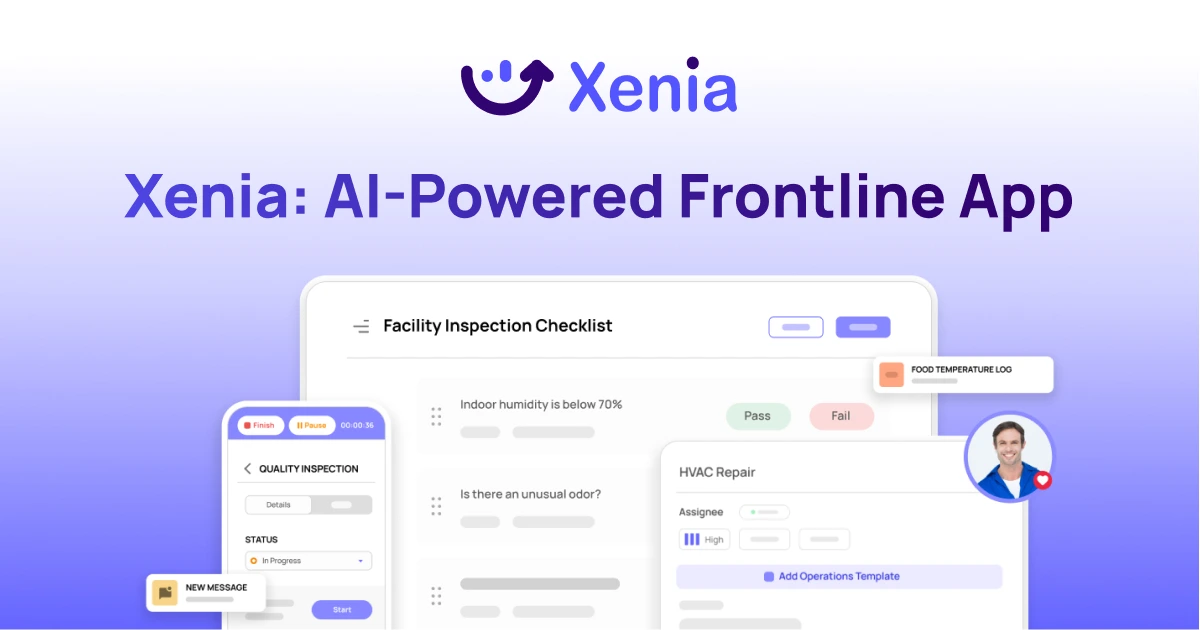
A Modern, AI-Powered Platform Built Specifically for Frontline Operations
Xenia brings daily operations, maintenance, audits, and compliance into one mobile-first platform. Frontline teams execute work consistently across locations while leadership gets real-time visibility.
Why Multi-Location Operators Choose Xenia:
🤖 AI-Powered Operations, Create digital checklists instantly or convert paper forms with AI. Verify compliance automatically with photo analysis and get instant answers from your operational data.
✅ Daily Operations & Maintenance, Assign work across hundreds of locations in minutes. Report and route issues instantly. Schedule preventive maintenance to catch problems before downtime.
📊 Real-Time Visibility, Track completion, work orders, and performance across all locations through dashboards. Filter by site or asset to spot trends and take action.
Manage operations, maintenance, and compliance across all your locations from one platform

.svg)
.webp)
%201%20(1).webp)

.svg)
%201%20(2).webp)