
.webp)
Post Summary
It is a Monday morning. A district manager pulls last week's coverage report.
Three locations ran understaffed on the same Saturday. All three had approved time off requests for that day. Each store manager approved independently. None of them knew what the others had done.
Nobody broke the rules. There were no rules to break. The policy had no mechanism for cross-location visibility. Three managers made three separate calls. The Saturday fell apart.
That is not a staffing problem. It is a policy problem.
This guide is for operators running time off requests across dozens of locations, not one. The real problems at that scale are not how to define PTO types. How to enforce blackout dates when every manager is approving independently. How to stop absence from turning into abandonment. How to read request frequency as a retention signal before you lose the employee.
If your time off policy only works at one location, it is not a policy yet.
.png)
.svg)

Priced on per user or per location basis
Available on iOS, Android and Web


What is a time off request policy?
A time off request policy is a written document. It defines how employees request time away from work, how managers approve or deny those requests, and what happens when the standard process breaks down.
For a single-location operator, it is an HR document. For a multi-unit operator managing 30 or 50 locations, it is something more critical than that. It is the operating system for absence management across the entire portfolio.
Without one, every store manager makes independent judgment calls. No consistency. No cross-location visibility. No paper trail. The result is exactly what the scenario above describes: requests approved in isolation, coverage gaps nobody saw coming, and nothing to audit when the weekend goes sideways.
A solid time off request policy gives every manager at every location the same rules, the same thresholds, and the same escalation path. That is what consistency at scale actually looks like.
Planned vs unplanned: why your policy needs to cover both
Here is something most operators miss. Not all time off is the same kind of problem.
Every time off scenario falls into one of two buckets. Each one needs a different process. A policy that only covers one of them leaves the other wide open.
**
Type, What it covers, When employee notifies
Planned time off, Vacation-personal days-scheduled medical-predictable leave, Days or weeks in advance
Unplanned absence, Sick days-emergencies-last-minute situations, Hours before shift or not at all
**
Planned time off requests
The employee submits in advance. The manager reviews against coverage requirements, blackout dates, and team availability. Approved or denied with a documented reason.
This is the process most operators have at least partially figured out. Submit a form, get an answer, done. The harder problem is below.
Unplanned absences and the call-out process
The employee cannot submit in advance. The shift is hours away. The call-out policy takes over.
This is where most multi-unit operators have absolutely nothing documented. No defined contact method. No required notification window. No line between an excused absence and a policy violation.
What happens? Every manager responds differently. Some are lenient. Some are strict. Across 30 locations, that inconsistency compounds into coverage gaps, attendance violations, and situations that start looking like abandonment. None of it can be treated as a policy violation because there is no policy behind it.
The call-out process is not a footnote. It is half the article. It needs its own section in the policy.
What to include in a time off request policy
Most operators write a policy that covers leave types and advance notice, then stop. That is the easy half. The hard half is the call-out process, the cross-location visibility mechanism, and the abandonment threshold.
All eight components belong in the policy. These are also the fields the downloadable template covers.
Leave types and eligibility
Define which leave types the policy covers: vacation, personal days, sick leave, bereavement, FMLA-qualifying leave. Then define eligibility by classification.
Full-time, part-time, and seasonal employees often have different entitlements. Those distinctions need to be written down. If a manager has to guess which classification gets which leave type, the policy is not doing its job.
Advance notice requirements
Two weeks is the standard minimum for planned requests in most frontline operations. That said, emergency leave and sick leave cannot require the same window. Define the exception process separately so managers know exactly when it applies and when it does not.
The call-out process
Define who employees contact when they cannot make a shift. Define how far in advance. Define the channel. A text to a manager's personal phone is not a documented call-out. A timestamped message through a defined channel is. The call-out process gets its own full section below because it is the most commonly missing piece in multi-unit operations.
Blackout dates and coverage minimums
Define blackout periods: peak seasons, high-volume weeks, specific holidays. Define minimum staffing thresholds for a given shift before any time off can be approved.
Blackout dates must be set at the corporate or area level before request season opens. Store managers enforce them. They do not set them. The moment each location is setting its own blackout dates independently, consistency is already gone.
Approval authority and cross-location visibility
Define who approves. Store manager for single-location requests. Area manager for anything affecting coverage across locations. Build cross-location visibility into the approval chain.
Without it, a store manager approving a Saturday off has no way to know that two other nearby locations approved the same Saturday. That is how the Monday morning coverage report becomes a problem.
Overlapping request resolution
Multiple employees request the same dates. Conflict. How does it get resolved?
Choose one system and write it down: first submitted, seniority-based, or rotation. Apply it the same way at every location. When managers make discretionary calls, employees at different locations experience different standards. That inconsistency creates grievances.
Documentation and record-keeping
Every request, approval, and denial needs a timestamp. Verbal approvals are not approvals. They are liabilities. Documentation protects the operator in disputes, compliance audits, and abandonment situations where the timeline of contact attempts determines the outcome.
Consequences for policy non-compliance
Define what happens when employees skip the request process, call out through the wrong channel, or repeatedly miss shifts without following the process. The escalation path must be identical at every location. Inconsistent consequences across locations create legal exposure just as much as inconsistent approvals do.
Here is how the eight components map to what they actually protect against:
**
Policy component, What breaks without it
Leave types and eligibility, Managers applying different leave rules by location
Advance notice requirements, Last-minute requests treated the same as emergencies
Call-out process, Undocumented absences-inconsistent manager responses
Blackout dates and coverage minimums, Understaffed peak shifts-simultaneous approvals
Approval authority and cross-location visibility, Three managers approving the same Saturday independently
Overlapping request resolution, Fairness grievances-discretionary manager decisions
Documentation and record-keeping, No paper trail for disputes or compliance audits
Consequences for non-compliance, No enforceable violation threshold-abandonment ambiguity
**
The call-out policy: what it is and why it needs its own section
A call-out policy is not the same as a time off request policy. It governs a completely different situation.
The employee could not give advance notice. The shift starts in hours, not days. There is no time for a formal request and approval chain. What happens next depends entirely on whether the call-out policy exists and whether every manager is following the same version of it.
Most multi-unit operators have no documented process for this at all. The call-out policy needs to define:
The notification window
How far in advance must the employee notify management before a shift?
One hour is not workable. By the time a manager reads the message and starts looking for coverage, the shift has started short. Two to four hours is the standard for most frontline operations. Pick a number. Write it down. "As soon as possible" is not a policy. It is the starting point for every manager to invent their own standard.
The notification channel
Who does the employee contact and through which channel?
Not a group chat. Not a personal text thread with no timestamp. A specific manager, a specific number or platform, with a documented record. The channel needs to produce a timestamp because that timestamp is what separates a documented absence from an undocumented one when the attendance conversation happens two weeks later.
**
Channel type, Documented, Timestamped, Recommended
Personal text to manager, No, No, No
Group chat, No, Rarely, No
Dedicated ops platform, Yes, Yes, Yes
Email to manager, Yes, Yes, Acceptable
**
What happens when the process is not followed
No call, no show is not the same as a late call-out. A late call-out is not the same as a documented emergency. The policy must define each scenario and the response for each.
This is the operator's protection against inconsistent manager behavior. When every manager knows exactly what each failure scenario means, the response is consistent across thirty locations. When they are guessing, thirty locations produce thirty different outcomes. Employee accountability tools make it possible to track patterns and flag repeat violations before they escalate to abandonment.
When the policy breaks down: work abandonment
Work abandonment is the downstream consequence of a failed call-out policy. It is also where operators face the most legal exposure, and it is almost entirely preventable with a documented policy.
What is work abandonment?
Work abandonment, also called abandonment of employment or abandonment of shift, is when an employee stops showing up without notice and without following the call-out process.
It is not the same as resignation. It is not always intentional. Some employees disappear because of genuine emergencies and no established way to communicate. Others stop showing up because the schedule stopped working for them and nobody noticed the signals earlier.
Without a documented policy, operators cannot treat abandonment as a policy violation. There is no policy to have violated.
How a clear policy prevents it
When employees have a documented call-out process, abandonment becomes distinguishable from policy violation. The timeline is clear. The contact attempts are recorded. The employment decision is defensible.
Without a policy, every abandonment situation becomes a judgment call. Judgment calls across thirty locations produce thirty different outcomes. Some of those outcomes create wrongful termination exposure.
What to include in the policy for abandonment
**
Element, What to define
Abandonment threshold, Number of consecutive no-call no-shows (standard: 2 to 3 shifts)
Manager response process, Documented contact attempts-timestamped records-HR notification
Outcome, Clear definition of what happens at the threshold
Documentation standard, Same process at every location-no discretionary variation
**
Every step in this process needs to be documented the same way at every location. The documentation is what makes the employment decision defensible if it is ever challenged.
How to enforce a time off request policy across multiple locations
Writing the policy is the easier half. Enforcing it consistently across a portfolio is the harder half. Most rollouts fail the same way.
The policy gets written at corporate, emailed to store managers, and never touched again. Six months later, half the locations have reverted to what they were doing before. That is what happens when rollout is treated as a communication task instead of a behavior change problem.
Set blackout dates at the portfolio level before the season begins
Blackout dates communicated after employees have already submitted requests create immediate resentment. Store managers end up in conversations they should not be having because the information came too late.
Set dates at the area or corporate level. Communicate them to every location simultaneously before the request season opens. Build them into the approval system before the first request comes in. Store managers enforce the dates. They do not determine them.
Give managers a one-page reference, not a policy document
A store manager approving a time off request at 7 AM will not re-read a seven-page policy document first. They need a one-page reference: notice requirements, blackout periods, minimum coverage thresholds, call-out steps, and escalation path.
The full policy lives in the handbook. The reference card lives at the manager station. HR workflow tools make it possible to assign the reference card to every location, confirm receipt, and verify that every manager has it before the request season opens.
Use absence frequency as a retention signal
High call-out volume at a specific location is not always a discipline problem. Most of the time it is a scheduling signal.
Employees who cannot get time off through the formal process stop requesting. They start no-showing. A location with spiking call-out violations in the same two-week window is telling you something about the schedule, not about the employees. Review absence frequency monthly by location. Employee accountability data surfaces those patterns across the portfolio without requiring a manual audit.
**
What the data shows, What it usually means, What to do
High call-out rate at one location, Schedule does not match staff availability, Review and rebuild the base schedule
Call-outs spiking in same week repeatedly, Recurring coverage problem-not random, Identify the shift pattern and fix it
Requests denied frequently at one location, Approval process too restrictive or unclear, Audit blackout dates and coverage minimums
Repeat no-call no-shows from same employees, Early abandonment signal, Review schedule fit before escalating discipline
**
For district and regional leaders running multiple locations, time off patterns tell you whether your schedules actually work. Our workforce scheduling guide shows how to build schedules that cut down on unnecessary time off requests before they start.
Time off request form template
Most generic time off request templates have six fields: employee name, dates requested, leave type, manager signature, and two blanks. They were built for a single-location office where the manager knows everyone and coverage is not a variable.
That template does not work for a 30-location operation.
The template below is made for multi-unit operators. It includes every field a single-location template skips:
.webp)
Related resources
- HR Workflows for Frontline Teams
- Employee Accountability Tools
- Shift Swap Policy Guide
- Workforce Scheduling Guide
- Workforce Management Best Practices
Conclusion
Three store managers approving time off independently on the same Saturday is not a people problem. It is a policy problem.
A time off request policy that holds across a portfolio gives every manager the same rules, the same blackout dates, the same call-out process, and the same documentation standard. It makes approval consistent. It makes absence manageable.
It makes work abandonment distinguishable from resignation. It turns absence frequency data from a Monday morning headache into a retention signal you can actually act on.
Xenia helps multi-unit operators manage HR workflows, frontline accountability, and operational communication across every location. Book a demo to see how it works.
Frequently Asked Questions
Got a question? Find our FAQs here. If your question hasn't been answered here, contact us.
What should a call-out policy include?

Three things: the notification window, the notification channel, and the consequence for not following the process.
The window defines how far in advance the employee must call out. The channel defines exactly who to contact and how, with a timestamp. The consequence section defines what separates an excused absence from a violation. Without all three, every manager fills the gap with their own judgment. Across 30 locations, that adds up fast.
How do you handle overlapping time off requests fairly?
Pick one system. First submitted, seniority-based, or rotation. Write it into the policy. Apply it the same way at every location.
The system you choose matters less than the fact that it is the same system everywhere. One location handling it differently is a complaint. Thirty locations handling it differently is a legal pattern.
What counts as work abandonment?
Work abandonment is when an employee stops showing up without notice and without following the call-out process. Most operations set the threshold at two to three consecutive no-call no-shows.
It is not the same as quitting. But without a documented policy behind it, the operator cannot treat it as a violation. That makes the employment decision harder to defend.
How much notice should employees give for time off requests?
Two weeks is standard for planned requests in most frontline operations.
Sick leave and emergencies cannot require the same window. Those need a separately documented exception. For unplanned absences, define a minimum notification window before the shift, typically two to four hours, through a specific channel that creates a timestamp.
What is the difference between a time off request and a call-out?
A time off request is planned. The employee submits in advance. A call-out is not. The shift is hours away and the employee cannot make it.
These are two different situations. They need two different processes. A policy that only covers planned requests leaves the call-out completely unmanaged, and that is where most coverage gaps actually come from.

A Modern, AI-Powered Platform Built Specifically for Frontline Operations
Xenia brings daily operations, maintenance, audits, and compliance into one mobile-first platform. Frontline teams execute work consistently across locations while leadership gets real-time visibility.
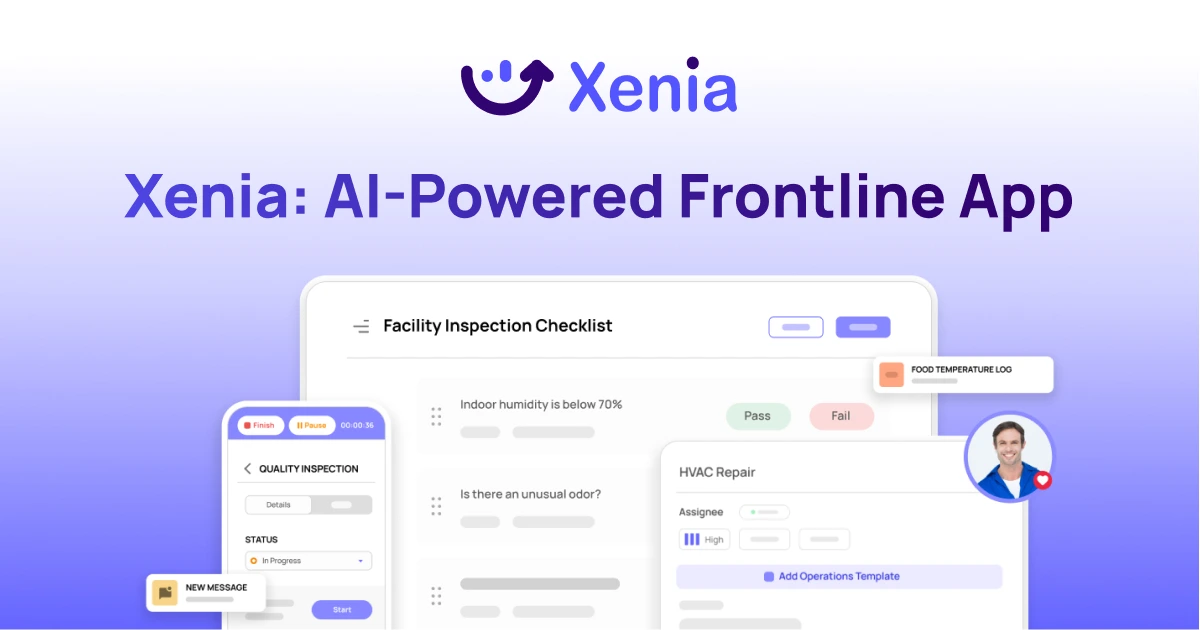
Why Multi-Location Operators Choose Xenia:
🤖 AI-Powered Operations, Create digital checklists instantly or convert paper forms with AI. Verify compliance automatically with photo analysis and get instant answers from your operational data.
✅ Daily Operations & Maintenance, Assign work across hundreds of locations in minutes. Report and route issues instantly. Schedule preventive maintenance to catch problems before downtime.
📊 Real-Time Visibility, Track completion, work orders, and performance across all locations through dashboards. Filter by site or asset to spot trends and take action.
Manage operations, maintenance, and compliance across all your locations from one platform

.svg)
.webp)
%201%20(1).webp)

.svg)
%201%20(2).webp)