
.webp)
Post Summary
Every Monday, the same report lands in the VP of Ops inbox.
Overtime up at the same three locations. Two stores short on coverage again. Shift tasks not completed at locations that showed full headcount on paper.
The scheduling tool is running. Managers are filling shifts. Timesheets are coming in.
And yet the outcomes keep slipping. The same locations keep showing up red.
This is not a people problem. It is not even a management problem. It is an optimization gap. And it costs operators more than they realize until it shows up in a P&L they cannot explain.
This guide breaks down what workforce optimization actually means, why it falls apart at scale, and what it takes to run it across 30, 80, or 500 locations with hourly frontline teams.
.webp)
.svg)

Priced on per user or per location basis
Available on iOS, Android and Web


What is workforce optimization?
Workforce optimization is the practice of using operational data to improve outcomes, rather than simply tracking them.
It sits above workforce management. Where management tells you what happened, optimization tells you what to change so next week looks different.
Most operators are doing workforce management. Scheduling shifts. Tracking attendance. Filling coverage gaps. The data is being collected. The system is running.
Workforce optimization is what happens when you actually use that data. Reducing labor cost. Tightening execution consistency. Fixing coverage accuracy before the schedule goes out, not after payroll closes.
One tells you what happened. The other changes what happens next.
The problem is most multi-unit operators are doing the first and calling it the second. That gap is where the labor budget gets lost. For a deeper look at the operational layer that workforce optimization builds on, see enterprise workforce management.
Workforce optimization vs workforce management
These two terms get used interchangeably. They should not be.
Here is the actual difference:
**
Aspect, Workforce Management, Workforce Optimization
What it does, Tracks operations, Improves operations
Primary question, What happened?, What do we change?
Focus, Scheduling-attendance-payroll, Labor cost-execution-retention
When it acts, After the fact, Before payroll closes
Who drives it, Store managers, Area managers and ops leaders
**
What workforce management covers
Workforce management is the operational foundation. It handles:
- Scheduling: who works which shifts
- Time and attendance: clock-in, clock-out, absence tracking
- Leave management: requests, approvals, call-outs
- Payroll inputs: hours worked, overtime flags, pay period closing
These systems keep the lights on. They answer one question: what happened this week?
Where workforce optimization picks up
Workforce optimization uses that same operational data to answer a harder question: why is this happening, and what do we fix?
It covers:
- Using scheduling history to reduce overtime and coverage gaps
- Using attendance patterns to catch retention problems early
- Using execution data to find where labor hours are not producing results
- Using cross-location data to spot which stores are drifting from standard
The distinction sounds small. The labor cost impact is not.
Why workforce optimization is harder across multiple locations
The concept is simple at one location. You see the problem. You fix the schedule. Done.
At 80 locations, it breaks down fast.
Each store has a different manager, a different crew mix, different peak patterns, and scheduling habits that have built up over years. Without a shared standard, what works at Location 12 never makes it to Location 47. You get drift. And drift compounds.
The location drift problem
When every location runs its own scheduling logic in isolation, the portfolio averages look fine. The outliers keep bleeding.
Here is a real pattern: a 60-location operator hitting 31% labor cost across the portfolio. Looks solid. But four locations are running at 38% and three are running at 26%. The average hides both problems.
The over-budget locations are the obvious issue. But the under-budget ones may be understaffed to the point of execution failure. Shifts completing on paper. Not in practice.
Portfolio-level reporting masks location-level problems. That is the drift problem.
What area managers actually see vs what is actually happening
Area managers work from rollup reports. Aggregated labor spend by week. Average task completion by region. Headcount vs plan by district.
By the time a problem surfaces in a rollup, it has been compounding at the store level for weeks.
This is not a failure of attention. It is a structural gap. The data exists. Shift-level labor cost, per-location task completion, call-out frequency by day of week. Sitting in scheduling and time-tracking systems that nobody has connected to a dashboard an area manager can actually act on.
Visibility across every location is the infrastructure problem that has to get solved before optimization is even possible.
When labor targets do not reach the store level
Corporate sets the labor budget. The store manager schedules based on what they know: who is available, who called out last week, what last Saturday looked like.
The budget and the schedule live in different systems. Owned by different people. Reviewed at different times.
A store manager building next week's schedule at 8 PM on a Thursday is not cross-referencing a corporate labor target in a separate system. They are filling the schedule based on what they know.
That is where the gap is born. By the time payroll closes, the overage is documented. It is not preventable.
The 5 levers of workforce optimization for multi-unit operators
Workforce optimization is not one decision. It is five operational disciplines running in parallel.
Each one has a version that works and a version that is quietly bleeding labor cost. Here is what they look like from the ground.
.webp)
1. Demand-based scheduling
What it is: Schedules built around actual traffic patterns, day-part demand, and historical data. Not copying last week's schedule. Not defaulting to the same headcount every Friday night.
When it works: The Friday dinner crew is sized on the last four Fridays of transaction data, not a gut call. Holiday weekends are staffed differently because the data shows they need to be.
When it breaks down: Managers schedule to habit. Same eight people every closing shift regardless of what Tuesday at 9 PM actually needs. The schedule is a copy, not a plan.
**
Warning signal, What it usually means
Same headcount on the same shift every week, Scheduling to habit-not demand
Overtime spiking on weekends, Peak demand not built into the base schedule
Understaffing complaints on the same shifts, Demand pattern not being read from data
Overstaffing on low-volume days, No connection between sales forecast and staffing
**
2. Labor cost visibility at the location level
What it is: Labor cost as a percentage of sales, visible per location and per shift, before the schedule is published. Not discovered after payroll closes.
When it works: The store manager sees Tuesday night is tracking 3 points over labor target before they hit publish. They pull one person off that shift, move them to Thursday where coverage is thin, and the schedule goes out clean.
When it breaks down: The only person who sees the overage is the CFO. On the weekly P&L, twelve days after the schedule ran. There is no feedback loop between what the manager built and what it cost. Real-time reporting at the location level closes that loop before payroll. Not after.
3. Cross-location labor sharing
What it is: Moving available employees across nearby locations to cover gaps instead of defaulting to overtime. This is the most underused lever in multi-unit operations.
When it works: An employee who wants extra hours at Location A gets picked up by Location B two miles away. Gap filled. Employee gets hours. No overtime generated. No shift uncovered.
When it breaks down: Location B schedules overtime on Friday. Location A has three employees who wanted hours and were told nothing was available. Neither manager knows what the other is doing. The overtime was never necessary.
**
Coverage approach, Overtime exposure, Coverage outcome, Cost
Cross-location labor sharing, Low, Gap filled, Base rate
Internal overtime, High, Gap filled, 1.5x rate
Open shift left unfilled, None, Gap remains, Execution failure
Last-minute agency or temp, None, Gap filled, Premium rate
**
4. Execution tracking tied to labor hours
What it is: Knowing whether the tasks that justify the labor hours actually got done. Headcount on a shift is only half the picture. The other half is whether the work happened.
When it works: A drop in closing checklist completion at one location flags before it becomes a pattern. The area manager sees it Wednesday. Addresses it Thursday. The standard is restored before the weekend.
When it breaks down: Labor hours are logged. Shifts ran. Whether the work actually happened is unknown until a customer complaint or a failed audit surfaces it weeks later.
5. Turnover as a scheduling signal
What it is: High turnover almost always shows up in the schedule before it shows up in an HR report. The early signals are chronic open shifts, rising call-out frequency, and overtime covering the same positions week after week.
When it works: A spike in call-out rate at one location over two weeks triggers an early HR conversation. The manager finds a scheduling conflict that was making the shift unworkable for three employees. The schedule gets adjusted. Two of those employees stay.
When it breaks down: Turnover data lives in the HR system. Call-out data lives in the scheduling tool. Nobody connects the two. By the time HR flags the location, positions are already open and recruiting costs have started.
How to reduce labor costs without cutting coverage
Cutting labor costs does not mean cutting people. It means eliminating three specific types of waste that multi-unit operators generate at scale. Each one is a system problem, not a performance problem.
Overtime that could have been avoided
Overtime caused by poor cross-location visibility is the most common and most preventable labor cost leak in multi-unit operations.
When managers schedule in isolation, overtime becomes the default fix. Labor sharing could have solved the same gap at base pay rate.
A district manager with 15 locations running 8% over labor budget is rarely looking at 15 different performance problems. They are looking at one visibility problem. Those managers do not have a shared view of who is available across the district. Overtime is not a discipline failure. It is an infrastructure failure.
The ghost labor problem
Ghost labor is when people were scheduled, clocked in, and clocked out, but the shift responsibilities were not completed. Labor hours paid. Execution did not happen.
This is invisible without task tracking. A closing shift where the temperature log was skipped and the fryer was left uncleaned is a ghost labor event. Looks like a staffed shift on paper. The operator paid full coverage cost and got partial execution.
Ghost labor compounds across locations. Fifteen locations running at 80% task completion are generating ghost labor costs every week that will never appear as a line item in the labor report.
Compliance exposure as a hidden labor cost
Missed breaks, uncapped hours, and predictive scheduling violations do not appear in the labor report. They appear in legal exposure.
For multi-unit operators in California, New York, and other regulated markets, compliance gaps are a real cost. Systematic schedule rules can prevent them.
A wage-and-hour claim or class action settlement is not something most operators budget for. Until it arrives. Workforce optimization builds automated schedule rules that prevent the violation from happening in the first place.
What workforce optimization actually looks like in practice
Take a 60-location convenience store group. Area managers receive weekly labor reports but have no shift-level visibility until after payroll closes. Twelve locations are running 8 to 12% over labor budget consistently.
The area managers know which locations are over. They do not know why, or when the overages are happening within the week.
The pattern turns out to be predictable. Thursday and Friday nights near a high school are running 40% over plan. The schedule was built for an average week. Nobody accounted for the game-night spike those locations see every week. Nobody connected the sales data to the scheduling pattern.
When those twelve locations switch to demand-based scheduling built on four weeks of transaction data, overtime exposure drops. Adding cross-location labor sharing across the six nearby locations accelerates the improvement. Both changes take effect within two scheduling cycles.
The outcomes are not the result of cutting staff. They are the result of building the schedule from data instead of habit. And giving managers visibility into available labor before they default to overtime.
Workforce optimization software: what to look for
This is not a buying guide. It is a capabilities checklist for operators evaluating workforce optimization software for multi-unit environments.
Five capabilities that matter at scale:
**
Capability, Why it matters
Cross-location scheduling visibility, Area managers need to act across locations without separate logins
Execution tracking beyond time and attendance, Clock-in data tells you who showed up-not whether the work got done
Labor cost dashboards at the location level, Aggregate spend hides overspend at individual locations
Mobile-first design, Frontline managers and crew do not work from desks
Real-time labor vs target comparison, Overages need to surface before payroll closes-not after
**
Cross-location scheduling visibility
Can you see all 60 locations in one view? Can an area manager identify a coverage gap at Location 34 and act without logging into a separate system?
If the answer is no, the software is a single-location tool running at multi-unit scale. That is workforce management done 60 times separately. It is not workforce optimization.
Execution tracking beyond time and attendance
Clock-in and clock-out tells you when someone was there. Execution tracking tells you what they did. If the software only captures attendance, it cannot tell you whether ghost labor is occurring. Task completion rate by shift and by location closes the loop.
Labor cost dashboards at the location level
Not aggregate labor spend. Cost per shift, per location, compared to labor target, before payroll closes. The dashboard has to be actionable during the scheduling window. A report that arrives after payroll closes is a record, not a tool.
Mobile-first design for deskless teams
If publishing a schedule requires a desktop login, the tool will not drive behavior change at the floor level. Frontline managers and crew do not work from desks. Desktop-first platforms fail at the last mile of execution, which is the only mile that matters.
Related resources
- Enterprise Workforce Management
- Best Reflexis Alternatives
- Optimize Staff Scheduling for Peak Hours
- Workforce Management (WFM)
- Workforce Management Best Practices
Conclusion
The reports exist. The VP of Ops running 60 locations already knows which stores are over on labor, which have low task completion, and which are burning overtime every week.
The data has always been there.
The problem is not visibility. It is whether the operation is structured to act on what it sees in time to matter.
Workforce optimization is the bridge between seeing the problem and fixing the system that causes it. Demand-based scheduling, cross-location labor sharing, execution tracking tied to labor hours: these are operational disciplines. Software makes them possible at scale. But the decision to run the operation this way comes before any tool is purchased.
Xenia gives multi-unit operators a multi-unit operations platform built to act on data before it becomes a problem. With visibility across every location in one place. Book a demo to see what that looks like for your portfolio.
Frequently Asked Questions
Got a question? Find our FAQs here. If your question hasn't been answered here, contact us.
How does workforce optimization software help multi-unit businesses?

It closes the gap between what corporate set as the labor target and what the store manager actually scheduled.
Without it, area managers are reading rollup reports. Aggregated numbers that hide what is happening at individual locations. By the time a problem surfaces in a district summary, it has been compounding for weeks.
With the right software, a manager sees shift-level labor cost and call-out patterns before the schedule runs, not after payroll closes. The operation stops reacting to last week and starts managing next week.
What KPIs should multi-unit operators track for workforce optimization?
Five metrics that actually tell you something useful:
- Labor cost as a percentage of sales, per location and per shift
- Overtime hours per location compared to the portfolio average
- Task completion rate by shift and by location
- Call-out frequency by location and by day of week
- Cross-location labor utilization rate
The key word is "per location." Portfolio averages hide the problem stores. A 31% blended labor cost looks fine until you see that four locations are running at 38%. Track at the location level and you catch problems while they are still fixable.
What is labor sharing in workforce optimization?
Labor sharing is the simplest lever most multi-unit operators are leaving on the table.
An employee at Location A wants extra hours. Location B, two miles away, has a gap to fill. Instead of scheduling overtime at Location B or leaving the shift uncovered, that employee goes where the work is. Gap filled at base pay rate. No overtime generated.
The math is obvious. The reason most operators are not doing it is even more obvious: their scheduling tools show one location at a time. You cannot share labor you cannot see.
How does workforce optimization reduce labor costs?
Three ways, and none of them involve cutting people.
First, demand-based scheduling. Shifts built around actual traffic data, not last week's copy-paste. That alone cuts the overstaffing on slow days and understaffing on peak days that quietly drives up overtime.
Second, cross-location labor sharing. Move an available employee to a nearby location before the gap becomes a 1.5x overtime cost. Simple idea. Wildly underused.
Third, execution tracking. Clocking in does not mean the work got done. Confirming that paid hours produced actual results is how you stop ghost labor from compounding week over week.

A Modern, AI-Powered Platform Built Specifically for Frontline Operations
Xenia brings daily operations, maintenance, audits, and compliance into one mobile-first platform. Frontline teams execute work consistently across locations while leadership gets real-time visibility.
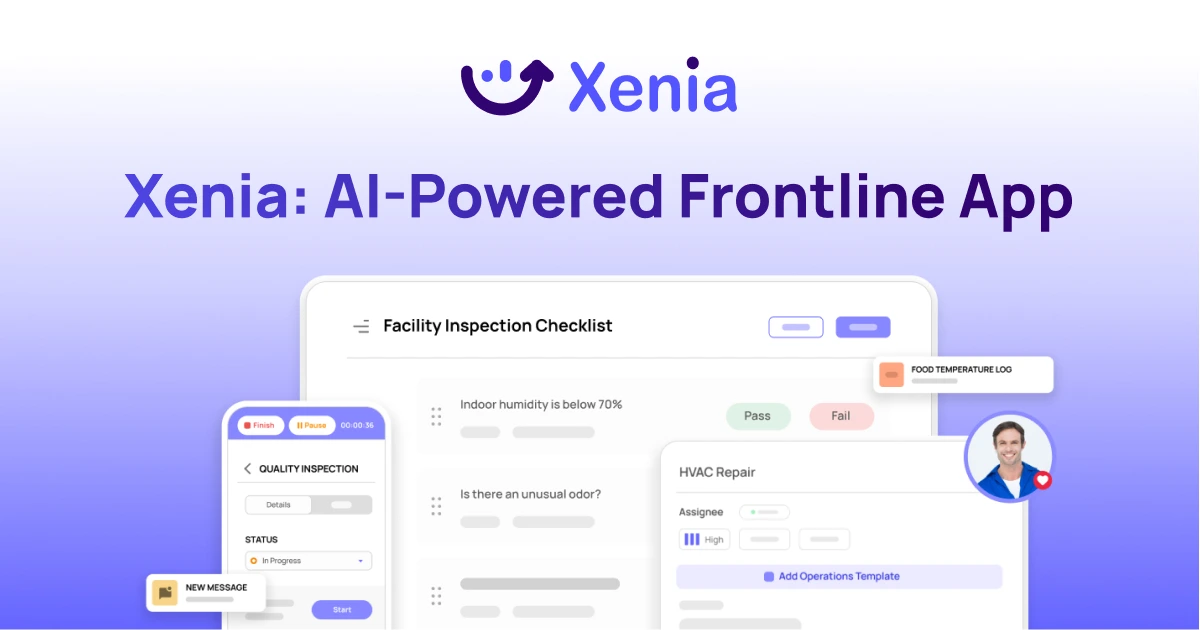
Why Multi-Location Operators Choose Xenia:
🤖 AI-Powered Operations, Create digital checklists instantly or convert paper forms with AI. Verify compliance automatically with photo analysis and get instant answers from your operational data.
✅ Daily Operations & Maintenance, Assign work across hundreds of locations in minutes. Report and route issues instantly. Schedule preventive maintenance to catch problems before downtime.
📊 Real-Time Visibility, Track completion, work orders, and performance across all locations through dashboards. Filter by site or asset to spot trends and take action.
Manage operations, maintenance, and compliance across all your locations from one platform

.svg)
.webp)
%201%20(1).webp)

.svg)
%201%20(2).webp)