
.webp)
Post Summary
The call came in on a Thursday afternoon.
A store manager in Seattle had added two employees to the schedule three days out. Completely routine. They do it all the time in other markets.
In Seattle, that one change triggered a predictability pay obligation payroll had never budgeted for.
The cost? Manageable that time. But that manager made that same call dozens of times a year. Multiply it across 35 locations in four states and the exposure adds up fast. In a line of the P&L nobody is watching.
Predictive scheduling laws are expanding. A habit that is perfectly legal in one city can generate fines in another. This article covers where these laws exist, what they require, and what multi-unit operators need to do about it.
.png)
.svg)

Priced on per user or per location basis
Available on iOS, Android and Web


What is predictive scheduling?
Predictive scheduling laws require employers to post schedules a set number of days in advance. You may also see them called fair workweek laws or secure scheduling laws. Same thing, different city branding.
Most laws come with three requirements:
**
Requirement, What it means
Advance schedule posting, Schedules must be posted in writing-in advance-somewhere employees can access
Good faith estimate of hours, New hires must receive a written estimate of their expected hours before they start
Predictability pay, If you change a posted schedule inside the notice window-the employee is owed premium pay
**
That third one is where most operators get caught. The change happens at the store. The penalty hits payroll. If those two systems are not talking to each other, the obligation gets missed.
One thing worth knowing early: Oregon is the only state with a statewide law. Everything else is city-level. The rules vary, sometimes a lot.
Why multi-unit operators carry more risk than single-location businesses
A single-location business has one scheduling policy and one management team to train. Simple.
A multi-unit operator running 40 locations across three states has a completely different problem. Each market may have:
- Different advance notice windows
- Different covered-employer thresholds
- Different predictability pay calculations
- Different recordkeeping requirements
- Different enforcement agencies
The real exposure is not that operators do not know the laws. It is that store-level managers make scheduling decisions on their own. Often without knowing which jurisdiction they are in or what rules apply to their location.
A manager who moves a shift forward by two days in an unregulated market is operating fine. That same manager doing the same thing at a Chicago restaurant is triggering a predictability pay obligation they may not even recognize.
The second layer is the systems gap. Schedule changes made at the store level need to flow directly to payroll. If the manager updates the schedule in one system and payroll runs from another, the premium pay obligation gets missed. This is not a people problem. It is a visibility problem. And it is extremely common.
Predictive scheduling laws by state and city
Each jurisdiction below covers who is affected, what the advance notice requirement is, and what operators need to know operationally. Requirements change and thresholds update.
Note: Treat every figure here as a starting point and verify against the relevant city or state agency before publishing.
**
Jurisdiction, Law name, Industries covered, Notice window, Predictability pay, Statewide
Oregon, Predictive Scheduling Law, Retail-hospitality-food service,7–14 days (verify with BOLI),Yes,Yes
Seattle WA, Secure Scheduling Ordinance, Retail-food service, 14 days, Yes, No
San Francisco CA, Formula Retail Employee Rights Ordinance, Formula retail (chain businesses), 2 weeks, Yes, No
Chicago IL, Fair Workweek Ordinance, Restaurants-retail-healthcare-hotels-manufacturing-warehouses-building services, 10 days, Yes, No
Philadelphia PA, Fair Workweek Employment Standards, Retail-hospitality-food service, 10 days, Yes, No
New York City NY, Fair Workweek Law, Fast food-retail, 72 hours, Yes, No
**
Oregon: statewide predictive scheduling law
Oregon is the only state with a statewide predictive scheduling law. That alone makes it different from everything else on this list.
It covers retail, hospitality, and food service employers above a minimum employee threshold. The advance schedule posting window has moved over time, commonly cited as 7 days originally and trending toward 14. Confirm the current threshold and requirement at Oregon BOLI.
What operators need to know:
- Predictability pay applies for covered schedule changes after posting
- Portland has additional local requirements on top of the state law
- Operators with Portland locations need to verify both state and city layers
- Every Oregon location is covered, including those outside Portland and other major cities
The statewide scope is what catches operators. You cannot assume a location is exempt just because it is not in a major city.
Seattle, Washington: secure scheduling ordinance
Seattle's Secure Scheduling Ordinance applies to retail and food service employers above a minimum employee threshold. It is one of the most actively enforced ordinances in the country.
Covered employers must:
- Post schedules within the required advance notice window
- Give new hires a written estimate of expected hours
- Pay predictability pay for covered changes inside the posting window
One thing multi-state operators get wrong: Washington state has no statewide law. Seattle's ordinance is local. Operators in Spokane, Tacoma, or anywhere else in Washington are not covered under the same rules.
Verify current requirements with the Seattle Office of Labor Standards.
San Francisco, California: formula retail employee rights ordinance
San Francisco's ordinance covers formula retail employers, meaning chain businesses above a certain number of locations. Verify the current threshold with the San Francisco Office of Labor Standards Enforcement.
This is one of the broadest local ordinances in the country. It covers:
- Advance notice posting
- Good faith estimates of hours at hire
- Predictability pay for covered changes
- Right of existing employees to be offered additional hours before new hires are brought in
California does not have a statewide predictive scheduling law as of publication. San Francisco's ordinance is local. Operators with Bay Area locations should verify their covered-employer status and current requirements directly with OLSE.
Chicago, Illinois: fair workweek ordinance
Chicago's Fair Workweek Ordinance covers a broader range of industries than most other city-level laws. This is the one most operators miss.
Industries in scope:
- Building services
- Healthcare
- Hotels
- Manufacturing
- Restaurants
- Retail
- Warehouse operations
Operators in hospitality or food service often assume predictive scheduling only applies to retail. Chicago proves that assumption wrong.
Advance notice and predictability pay requirements apply to covered employers. Verify current thresholds and notice windows with the Chicago Business Affairs and Consumer Protection office.
Philadelphia, Pennsylvania: fair workweek employment standards
Philadelphia's ordinance covers retail, hospitality, and food service employers above a minimum threshold. Advance notice and predictability pay requirements apply. Verify current figures with the Philadelphia Office of Worker Protections.
Philadelphia has a provision most other jurisdictions do not. Employees have the right to request schedule changes, and employers must consider those requests through a documented process. Most operators have not built that procedural layer into their manager training. It is not optional.
New York City: fair workweek law
New York City's law covers fast food and retail workers. Fast food enforcement in NYC is among the most active in the country.
The provision that surprises restaurant operators most is the anti-clopening rule. Employees must give written consent when two shifts are scheduled with fewer than a set number of hours between them. Verify the exact threshold with the NYC Department of Consumer and Worker Protection.
Why this matters operationally:
- Scheduling a closing shift followed by an opening shift without written consent triggers a premium
- The employee saying nothing is not enough. Verbal agreement does not count
- The written consent has to exist before the schedule posts
This catches restaurant groups the most. The clopening schedule is common. The written consent process usually is not.
Other jurisdictions to watch
Predictive scheduling legislation is moving in additional cities and states. The line between proposed and enacted changes fast.
Jurisdictions with active legislative activity as of publication:
- Los Angeles, California: fair workweek protections for retail and food service workers have been under active discussion
- Minneapolis, Minnesota: scheduling predictability has been part of broader worker protection conversations
- Washington, D.C.: fair scheduling legislation has been introduced in recent sessions
Verify current status with local labor agencies before assuming any of these have or have not passed. Operators expanding into new markets should treat this as an open question, not an assumed answer.
What predictive scheduling laws actually require you to do
Enough about what the laws say. Here is what they require you to actually do differently.
Five operational changes apply across most jurisdictions.
Post schedules on time, in writing, in the right place
The advance notice clock starts when the schedule is published and accessible to employees. Not when the manager has it drafted. Not when it is sitting in a system only managers can see.
For multi-unit operators, every location needs a consistent, documented posting process:
- The schedule must be accessible to employees from the moment it is posted
- A scheduling tool that only managers can log into does not satisfy the requirement
- Employees need to see their schedule, in writing, within the required advance notice window
One location getting this right is not enough. Every location has to get it right, every time.
Document good faith hour estimates at every new hire
High-turnover industries hire constantly. Every new hire needs a written good faith estimate of their expected weekly hours and general schedule before their first shift.
Without a standardized process that generates this document automatically:
- One location does it correctly
- Another skips it entirely
- A third does it verbally and assumes that counts
When an audit happens, all three of those gaps surface at once. The fix is not training people harder. It is building a process that makes the document automatic.
Connect schedule changes to payroll
When a covered schedule change happens after posting, the predictability pay obligation is created at the store level but settled in payroll. If those two systems do not talk to each other, the premium pay gets missed.
This is the most common systems failure in multi-unit predictive scheduling compliance. Building HR workflows that connect scheduling changes to payroll flags is how operators close the gap before it becomes an audit finding.
Keep scheduling records by location
Most jurisdictions require employers to retain scheduling records for a defined period, often two to three years. Records need to be organized by location and retrievable on demand.
What that means in practice:
- Manager notebooks do not pass an audit
- Shared spreadsheets across locations do not pass an audit
- Email threads do not pass an audit
Employee accountability documentation needs to be centralized, location-tagged, and stored in a place that survives manager turnover.
Handle schedule swaps with documentation
Employee-initiated swaps are usually exempt from predictability pay. But only if the documentation exists.
For the exemption to hold:
- Both employees agreed to the swap in writing
- The employee initiated it, not the manager
- The record is kept and retrievable
Verbal agreements do not count. A manager who reassigns a shift and calls it a swap does not qualify. No documentation means no exemption.
Build a clear shift swap policy and make sure every manager knows what that looks like in practice.
How to stay compliant across multiple locations
Compliance across a multi-jurisdiction operation is a systems and process problem. Not a legal research problem. Here is the operational framework.
Map your locations against current laws
Build an internal reference that lists every location: its jurisdiction, the applicable law or ordinance, the advance notice window, covered-employer status, and effective date.
**
What to track per location, Why it matters
City and state jurisdiction, Determines which law applies or whether any law applies
Covered-employer status, Many laws only apply above a minimum employee threshold
Advance notice window, Varies by city: 7 days in some-14 in others
Predictability pay rate, Calculation method differs by jurisdiction
Recordkeeping requirement, Retention period and format requirements vary
Effective date of current ordinance, Laws update. The last verified date matters
**
For operators who have expanded into new markets, the legal map may not have kept pace with the growth map. This exercise surfaces gaps before an audit does.
Give managers market-specific scheduling rules
A single national scheduling policy does not work in a multi-jurisdiction operation.
Managers need to know the specific rules for their market:
- The advance notice window for their city
- What counts as a covered schedule change in that jurisdiction
- What the predictability pay obligation looks like and how it gets calculated
- How to document schedule changes properly
Generic compliance training does not cover this. Location-specific rules do.
Catch compliance issues before the schedule publishes
The cheapest compliance intervention is the one that happens before a schedule goes out. If a manager is about to make a change that triggers predictability pay, the best outcome is that they know it in advance. So they can either adjust the schedule or document the change properly.
Compliance after the fact is always more expensive than compliance at the point of decision.
Keep documentation centralized and audit-ready
When a city labor agency requests scheduling records, they expect them organized and retrievable. Not assembled from scattered sources under time pressure.
Centralized compliance tracking across every location is the difference between an audit that closes in a week and one that runs for months.
Related resources
- Shift Swap Policy Guide
- Employee Accountability Software
- HR Workflows
- Workforce Scheduling Guide
- Workforce Management Best Practices
- Types of Work Shifts
Conclusion
The HR Director who got that call from Seattle knew her overtime numbers. She knew her highest-volume markets. What she did not know was that a routine scheduling decision in one city was a violation in another. Nobody had built anything to flag it.
That is the gap. Not the law. The law is findable. The gap is managers making scheduling calls on their own, in markets they do not fully understand, using systems that have no connection to payroll.
Staying compliant across multiple locations is not about knowing every ordinance. It is about building a process where the right thing happens automatically, at every location, every time.
Xenia helps multi-unit operators manage HR workflows, compliance tracking, and operational visibility across every location. Book a demo to see how it works.
Frequently Asked Questions
Got a question? Find our FAQs here. If your question hasn't been answered here, contact us.
Are employee-initiated schedule swaps exempt from predictability pay?

Usually yes, but the exemption is conditional. Both employees must agree to the swap in writing. The request has to come from the employee, not the manager. And the record must be kept. No documentation means no exemption, and the predictability pay obligation stands.
Can my employer change my schedule last minute in Washington state?
Washington state has no statewide predictive scheduling law. Seattle does. If you work for a covered employer in Seattle, your employer must follow the Secure Scheduling Ordinance. Anywhere else in Washington, there is no statewide protection. Check current requirements with the Seattle Office of Labor Standards.
Do predictive scheduling laws apply to all employers?
No. Most laws only apply above a minimum employee threshold and in specific industries like restaurants, retail, or hospitality. A small independent restaurant is often exempt. A regional chain above the threshold almost certainly is not. Check the covered-employer threshold for every city you operate in.
Which states have predictive scheduling laws?
Only Oregon has a statewide law. Everything else is city-level. Seattle, San Francisco, Chicago, Philadelphia, and New York City each have their own rules. If you operate across multiple markets, track both state and city level for each location. Always verify with the relevant local labor agency.

A Modern, AI-Powered Platform Built Specifically for Frontline Operations
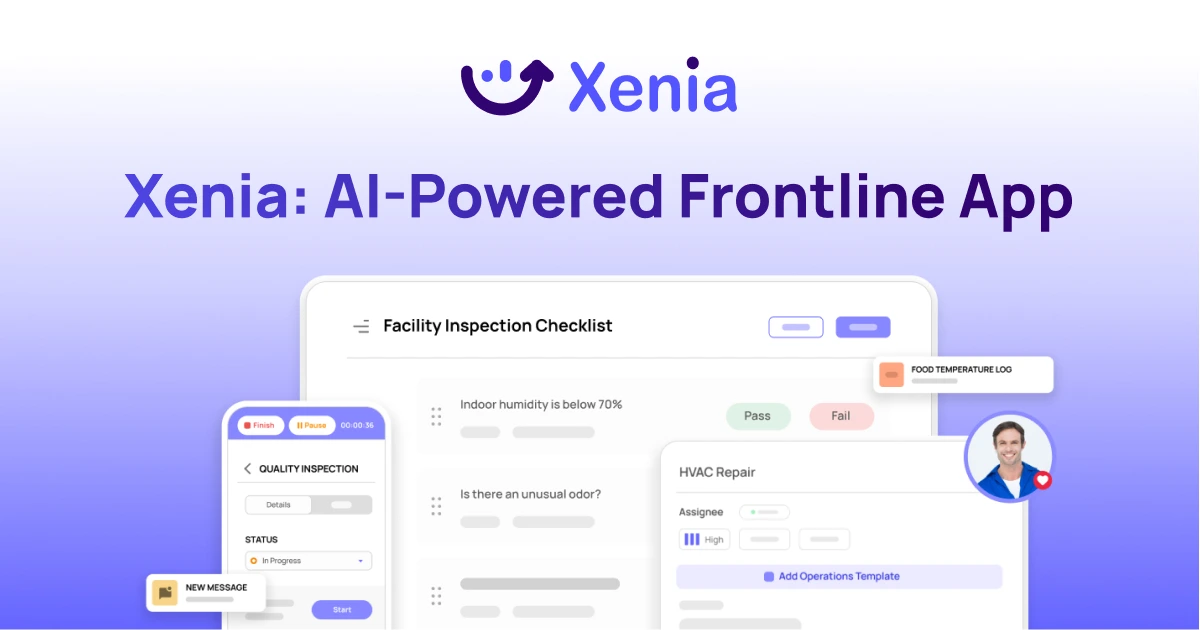
Xenia brings daily operations, maintenance, audits, and compliance into one mobile-first platform. Frontline teams execute work consistently across locations while leadership gets real-time visibility.
Why Multi-Location Operators Choose Xenia:
🤖 AI-Powered Operations, Create digital checklists instantly or convert paper forms with AI. Verify compliance automatically with photo analysis and get instant answers from your operational data.
✅ Daily Operations & Maintenance, Assign work across hundreds of locations in minutes. Report and route issues instantly. Schedule preventive maintenance to catch problems before downtime.
📊 Real-Time Visibility, Track completion, work orders, and performance across all locations through dashboards. Filter by site or asset to spot trends and take action.
Manage operations, maintenance, and compliance across all your locations from one platform

.svg)
.webp)
%201%20(1).webp)

.svg)
%201%20(2).webp)