
Post Summary
Labor costs increased 20% since 2020. Customer expectations continue rising. Store managers need better tools to maintain consistency across locations.
The retailers succeeding right now use AI and digital platforms to streamline operations and drive consistency across every location.
This guide shows you exactly how to improve operational efficiency in retail using systems your team will actually use.
.svg)

Priced on per user or per location basis
Available on iOS, Android and Web


What Is Operational Efficiency in Retail?
Operational efficiency in retail measures how well you convert resources (people, inventory, space) into revenue and customer satisfaction.
Strong efficiency means stores run smoothly. Products are positioned correctly. Teams follow clear processes. Issues get identified and resolved quickly.
Opportunities for improvement often show up as inconsistency between locations, unclear task ownership, or delayed problem resolution.
The difference comes down to systems. Digital platforms built for retail operations deliver better results than manual processes and spreadsheets.
Why Operational Efficiency in the Retail Industry Matters in 2026
The retail landscape changed dramatically in recent years. Three forces make operational efficiency critical right now.
Labor costs increased significantly. Wages rose 20% since 2020. Every hour of manager's time costs more. Retailers need systems that make each hour more productive.
Customer expectations keep rising. Shoppers expect consistent experiences across every location. Product availability. Clean stores. Brand standards executed perfectly. One inconsistent location impacts your entire brand.
Technology creates competitive advantages. Leading retailers use AI and automation to accomplish more with optimized resources. The gap between efficient and inefficient operators widens every quarter.
Operational efficiency in retail isn't about incremental improvements anymore. It's about fundamental competitive positioning.
The retailers investing in digital operations platforms gain market share. The ones managing through spreadsheets and manual processes fall behind.
4 Common Challenges That Impact Retail Operational Efficiency
1. Maintaining Planogram Compliance Across Locations
Corporate designs planograms for every location. Maintaining visual consistency across stores requires regular verification.
Store teams handle multiple priorities simultaneously. Team members at different experience levels may interpret standards differently. Physical distance makes verification difficult.
The impact: Products positioned incorrectly reduce sales. Customers can't find what they're looking for. Visual merchandising investments don't deliver expected returns.
2. Verifying Task Completion Accurately
Morning checklists include critical procedures like emergency exit inspections and equipment checks. Manual verification systems can make it easier to mark tasks complete than to verify actual completion.
Paper checklists provide no documentation. Digital checkboxes without photo verification rely on individual accountability.
The impact: Safety procedures may not be executed consistently. Equipment issues go unnoticed until they become urgent. Compliance gaps emerge across locations.
3. Sharing Operational Insights Across All Stores
When an operational insight emerges at one store, that knowledge should benefit all locations.
A process improvement at Store 47 might solve challenges at Store 52. A customer service innovation at your top-performing location could raise performance across your entire portfolio.
Manual communication methods (calls, emails, district meetings) can't scale operational learning effectively.
The impact: Each store solves the same problems independently. Best practices stay localized. Your organization learns more slowly than competitors with better knowledge-sharing systems.
4. Shifting From Reactive to Preventive Maintenance
Equipment provides early warning signs before complete failure. Unusual sounds. Temperature fluctuations. Performance degradation.
Manual monitoring relies on store managers noticing issues and reporting them. Communication delays can lead to extended timelines between problem identification and resolution.
The impact: Emergency repairs cost 3-5x more than preventive maintenance. Equipment failures during peak hours impact sales. Customer comfort suffers.
The common thread: These challenges stem from disconnected manual processes rather than integrated digital systems.
How AI Impacts Operational Efficiency in Retail
AI handles verification work so your teams can focus on customer service and sales. Here's how AI applications in retail operational efficiency actually work.
AI Photo Analysis for Planogram Compliance
Traditional planogram verification requires district managers to visit each store physically. They walk aisles comparing reality to planogram standards. This approach limits verification to the stores they can physically reach.
AI photo analysis changes the process:
- Store teams take photos of displays using their mobile devices
- AI compares images to planogram standards automatically
- System identifies variances and specific products out of position
- Merchandising team sees exactly where to focus improvement efforts
You verify 100% of locations instead of the 5-10 stores your DM can visit weekly.
Automated Corrective Actions
When AI identifies an improvement opportunity (product placement variance, missing signage, safety observation), manual follow-up can create delays and inconsistency.
Automated corrective actions work differently. The system automatically:
- Creates a corrective action task with specific instructions
- Assigns it to the appropriate team member based on role
- Sets a clear deadline based on priority level
- Tracks resolution and documents completion with photo verification
Store managers receive clear direction without manual follow-up processes. District leaders see resolution rates across all locations in real time.
Predictive Analytics for Equipment Maintenance
AI analyzes maintenance data across all locations. It identifies patterns in equipment performance that predict potential failures.
Temperature fluctuations in refrigeration units. Runtime patterns in HVAC systems. Performance metrics that indicate upcoming service needs.
The system predicts which stores may need equipment service in the next 30 days. Your facilities team schedules preventive maintenance during low-traffic periods.
You maintain comfortable shopping environments during peak hours. Maintenance budgets get optimized through prevention rather than emergency response.
AI-Powered Operational Summaries
District and regional leaders previously spent hours reviewing task completion logs, safety audit results, and maintenance reports across all locations.
AI-powered summaries analyze this data automatically and highlight what matters:
- Which stores would benefit from additional compliance support
- Which tasks consistently take longer than expected across locations
- Where teams need additional training based on performance patterns
- What patterns represent optimization opportunities
Leaders access retail data analytics dashboards that surface these insights automatically. They focus on strategic decisions rather than data compilation.
This is how you increase operational efficiency in retail without expanding corporate headcount.
Digital Systems That Increase Operational Efficiency in Retail
AI delivers powerful insights. But AI needs foundation systems to work effectively. Here are the digital platforms that enable operational efficiency in retail.
Digital Task Management
Digital task management replaces paper checklists and disconnected communication.
Every task exists in one unified system. Each task has a clear owner, specific deadline, and defined completion criteria. Managers see their complete workload in one interface.
What digital task management enables:
**
Manual Processes, Digital Platform
Tasks tracked across notebooks/texts/emails, Every task in one unified system
Each manager develops individual processes, All locations follow consistent standards
Task status updates during store visits, Real-time visibility across all locations
Training through verbal handoffs, SOPs documented in the platform
Limited performance data, Analytics showing patterns across all stores
**
This matters for stores with frequent hiring. New team members follow the same processes as experienced staff. Training lives in the system. Operational knowledge transfers seamlessly between team members.
Integrated Temperature Monitoring
Food retailers and convenience stores need consistent temperature control to maintain product quality and comply with food safety regulations.
Traditional approaches involve manual temperature checks three times daily with written logs.
Manual monitoring considerations:
- Relies on consistent human execution during busy shifts
- Requires staff time multiple times per shift
- Provides periodic snapshots rather than continuous monitoring
- Limited alerting capability for temperature excursions
How integrated temperature monitoring works:
Sensors track coolers and freezers continuously. If temperatures move outside safe ranges, the system alerts managers immediately via mobile notification.
The efficiency advantage: alerts flow directly into your task management platform.
When the temperature moves out of range:
- System creates a corrective action automatically
- Assigns it to the store manager or maintenance tech
- Sets a resolution deadline based on severity
- Tracks when the issue gets resolved and the temperature returns to the safe range
Temperature monitoring integrates into your standard operational workflow. Store managers don't monitor a separate temperature system. They see temperature alerts alongside all other operational tasks.
HRIS Integration for Labor Optimization
Most retailers manage scheduling in one system, track time and attendance in another, and handle task assignment in a third platform.
Connecting these systems improves how you increase operational efficiency in retail.
What HRIS integration enables:
When you connect your workforce system (Workday, ADP, UKG) to your operations platform:
- Tasks get assigned to team members actually scheduled that shift
- You measure actual task duration across locations
- You identify optimal staffing levels by location and daypart
- Labor costs connect directly to operational execution
You assign opening tasks to team members who work opening shifts. Closing procedures go to closing team members. The system knows who's scheduled.
Labor analytics improve. You see which tasks take longer than expected. You identify which stores need adjusted staffing relative to their task volume. You optimize scheduling based on actual operational needs.
This is how digital systems create the foundation for AI applications in retail operational efficiency.
How Xenia's Platform Combines AI Applications in Retail Operational Efficiency
Many retailers operate 5-7 different systems:
- Task management platform
- Safety audit software
- Equipment maintenance tracking
- Temperature monitoring system
- Separate analytics and reporting tools
Each additional system creates complexity. Multiple logins to manage. Different interfaces to navigate. Data that doesn't connect automatically.
Xenia combines maintenance, safety, and operations into a single retail operational excellence solution.

What unified platform integration delivers:
**
Function, How It Works in Xenia
AI Photo Analysis, Verifies planograms - brand standards - safety in the same interface where managers complete daily tasks
Corrective Actions, Flow automatically from safety audits - temperature alerts - AI-detected opportunities through one consistent workflow
Temperature Monitoring, Creates tasks in the same system tracking all other operational work
HRIS Integration, Assigns tasks to team members actually scheduled that day
Predictive Analytics, Analyzes complete operational data - maintenance - safety - operations - not isolated datasets
Task Management, Centralizes all work in one interface for store managers
**
Store managers see all their work in one interface. District leaders get unified visibility across locations. AI applications work across your entire operation rather than in isolated tools.
How to Improve Operational Efficiency in Retail: Implementation Guide
Reading about operational efficiency and actually achieving it require different approaches. Here's the implementation process that works.
Step 1: Identify Your Highest-Impact Opportunity
Focus on the one process with the most improvement potential:
- Safety audit completion rates below 80%
- Planogram compliance inconsistency across locations
- Reactive equipment maintenance driving high costs
- Temperature monitoring gaps causing spoilage
Prove the concept in one high-impact area first.
Step 2: Run a Pilot Program (3-5 Stores)
Choose pilot locations strategically:
- Mix of high-performing and average-performing stores
- Experienced managers who provide constructive feedback
- Geographic diversity if relevant to your operation
- Representation of different store formats if applicable
Test the workflows. Refine the processes. Build your internal success story with real data.
This pilot demonstrates measurable value for company-wide rollout.
Step 3: Build Your Task Library Before Launch
Set teams up for success with pre-configured content:
- Standard operating procedures for all key processes
- Daily opening and closing checklists
- Weekly and monthly recurring workflows
- Safety audit templates
- Maintenance schedules
Make the system immediately useful from day one. Store managers shouldn't build tasks from scratch.
Step 4: Train District Managers First
Your district managers become expert users before rolling out to store teams.
DM training should cover:
- Complete platform functionality
- How to analyze location performance data
- How to support store managers during adoption
- How to identify and share best practices
District managers provide on-the-ground support when store managers have questions. DM expertise drives store-level success.
Step 5: Measure What Matters
Track the metrics that indicate improved operational efficiency in retail:
Execution metrics:
- Task completion rates by location
- Average time to resolve corrective actions
- Compliance scores across stores
- Photo verification usage rates
Business impact metrics:
- Manager time spent on administrative work
- Emergency maintenance incidents
- Inventory shrink and spoilage rates
- Customer satisfaction scores
Focus on execution outcomes, not just system login statistics.
Step 6: Integrate Systems Gradually
Month 1: Launch core task management
- Deploy daily/weekly/monthly task templates
- Train all store managers
- Establish baseline completion metrics
Month 2: Add photo verification for key processes
- Planogram compliance verification
- Safety hazard documentation
- Opening/closing procedure verification
Month 3: Layer in temperature monitoring
- Install sensors in pilot stores
- Configure alert thresholds
- Integrate alerts into task workflows
Month 4: Connect HRIS integration
- Configure role-based task assignment
- Enable schedule-aware task routing
- Activate labor analytics
Month 5: Activate predictive analytics
- AI-powered operational summaries
- Equipment maintenance predictions
- Performance pattern identification
Each integration builds on previous success. Teams adapt to improvements incrementally rather than facing overwhelming change.
Step 7: Document and Share Success Stories
As you see results, document them:
- Specific stores that improved compliance scores
- Maintenance cost reductions with dollar amounts
- Manager testimonials about time savings
- Customer satisfaction improvements
Share these stories across your organization. Success breeds adoption.
FAQs
How can I improve operational efficiency in a retail store with frequent hiring?
Digital systems create consistency. New team members follow the same clear processes as experienced staff. Training integrates into the platform. SOPs stay documented and accessible.
When team members transition, their replacements become productive immediately.
What are the best AI applications in retail operational efficiency for 2026?
In 2026, AI is helping retail teams work smarter, not harder. It checks store layouts and brand rules with photos, turns problems into tasks automatically, predicts when equipment might fail, and highlights patterns in your operations. The best part? When all these AI tools are in one platform, they actually make running multiple stores way easier.
How does digital task management impact operational efficiency in the retail industry?
Digital task management creates accountability and consistency.
Every task has a clear owner and deadline. Managers see their complete workload in one interface. District leaders track completion across all locations in real time.
You shift from reactive management to proactive optimization. Opportunities surface before they impact operations.
Conclusion
The retailers succeeding in 2026 use digital systems that make efficiency the default, not the exception.
You don't need to overhaul everything at once. Pick one high-impact area. Run a pilot in a few stores. Measure the results. Then expand.
Look for platforms that connect your work instead of adding more separate tools. When task management, safety checks, and maintenance tracking work together, your teams spend less time managing systems and more time running better stores.
Xenia combines maintenance, safety, and operations in one platform. Your managers see their complete workload in one place. You get visibility across all locations without juggling multiple logins. Most retailers see payback in 6-9 months.
Want to see how it works? Book a demo.
Frequently Asked Questions
Got a question? Find our FAQs here. If your question hasn't been answered here, contact us.

Looks like there's no data available in our FAQ section at the moment.

A Modern, AI-Powered Platform Built for Retail Operations
Xenia brings store operations, merchandising, audits, and loss prevention into one mobile-first platform. Store teams execute daily work consistently, maintain brand standards, and resolve issues faster, while regional and corporate leadership get real-time visibility across all locations.
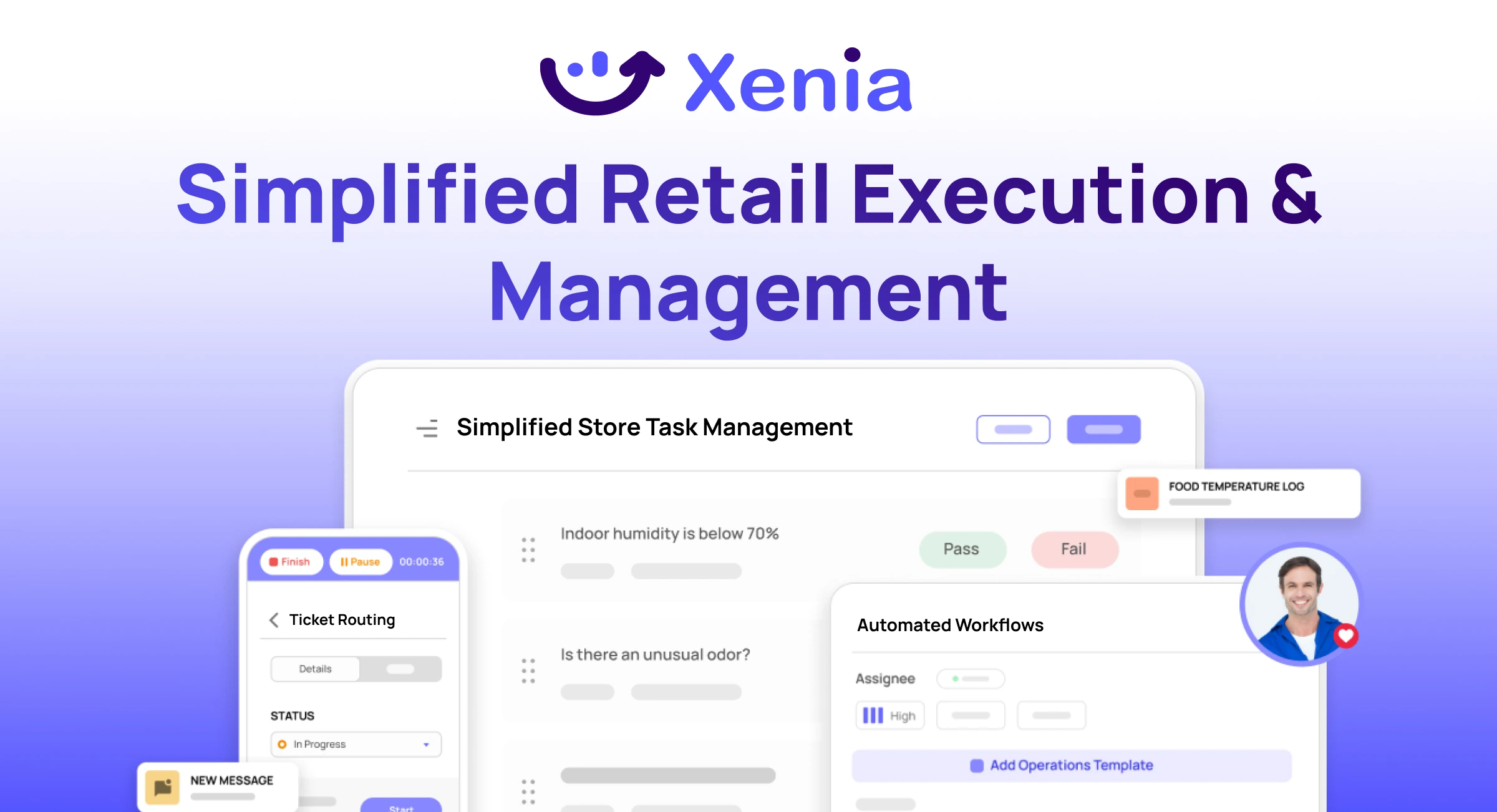
Why Retail Operators Choose Xenia:
🤖 AI-Powered Merchandising, Verify planograms, displays, and brand standards automatically with AI photo analysis. Build digital checklists instantly or convert existing merchandising guides.
🏬 Operations & Loss Prevention, Assign opening procedures, store walks, and resets across locations. Track theft, cash discrepancies, and security incidents with evidence and approval workflows.
📊 Real-Time Visibility, Compare audit scores and task completion across stores. Identify top and underperforming locations. Export reports for leadership reviews.
One platform for operations, merchandising compliance, and loss prevention across all locations.

.svg)
.webp)
%201%20(1).webp)

.svg)
%201%20(2).webp)