

Summary
What are the main types of work orders?
A work order is a documented, trackable request to perform maintenance or repair on a specific asset, recording what needs to be done, where, by whom, and by when. The five canonical types of work orders are preventive, corrective, emergency, inspection, and predictive. They differ on one axis: when the work is triggered relative to failure.
Here are the five work order types, each defined first:
- Preventive work order. A preventive work order is scheduled maintenance performed on a time, usage, or calendar interval to stop a failure before it happens. Examples: a quarterly HVAC filter change, a weekly walk-in cooler gasket check, a monthly fire-extinguisher inspection.
- Corrective work order. A corrective maintenance work order fixes a known problem that is not an immediate safety or shutdown risk, before it gets worse. Examples: a flickering sign ballast, a slow-draining sink, a cooler running 2 degrees warm but still in range. It is often the child work order spawned by an inspection finding. (Corrective maintenance has no learning-center entry, so define it inline as a planned fix for a known, non-urgent defect.)
- Emergency work order. An emergency work order responds to a sudden failure that threatens safety, property, or active operations and demands immediate dispatch. Examples: a fuel pump that will not start at 11pm, a walk-in down during the dinner rush, a guest-room AC dead on a sold-out night. Emergency work orders rank highest in the prioritization hierarchy.
- Inspection work order. An inspection work order schedules a tech or staff member to assess an asset's condition without performing a repair. It produces information. A finding becomes a corrective or preventive work order. Examples: a monthly forecourt safety walk, an annual hood-suppression inspection, a daily line-check.
- Predictive work order. A predictive maintenance work order is triggered by sensor or condition-based data that signals a developing failure, scheduling the fix before the asset breaks. Examples: a vibration sensor flagging a compressor bearing, a temperature sensor trending a cooler toward failure. This is the tier where a full CMMS leads.
Why classification matters: it drives prioritization, planning, and budgeting. The benchmark for a healthy maintenance program is roughly an 80/20 ratio of preventive to reactive work. Many facilities run the inverse. Reactive and emergency repairs cost roughly 3 to 5 times more than the same job done as planned maintenance, per eWorkOrders' reactive vs. preventive cost comparison. For the reactive end of the spectrum, see our deep-dive on reactive maintenance work orders.
Workflow diagram, submission to resolution
Every work order type follows the same five-stage lifecycle. The type only changes who triggers it and how fast it moves. Here is the submission-to-resolution flow at the level a closing attendant or area maintenance tech would actually read it:
- Submit. Someone reports the issue. In Xenia, store staff or a third-party vendor can scan a QR code on the asset and submit a work request without logging in. The form auto-populates the asset, location, and category. Emergency and corrective work orders usually start here. Preventive and inspection work orders auto-generate on a schedule.
- Triage and approve. A manager reviews the request in the authenticated Xenia app, sets the type and severity, and approves it. Severity is tiered: low, medium, high, critical. Triage is manual, so a person decides where each request lands.
- Route and assign. The work order auto-routes by region, priority, and skill to the right tech or vendor, and notifies the DM. Severity drives speed. A critical or emergency order escalates immediately. A low-severity corrective order enters the queue.
- Resolve. The assignee completes the work, captures a photo of the fix, and logs parts or notes. Escalation fires if the order is not closed by its deadline.
- Close and record. The work order closes to a service-history record on the asset. The submission trail and the closure trail are the same record. That record is the audit trail when corporate or an inspector asks.
In one line: scan QR or auto-schedule, then manager triage plus severity, then auto-route by region, priority, and skill, then a tech or vendor resolves with photo proof, then close to asset service history. The no-login step applies to submission via QR code only. Store staff or third-party vendors submit without logging in. Managers approve in the app.
This is the defensible piece. Store staff or third-party vendors submit work requests via QR code without logging in, and the form auto-populates the asset, location, and category. The manager approves and routes by region, priority, and skill, automatically. A pump attendant scans the QR on a faulty pump, the request routes to the area tech by region, and the DM gets notified. For the full handoff, see dispatch to resolution workflow and the close-out detail in maintenance ticket system closure tracking.
Preventive, corrective, emergency, inspection, and predictive, compared
The five types line up cleanly when you put trigger, timing, urgency, and a multi-site example side by side. This is the comparison the generic CMMS blogs skip.
| Work order type | When it triggers | Planned or reactive | Urgency | Multi-site example |
|---|---|---|---|---|
| Preventive | Time, usage, or calendar interval, before failure | Planned | Low to medium | Monthly fire-extinguisher check across 60 C-stores |
| Inspection | Scheduled condition assessment, no repair | Planned | Low | Daily forecourt safety walk, annual hood-suppression inspection |
| Predictive | Sensor or condition data signals a developing failure | Planned (data-triggered) | Medium | Vibration sensor flags a walk-in compressor bearing |
| Corrective | A known, non-urgent problem is found | Reactive (often from an inspection) | Medium | Flickering sign ballast at one retail banner location |
| Emergency | Sudden failure risking safety, property, or operations | Reactive | Critical (highest priority) | Fuel pump down at 11pm at a rural stop |
The same five types run across every vertical, just with different assets:
- Restaurant / QSR: Preventive is a weekly walk-in gasket check. Inspection is the nightly line-check. Corrective is a drive-thru menu board light out. Emergency is a fryer down during the dinner rush. Predictive is a Bluetooth thermometer trend flagging a walk-in drifting out of range.
- C-store / petroleum: Preventive is a quarterly dispenser filter change. Inspection is the monthly forecourt safety walk. Corrective is a cooler running warm but in range. Emergency is a pump dead at 11pm at a rural stop. Predictive is a tank monitor or sensor signaling a cooler heading for failure.
- Retail: Preventive is scheduled HVAC service. Inspection is a weekly fixture-and-signage store walk. Corrective is a broken shelf bracket. Emergency is HVAC failure on a heat-advisory sales day. Predictive is rare, condition-based on refrigerated fixtures only.
- Hotel / hospitality: Preventive is a guest-room PPM cycle. Inspection is the pre-arrival room inspection. Corrective is a dripping faucet logged during turnover. Emergency is AC dead in a sold-out room. Predictive is boiler or chiller sensor data.
A few common questions get resolved right here. Corrective and emergency share a reactive origin but differ on urgency: a corrective is a known problem that can wait for the queue, while an emergency threatens safety, property, or active operations and dispatches now. An inspection becomes corrective the moment it finds a defect, which spawns a corrective or preventive child order. And preventive runs on a fixed schedule whether the asset needs it or not, while predictive runs only when the data says failure is developing. For the urgency tier itself, see emergency work order escalation and how to rank everything in work order prioritization.
.svg)

Priced on per user or per location basis
Available on iOS, Android and Web


How does Xenia's approach differ from a full CMMS?
Xenia captures, routes, and closes every work order type at the frontline. It is not a full CMMS. For parts inventory, depreciation tracking, deep vendor invoicing, and IoT-driven predictive maintenance at the engineering layer, a dedicated CMMS like Limble or Service Channel leads, and Xenia complements it. Operator credibility requires saying that plainly.
Here is the split by type. For preventive, inspection, corrective, and emergency work orders, Xenia handles submission, triage, routing, photo-proof resolution, and closure at the store-walk and DM and store-level layer. That is the strongest fit. For predictive, Xenia surfaces sensor-triggered alerts and can spawn the resulting work order. Power Market runs 360+ locations on continuous sensor and QR deployment. The deep condition-based modeling, asset-failure analytics, and reliability engineering live in a full CMMS. Predictive is where a full CMMS leads, full stop.
The defensible differentiator is the no-login entry point. No major competitor (Zenput, RizePoint, Bindy, Limble, Service Channel) offers no-login QR work-request submission. Per Limble's work order documentation and the CMMS category broadly, third-party vendor submission typically requires a seat or a login. Xenia lets the closing attendant or a third-party vendor scan and submit without an account.
| Capability | Typical CMMS (Limble, Service Channel) | Xenia |
|---|---|---|
| Parts inventory and depreciation | Deep | Not the scope |
| Vendor invoicing depth | Deep | Not the scope |
| IoT predictive modeling | Deep | Surfaces alerts, spawns work orders |
| No-login QR work-request submission | Generally requires login or seat | Yes, scan and submit, no account |
| Audits, daily ops, and comms in same app | No | Yes |
| Captures all five work order types at the frontline | Yes (engineering layer) | Yes (frontline layer) |
The honest framing is run-both, not rip-and-replace. Refuel runs Xenia for frontline ops and offline submission while keeping its Service Channel integration. That is the complementary-buy pattern, not a CMMS-replacement claim. If you are weighing a head-to-head, see our breakdowns of Xenia vs. Limble and Xenia vs. Service Channel.
Where do operators see results?
Standardizing work order types pays off in faster resolution, fewer manager phone calls, and a cleaner audit trail, and the gains compound across locations. The numbers below come from real multi-site deployments, not generic factory case studies.
- Power Market (C-store) hit 40% faster task resolution and went live across 360 locations with bilingual checklists and QR deployment. That is the multi-site QR-routing payoff in one number.
- Mezeh (restaurant) cut manager phone calls by 60%, the direct result of staff submitting and tracking work themselves instead of calling a manager.
- Refuel (C-store) runs offline mode plus a retained Service Channel integration. Offline submission matters at rural fuel stops where connectivity drops, and the 11pm-pump scenario is the emergency-work-order archetype.
- Tempstop (C-store) went paperless in 14 days, the time-to-value proof for moving paper work orders to digital.
Two facts explain why this matters. First, reactive and emergency repairs cost roughly 3 to 5 times more than the same job run as planned maintenance, and the industry target is an 80/20 preventive-to-reactive ratio, per eWorkOrders. Second, compliance-grade work orders matter for safety. OSHA's lockout/tagout standard, 29 CFR 1910.147, governs hazardous-energy control during equipment servicing and ranks among OSHA's most-cited standards. Maintenance and emergency work orders on energized equipment fall under it. Xenia provides the audit trail. It does not auto-file OSHA reports. Submission stays operator-driven.
The compounding effect shows up at the C-store level especially. C-store chains running mixed formats can standardize one work order setup across every store, and rural sites keep submitting offline until connectivity returns. For the full vertical picture, see convenience store operations software. And because work order severity and audit scoring follow the same critical-vs-minor logic, the weighted audit scoring approach pairs naturally with how you tier work orders.
How to capture every work order type in Xenia
You do not need a separate tool per work order type. One Xenia setup captures preventive, corrective, emergency, inspection, and predictive work orders by combining scheduled templates, QR-code submission, and severity-tiered routing. Here is the setup, step by step:
- Tag your assets. Put a QR code (an asset tag, the scannable label on equipment) on every pump, cooler, fryer, HVAC unit, or fixture. A scan auto-populates the asset, location, and category on any work request. See scan to create work orders with asset tags.
- Schedule the planned types. Build preventive and inspection work orders on a recurring cadence by time, usage, or calendar. See preventive maintenance cadence.
- Open the reactive channel. Enable no-login QR submission so staff and third-party vendors can report corrective and emergency issues the moment they find them, with a photo. See QR-code anonymous work requests and vendor work requests with no login.
- Set severity tiers and routing. Configure low, medium, high, and critical severity, and auto-route by region, priority, and skill. Critical and emergency orders escalate immediately.
- Wire predictive triggers where you have sensors. Connect Bluetooth thermometers or condition sensors so an out-of-range reading spawns a work order automatically.
- Close to service history. Require a photo of the fix on resolution so the work order closes to the asset's service-history record.
The practical next step for the planned types is a schedule you can fill in today. Start with the preventive maintenance calendar.
Frequently Asked Questions
Got a question? Find our FAQs here. If your question hasn't been answered here, contact us.
How many types of work orders are there in facilities maintenance?

What's the difference between a corrective and an emergency work order?
When does an inspection work order turn into a corrective one?
Which work order type should a multi-site operator standardize on first?
Can one platform capture every work order type, or do I need a CMMS per type?

A Modern, AI-Powered Platform Built for Facility Operations
Xenia connects maintenance, safety, inspections, and daily operations into one mobile-first platform. Facility teams respond faster, prevent downtime, and maintain compliance, while leadership tracks performance across all buildings in real time.
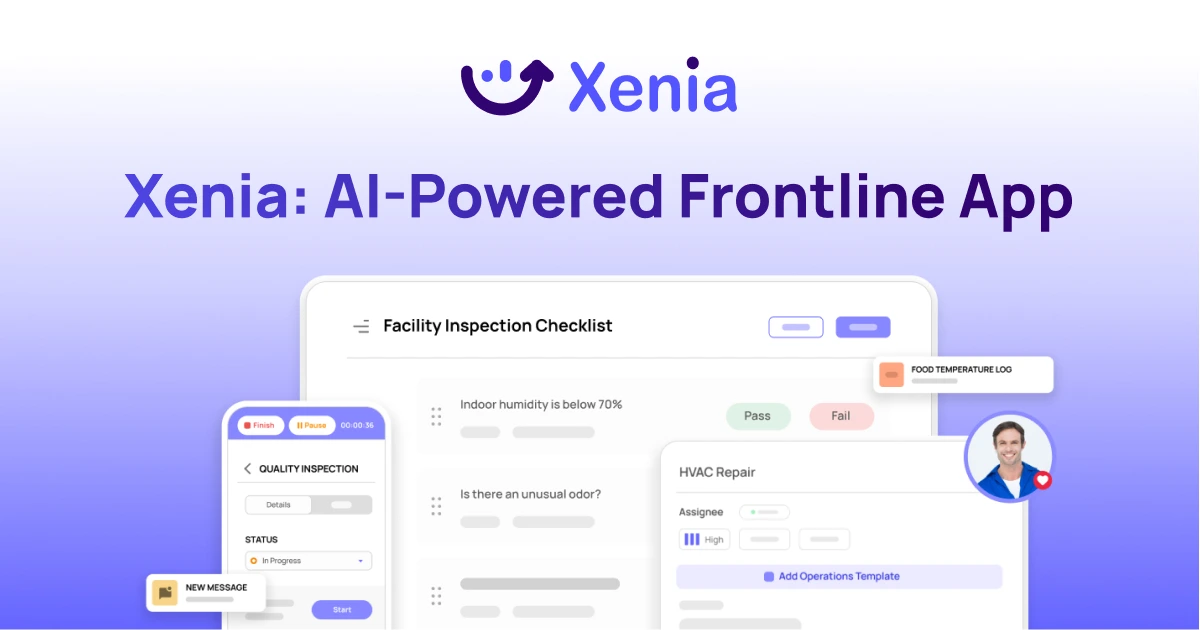
Why Facility Managers Choose Xenia:
🤖 AI-Powered Inspections, Verify safety equipment and compliance automatically with AI photo analysis. Surface critical maintenance issues instantly with AI-powered summaries.
🛠️ Work Orders & Maintenance, Report issues via mobile or QR codes. Route requests to teams or vendors. Schedule preventive maintenance for HVAC, elevators, and emergency systems to reduce downtime.
📊 Safety & Visibility, Deploy fire safety and hazard inspection workflows. Monitor work order resolution times and asset health across all facilities.
Manage work orders, maintenance, and safety inspections across all facilities from one platform.

.svg)
.webp)
%201%20(1).webp)

.svg)
%201%20(2).webp)


