
Summary
What is weighted audit scoring?
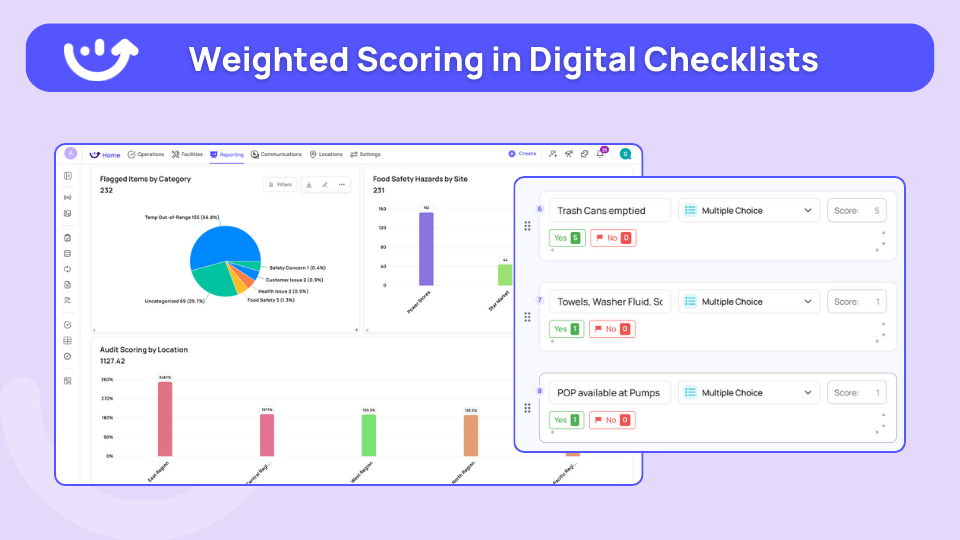
Weighted audit scoring is a methodology where each checklist item carries a numeric point value reflecting its operational severity. Critical items sit at 10 points, major items at 5, minor items at 1.
The audit score is the weighted sum of passing items divided by the weighted sum of evaluated items, expressed as a percentage. Unlike a flat completion percentage, the weighted score reflects which categories of items passed and which failed.
The methodology solves the classic 87% problem in multi-unit operations. A 100-item flat-percentage audit where 87 items pass and 13 fail produces an 87% score.
If 12 of the 13 failures are minor cosmetic items and the 13th is a critical food-safety failure, the operator reading the 87% sees a passable store. Weighted scoring on the same data produces a meaningfully lower number because the critical item carries 10x the impact of any one cosmetic finding.
The signal-to-noise inversion of unweighted scoring is severe enough that the FDA Food Code Priority versus Core item taxonomy was built to encode the same logic at the regulatory level: not every observation deserves equal weight in a pass/fail decision.
The FDA Food Code already encodes a lighter version of weighting in its Priority versus Core item taxonomy. A Priority 1 item, for example a temperature-control-for-safety violation, can shut down a kitchen on its own. A Core item gets a fix-by-next-routine-inspection note.
The regulatory framework recognizes that not every checklist item carries the same operational weight, which is the foundational case for weighted scoring at the platform level. Operators running weighted audits on Xenia map their question taxonomy to the FDA framework directly. For HACCP-aligned operations, this matters even more. See HACCP principles in audits.
Example walkthrough, weighted scoring in action
Consider a 50-item line-check audit at a QSR location with a fryer, a walk-in cooler, a hot-hold cabinet, a patio, and a drive-thru.
A typical Xenia weighting structure for this audit might look like this:
**
Item, Weight, Category
Walk-in cooler temp in range, 10 points, Critical-food safety
Hot-hold temp at 135°F or above, 10 points, Critical-food safety
Three-compartment sink sanitizer ppm in range, 10 points, Critical
Fryer oil daily change documented, 5 points, Major
Drive-thru window cleanliness, 1 point, Minor-cosmetic
Patio cleanliness, 1 point, Minor-conditional
Menu board alignment, 1 point, Minor-cosmetic
**
If a tablet auditor finds the walk-in cooler temp at 45°F (out of range, fails the 10-point critical), the fryer oil change undocumented (fails the 5-point major), and three menu boards misaligned (fails 3 of 1-point minors), the failure load adds to 18 weighted points lost across roughly 110 weighted points evaluated.
The weighted score lands around 84%. An unweighted percentage on the same data would show roughly 90% (45 of 50 items passed), five percentage points higher than the weighted truth, with the critical walk-in failure flattened by the cosmetic passes.
What happens next is the difference between an audit platform and a closed-loop operations platform. The 10-point critical failure on the walk-in temp triggers a corrective action workflow: a follow-up question captures root cause, a photo is required at the moment of failure, and a task is auto-assigned to the kitchen manager with a deadline.
If the task isn't closed by the deadline, the system escalates to the district manager. Dave's Hot Chicken implemented this exact pattern across 321 locations and reported faster corrective-action closure as a direct consequence.
See the restaurant corrective action playbook for the procedural detail. Operators looking to build the same workflow start from the audit checklist template for restaurants.
How does weighted scoring differ from unweighted scoring?
The two methodologies look superficially similar, both produce a percentage at the end of the audit, but they describe fundamentally different operational realities. The table below captures the contrast.
**
Aspect, Weighted scoring, Unweighted (percentage) scoring
Item value, Variable-by severity, Equal across all items
Critical-item visibility, Surfaces in score, Hidden in average
Hard-fail support, Native via thresholds, Requires manual override
N/A handling, Nullify (drop from denominator), Penalty (counts as zero)
Operator signal, Reflects severity reality, Reflects raw completion
Multi-format support, Strong with conditional visibility, Weak. Templates fragment
**
The weighted methodology pairs naturally with conditional visibility, the ability to ask different questions at different locations without penalizing stores for items they don't have. A unit without a patio shouldn't see patio-cleanliness questions, and the audit denominator shouldn't include them.
The combination of weighted scoring plus nullify plus conditional visibility is what makes a single audit template viable across 100+ format variations. Without that combination, multi-format chains end up either fragmenting into multiple templates (an authoring nightmare) or accepting that their scores are systematically corrupted at non-standard formats.
For a fuller comparison of audit scoring methodologies across major platforms, see the audits and inspections software comparison, which contrasts the scoring approaches at RizePoint, SafetyCulture, Bindy, and Xenia. Operators evaluating SafetyCulture specifically can read the SafetyCulture alternatives breakdown for the head-to-head feature comparison.
.svg)

Priced on per user or per location basis
Available on iOS, Android and Web


How to set up weighted audits in Xenia
Setting up weighted audits in Xenia takes about twenty minutes for a new template and is something a franchise compliance officer can do without engineering support. The setup pattern is the same whether you're converting an existing paper or RizePoint audit or building one from scratch.
- Open the audit template editor and add your checklist items as you would in any builder.
- For each item, set the weight from the dropdown: critical (10), major (5), or minor (1). If your operation already maps to FDA Priority/Core, mirror that mapping.
- Configure pass/fail thresholds at the template level. The most common pattern is "any critical-item failure equals hard fail regardless of overall score" plus a 90% weighted threshold for an A-grade audit.
- Wire follow-up questions on critical and major items: when the answer is fail, capture root cause text and require a photo of the failure or the corrective action.
- Connect each follow-up to a corrective-action workflow. Assign the default owner role (Kitchen Manager, Front Desk Manager, etc.), set the deadline (typical 24-72 hours for criticals, 7 days for majors), and configure the escalation chain.
- Publish the template to the location group. Auditors on the tablet see the questions the same way. The weighting is invisible to them.
Multi-unit operators rolling this out for the first time should start with the CAPA audit template as the corrective-action backbone. The template ships with the standard escalation chain pre-configured, and franchise compliance officers can clone and adjust without rebuilding from scratch.
Where do operators see results?
Dave's Hot Chicken ran the canonical weighted-scoring migration. Across 321 locations they replaced RizePoint with Xenia, primarily driven by three factors: weighted scoring with native nullify support, Bluetooth thermometer integration that turned every walk-in and hot-hold into a continuously logged data point, and corrective-action closure tracking that took the operational signal and converted it into closed tasks rather than a quarterly report.
Corrective-action closure ran materially faster because the closure path was native to the platform rather than living in a spreadsheet. And critical-item zero-tolerance, the practice of failing the audit on any single critical violation, became enforceable at scale rather than dependent on spreadsheet escalation discipline.
The results weren't unique to Dave's. Newk's Eatery runs weighted audits across their portfolio with the same methodology, applying it across multi-unit kitchens where critical food-safety items must surface in the headline number, the same pattern Dave's adopted at 321 locations.
The pattern repeats: operators move when they can no longer accept that the audit number doesn't reflect the audit truth.
For broader context on the multi-unit restaurant ops category, the restaurant task management industry hub covers the full scope. The restaurant audit and inspection software guide is the recommended next read for buyers benchmarking platforms, and the audit and inspection fundamentals page covers the underlying methodology for operators new to digital audits. HACCP-aligned operators should also review the hazard analysis and critical control points (HACCP) glossary entry for the regulatory baseline.
Frequently Asked Questions
Got a question? Find our FAQs here. If your question hasn't been answered here, contact us.
What is weighted audit scoring?

How is weighted scoring different from a percentage score?
Can I change item weights after publishing the audit template?
Does Xenia support pass/fail thresholds tied to weighted scores?
How do most multi-unit operators weight food safety items?
Will weighted scoring slow down the audit on a tablet?


A Modern, AI-Powered Platform Built for Restaurant Operations
Xenia brings kitchen operations, food safety, audits, and team communication into one mobile-first platform. Restaurant teams execute daily work consistently, maintain compliance, and resolve issues faster, while leadership gets real-time visibility across all locations.
.webp)
Why Restaurant Operators Choose Xenia:
🤖 AI-Powered Operations, Convert paper logs instantly and verify food presentation and kitchen cleanliness automatically. Get instant answers about food safety trends without building reports.
🍽️ Food Safety & Compliance, Track line checks and temperature logs with automated alerts. Trigger corrective actions when readings exceed safe ranges. Maintain audit-ready records for health inspections.
📊 Multi-Location Control, Monitor food safety compliance and task completion across regions. Benchmark locations to identify training needs. Export reports for operational reviews.
One platform for kitchen operations, food safety, and compliance across all locations.

.svg)
.webp)
%201%20(1).webp)

.svg)
%201%20(2).webp)