

Summary
What is a preventive maintenance cadence?
A preventive maintenance (PM) cadence is the recurring interval at which a facilities team services an asset to prevent failure. You set it by calendar time (every 90 days), by usage (every 200 run-hours), or by a regulatory minimum. It is the "how often" half of a PM program. The "what" half is the task list on the work order.
There are two ways to set the interval:
- Time-based (calendar): A fixed interval. "Inspect HVAC filters every 90 days." This is the easiest to schedule across many sites.
- Usage-based (meter): Triggered by run-hours, cycles, or mileage. "Service the forklift every 200 operating hours." This fits assets whose wear tracks usage, not the calendar.
Many platforms support "time OR usage, whichever comes first." Per Limble's PM scheduling documentation, a PM can trigger on a time schedule, a usage meter, or both, resetting on whichever fires first. UpKeep frames the same point operator-side: service frequency depends on equipment type, usage, manufacturer recommendation, and industry standard, ranging from daily through annual.
Here is the operator framing that matters. The cadence for any asset is the strictest of three things. The manufacturer's spec. The regulatory minimum (NFPA, health code, OSHA). And how hard the unit actually runs. A fryer in a 16-hour-a-day QSR is on a tighter cadence than the same fryer in a breakfast-only cafe.
A few terms worth defining on the way through. Preventive maintenance is the scheduled work that keeps an asset running. Reactive maintenance is the repair after it breaks. Predictive maintenance uses condition data to time the service. Deferred maintenance is the PM you skipped, which is where the big bills come from.
Verified PM cadence reference table
This is the asset-by-asset starting point. Every interval traces to a published source.
| Asset | Typical cadence | Source basis |
|---|---|---|
| HVAC professional service (commercial) | Quarterly, semi-annual full service | ASHRAE Standard 180 |
| HVAC air filter inspection or change | Monthly to quarterly, biweekly in high-traffic kitchens | ASHRAE 62.1 filter guidance |
| HVAC coil cleaning | Quarterly inspection, semi-annual clean | ASHRAE 180 |
| Walk-in cooler condenser coil | Every 3 months, every 6 to 8 weeks near a cooking line | Commercial refrigeration guidance |
| Kitchen exhaust hood, high volume (12 to 16 hr) | Quarterly | NFPA 96 |
| Kitchen exhaust hood, 16+ hr or solid fuel | Monthly | NFPA 96 |
| Kitchen exhaust hood, moderate volume | Semi-annual | NFPA 96 |
| Kitchen exhaust hood, low volume | Annual | NFPA 96 |
| Fryer (oil filtration, thermostat calibration) | Weekly | Equipment-maker spec |
| Grease trap pump-out | Quarterly | Equipment and health-code basis |
The HVAC intervals follow ASHRAE Standard 180 task-level schedules. The hood tiers follow NFPA 96 cleaning intervals by cooking volume. Condenser coil cadence follows commercial refrigeration maintenance guidance. Fryer and grease-trap intervals come from Xenia's own preventive maintenance schedule guide.
How this plays out by vertical:
- Restaurant and QSR: Fryers weekly, walk-in condensers quarterly, hoods monthly to quarterly by volume, HVAC quarterly. The kitchen team feels the miss first. An overdue hood is a fire-code violation and a failed health inspection.
- C-store: Fuel dispensers and tank monitors on vendor-set intervals, cooler and freezer condensers quarterly, HVAC quarterly, foodservice equipment per maker spec. Rural sites add travel time. A missed PM means the area tech drives two hours for a repair a 20-minute scheduled clean would have prevented.
- Retail: Rooftop HVAC quarterly, grab-and-go refrigerated cases monthly to quarterly, automatic doors and lighting on annual to semi-annual cycles.
- Hospitality: Guest-room PTAC and HVAC units on a rooms-division PPM rotation, boilers and chillers on ASHRAE-aligned cadences, laundry equipment on maker intervals. Hotels already call this PPM, or planned preventive maintenance.
Cadence is not busywork. The U.S. Department of Energy FEMP guide reports a preventive maintenance program saves as much as 12 to 18 percent on average over a reactive program, plus longer component life and fewer failures. Xenia's own field data lines up: reactive repairs run 3 to 5 times the cost of the scheduled PM.
Workflow diagram, submission to resolution
A preventive maintenance cadence runs as a closed loop in Xenia, from scheduled trigger to time-stamped sign-off, with no one having to remember the due date. Here is the PM lifecycle as a closing attendant or area tech would read it:
- The schedule fires. The cadence (calendar or usage) hits its due date. Xenia auto-generates the work order. No one has to remember.
- The work order auto-assigns. It routes by location, asset, and skill, to the in-house tech, the area maintenance manager, or a flagged third-party vendor.
- The assignee executes with a checklist. They open the PM task list on a tablet or phone. Each step gets checked off, with photo proof and timestamps where the step requires it.
- Exceptions get captured. If the tech finds a worn belt or a leaking gasket mid-PM, a follow-up question and a required photo capture the issue, and a separate corrective work order spins off.
- The PM closes to evidence. Completion proof, photos, and a time-stamped sign-off land on the asset's service history.
- Misses escalate. If the PM is not done by the deadline, it escalates up the chain, from tech to area manager to regional. The miss shows on the dashboard before it becomes a failure.
Contrast that with the reactive path. No cadence means the closing attendant discovers the pump is dead at 11pm, calls someone, someone logs a ticket, and nobody knows what's actually broken until the area tech arrives. The PM cadence removes that surprise. The asset gets serviced before the attendant ever finds it down.
Planned work is only half the picture. The unplanned find still happens: a fixture cracks, a cooler trips, a guest reports a dead AC unit. For that side, store staff or third-party vendors submit a request via QR code without logging in, and the form auto-populates the asset, location, and category while the manager approves and routes it in the app. That no-login QR-code work request flow covers the unplanned find. The PM cadence covers the planned work. Both land in the same dashboard, routed and tracked to closure the same way, which is also how work order prioritization and the dispatch-to-resolution workflow stay in one place instead of three tools.
How does Xenia's approach differ from a full CMMS?
Xenia schedules and routes preventive maintenance at the frontline-ops layer. It is not a full CMMS. It does not match Limble or Service Channel for parts inventory, depreciation tracking, or vendor invoicing depth. Many operators run both: Xenia for frontline submission, scheduling, and closure, and a depth-CMMS for asset lifecycle and parts.
That honesty matters, so here is the side-by-side.
| Capability | Xenia (frontline ops) | Full CMMS (Limble, Service Channel) |
|---|---|---|
| PM scheduling (time and usage) | Yes | Yes |
| No-login QR work request submission | Yes (differentiator) | No |
| Auto-route plus escalation to closure | Yes | Yes |
| Audits plus daily ops checklists in same app | Yes | No |
| Team comms and announcements with signature | Yes | No |
| Parts inventory depth | No, use CMMS | Yes |
| Depreciation and asset lifecycle accounting | No, use CMMS | Yes |
| Vendor invoicing depth | No, use CMMS | Yes |
| Per-location flat pricing | Yes | Varies |
Per Limble's preventive maintenance product documentation, Limble centers on asset PM depth, parts, and meter-based triggers. Service Channel centers on facilities and vendor coordination depth. The way to think about the choice: Limble is the right tool if you are a facilities engineer running PMs and parts inventory. Xenia is the right tool if you are a multi-unit ops director who needs work orders, audits, daily ops, and comms in one app. The Xenia vs Limble comparison breaks the feature lines down for a BOFU reader.
The two are not mutually exclusive. Refuel runs Xenia for frontline ops and kept its Service Channel integration for asset depth. Xenia is the frontline layer that complements a depth-CMMS where one already exists, not an all-or-nothing rip-and-replace. The no-login piece is specific: store staff or third-party vendors submit without logging in, and managers approve, assign, and route in the authenticated app.
.svg)

Priced on per user or per location basis
Available on iOS, Android and Web


How to set up preventive maintenance cadences in Xenia
Setting up a preventive maintenance cadence in Xenia takes six steps, from tagging the asset to pulling the service history when the inspector asks. Each one is operator-facing, not an admin project.
- Tag every asset. Put a QR-code asset tag on each unit: the walk-in, the rooftop HVAC, the fryer, the pump. The tag carries the asset ID, location, and category. See the walkthrough on QR-code asset tagging.
- Set the cadence per asset. Pick time-based (every 90 days) or usage-based (every X run-hours), using the strictest of manufacturer spec, regulatory minimum, and run-intensity. The verified cadence table above is the starting point.
- Attach the PM task list. Build the step list once, or upload an existing SOP PDF and convert it with the AI Template Agent. Upload the PDF, get a digital form with required fields and photo steps in minutes, which cuts franchise rollout time from weeks to days. Mark which steps require a photo.
- Set routing and escalation. Route the auto-generated work order by location, skill, and priority. Set the deadline and the escalation chain (tech to area manager to regional) for a missed PM.
- Let the schedule run. Xenia generates the work order on the due date, assigns it, and tracks it to closure. The dashboard surfaces what's coming up as a problem, the flagged and overdue PMs, not just a completion percentage. That issues view shows where the next failure is forming.
- Review the service history. Every closed PM, with photos and timestamps, sits on the asset record. When the auditor or the health inspector asks, the proof is already there.
Want the cadence starting points in one place? Pull the preventive maintenance calendar tool or the PM schedule template and load the intervals straight in.
Where do operators see results?
The payoff is not "we do PMs now." It is that the missed PM disappears as a category. The DM opens the dashboard and sees what's due this week across every store, not a stack of surprise failures. The asset's service history is audit-ready. And the planned work and the unplanned find live in one app, on one dashboard.
A few operators show the shape of that result:
- Refuel (200+ C-stores) switched to Xenia for offline mode, work orders, and a retained third-party Service Channel integration. The app works fully offline and syncs when connectivity returns, which is what made it land at rural fuel stops. The tablet completes the PM even where the signal drops, then syncs the proof when it comes back. That is the frontline-ops layer sitting alongside a depth-CMMS, exactly the pattern in the comparison above.
- Power Market went live across 360 locations with bilingual checklists and QR deployment and hit 40% faster task resolution. That number is Power Market's, tied to multi-location rollout speed and QR-driven work.
- H&S Energy runs 360+ stores on continuous sensor deployment. That sensor data is the bridge from condition to cadence, where readings can tighten or relax the interval per asset.
- Mezeh cut manager phone calls 60% by moving the broken-equipment scramble into a tracked work order. That is the 11pm phone-tree problem the workflow section opens with, closed out.
Those numbers belong to those customers. Forty percent is Power Market's. Sixty percent is Mezeh's. The repeatable part is the structure: tag the asset, set the cadence, route to closure, and the surprise failure stops being the thing the closing attendant finds first.
Frequently Asked Questions
Got a question? Find our FAQs here. If your question hasn't been answered here, contact us.
How often should HVAC be serviced in a restaurant?

What's the cadence for walk-in cooler compressors?
How do I schedule preventive maintenance across multi-site operations?
What happens if a PM is missed?
Does Xenia integrate with Service Channel for vendor PMs?
Can I run reactive and preventive work orders in the same dashboard?

A Modern, AI-Powered Platform Built for Facility Operations
Xenia connects maintenance, safety, inspections, and daily operations into one mobile-first platform. Facility teams respond faster, prevent downtime, and maintain compliance, while leadership tracks performance across all buildings in real time.
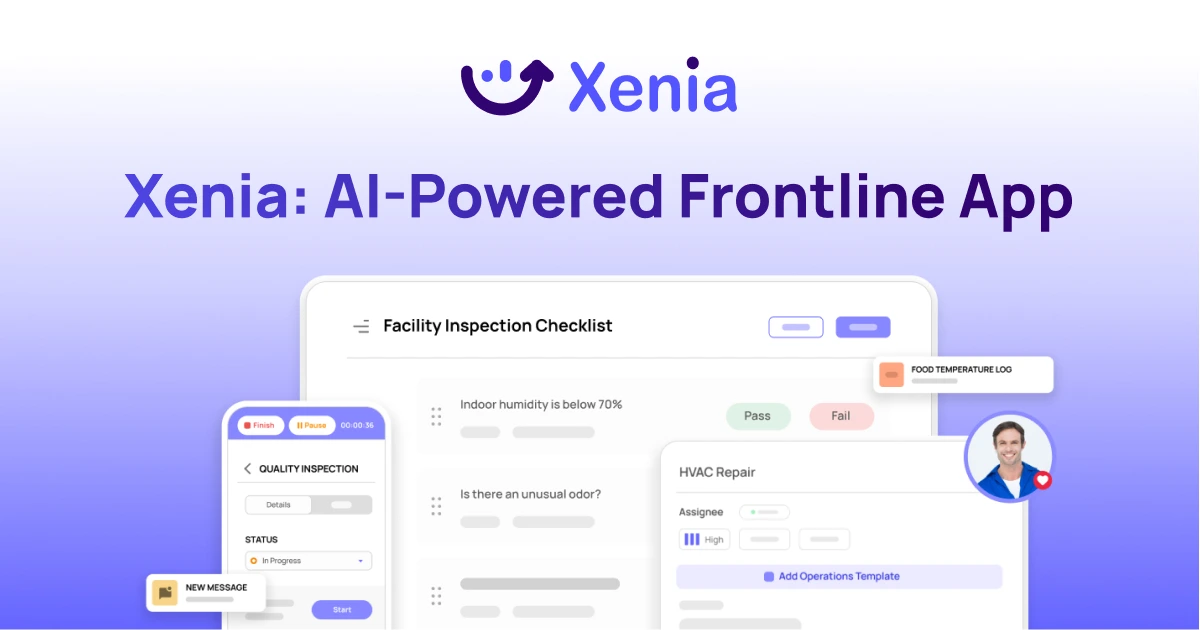
Why Facility Managers Choose Xenia:
🤖 AI-Powered Inspections, Verify safety equipment and compliance automatically with AI photo analysis. Surface critical maintenance issues instantly with AI-powered summaries.
🛠️ Work Orders & Maintenance, Report issues via mobile or QR codes. Route requests to teams or vendors. Schedule preventive maintenance for HVAC, elevators, and emergency systems to reduce downtime.
📊 Safety & Visibility, Deploy fire safety and hazard inspection workflows. Monitor work order resolution times and asset health across all facilities.
Manage work orders, maintenance, and safety inspections across all facilities from one platform.

.svg)
.webp)
%201%20(1).webp)

.svg)
%201%20(2).webp)


