

Summary
What is a maintenance ticket system with closure tracking?
A maintenance ticket system is software that captures a repair request, routes it to the right person, and tracks it to a verified close. Closure tracking is the discipline that decides when a ticket is genuinely done. Not when work stops, but when a status, a photo, and a sign-off complete the record. Without closure tracking, "open" and "fixed" blur together.
A work order is the documented instruction to perform a maintenance task on a specific asset. A maintenance request tracking flow turns each reported problem into one of those work orders and follows it to the end. The broader category of computerized maintenance management system (CMMS) software adds parts, asset lifecycle, and invoicing on top of that loop.
Industry guides converge on a consistent set of lifecycle stages. Mapped to the language multi-unit operators actually use, a ticket moves through six stops:
- Submitted. Request created with who, what, where, and a photo.
- Accepted. A manager reviews it and greenlights it into a work order.
- Assigned. Routed to the tech or vendor by region, priority, and skill.
- In progress. Work is happening and the status is visible.
- Closed. Work done, closing photo attached, completion note written.
- Verified. A supervisor confirms the asset is back in service.
The pain is not logging the ticket. The pain is the broken cooler at a C-store that reads "open" for nine days because nobody confirmed the vendor actually fixed it. Closure tracking turns "I think it's handled" into "here is the photo and the timestamp." For a deeper walkthrough of how requests become tracked work, see Xenia's guide to work order requests. One honest note up front: Xenia handles frontline submission, routing, and closure with evidence. It does not track parts inventory, depreciation, or vendor invoicing. A depth-CMMS owns that layer.
Workflow diagram, ticket submission to closure with evidence
A maintenance ticket flows in five movements: submit, route, work, close with photo, verify. The closing photo is the gate. The ticket physically cannot move to "closed" until evidence is attached. This is what separates real closure tracking from a status field someone flips by hand.
Here is the full ticket-to-closure flow, written at the level a closing attendant or area tech would read it:
- Scan and submit. A kitchen manager, pump attendant, or housekeeper scans the QR code on the broken asset. The form opens already populated with the asset ID, location, and category. No app install, no login. They type the symptom ("won't start, no error code") and add a photo.
- Auto-route to an owner. The request lands in the Xenia app. A manager approves it and it routes by region, priority, and skill to the area tech or third-party vendor. The DM is copied. Store staff or vendors submit a work request via QR code without logging in, and the manager routes it by region, priority, and skill automatically.
- Work in progress. Status is visible to everyone scoped to that location. No "did anyone ever call the tech?" phone tree.
- Close with required photo evidence. The tech marks the work done, writes a completion note, and attaches a closing photo. The ticket cannot close without it. This mirrors the closure fields the maintenance discipline expects: time spent, materials used, completion comments, and attached pictures.
- Verify and bank the record. A supervisor confirms the asset is back in service. The closed ticket becomes a permanent line in the asset's service history.
Why does the photo gate matter so much? Maintenance best-practice guides call requiring closure at the asset location, enforced by QR scan, the single practice that transforms record quality. Photo proof at closure ends the "I think the vendor fixed it" disputes and produces the documentation an inspector expects.
The vertical examples make the flow concrete:
- C-Store, pump. A pump goes down at a Refuel rural stop at 11pm. The closing attendant scans the QR on the dispenser. The form pre-fills pump ID, store address, and the fuel-equipment category. Even with spotty rural connectivity, Xenia's offline mode holds the request and syncs when the tablet hits WiFi. Refuel kept its Service Channel integration. The work request layer sits on top of it.
- C-Store, cooler. A walk-in cooler reads out of range. The attendant scans, submits, and attaches a photo of the thermostat. It routes to the area refrigeration vendor. Closure requires a photo of the corrected reading.
- Restaurant, fryer. A kitchen manager scans the QR on a dead fryer. The request auto-routes to maintenance with the photo. The closure photo shows the fryer back at temp.
- Hotel, AC unit. A housekeeper scans the QR on a broken in-room AC. The room number pre-populates. It routes to property maintenance, and the closure photo confirms the fix before the room is sold.
This same evidence-at-closure logic powers Xenia's audit work. The platform's corrective action tracking workflow keeps the closure record permanently linked to the originating audit line, so the proof is never orphaned. The dollar case is real too. A single broken fuel dispenser costs $400 to $600 per day in lost sales, and $500 to $2,000 or more at a busy site, per Station Dispenser's gas station maintenance guide. At the macro level, unplanned equipment downtime costs the Fortune Global 500 a combined $1.4 trillion per year, about 11% of revenue, per the Siemens True Cost of Downtime 2024 report. Ticket-to-closure speed has a P&L number attached.
How does ticket closure in Xenia differ from a full CMMS?
Xenia closes the frontline loop (submit, route, close with photo, verify) inside one app the store team already uses. A full CMMS like Limble or Service Channel closes a deeper loop that adds parts inventory, vendor invoicing, and asset-lifecycle depth. Many multi-unit operators run both. Xenia handles the frontline submission and closure layer, and the depth-CMMS handles asset and invoice depth.
| Closure step | Xenia (frontline ticket system) | Full CMMS (Limble / Service Channel) |
|---|---|---|
| Submission without login | QR scan, asset pre-populated, no app | No-login request portal exists, form-based, not QR-asset-anchored |
| Photo required at closure | Yes, the ticket cannot close without it | Configurable, often optional by default |
| Routing | Region, priority, and skill in-app | Deep dispatch plus vendor network |
| Vendor invoicing | Not handled by design | Core feature, proposal to invoice flow |
| Parts inventory and depreciation | Not handled | Core feature |
| Same app as audits, daily ops, comms | Yes | No |
| Verification and sign-off | Supervisor confirms asset back in service | Requester or supervisor confirmation status |
The competitor docs show where the depth lives. Service Channel's work order status guide runs a long status chain that ends at Invoiced. That invoice leg is the asset-depth layer Xenia deliberately does not replace. Limble's work requests overview confirms anyone can submit a request through a portal, but a Limble account is required to create the work order itself.
Xenia's edge is narrow and specific. It is the QR-code, asset-pre-populated submission tied directly into routing and a photo-gated closure, all inside the same app the store runs daily ops and audits in. That is not a claim that "only Xenia allows no-login" submission. It is the all-in-one frontline reality that a separate request portal cannot match. For more on the category itself, see Xenia's primer on what a CMMS is and the broader look at maintenance work order software. Refuel is the proof of the both-tools pattern: it retained Service Channel and layered Xenia's work request flow on top.
.svg)

Priced on per user or per location basis
Available on iOS, Android and Web


How to set up maintenance ticket closure tracking in Xenia
Setting up closure tracking takes five steps: tag the assets with QR codes, build the request form, set routing and escalation rules, require a photo at closure, and wire a dashboard to the open-ticket view. Most multi-unit teams stand this up in days, not weeks.
- Tag assets with QR codes. Print a QR for each pump, cooler, fryer, or AC unit. The scan pre-populates asset ID, location, and category on the request form. See Xenia's guide to QR code asset tagging.
- Build the request form. Add a symptom field, a photo field set to required, a category, and a severity level. Use a 1-to-5 numeric severity scale so a dead pump (5) outranks a flickering light (1).
- Set routing and escalation rules. Route by region, priority, and skill. Then define what happens to an unassigned ticket overnight: escalate to the DM at a set hour, regional next. This mirrors the escalation chain Xenia uses for corrective actions, where a critical jumps to the DM at 24 hours, regional at 48, and corporate at 72.
- Require photo evidence at closure. Turn on the closing-photo requirement so a ticket cannot be marked closed without it. Optionally require a re-reading (a cooler temp) or a supervisor sign-off.
- Wire the dashboard to the issues view. Surface open tickets by age, by location, and by overdue status, not just a completion percentage. A 50-location operator wants the issues-coming-up view, not the completion-percent view.
One more setup decision matters: aging and escalation are what keep priority work from stalling. In Xenia, configure the escalation so an unassigned high-severity ticket pings the DM automatically rather than waiting for someone to notice. For the full feature set behind these steps, see Xenia's maintenance management software and its work orders product page.
Where do operators see results?
Operators see results in three places: faster resolution, fewer manager phone calls, and a closure record that doubles as the asset's audit trail. The number that moves first is the time a ticket spends open.
Two metrics tell the story. Mean time to repair (MTTR) measures the average time from a failure being reported to the asset being back in service, including diagnosis, repair, and testing, per IBM's MTTR definition and eMaint's MTTR guide. A photo-gated, auto-routed ticket system attacks the diagnosis-and-handoff delay that inflates MTTR. The second metric is open-ticket age. A ticket reading "open" for nine days is the failure closure tracking exists to fix.
The customer outcomes back this up:
- Power Market (C-Store) consolidated audits, maintenance, and corrective actions onto Xenia across more than 300 locations and reported 40% faster operational task resolution. Read the Power Market customer story.
- Mezeh (Restaurant) reported a 60% reduction in manager phone calls after moving frontline issue reporting into Xenia.
- Refuel (C-Store) runs offline-mode submission for rural fuel stops and retained its Service Channel integration.
- Tempstop (C-Store and Restaurant) went paperless in 14 days.
The audit-trail payoff is the part that compounds. A closed ticket is not the end. It is a data point that updates the asset's repair history and flags recurring faults. In Xenia, the closing photo and completion note become the asset's service history, the same record an auditor or brand-standards reviewer asks for. That photo can also seed the next preventive maintenance check as the documented as-fixed baseline. This article covers the closure-tracking pattern. Related work-order topics, dispatch-to-resolution workflow, work-order prioritization, anonymous QR work requests, and no-login vendor access, build on the same QR-and-closure foundation.
Frequently Asked Questions
Got a question? Find our FAQs here. If your question hasn't been answered here, contact us.
What counts as a closed maintenance ticket in Xenia?

How does the system enforce photo evidence at closure?
What happens to a ticket that sits unassigned overnight?
Does the closure record become the audit trail for the asset?
How does Xenia's closure tracking compare to Limble's work-order workflow?
Can the closing photo be reused on the next preventive maintenance check?

A Modern, AI-Powered Platform Built for Facility Operations
Xenia connects maintenance, safety, inspections, and daily operations into one mobile-first platform. Facility teams respond faster, prevent downtime, and maintain compliance, while leadership tracks performance across all buildings in real time.
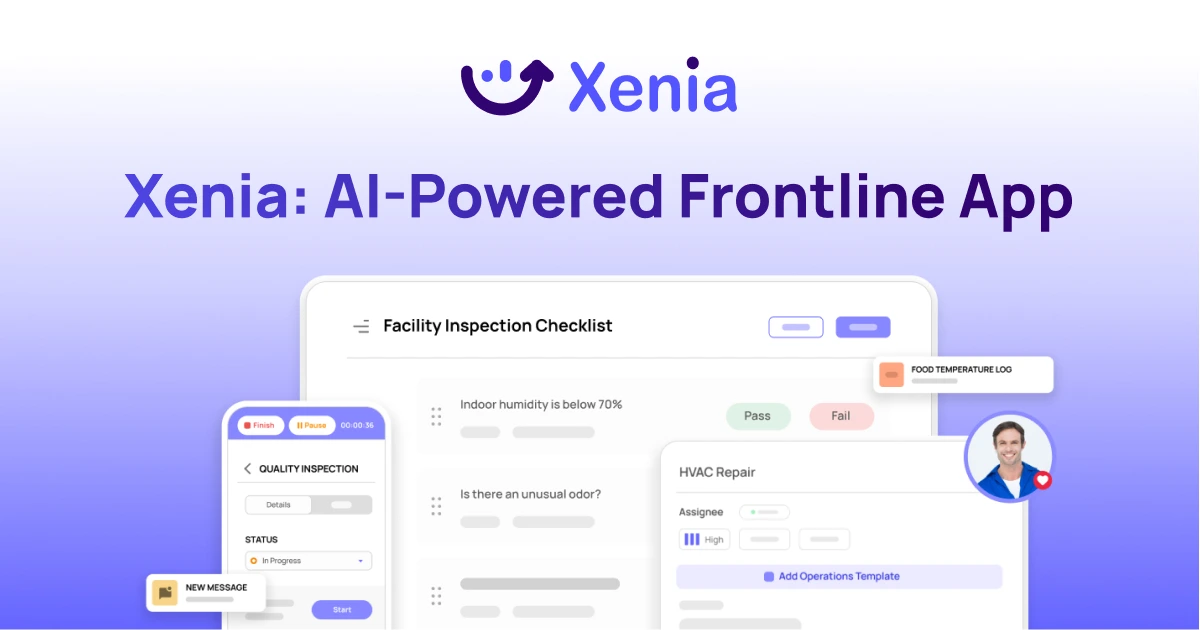
Why Facility Managers Choose Xenia:
🤖 AI-Powered Inspections, Verify safety equipment and compliance automatically with AI photo analysis. Surface critical maintenance issues instantly with AI-powered summaries.
🛠️ Work Orders & Maintenance, Report issues via mobile or QR codes. Route requests to teams or vendors. Schedule preventive maintenance for HVAC, elevators, and emergency systems to reduce downtime.
📊 Safety & Visibility, Deploy fire safety and hazard inspection workflows. Monitor work order resolution times and asset health across all facilities.
Manage work orders, maintenance, and safety inspections across all facilities from one platform.

.svg)
.webp)
%201%20(1).webp)

.svg)
%201%20(2).webp)


