

Summary
What is work order prioritization?
Work order prioritization is the process of scoring each maintenance request by impact and urgency, then ranking the queue so critical failures get attention before minor ones. Most facilities teams use a four-level scheme, P1 critical through P4 routine, and attach an SLA response time to each level. A work order is a documented request to repair, inspect, or maintain an asset, tracked from submission to closure. The priority is the work-sequencing rank that combines severity, urgency, safety, and resource availability into one decision.
The dominant framework is a two-factor matrix: urgency (how fast must this be fixed to prevent failure, injury, or a compliance miss) crossed with impact (the consequences of delay). Here is the four-level scheme operators actually use:
| Level | Name | What it means | Typical SLA response |
|---|---|---|---|
| P1 | Critical / Emergency | Immediate safety hazard or production stop (gas leak, walk-in cooler down, dead fuel pump, fire or life-safety) | Respond within 15 minutes |
| P2 | High | Material impact, degraded but not fully stopped (one of two coolers down, HVAC failing in summer) | Same day, acknowledge within 1 hour |
| P3 | Medium | Minor impact, work continues (most scheduled repairs and PMs) | 48 to 72 hours |
| P4 | Low / Routine | No immediate operational or safety impact (cosmetic, minor improvements) | Scheduled window |
The nuance most pages miss is the gap between severity and priority. Severity is the objective magnitude of impact. A complete boiler failure has higher severity than a dripping faucet, regardless of timing. Priority is the sequencing decision that also factors urgency, safety, cost, and who is on shift. ITIL 4 separates the two on purpose. Teams that conflate them get inconsistent escalation and SLA metrics that do not reflect real performance, per InvGate's ITIL priority matrix guidance. This matters in dollars. Unplanned downtime costs industrial operators an estimated $50 billion a year, per Deloitte's predictive-maintenance research. For a multi-site operator, the equivalent is a dead fuel dispenser on the forecourt or a down walk-in at a single store. A dead dispenser is a P1, every minute is lost revenue. A scuffed cooler door gasket is a P3. Prioritization is what keeps that P1 from sitting behind the gasket.
Workflow diagram, submission to resolution
A prioritized work order moves through five stages: submission, triage, routing, execution, and closure. The one-line flow reads: submission (QR scan, no login) to triage (priority and SLA assigned) to routing (auto-matched by region, skill, and on-shift) to execution (tech accepts, repairs, logs evidence) to closure (SLA result recorded, audit trail saved). Here is each step in plain terms, written for the closing attendant or area tech who actually runs it.
- Submission. A store attendant or third-party vendor scans the QR code on the asset. The form opens with no login and auto-populates the asset ID, location, and category. They type the issue and attach a photo. Store staff or third-party vendors submit without logging in. Managers approve and route in the app.
- Triage. The request gets a priority. If the form is configured with rules, priority is calculated automatically at submission from category and asset criticality, so no supervisor has to make a judgment call on every ticket.
- Routing. The work order auto-routes to the right technician or vendor by region, priority, and skill, and only to people on shift. Proximity-based routing across a multi-building portfolio cuts average response time by 30 to 40%, per oxmaint's AI routing guidance.
- Execution. The assigned tech accepts the work, performs the repair, and logs evidence (photo, notes). A P1 that is not accepted inside its window escalates automatically up the chain.
- Closure. The work order closes with a timestamp, the SLA result (met or missed), and the full who-did-what-when trail retained for audit.
This is the same shape used in the dispatch-to-resolution workflow, so the cluster reads coherently from one article to the next. The submission step is where Xenia's frontline layer earns its place. A pump attendant scans the QR on a faulty pump, the request routes to the area tech by region, and the DM gets notified, all without anyone logging in. For preventive work that enters the queue on a schedule rather than a failure, see the preventive maintenance cadence guide, where PM work orders default to P3 and slot into the same routing rules.
How does Xenia's approach differ from a full CMMS?
A full CMMS like Limble or Service Channel prioritizes work orders inside a tool built for maintenance engineers, with parts inventory, asset depreciation, and vendor invoicing underneath. Xenia handles the frontline layer. The store attendant or vendor submits via QR code with no login, the request auto-populates the asset and location, and a manager assigns priority and routes it in the app. A CMMS is a computerized maintenance management system. Xenia is the frontline submission-and-routing layer, not a parts-inventory CMMS. Where operators run a depth-CMMS, Xenia complements it rather than replacing it.
The defensible difference is no-login submission. That entry point is structurally absent from the CMMS incumbents, where vendor and tenant access runs through a portal or a paid seat. Per Facilio's UpKeep-vs-Limble breakdown, Limble shares the same structural gap: no vendor portal and no tenant SLA layer. Every vendor you want submitting work is another seat or another portal login on a per-seat model.
| Capability | Full CMMS (Limble or Service Channel) | Xenia (frontline layer) |
|---|---|---|
| No-login QR submission | Portal or seat required | Yes, scan and submit, no login |
| Priority and SLA assignment | Yes | Yes |
| Auto-route by region and skill | Yes | Yes |
| Parts inventory, POs, invoicing depth | Yes | No, complements the CMMS |
| Audits, daily ops, and comms in one app | No | Yes |
| Pricing model | Per-seat or per-user | Flat per-location |
The honest framing matters here. Where Xenia wins is no-login submission, frontline UX, and one app for audits, daily ops, and comms. Where the full CMMS still leads is parts inventory, depreciation tracking, and deep vendor invoicing. Some operators run both. Refuel kept Service Channel for asset depth and added Xenia for offline-capable frontline ops, naming offline mode as a switching driver for rural fuel stops. For the full side-by-side, see Xenia vs. Limble.
.svg)

Priced on per user or per location basis
Available on iOS, Android and Web


How to set up work order prioritization in Xenia
You configure prioritization in Xenia in four moves: define levels and SLAs, set routing rules, build the QR submission form, and turn on escalation.
- Define your priority levels and SLA windows. Set P1 (critical, respond in 15 minutes), P2 (high, same day), P3 (medium, 48 to 72 hours), and P4 (routine, scheduled). Make the priority field mandatory on the request form so nothing enters the queue unranked.
- Set routing rules by region and skill. Map each priority and asset category to the right technician or vendor pool, scoped to who is on shift. Assignment matches skill, location, current workload, and shift schedule, per Eptura's work-order process guidance.
- Build the no-login QR submission form per asset. Tag the asset, generate the QR code, and configure the form to auto-populate asset ID, location, and category. A store attendant or vendor can then submit in one scan. This is the no-login QR work request path that store staff and third-party vendors use without an account.
- Turn on escalation. Set the rule so a P1 not accepted in 15 minutes escalates to the next tier (DM, then Regional). Automated escalation alerts at 60% and 100% of the SLA window cut breach events by roughly 70% in the first 30 days, per InvGate.
One category overrides everything else. Any work order that involves servicing equipment where unexpected energization could injure a worker falls under OSHA's Control of Hazardous Energy (Lockout/Tagout) standard, 29 CFR 1910.147. These are P1 by default. The LOTO standard prevents an estimated 120 fatalities and 50,000 injuries each year and ranked among OSHA's most-cited standards. Xenia captures the audit trail on these requests. It does not auto-file OSHA reports, submission stays operator-driven.
Where do operators see results?
Operators see prioritization pay off in three measurable places: faster response on critical work, fewer manager phone calls, and a clean SLA audit trail. The P1 stops sitting behind the P4, and the manager stops being the switchboard for every "something's broken" voicemail.
- Faster critical response. Proximity and skill-based routing cuts average response time 30 to 40% across multi-building portfolios. The most consequential failure gets the closest qualified tech first.
- Fewer manager phone calls. When the request carries its own context, asset, location, photo, and priority, the manager is no longer the dispatcher. Mezeh cut manager phone calls 60% with this pattern.
- Faster resolution at scale. Power Market reached 40% faster task resolution across 360 locations after deploying QR-based submission and bilingual checklists. See the Power Market results for the full rollout.
- Audit-ready SLA trail. Every closed work order records whether the SLA was met, who was assigned, and when. The same record serves the store manager and the compliance auditor.
This is also where the layers connect. A failed audit can spin off a corrective task that behaves like a prioritized work order, tracked to closure with corrective action tracking the same way a P1 escalates if no one accepts it. For C-store operators running rural sites, the offline-capable model that Refuel uses lives inside the broader convenience store operations platform. The takeaway from Refuel holds across verticals: prioritize and route at the frontline, keep your depth-CMMS for asset history, and let the two work side by side. For teams that want closure metrics on top of routing, the maintenance ticket system closure tracking guide covers how SLA-met rates roll up to a dashboard. The full picture sits on the work orders hub.
Frequently Asked Questions
Got a question? Find our FAQs here. If your question hasn't been answered here, contact us.
What are typical work order severity levels?

How does an SLA tie to severity?
Who decides if a request is priority 1 or priority 3?
Can prioritization route by skill, region, and on-shift availability?
What happens if no one accepts a priority 1 request in 15 minutes?
Does Xenia automate escalation chains?

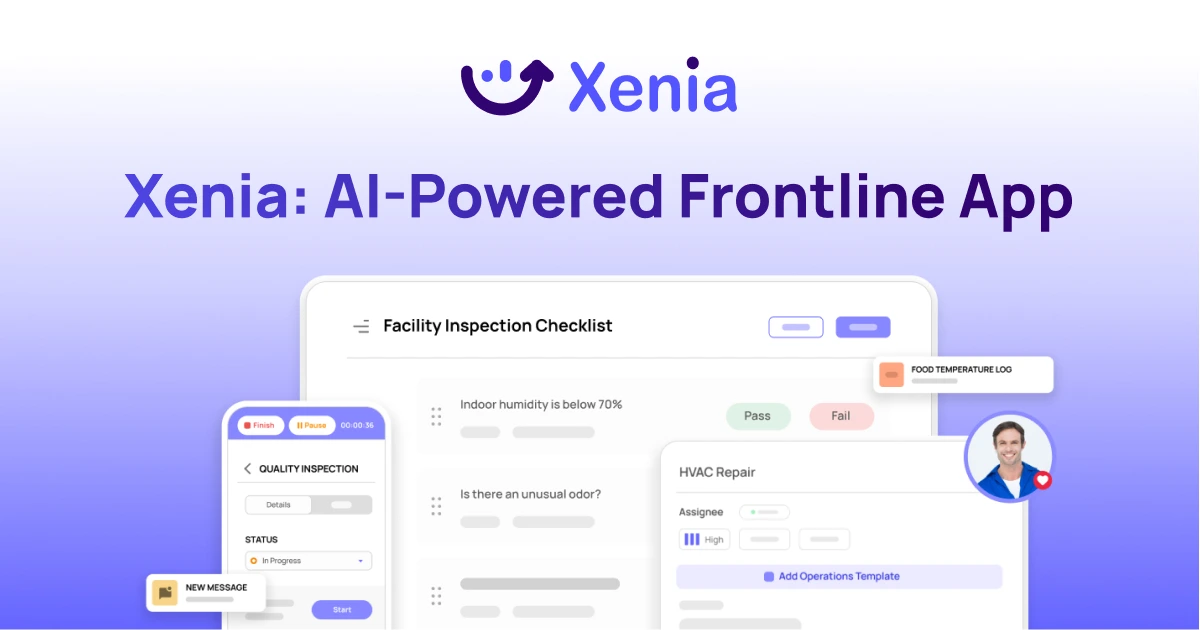
A Modern, AI-Powered Platform Built for Facility Operations
Xenia connects maintenance, safety, inspections, and daily operations into one mobile-first platform. Facility teams respond faster, prevent downtime, and maintain compliance, while leadership tracks performance across all buildings in real time.
Why Facility Managers Choose Xenia:
🤖 AI-Powered Inspections, Verify safety equipment and compliance automatically with AI photo analysis. Surface critical maintenance issues instantly with AI-powered summaries.
🛠️ Work Orders & Maintenance, Report issues via mobile or QR codes. Route requests to teams or vendors. Schedule preventive maintenance for HVAC, elevators, and emergency systems to reduce downtime.
📊 Safety & Visibility, Deploy fire safety and hazard inspection workflows. Monitor work order resolution times and asset health across all facilities.
Manage work orders, maintenance, and safety inspections across all facilities from one platform.

.svg)
.webp)
%201%20(1).webp)

.svg)
%201%20(2).webp)


