

Summary
What is a QR code work request?
A QR code work request is a scan-to-submit maintenance ticket that any employee, contractor, or guest can file without a login. The QR code is printed on a durable label and posted on the asset itself, the back of a fryer, the inside of a walk-in cooler door, the fuel dispenser column, the restroom mirror, or the housekeeping closet. One scan opens a mobile web form with the location and asset already pre-filled. The reporter types the description, attaches a photo, and submits. The system creates a routed, prioritized work order in the same queue your daily ops failures and audit-triggered tasks land in.
The category exists because most maintenance backlogs are not a technician-throughput problem. They are a reporting friction problem. Three failure modes show up across every multi-unit operator we work with:
- Unreported defects compound into capital expense. A Department of Energy benchmark cited by Re-Leased puts reactive maintenance at 3-5x the cost of preventive. Every $1 of deferred maintenance escalates to roughly $4 in eventual capital renewal.
- Frontline workers and guests will not call a hotline. Alertify's hotel noise complaint analysis found roughly 75% of guest-noted disturbances go unreported to staff. Line cooks, c-store clerks, and retail associates show the same pattern. If reporting requires a phone call or a login, the issue stays invisible until it escalates.
- Restroom and back-of-house issues drive reputational risk. QRCodeChimp's restroom feedback research cites a 2021 study showing 74% of Americans form a negative perception of a business from a dirty restroom. Anonymous QR reporting collapses the report-to-resolution window for the issues guests judge a brand on most harshly.
A QR code work request, sometimes called a no-login maintenance submission or scan-to-report work order, removes every step between "I see a problem" and "the right tech is on the way." The Xenia version posts a unique QR per asset or per location, so the form arrives pre-populated and the request lands in the same operating queue as audit-triggered work and daily ops exceptions.
Workflow diagram, submission to resolution
The end-to-end workflow has seven steps. The operator-quality of the platform is measured by how few of those steps require a human touch.
- Print the QR label. Xenia generates a unique QR code per asset or per location. The team prints the codes on polyester with a clear laminate for indoor assets, vinyl with 3M heavy-duty adhesive for kitchens and fitting rooms, and laser-etched metal plates for HVAC roof units, walk-in coolers, and forecourt dispensers per the Maverick Label durability guide. Use error-correction level H so a partly scratched sticker still scans.
- Post it where the failure occurs. Back of the fryer, inside the walk-in door, on the fuel dispenser column, on the housekeeping closet wall, in the guest restroom. Proximity to the failure point is the single biggest driver of report rate.
- A staff member, vendor, or guest scans the code. The phone's native camera reads the QR and opens a mobile web form. No download, no account, no login. This is the deal-breaker test. Any system that requires an app install for the requester loses 80% of would-be reporters at the install prompt.
- The form auto-populates. Location, asset, category, and a default priority pre-fill from the QR's encoded identifier. The reporter only types what is wrong and attaches a photo. The form stays under 60 seconds because that is the threshold where abandonment spikes.
- Submission creates a work order, not a ticket-in-limbo. This is the line that separates a real anonymous request system from a glorified contact form. The submission auto-generates a routed work order with the asset, location, photo, and category attached. The reporter sees an on-screen confirmation with a request number.
- Routing rules assign the right person. Region, asset type, severity, and time-of-day drive the assignment. A pump issue at a Refuel store routes to the area maintenance tech and copies the DM. A broken AC at a hotel routes to property maintenance with the room number pre-populated. A walk-in cooler alarm at a Rosetta Bakery location routes to the approved third-party HVAC vendor who has scoped access to that store only.
- The tech accepts, sets an ETA, and closes the loop with timestamp and photo. Resolution evidence lives in the same record as the original report. The audit trail is complete the moment the work order closes.
Xenia's QR code work request workflow lets store staff and third-party vendors submit work requests via QR code without logging in. The form auto-populates the asset, location, and category. The manager approves and routes the work by region, priority, and skill, automatically. The pattern is the same across verticals: a kitchen manager scans a broken fryer, a pump attendant scans a faulty dispenser, a housekeeper scans a broken AC unit. The form changes the asset reference, not the workflow.
For a deeper look at how routed requests close out, see the dispatch-to-resolution work order workflow and the maintenance ticket system closure tracking guide.
How does Xenia's approach differ from a full CMMS?
Xenia and a dedicated CMMS like Limble or Service Channel solve overlapping problems with different center-of-gravity. Xenia is built for the frontline of a multi-unit operator: the closing attendant, the kitchen manager, the housekeeper, the area DM. A full CMMS is built for the facilities engineer running parts inventory and asset depreciation across a portfolio. The tools complement more often than they replace.
The honest tradeoff:
| Capability | Xenia | Full CMMS (Limble / Service Channel) |
|---|---|---|
| QR code work request, no login | Native, public template URL plus per-location QR codes | Available, varies by platform on routing depth |
| Frontline UX for the requester | Mobile web form under 60 seconds, photo plus description only | Mobile form, deeper field configuration, more friction |
| Anonymous vendor access | Scoped per-store QR for third-party vendors with no account | Vendor portal usually requires a license or seat |
| Multi-site routing rules | Native by region, asset, severity, time-of-day | Strong on asset hierarchy, lighter on store-format variation |
| Parts inventory depth | Basic asset record, photo log | Full parts catalog, reorder thresholds, vendor invoicing |
| Depreciation and asset lifecycle | Not the focus | Native, designed for this |
| Audits, daily ops, comms in the same app | Yes, requests land in the same queue as audit failures and checklist exceptions | No, requires a separate audit and comms platform |
| Pricing model | Flat per-location, no per-form or per-seat penalty | Often per-asset or per-technician seat |
Operator credibility requires the honest framing. If a facilities engineer needs deep parts inventory and depreciation tracking, the CMMS still leads. Pursuit Collection runs Limble alongside Xenia for that reason. Refuel keeps Service Channel for third-party vendor dispatch on national contracts and added Xenia for the daily-ops plus anonymous-request layer Service Channel does not cover natively. The decision is rarely "which one." It is "where does each one earn its keep." For the head-to-head on the audit-side decision, see the Xenia vs. Limble multi-unit operator comparison.
The differentiator most operators land on is queue integration. A QR code work request in Xenia lands in the same operating view as an audit failure, a missed closing checklist, or a flagged temp log. The DM is not switching tools to triage the inbound, which is the friction that breaks the workflow at 30, 200, or 1,000 locations.
.svg)

Priced on per user or per location basis
Available on iOS, Android and Web


How to set up QR work requests in Xenia
Setting up QR work requests in Xenia is a six-step rollout. Most teams run the first 30 locations in a single afternoon and complete the full rollout inside two weeks.
- Build the request template. Open the work request template in Xenia. Set the required fields to description plus photo. Make priority, urgency, and category default-populate from the asset. The shorter the form, the higher the scan-to-submit conversion.
- Generate per-asset or per-location QR codes. Inside Xenia, generate a unique QR for every asset that fails enough to justify a sticker, fryers, walk-ins, ice machines, hood vents, fuel dispensers, restrooms, housekeeping closets. Avoid a single QR for the whole building. The auto-populated location and asset is the entire point.
- Print on the material matched to the environment. Polyester plus laminate for office and back-of-house. Vinyl with 3M heavy-duty adhesive for kitchens and fitting rooms. Laser-etched metal for HVAC roof units and walk-in coolers per the Silver Fox equipment label guide.
- Configure routing rules. Set region, asset type, severity, and time-of-day routing. Decide which categories require admin approval before they become a work order and which auto-route. High-severity safety issues should bypass the approval gate.
- Set the anti-spam guardrails. Rate-limit submissions per IP and per session. Build a duplicate-detection window so the same broken pump scanned by three different attendants does not create three tickets. Print branded URL previews on the labels to defend against QR-swap attacks, sometimes called quishing per the WWPass enterprise QR guide.
- Train the first 30 days. Redirect phone-and-text "hey can you tell facilities about..." conversations to the QR. Post the QR codes in common areas. Brief shift leads and DMs on the new flow. OxMaint's adoption research shows portal-only operators hit 85% digital adoption inside the first quarter when this is enforced.
Once the rollout is live, fold a quarterly QR-label spot-check into the restaurant opening checklist or the c-store shift handover walk. Stickers fade, get covered with grease, and occasionally get vandalized. The audit checklist is where you catch it.
Where do operators see results?
Multi-unit operators see results in three places. The reporting funnel widens, the report-to-resolution clock shrinks, and the audit trail closes out without manual reconciliation.
Refuel runs 200-plus c-store locations across the southeast. The team kept Service Channel for national third-party vendor dispatch and added Xenia for the daily-ops plus anonymous-request layer Service Channel does not cover. The wedge was offline mode for rural fuel stops and a frontline-grade work request flow that closing attendants and pump technicians actually use. A pump goes down at 11pm. The closing attendant scans the QR on the pump column, types "card reader dead, error code 41," attaches a photo of the screen, and submits. The request routes to the area maintenance tech and copies the DM. The tech accepts on the app, sets an ETA, and closes the work order with a timestamped resolution photo. The forecourt downtime that used to wait for the morning shift handoff is logged and dispatched the same night. For the broader c-store deployment pattern, see the convenience store operations software hub.
Rosetta Bakery uses Xenia for third-party vendor access via QR code. The bakery posts QRs in production areas and back-of-house. An approved third-party HVAC tech can scan the code on a walk-in cooler, file a request scoped to that store only, and update the work order without a Xenia account. The bakery never gives the vendor portal-wide access, never pays for a vendor seat, and never loses the audit trail. The vendor record sits in the same operating queue as the bakery's daily ops checklists and food safety audits.
Pursuit Collection runs Xenia alongside Limble. The hospitality operator uses Limble for asset depth and Xenia for daily ops, audits, and frontline work request submission. The QR-on-the-AC-unit workflow lives in Xenia. The depreciation schedule lives in Limble. This pairing is the cleanest way to read the all-in-one-versus-CMMS question. For the housekeeping side of the same operation, see the hotel housekeeping room turnover guide and the guest request management workflow.
The KPIs that separate this feature from a marketing checkbox are measurable inside the first 90 days. Scan-to-submit conversion should clear 40%, anything lower means the form is too long or broken on the dominant device. Time from submission to work-order assignment should be under five minutes, anything over an hour means the admin-approval queue is the bottleneck. Anonymous-channel share of total work requests should land between 25% and 50%, lower means staff are not scanning, higher means authenticated channels are leaking accountability data. Facilio's maintenance KPI guide and UpKeep's maintenance statistics both support these as standard CMMS benchmarks. For the prioritization rules that drive routing once the request lands, see work order prioritization with severity levels and SLAs and preventive maintenance cadence per asset. The full set of patterns for the work-order layer lives in the work order management hub.
For multi-banner retail operators running the same play on fitting rooms and HVAC return grills, the retail operations software hub covers the visual audit and store-walk pairing. For the closure side of the audit trail on the food safety lane, see the food safety corrective action workflow. On the comms side, the policy rollout tracking guide covers the acknowledgment and signature capture that pairs with the anti-spam rollout brief. NACS publishes vendor stewardship guidance for fuel retailers on foodservice equipment maintenance that aligns with the QR-on-the-asset playbook.
Frequently Asked Questions
Got a question? Find our FAQs here. If your question hasn't been answered here, contact us.
Can a third-party vendor submit a work request without an account?

What information does the QR code pre-populate?
Who routes the request after submission?
Does Xenia compete with Limble for full CMMS depth?
Can I track resolution time per request?

A Modern, AI-Powered Platform Built for Facility Operations
Xenia connects maintenance, safety, inspections, and daily operations into one mobile-first platform. Facility teams respond faster, prevent downtime, and maintain compliance, while leadership tracks performance across all buildings in real time.
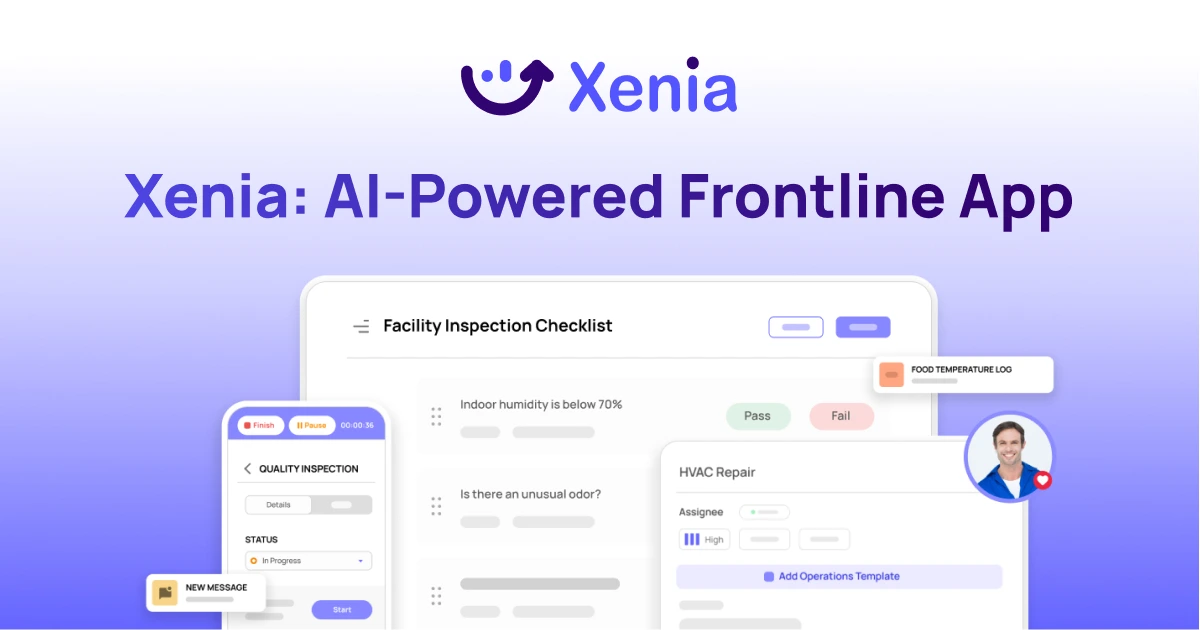
Why Facility Managers Choose Xenia:
🤖 AI-Powered Inspections, Verify safety equipment and compliance automatically with AI photo analysis. Surface critical maintenance issues instantly with AI-powered summaries.
🛠️ Work Orders & Maintenance, Report issues via mobile or QR codes. Route requests to teams or vendors. Schedule preventive maintenance for HVAC, elevators, and emergency systems to reduce downtime.
📊 Safety & Visibility, Deploy fire safety and hazard inspection workflows. Monitor work order resolution times and asset health across all facilities.
Manage work orders, maintenance, and safety inspections across all facilities from one platform.

.svg)
.webp)
%201%20(1).webp)

.svg)
%201%20(2).webp)


