

Summary
What is reactive maintenance?
Reactive maintenance repairs or replaces an asset only after it fails, rather than on a planned cadence. The industry also calls this break-fix or run-to-failure maintenance. The strategy is simple to define and brutal to manage at scale. When a walk-in cooler dies on a Friday night, the cost is not just the repair. It is the spoiled product, the lost trips, and the overtime call to a tech who is already off the clock.
The operational problem reactive maintenance solves, and creates, is timing. Every other strategy tries to act before failure. Reactive accepts the failure and races to recover. That race is where multi-unit operators lose money. The U.S. Department of Energy figure cited by eWorkOrders puts emergency reactive repair at roughly 3 to 5 times the cost of the same planned job once all costs are counted. Limble cites a wider 3x to 10x range, driven by expedited parts shipping and overtime labor.
A few terms get tangled here, so define them up front:
- Reactive maintenance is the unplanned response to an unexpected failure.
- Run-to-failure maintenance is planned reactive work. It is a deliberate decision to let a cheap, non-critical asset run until it dies.
- Corrective maintenance is the repair itself. It can be triggered reactively after a breakdown or proactively from an inspection finding.
- Preventive maintenance is scheduled servicing that aims to prevent the failure in the first place.
Why does the speed of the fix matter so much? Because MaintainX reports that an hour of unplanned downtime averages around $25,000, and far more for larger operations. Every minute a cooler is down at a c-store is spoiled inventory plus lost trips. The faster the ticket gets captured and routed, the smaller that window. This is the part most teams never measure, and the part Xenia is built to compress.
Workflow diagram, submission to resolution
A reactive maintenance work order moves through seven steps, from the moment of discovery to a closed ticket with photo proof. The faster each step runs, the less an unplanned failure costs. Here is the flow at the level a closing attendant or area tech actually reads it:
- Discovery. A frontline worker finds the failure mid-shift or at close. A walk-in is over temp. A fuel dispenser will not start. A guest-room AC is dead.
- Submission. The worker scans the QR code on the asset (the asset tag). The work-request form opens pre-populated with the asset ID, location, and category. No login, no app install. They type the symptom ("won't start, no error code") and attach a photo.
- Triage. The request lands tagged with a severity level: low, medium, high, or critical. The severity level is the priority rating that tells dispatch what is a $40 ice-bin and what is a food-safety-critical cooler failure.
- Auto-route. The platform auto-routes the request by region, priority, and skill to the right area tech or vendor, and notifies the DM or facilities manager. Auto-route means the system sends the right ticket to the right person on its own, based on rules, instead of someone deciding who to call.
- Assignment. A manager approves and assigns inside the authenticated app. Submission is no-login. Approval, assignment, and routing happen in Xenia.
- Resolution. The tech closes the work order with a photo of the repair and notes. Photo-on-closure becomes the service-history record for that asset.
- Escalation. If the ticket is not actioned by its deadline, it climbs the escalation chain automatically. The escalation chain is the ordered path a stalled ticket follows: area tech, then facilities manager, then regional.
This is where Xenia earns its place in a reactive program. Store staff or third-party vendors submit work requests via QR code without logging in, the form auto-populates the asset, location, and category, and a manager approves and routes by region, priority, and skill automatically. MaintainX confirms the routing principle: the right request should reach the right person and trigger a notification so the responsible tech can act fast. The defensible Xenia angle is the capture itself. The QR is on the asset, the scan fills in the details, and the request routes in one motion. A three-minute write-up becomes a 20-second scan-type-photo-send. For the routing rules behind step 4, see how work order prioritization assigns severity levels, SLAs, and smart routing.
When reactive work orders make sense (and when they cost you)
Reactive maintenance makes sense when an asset is non-critical, cheap to replace, fails unpredictably, or is redundant. In those cases, running it to failure costs less than servicing it on a schedule. It costs you when it becomes the default for critical, expensive, or safety-relevant equipment, where a single failure cascades into spoiled inventory, overtime, and lost revenue.
eWorkOrders lists four scenarios where reactive is the right call:
- Non-critical equipment. Failure does not interrupt service or compromise safety.
- Low replacement cost. Replacing is cheaper than preventive servicing.
- Unpredictable failures. There is no pattern to plan around.
- Redundant systems. One component can fail without stopping operations.
In a multi-unit setting, that looks like a backup ice machine while the primary still runs, a spare break-room microwave, a decorative light fixture, or one display cooler at a store that has two. These are deliberate run-to-failure decisions, not neglect.
Reactive starts costing you when it becomes the whole program. Limble notes that a facility running more than 50% unplanned work is in "a permanent state of emergency." The clearest signal is repetition. When reactive tickets on the same asset keep stacking up (cooler #3 fails every month), the issue is not a reactive-versus-planned debate. It is a missing PM. That is the moment to bridge from break-fix to a real preventive maintenance cadence that sets how often you service each asset. Even when reactive is the right strategic call, the capture still has to be fast and the evidence still has to exist. Reactive strategy is not the same as reactive chaos.
.svg)

Priced on per user or per location basis
Available on iOS, Android and Web


How does Xenia's approach differ from a full CMMS?
Xenia is the frontline submission-and-routing layer for break-fix work orders, not a full CMMS. It captures the request at the asset via no-login QR scan, routes it to the right tech with photo evidence, and tracks it to closure. It does not replace Limble or Service Channel for parts inventory, asset depreciation, or deep vendor invoicing. Many operators run both.
Here is the honest comparison on the submission layer, where the day-to-day frontline experience lives:
| Capability | Typical CMMS request portal | Xenia QR work request |
|---|---|---|
| Login required to submit | No (request portals are public) | No |
| Reachable by QR code | Yes (QR opens the portal) | Yes (QR is on the specific asset) |
| Auto-fills asset, location, category on scan | Often manual selection from a list | Auto-filled from the scanned asset tag |
| Photo capture at submission | Varies by tool | Built in |
| Auto-route by region, priority, skill | Yes (config-dependent) | Yes |
| Parts inventory, depreciation, vendor invoicing | Yes (core CMMS depth) | No, not a CMMS replacement |
| Lives with audits, daily ops, and comms in one app | No | Yes |
Be precise about what is and is not different. CMMS request portals are not login-walled. MaintainX confirms that anyone can submit a work request via a portal without a MaintainX account. So Xenia is not "the only no-login option." The real differences are narrower and truer. First, the QR is at the asset level and auto-populates the ticket on scan. Second, the work request lives in the same app as audits, daily ops checklists, and team comms, so the frontline worker is not bouncing between a CMMS portal and the ops app they already use all shift.
The fair framing is this. Limble is the right tool if you are a facilities engineer running PMs and parts inventory across a portfolio. Xenia is the right tool if you are a multi-unit ops director who needs work orders, audits, daily ops, and comms in one app. Some operators run both. Refuel migrated to Xenia for offline mode and work orders while keeping its third-party Service Channel integration for asset depth. For the full head-to-head, see the honest Xenia versus Limble comparison for multi-unit operators. One limitation worth naming: Xenia does not auto-file OSHA reports or generate regulatory submissions. The audit trail exists, but submission stays operator-driven.
Where do operators see results?
Operators see results in three places: faster capture, faster routing, and a real service-history trail per asset. A 20-second QR scan replaces a phone call and a tomorrow-morning write-up. The right tech gets the right ticket with a photo, with no triage call. And repeat reactive tickets on one asset turn into a PM decision instead of a recurring fire drill.
The proof shows up at scale. Power Market went live across 360 locations with bilingual checklists and QR deployment, and reports 40% faster task resolution. That is the strongest QR-at-scale and speed-of-execution outcome on the board. Mezeh, a restaurant operator, cut manager phone calls by 60%, which maps straight to the "no more 11pm phone call" reactive-capture story. Tempstop went paperless in 14 days, a marker of how fast the capture switch can land. Refuel runs 200-plus c-stores including rural fuel stops with intermittent connectivity. Its offline mode is the switching driver: the closing attendant completes the work order on the tablet and it syncs when WiFi returns. Offline mode is most useful for rural sites. Stores with reliable WiFi rarely need it.
The benchmark math is the why behind the speed. High-performing teams target an 80/20 ratio of planned to unplanned work, with utilities pushing to 90/10, while reactive-dominant organizations average 64% unplanned. Moving off reactive-dominant operation avoids the 3-to-5x emergency-cost penalty, and every hour a critical asset is down averages around $25,000. Capture speed and routing speed directly compress that window. This pattern runs across every vertical Xenia serves, from the convenience store operations platform to restaurants and hotels. And the closed-loop discipline is the same one behind corrective action tracking that drives an audit failure to closed resolution: capture the issue, route it, prove the fix.
How to set up reactive work order capture in Xenia
Set up reactive work order capture in six steps: tag each asset with a QR code, build a no-login request form, define severity tiers, set auto-routing rules, turn on escalation deadlines, and require a photo on closure. The goal is to make the slowest part of a break-fix response, the capture, the fastest.
- Tag the assets. Print and place QR-code asset tags on the equipment most likely to break: walk-ins, coolers, fryers, fuel dispensers, HVAC, ice machines, guest-room units.
- Build the no-login request form. The scan opens a form pre-filled with the asset, location, and category. The worker adds the symptom and a required photo. No app install, no login.
- Define severity tiers. Low, medium, high, and critical, so a dead food-safety-critical cooler outranks a cosmetic fixture. UpKeep's four-tier priority framework scores severity on safety impact, asset criticality, and downtime cost.
- Set auto-routing rules. Route by region, priority, and skill to the right area tech or vendor, and notify the DM or facilities manager automatically.
- Set escalation deadlines. If a critical ticket is not actioned by its deadline, it escalates up the chain from tech to facilities manager to regional.
- Require a photo on closure. The tech closes with a photo and notes, and that becomes the asset's service history. Then watch the dashboard for repeat reactive tickets on one asset, which is your signal to schedule a PM.
The capture pattern looks the same across every vertical. A c-store pump goes down at 11pm, the attendant scans the QR on the dispenser, and the form is pre-filled with the pump ID and store address before routing to the area tech and copying the DM. No phone call. A kitchen manager scans the QR on a dead fryer mid-service and the request routes to maintenance with the photo attached, without leaving the line. A retail associate scans a broken fixture and it routes by location and priority. A housekeeper scans a broken AC and the request reaches property maintenance with the room number already filled in. For the no-login mechanics behind every one of those scans, see how QR code work requests cut friction with no-login submission.
Frequently Asked Questions
Got a question? Find our FAQs here. If your question hasn't been answered here, contact us.
What's the difference between reactive and corrective maintenance?

How much more does an emergency repair cost than the same job planned?
What's a healthy ratio of reactive to planned work orders for a multi-site operator?
Who gets the reactive ticket when equipment goes down after close?
Can frontline staff log a break-fix request without a Xenia login?

A Modern, AI-Powered Platform Built for Facility Operations
Xenia connects maintenance, safety, inspections, and daily operations into one mobile-first platform. Facility teams respond faster, prevent downtime, and maintain compliance, while leadership tracks performance across all buildings in real time.
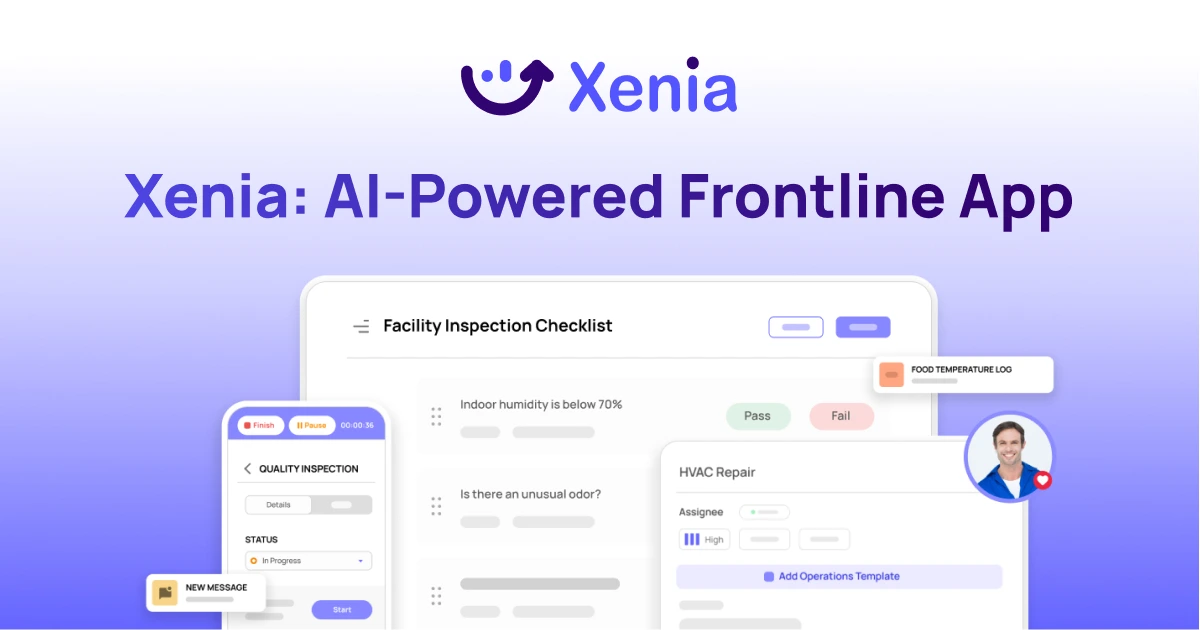
Why Facility Managers Choose Xenia:
🤖 AI-Powered Inspections, Verify safety equipment and compliance automatically with AI photo analysis. Surface critical maintenance issues instantly with AI-powered summaries.
🛠️ Work Orders & Maintenance, Report issues via mobile or QR codes. Route requests to teams or vendors. Schedule preventive maintenance for HVAC, elevators, and emergency systems to reduce downtime.
📊 Safety & Visibility, Deploy fire safety and hazard inspection workflows. Monitor work order resolution times and asset health across all facilities.
Manage work orders, maintenance, and safety inspections across all facilities from one platform.

.svg)
.webp)
%201%20(1).webp)

.svg)
%201%20(2).webp)
.webp)


