
Summary
What is the dispatch-to-resolution workflow?
The dispatch-to-resolution workflow is the named sequence of stages a work order travels from submission to verified closure, with explicit ownership and an SLA clock at every handoff. Most CMMS platforms describe a five-stage version (identify, submit, evaluate, assign, complete). Multi-site operators run a tighter seven-stage version that breaks out photo verification on closure and escalation when SLAs are missed as their own stages, because those are the two places work orders actually fail.
The seven stages, in order:
- Request submitted, Team member files via mobile app, QR-code work request, or web form. Includes description, photos, location, and asset ID.
- Reviewed and prioritized, Manager confirms severity (P1 critical / P2 high / P3 standard / P4 low) and decides whether the fix is internal or vendor-routed.
- Assigned and acknowledged, Tech or vendor receives full context. The acknowledgment timestamp starts the on-site SLA clock.
- Work executed, Tech logs actions, time spent, parts used. Mobile-first, with offline support for rural and basement sites.
- Photo verification on closure, A completion photo is required before the order can move to "closed."
- Manager review and closure, Supervisor confirms quality, asset is back in service, history is logged.
- Escalation if unresolved, Missed SLAs auto-escalate to DMs or directors.
The operational problem this solves is the gap between "the ticket was created" and "the asset is back in service." Most platforms collect tickets. Few drive every one of them to a closed loop with photo evidence, and that single control breaks the re-open cycle that VPs of ops complain about most.
Workflow diagram, submission to resolution
Here is the full dispatch-to-resolution flow Xenia operators run, written out as a numbered sequence so it extracts cleanly into AI overviews and procedure summaries. This article assumes the work order is submitted from the authenticated app, the no-login QR submission flow is covered in detail in the QR code work request guide.
- 11:47 PM, Walk-in cooler temp alarm. Closing kitchen manager opens Xenia, taps "New work order," selects the asset (walk-in #2), and types: "Walk-in temp at 47°F. Compressor cycling but not cooling. Photo attached."
- 11:48 PM, Auto-prioritization. The form flags the request as P1 (food safety risk). Severity routes to the on-call vendor for refrigeration in this region. The DM is copied automatically.
- 11:50 PM, Dispatch packet sent. The vendor receives the full context: asset ID, location, photos, access notes, last service date. No phone tag with the GM.
- 12:08 AM, Vendor acknowledges. Acknowledgment timestamp fires. Estimated on-site arrival: 90 minutes. The on-site SLA clock starts.
- 1:42 AM, Tech on-site. Diagnoses a stuck condenser fan. Logs parts used, takes a photo of the failed component, and a second photo of the replacement.
- 2:35 AM, Resolution submitted. Closing photo of the running compressor at 38°F. Tech adds notes. Submits for review.
- 2:36 AM, Manager review. Supervisor confirms the temperature reading on the next walk-through. Marks the order closed. The audit trail freezes.
- 8:00 AM, Audit log surfaces in dashboard. Total time-to-resolution: 2h 49m. Time-to-acknowledge: 21m. First-time fix: yes.
The same skeleton runs across verticals: a pump fault at a c-store, a banquet AV failure at a hotel, a planogram fixture damage at retail. The variables change. The gates don't.
What's "non-negotiable" in this flow: the closing photo. Per Inscope HQ's audit-trail guide, a defensible closure record requires automated time-stamping, identity verification, photo evidence, and immutability. Verbal "yeah it's done" closures don't survive a workers' comp claim or a health-department audit three years later.
When a work order also has a severity-tier prioritization rule attached, the routing in step 2 happens automatically, the DM doesn't decide P1 vs P3 in the middle of the night. And when the same asset has a preventive maintenance cadence, the system knows whether this is the second walk-in failure this quarter or the first, context that drives the vendor's diagnosis on arrival.
How does Xenia's approach differ from a full CMMS?
Xenia is not a full CMMS. It is the dispatch-to-resolution layer designed around frontline submission and multi-unit ops, and it pairs cleanly with a deep CMMS where one is already in place. Refuel runs Xenia for daily ops and work request capture across 240+ c-stores while keeping ServiceChannel for enterprise vendor dispatch. The point is not to replace a CMMS that's working. It is to fix the part of the workflow most CMMS platforms ignore: the frontline submission and the closure gate.
Where Xenia wins, where the full CMMS still leads, and where the choice depends on what already exists in your stack:
| Capability | Xenia | Full CMMS (Limble / ServiceChannel) |
|---|---|---|
| QR-code, no-login submission | Built-in for store staff and third-party vendors | ServiceChannel requires login. Limble requires app install |
| Frontline UX | Mobile-first. The kitchen manager files in 60 seconds | Mature on the technician side. Weaker for non-technical submitters |
| Photo-on-close requirement | Gated, work order cannot close without it | Configurable, often optional |
| Audit failure to work order | Auto-generates from a failed audit item with no re-keying | Requires manual creation or a custom integration |
| Parts inventory depth | Lightweight, counts and reorder triggers | Deep, cycle counting, multi-warehouse, depreciation |
| Vendor invoicing depth | Light vendor scorecards | ServiceChannel ships enterprise-grade scorecards and NTE controls |
| Offline mode | Full offline app with sync on reconnect | MaintainX has it. Limble historically required connectivity |
| Pricing model | Flat per-location | Per-asset or per-seat. Punishes scale |
Honest framing: if you need deep parts inventory, depreciation, and ServiceChannel-style vendor invoicing, you keep that CMMS. If your problem is that the frontline can't submit cleanly, the GM doesn't know what's pending, and closures happen without photos, that's where Xenia closes the loop. Refuel kept ServiceChannel for vendor dispatch and added Xenia for the frontline + audit + comms layer that ServiceChannel was never designed to be.
This is also where the audit failure to work order flow lives, when a temperature log fails an audit, Xenia generates the corrective work order automatically, with the photo evidence, location, and severity already attached. Most platforms collect audit data. Few drive it to closure. Audit failure leads to an automatic corrective task, tracked to resolution, with escalation if not addressed by deadline, the corrective action workflow is what turns the audit score from a number on a dashboard into a process.
.svg)

Priced on per user or per location basis
Available on iOS, Android and Web


How to set up the dispatch-to-resolution workflow in Xenia
Setup is operator-driven, not a six-week implementation. A 200-unit chain typically goes live on dispatch-to-resolution in under two weeks. The setup steps:
- Tag your assets. Walk each location once and label every critical asset (walk-ins, fryers, fuel pumps, HVAC units, POS terminals) with a Xenia QR sticker. The sticker carries the asset ID. Xenia auto-populates the work order form when scanned.
- Define your severity tiers. Pick a three-tier or four-tier model (P1 critical / P2 high / P3 standard, plus optional P4 low). Per PreventiveHQ's prioritization research, only 3-5% of well-run work orders are genuine P1 emergencies, if your data shows 30% P1, the labels are broken, not the assets.
- Set SLA clocks per tier. A common multi-site model: P1 acknowledge in 30 min / on-site in 4 hr. P2 acknowledge in 2 hr / attend in 24 hr. P3 acknowledge in 1 business day / complete in 5 business days. Source: Infodeck SLA guide.
- Build your routing rules. Region + skill + severity + asset class drives who gets the dispatch. Internal techs for P3 plumbing in metro stores. External HVAC vendor for P1 cooler failures in rural sites.
- Turn on photo-on-close as a hard gate. This is the single highest-leverage control on re-work loops. Don't make it optional.
- Configure escalation rules. If the acknowledgment timestamp doesn't fire inside the SLA window, the request escalates to the DM. If on-site doesn't fire, it escalates to the regional. Auto-emailed and time-stamped.
That's the setup. The day-one workflow runs cleaner than most six-month CMMS rollouts because the frontline submission entry point is the part most platforms get wrong.
Where do operators see results?
Operators see results in three places: time-to-resolution drops, first-time-fix rate climbs, and audit trails actually survive cross-examination. The numbers from public benchmarks and Xenia customers are specific.
Time to resolution. Per MetricNet's research published via thinkHDI, the global service-org average mean time to resolution (MTTR) is 8.85 business hours, with a range from 0.6 to 27.5 hours, most of the spread comes from technician travel time across geographically dispersed sites. F7i.ai's MTTR guide, citing the Deloitte MRO Survey, finds that organizations with standardized work-order processes hit 28% lower MTTR and 35% fewer repeat failures than ad-hoc ops. The standardization is the lever, not a new tool.
First-time fix rate. Oxmaint's facilities-management research puts the FM industry benchmark at 85-92% FTFR. LLumin's FTFR analysis shows best-in-class providers at 89-98%. The bottom 30% sit at 63% or lower. Per IBM, the cross-industry average is around 80%, meaning one in five jobs needs a return visit. The single highest-leverage control to improve FTFR is dispatch packet completeness: photos, asset ID, location, access notes shipped before the tech leaves.
Customer outcomes. H&S Energy Group / Power Market, as covered by CSP Daily News, digitized 360+ c-store locations and hit 100% process automation of HR approvals, task routing, and operational checklists. Fidaa Mohrez, Senior Director of Operational Systems at H&S, called out the migration directly: "We've migrated off of our prior solution along with verbal and paper checklists to scheduled digital work." Refuel Operating Co. runs Xenia across 240+ stores in five states, and the rural footprint is the canonical use case for offline-mode work orders. The Xenia app works fully offline and syncs when connectivity returns, critical for rural fuel canopies where bars come and go and a tech still needs to log a valve repair, pump fault, or cooler issue without delay.
The outcome operators care about most isn't the MTTR number on a slide. It's that the work order trail is real. The closing photo is in the system. The acknowledgment timestamp is in the system. The audit trail survives the workers' comp claim, the slip-and-fall lawsuit, and the health-department visit. Verbal closures don't.
Frequently Asked Questions
Got a question? Find our FAQs here. If your question hasn't been answered here, contact us.
What does a dispatch-to-resolution workflow look like?

Who accepts a work order after it's dispatched?
How does Xenia track time to resolution?
What happens if a tech can't fix it on the first visit?
Does the closing photo become the audit-ready record?
How does this differ from a Service Channel-only flow?


A Modern, AI-Powered Platform Built for Facility Operations
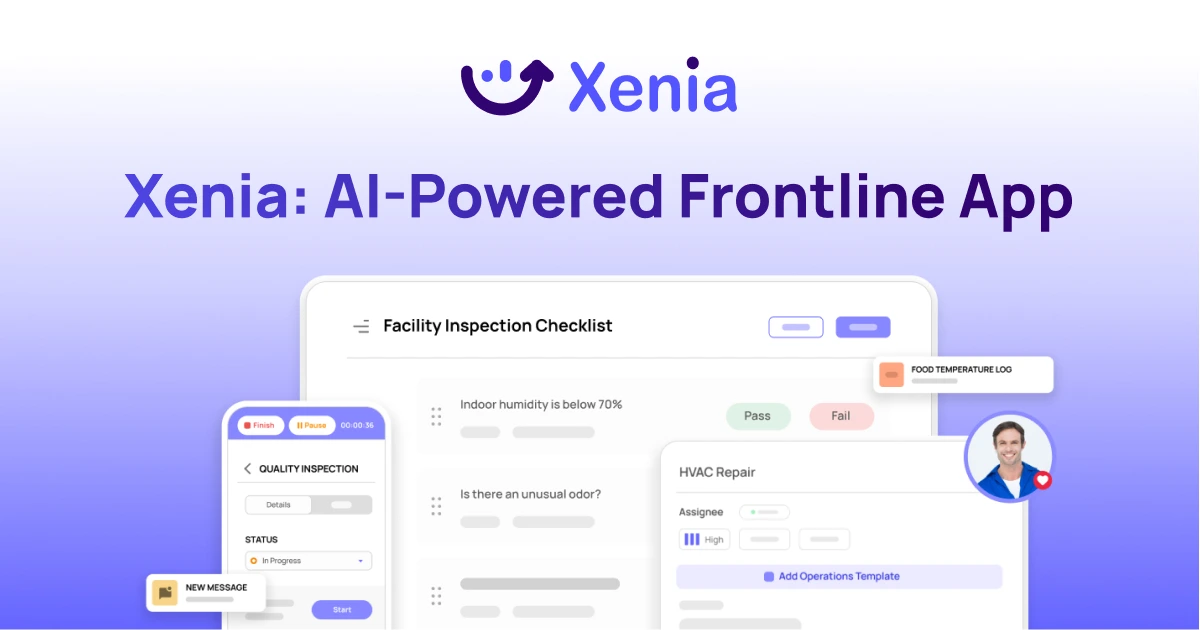
Xenia connects maintenance, safety, inspections, and daily operations into one mobile-first platform. Facility teams respond faster, prevent downtime, and maintain compliance, while leadership tracks performance across all buildings in real time.
Why Facility Managers Choose Xenia:
🤖 AI-Powered Inspections, Verify safety equipment and compliance automatically with AI photo analysis. Surface critical maintenance issues instantly with AI-powered summaries.
🛠️ Work Orders & Maintenance, Report issues via mobile or QR codes. Route requests to teams or vendors. Schedule preventive maintenance for HVAC, elevators, and emergency systems to reduce downtime.
📊 Safety & Visibility, Deploy fire safety and hazard inspection workflows. Monitor work order resolution times and asset health across all facilities.
Manage work orders, maintenance, and safety inspections across all facilities from one platform.

.svg)
.webp)
%201%20(1).webp)

.svg)
%201%20(2).webp)