

Summary
Why are multi-unit operators looking for Zenput alternatives in 2026?
Operators are shortlisting Zenput alternatives in 2026 for three reasons. The product changed names and now sits inside a seven-product enterprise suite. Its entry tiers gate how much of your playbook you can actually deploy. And its documented module set stops at checklists, audits, temperature, and labeling, which is why most Zenput shops also run a separate maintenance tool and a separate comms tool.
What happened to Zenput, and is it still available?
Zenput is still available. It is now called Crunchtime Ops Execution. Crunchtime announced the rename on February 9, 2026 and was direct about the scope: "Crunchtime Ops Execution is the new name for Zenput," delivering "the same product, functionality, teams, and support." Crunchtime's own guidance to customers was that no action is required. The zenput.com domain still resolves, still serves the login, and now carries a rebrand banner.
The bigger story is the roll-up around it. Here is the dated sequence, all of it from primary sources:
- 2021. Crunchtime acquires DiscoverLink.
- June 23, 2022. Crunchtime acquires Zenput. The combined company reports 500+ brands and 100,000+ locations.
- 2022. Crunchtime also acquires Squadle, including BrandMate.
- March 4, 2025. Ladle launches with Nexa Equity backing, uniting ComplianceMate, MeazureUp, and Storewise across 18,000+ locations.
- 2025. Crunchtime merges with QSR Automations.
- November 18, 2025. Xenia announces a $12M Series A led by PSG and stays independent.
- February 9, 2026. Zenput becomes Crunchtime Ops Execution.
- August 11, 2026. SafetyCulture rebrands to Mitti, reporting 80,000 organizations and 2M+ frontline workers.
Crunchtime today reports 850+ restaurant brands across 150,000+ locations. The product is actively shipping, so predicting a sunset would be wrong. The honest operator concern is narrower. A checklist tool a mid-market group bought in 2019 is now one module inside a suite whose center of gravity is inventory, labor, kitchen, and host. If that concern is what brought you here, the direct head-to-head is Xenia versus Zenput for multi-unit ops, and the post-rebrand version of the same question is Xenia versus Crunchtime.
One correction worth making, because it shows up on other comparison pages including an older version of this one: the review data does not show a support problem. Capterra rates Zenput 4.7 out of 5 across 52 reviews and lists fast, responsive customer support as a top pro, with support sub-scores of 4.6 to 4.7. The sourced complaints are different: complex hierarchy and form management, a steep learning curve for new managers, limited reporting customization and formatting, time-consuming setup, and occasional form-submission bugs.
Tier gating on recurring projects, alerts, and add-ons
The pricing friction is real, but it is not a "form count" cap. Crunchtime publishes no rate card for Ops Execution. The pricing page routes to a demo request and a phone number. Capterra lists a starting price of $40 per month. The most detailed public teardown, published by competitor Operandio and worth reading with that in mind, reports four plans (Essentials, Premium, Advanced, Brand-Wide), a cap of up to 15 recurring projects on Essentials, limited alerts and corrective actions at the entry tier, and paid add-ons for temperature monitoring, food labeling, single sign-on, and org-hierarchy integration.
That math bites in proportion to how serious your playbook is. Think about what a real checklist library looks like across 50 or 100 locations:
- Opening and closing checklists by daypart
- Location-specific food safety logs
- District manager audit forms
- Brand standards inspections
- Seasonal or promotional compliance checks
- Facilities and maintenance request forms
Nobody runs six recurring programs and stops. The moment the library gets deep, the tier conversation starts, and add-ons that felt optional at signup become line items.
Where the documented module set stops
Crunchtime documents the Ops Execution module set as task management, audits, food safety, temperature monitoring with Bluetooth probes, food prep labeling, AI photo validation, in-app reporting, and integration with Crunchtime Insights. Learning and Development is a separate Crunchtime product, not part of Ops Execution. Announcements do exist inside Ops Execution, with documented 2025 and 2026 improvements, but no two-way frontline messaging module is documented on the product page. No work-order or maintenance module is documented either.
Read that as scope, not as failure. Ops Execution is a checklist, audit, and food safety product, and it is good at that. The consequence for a buyer is the stack around it. A separate CMMS handles the broken fryer or the dead pump. A separate comms tool handles the announcement. A separate document library holds the SOPs. That is three or four logins for workflows an ops director wants on one record, and it is the single most common reason a Zenput shop starts evaluating convenience store operations software and restaurant platforms that cover more ground.
Zenput vs top alternatives: feature comparison
Here is how the five platforms that show up most often in multi-unit evaluations compare across the capabilities that decide the deal. Every cell reflects what the vendor documents publicly as of August 2026.
| Capability | Crunchtime Ops Execution (Zenput) | Xenia | Operandio | Jolt | SafetyCulture (now Mitti) |
|---|---|---|---|---|---|
| 2026 name and ownership | Renamed Feb 9, 2026. Crunchtime acquired Zenput June 23, 2022 | Xenia. Independent. $12M Series A led by PSG, Nov 18, 2025 | Operandio. Independent | Jolt | Platform renamed Mitti Aug 11, 2026. iAuditor previously renamed SafetyCulture |
| Daily checklists and task management | Yes | Yes | Yes | Yes, called Lists | Yes |
| Audits and inspections | Yes | Yes | Yes | Checklist-based. Audits not named as a separate module | Yes, the core product |
| Location-level conditional targeting | Yes. Attributes and Calendar Events target by store characteristic and by per-location timing | Yes | Not documented in sources reviewed | Not documented | Not verified in this research |
| Question-level conditional visibility with N/A nullify scoring | Not documented | Yes | Not documented | Not documented | Not verified in this research |
| Native work orders and maintenance | Not in the documented Ops Execution module set | Yes, including QR-code work requests with no login | Yes. Asset tracking, preventive maintenance, smart work orders | Not in the documented module set | Maintenance named in Mitti platform positioning |
| Frontline communications | Announcements yes. No two-way messaging module documented | Yes. Communications suite, announcements with acknowledgment and signature | Yes. Staff updates with required confirmation | Yes. Communication Manager | Issue reporting and training. Comms not a named module in sources reviewed |
| Training and document hub | Learning and Development is a separate Crunchtime product | Yes. Content and training documentation hub on Pro | Yes. Mobile-first LMS plus permissioned knowledge base | Yes. Information Library | Yes. Training included in all plans |
| Temperature monitoring and sensors | Yes. Bluetooth probes. Third-party teardown reports a separate subscription | Yes. Bluetooth thermometer integration | Yes. Wireless sensors | Yes. Sensors and digital probes | Not verified in this research |
| AI capabilities | AI photo validation flags substandard photos. In-product AI chat assistant. Insights integration | AI Co-Pilots on Pro. AI summaries, Analytical Agent, AI Template Agent | Not named on the platform page | Not named on the homepage | AI included in every plan, with monthly AI credits per seat |
| Photo evidence on a failed item | Image fields offer camera or gallery | Required photo capture at the point of failure, timestamped and bound to the submission | Photo capture within checklists | Photo verification on time clock | Photos in inspections |
| Pricing model | No public rate card. Demo request only. Teardown reports tiers that cap recurring projects plus paid add-ons | Flat per location across Basic, Pro, Enterprise. No per-form, per-template, or per-seat fee | By number of locations or users, plus the modules you choose | No published pricing | Per seat |
| Published starting price | Capterra lists $40 per month | Not published. Quoted by location count | Not published | Not published | $24 per seat per month on annual billing |
| Free plan or self-serve trial | No published free plan or self-serve trial | 14-day free trial, no credit card | 14-day trial after booking a demo | Not published | Free plan up to 10 seats with 5 active inspection templates |
| Part of a roll-up | Yes. Crunchtime also owns Squadle, DiscoverLink, and QSR Automations | No | No | Not verified in this research | Parent rebranded to Mitti |
Sources for the cells above: Crunchtime Ops Execution, Crunchtime portfolio, Zenput Calendar Events and Attributes, Crunchtime support release notes, Zenput camera and gallery permissions, Operandio platform, Operandio pricing, Jolt, Mitti pricing, and Xenia pricing.
Three things fall out of that grid. First, only two platforms here cover audits, maintenance, and communications in one place: Xenia and Operandio. Everyone else expects a second tool for at least one of the three. Second, the pricing units are not comparable, so procurement math has to be redone per vendor. Flat per location, per seat, module-based, and quote-only are four different contracts, and a per-seat model changes shape the moment every DM needs a login. Third, only one platform on this list is not part of a roll-up or a rebrand.
One caveat that makes the table usable rather than dismissible: "not documented in sources reviewed" is not the same as "the vendor cannot do it." It means the capability is not stated on the public product pages checked in August 2026. Ask each vendor directly in the demo, and ask them to show it in their own environment rather than a slide. If you want the longer version of that evaluation process, the multi-location audit software buyers guide walks the requirements list, and pencil-whipping covers why photo evidence rules matter more than photo features. The definition behind row five is worth knowing before any demo: conditional visibility means showing different questions at different locations inside one template.
How does Xenia compare to Zenput for multi-unit operations teams?
Xenia is the closest like-for-like replacement for a Zenput deployment. It covers the audits and daily checklists Crunchtime Ops Execution covers, then adds native work orders, frontline communications with acknowledgment, and a documentation hub, on flat per-location pricing. Teams that make the switch usually describe it as going from "audits only" to "everything on one record."
No per-form or per-template fees
Xenia's pricing changes with location count, not with how deep your playbook gets. There is no per-form, per-template, or per-seat fee. The only line item that moves is the number of locations you run.
That matters most for the operators who have spent years rationing programs. If you have been merging two closing checklists into one because of a tier cap, you are managing the tool instead of the operation. Build the daypart version, the patio version, the co-branded version, and the seasonal LTO version. Xenia ships a template library of 100+ ready-to-use checklists on the entry tier, so the first build is assembly rather than authoring. Current tiers and what sits in each are published on the Xenia pricing page.
One platform for the full operations stack
Xenia covers what Crunchtime Ops Execution covers. It also covers the two modules that are not documented in the Ops Execution set.
- Daily task management and scheduling
- Digital checklists and audits with weighted scoring and conditional logic
- Native work orders and maintenance
- Communications suite with announcements and acknowledgment
- Content and training documentation hub for SOPs
- Corrective action tracking from submission through closure
That is the Zenput plus CMMS plus comms stack collapsed into one login, one dashboard, and one reporting layer. The consolidation question every ops director is actually asking has two halves: what can we combine, and what can we retire. Basic covers daily task management, checklists and audits, basic reporting, the mobile app, and the template library. Pro adds AI Co-Pilots, custom dashboards, the documentation hub, the communications suite, location hierarchy with custom user roles, and third-party integrations.
Question-level conditional visibility and automatic corrective actions
Give Crunchtime credit here, because the older version of this page did not. Ops Execution shipped Attributes and Calendar Events on October 31, 2024. Attributes assign projects and announcements by location characteristic, and Crunchtime's own examples are drive-thrus, patios, and mall locations. Calendar Events assign by per-location timing such as open, close, and pre-rush. That is real location-level targeting.
The line Xenia draws is one level deeper, at the question. Same audit template for 100 franchises, but units with drive-thrus see drive-thru questions, units with patios see patio questions, and units with espresso bars see espresso bar questions. Pair that with nullify scoring and the score stays honest: a location without a patio does not get dinged on patio cleanliness, and a unit without a fryer does not fail on fryer temp logs. Add weighted audit scoring and a 10-point temp failure stops reading like a 1-point smudged menu board.
Then the part that closes the loop. When an item fails in Xenia, a corrective action task is created automatically, assigned to the right person, with a due date, a photo requirement, and an escalation rule if the deadline passes. Most platforms collect audit data. Few drive it to closure.
Reporting and AI on the same operations record
Reporting is a documented friction point for Zenput teams. Capterra's cons list names limited reporting customization and formatting options. Be fair about the rest: Crunchtime has in-app reporting, a separate Insights product, and AI photo validation that flags substandard photos.
Xenia's difference is where the AI sits, not whether it exists. AI summaries roll up audit results, corrective actions, and trends into a one-paragraph briefing per location, region, or time window, and the Analytical Agent answers plain-language questions like "which 10 stores have the worst food safety scores this quarter" with the underlying data view attached. Both read the same record as the audit, the corrective task, and the work order. Summaries describe what happened and what is still open. They do not predict next week. And per the pattern we see most often at 50 locations, the group does not want another completion percentage. It wants to see what is coming up as an issue.
Photo evidence at the point of failure
Zenput's image fields offer a choice of camera or gallery. That is documented in Crunchtime's own support article on camera and photo gallery permissions, and it means a team member can attach a photo taken last week to a check filled out today.
Xenia handles this at the question level. A failed item can require a photo at the moment of failure, timestamped and bound to that submission, and the corrective task can require photo proof of the fix before it closes. For the visual side of brand standards, photo rollouts push a reference image to every store, stores submit theirs back, and the compliance gallery surfaces variance in one view. Xenia does not auto-interpret what is in the photo. A DM reviews the gallery. The platform organizes it and keeps the evidence attached to the record.
Work orders the frontline can file without a login
This is the widest gap between the two platforms, and it is the one buyers underweight until the first broken fryer. Store staff and third-party vendors submit QR-code work requests in Xenia with no login and no app install. The form auto-populates the asset, location, and category. A kitchen manager scans the QR on a dead fryer, adds a photo, and the request routes to the maintenance team by region, priority, and skill.
Be honest about the ceiling. Xenia does not match Limble or ServiceChannel on parts inventory, depreciation tracking, or vendor invoicing depth. It handles work orders and preventive maintenance at frontline-ops depth. For most multi-unit restaurant and C-store groups, that is the right trade, because the alternative is a second contract and a second login for the same broken fryer. Comms follow the same pattern: announcements with acknowledgment and signature turn a fuel price policy or an allergen protocol into compliance evidence, with a timestamped record of who saw it and when.
Per-location pricing instead of tier gating
Xenia publishes three per-location tiers, Basic, Pro, and Enterprise, with Enterprise quoted as custom volume pricing, plus a 14-day free trial that does not ask for a credit card. Quotes are built from location count. There is no per-form, per-template, or per-seat penalty in the model.
Compare that to the other three pricing units on this page. Crunchtime Ops Execution and Jolt are quote-only. Mitti and GoAudits are per seat, which is fine at 10 inspectors and a different conversation at 60 DMs. Operandio is module-based, so the number depends on how much of the platform you switch on. None of these is wrong. They are just four different procurement conversations, and the one you can model on a napkin is usually the one finance approves faster. Power Market digitized multi-store operations with Xenia across 280+ locations, which is the scale this model was built for.


Priced on per user or per location basis
Available on iOS, Android and Web


Other Zenput alternatives worth evaluating
Nine platforms come up regularly in Zenput evaluations, and one of them is staying put. Here is what each is genuinely good at, where its scope ends, and who should pick it.
Crunchtime Ops Execution, if staying is the right answer
Staying is a legitimate option, and saying so is what makes the rest of this page worth trusting. Crunchtime Ops Execution rates 4.7 out of 5 on Capterra across 52 reviews. Its named roster includes Chipotle, Domino's, Taco Bell, KFC, Five Guys, McDonald's, Dunkin', Sweetgreen, CAVA, Wingstop, and Texas Roadhouse. Bluetooth temperature probes, food prep labeling, and AI photo validation are built in, and Attributes plus Calendar Events give you real location-level targeting.
The strongest argument for staying has nothing to do with the checklist module. If you already run Crunchtime Inventory or Labor, the suite integration is an advantage no standalone tool can match. Pick this if you are already a Crunchtime shop and your gaps are back-office, not maintenance and comms.
Xenia
Covered in depth in the section above, so the short version here. Xenia is the multi-unit operations execution platform for teams that want audits, daily checklists, work orders, frontline comms, training documents, and reporting on one record, priced flat per location. It is strongest for 50 to 500 location groups in restaurant, C-store, retail, and hospitality, and its differentiators are question-level conditional visibility, nullify scoring, no-login QR work requests, and Bluetooth thermometer integration for automated temp logs.
Pick it if you are currently paying for a checklist tool plus a maintenance tool plus a comms tool. The full product context sits on the multi-unit operations software page.
Operandio
Operandio is the closest positional competitor to Xenia on this list, and the platform most under-credited on comparison pages including the earlier version of this one. Its documented modules include task management and checklists, audits and inspections, a mobile-first LMS with courses, quizzes and certificates, communications with required confirmation, a permissioned knowledge base, wireless temperature sensors, EHS incident reporting, food safety with labeling, role-based dashboards, and a maintenance module with asset tracking, preventive maintenance, and smart work orders.
The scope note is about breadth, not quality. Operandio's named verticals run from restaurants and hotels into childcare, fitness, healthcare, and cleaning services, so it is broad rather than multi-unit-restaurant deep. Pricing is based on locations or users plus the modules you enable, which means the quote depends on how much you switch on. The head-to-head detail is in Xenia versus Operandio.
Jolt
Jolt is the restaurant-specialist pick. Its documented modules are Lists for task management, Sensors for remote temperature monitoring with alerts, high-speed date-code and expiration labeling, digital temperature probes, an Information Library for training content, employee scheduling, a time clock with photo verification, and Communication Manager. Verticals span food and beverage, grocery, car washes, hotels, healthcare, retail and convenience, and entertainment. Pricing is not published.
Give Jolt its real edge: it is the only platform here that bundles scheduling and time clock with the checklist layer, and for a 30-unit group that already fights two labor tools, that is a legitimate reason to buy. Where multi-format chains hit limits is audit weighting and conditional-logic depth. See Xenia versus Jolt and the wider Jolt alternatives roundup.
SafetyCulture, now Mitti
The freshest change on this list. SafetyCulture rebranded to Mitti on August 11, 2026, and its flagship inspection product iAuditor had already been renamed SafetyCulture before that. Scale is the story: 80,000 organizations, 2M+ frontline workers, 185 countries. Founder and CEO Luke Anear framed the rebrand plainly, saying customers had told them for years they were using the platform for much more than safety.
It is also the only platform here with a genuinely public, self-serve price and a real free tier. Mitti pricing lists Free at $0 per seat for up to 10 seats with 5 active inspection templates, Premium at $24 per seat per month on annual billing or $29 monthly, and custom Enterprise, with AI credits in every plan. The scope difference is that Mitti is horizontal across manufacturing, construction, mining, and QSR rather than purpose-built for the franchise, DM, and store-walk layer, and per-seat math changes once every DM needs a login. Compare in Xenia versus SafetyCulture or the broader SafetyCulture alternatives list.
Squadle, which is also Crunchtime
Disclosure first, because it changes the recommendation. Crunchtime acquired Squadle in 2022, the same year it acquired Zenput, and squadle.com now redirects to crunchtime.com/squadle. Documented scope is a Remote Temperature System with 24/7 monitoring and real-time alerts, ZeroTouch automated temperature logging, digital checklists covering food safety and shift management, and customized reporting dashboards. Crunchtime's page reports 3.3B+ completed tasks and records, 100M+ temperatures measured, and 4.8 out of 5 on Capterra.
Squadle is a strong remote-temperature product, and plenty of QSR groups run it happily. But if you are leaving Zenput because of who owns it, Squadle does not change that answer. Same parent, same portfolio, same roadmap owner.
MeazureUp, now part of Ladle
Same logic, different roll-up. Ladle launched on March 4, 2025 with Nexa Equity backing, uniting ComplianceMate, MeazureUp, and Storewise, with TrackAssure also in the portfolio, serving 18,000+ locations. meazureup.com now redirects to ladle.com. MeazureUp's AuditApp covers digital site audits and checklists for brand consistency and compliance, with a 14-day AuditApp trial and no published pricing.
MeazureUp is a credible audit product with real QSR tenure, and its site-audit workflow is well understood by DMs. Just go in knowing this is a second roll-up rather than an escape from roll-ups. Deeper reads: MeazureUp alternatives and ComplianceMate alternatives.
Narrower tools worth a short look
Three more platforms earn a mention without a full block, because each wins on one specific job.
| Platform | Best for | Pricing model |
|---|---|---|
| Squadle | Remote temp monitoring and checklists, Crunchtime-owned | Quote only |
| MeazureUp and Ladle | Site audits and checklists inside the Ladle portfolio | Quote only, 14-day AuditApp trial |
| Delightree | Franchise onboarding and opening new locations | Flat per location with HQ seats included |
| GoAudits | Audit-only with a published rate card | $10 to $30 per user per month on annual billing |
| Trail | UK-weighted hospitality and leisure estates | Tiered by Independent, Multi-Site, Enterprise, Franchise |
- Delightree is franchise-native, with a knowledge base and SOPs, training, tasks, audits and site visits, a location launcher, comms, dashboards, and AI Search, at a flat rate per location that includes every HQ and corporate seat. Pick it if your hardest problem is opening locations and onboarding franchisees. The head-to-head is Xenia versus Delightree.
- GoAudits is the transparent budget option and the only platform here with a full published rate card: Starter at $10 per user per month annual covering 25 locations and 10 checklist templates, Enterprise at $30 per user per month annual with unlimited locations and templates, a 14-day full-feature trial, and a 60-day money-back guarantee. Pick it if you need audits only and a number today. See GoAudits alternatives.
- Trail is UK-first and strong in hospitality and leisure, with checklists, HACCP and food safety, incident reporting, fire safety logging, equipment maintenance logs, audit records, IoT fridge integration, and an AI feature called Evo. Named customers include Costa, Wagamama, Leon, Gail's, and Honest Burgers, with 300M+ tasks completed across 40+ countries per trailapp.com. Pick it if your estate is UK-weighted. See Trail app alternatives.
Platforms that show up on Zenput alternatives lists but are not alternatives
Directory pages pad their lists with software that cannot run a store walk. If you are working from a Capterra or Software Advice shortlist, cut these first.
- Looker, SAS Viya, Phocas, FactoryTalk View. BI, analytics, and industrial HMI tools. All four appear on Capterra's Zenput alternatives list. None of them runs a closing checklist.
- Cority, Intellect QMS, QT9 QMS, HighQ, Ideagen Healthcare Guardian. Enterprise EHS, quality management, and legal platforms built for manufacturing, life sciences, and healthcare compliance, not multi-unit store execution.
- Restaurant365, Toast, Square. Back-office accounting and POS. Complementary to an ops platform, never a replacement for one.
- Nory, 7shifts, Connecteam. Labor forecasting, scheduling, and deskless comms. Genuinely adjacent, often bought alongside, but they do not replace an audit and checklist deployment.
- Limble, MaintainX, ServiceChannel. Real CMMS depth, and better than Xenia on parts inventory, depreciation, and vendor invoicing. They also do not run audits or daily ops, so they solve the opposite half of the problem.
You can see the full set of head-to-head breakdowns on the Xenia platform comparison hub.
Conclusion
Zenput built the category. That matters. But the category has moved on, and in 2026 it has also consolidated. Zenput is now Crunchtime Ops Execution, and three of the platforms that appear on most Zenput alternatives lists share a parent with it or sit inside a different roll-up entirely.
Multi-unit operators today need more than a checklist tool. They need audits, maintenance, communications, and reporting in one system, pricing that survives a growth year, and a vendor still building the thing they bought.
The best Zenput alternative depends on which gap is costing you money right now:
- Stay on Crunchtime Ops Execution if you already run Crunchtime Inventory or Labor and your gaps are back-office.
- Pick Mitti if you want a free tier and a self-serve start with no demo gate.
- Pick GoAudits if you need audits only and a published price today.
- Pick Delightree if your hardest problem is opening franchise locations.
- Pick Jolt if scheduling and labeling matter as much as checklists.
- Pick Xenia if you are paying for a checklist tool plus a maintenance tool plus a comms tool, and you want the audit, the corrective task, the work order, and the announcement on one record.
Before you sit through five demos, run everyone through the same list. The questions to ask before buying a restaurant operations platform is the one we would use.
One platform. Every location. No spreadsheets required.
Why do multi-unit operations teams choose Xenia over Zenput?
Operators who move from Zenput to Xenia point to three things, and one of them is about the vendor rather than the product.
The consolidation factor. They are retiring tools, not adding one. Crunchtime Ops Execution handles checklists and audits. A CMMS handles maintenance. A comms tool handles announcements. Xenia handles all three on one record, so the audit, the corrective task, the work order, and the announcement share a history instead of living in three exports. The savings show up as fewer contracts, fewer logins, and operations data in one place. G&M Oil replaced fragmented manual processes with Xenia across 220 stores, which is what that looks like at C-store scale. The longer argument sits in restaurant operations tool consolidation.
The pricing clarity. No form limits, no per-module fees, one flat rate per location, with custom volume pricing at Enterprise. Compare that against the other three units on this page: per seat at Mitti and GoAudits, module-based at Operandio, and quote-only at Crunchtime Ops Execution and Jolt. Nothing here is dishonest. But the model you can model is the one procurement clears fastest. Current tiers are on the pricing page.
The reporting layer. Knowing which locations are struggling, which SOPs get missed most often, and where corrective actions are stalling, without building a spreadsheet first, is what separates a multi-unit operations execution platform from a checklist tool. The sourced complaint about Zenput reporting is limited customization and formatting. The practical version at 50 locations is simpler: the ops director wants the issues view, not the completion view.
On vendor durability, be specific rather than snide. Xenia is independent and announced a $12M Series A led by PSG on November 18, 2025. That is the fact worth weighing against a three to five year contract with a platform inside a portfolio, and it is the whole claim. Every other vendor on this page is actively shipping too.
See how Xenia compares to Zenput, now Crunchtime Ops Execution, for your operation, your location count, and your use cases. Book a 20-minute call with the team. No sales deck. Just your operation, your questions, and a live demo. Book a demo.
Frequently Asked Questions
Got a question? Find our FAQs here. If your question hasn't been answered here, contact us.
Does Xenia replace Zenput completely?

How does Xenia's pricing compare to Zenput?
What is the best Zenput alternative for restaurant operations in 2026?
Why are operators switching from Zenput in 2026?

A Modern, AI-Powered Platform Built for Restaurant Operations
Xenia brings kitchen operations, food safety, audits, and team communication into one mobile-first platform. Restaurant teams execute daily work consistently, maintain compliance, and resolve issues faster, while leadership gets real-time visibility across all locations.
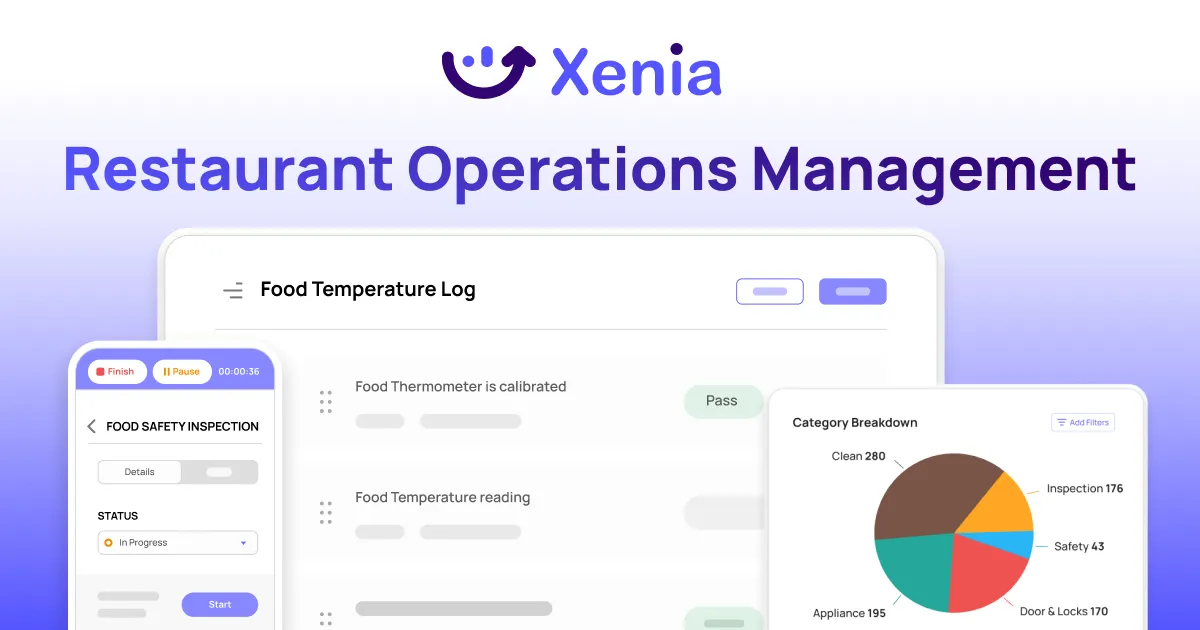
Why Restaurant Operators Choose Xenia:
🤖 AI-Powered Operations, Convert paper logs instantly and verify food presentation and kitchen cleanliness automatically. Get instant answers about food safety trends without building reports.
🍽️ Food Safety & Compliance, Track line checks and temperature logs with automated alerts. Trigger corrective actions when readings exceed safe ranges. Maintain audit-ready records for health inspections.
📊 Multi-Location Control, Monitor food safety compliance and task completion across regions. Benchmark locations to identify training needs. Export reports for operational reviews.
One platform for kitchen operations, food safety, and compliance across all locations.


