

Post Summary
You book the demos. Six of them, maybe more. The decks look different. The logos are different. But by demo three, you realize every vendor is basically saying the same thing: easy to use, built for restaurants, saves your team time.
You leave every call with a polished one-pager and zero clarity.
That is the real problem with buying restaurant operations software today. It is not that the options are bad. It is that demos are designed to impress, not to expose. Vendors show you the best-case environment. Clean data, a single-location setup, a sales rep who knows every shortcut. None of it looks like your Thursday night at location seven.
Twelve months on the wrong platform is an expensive lesson. These 14 questions are designed to help you avoid it. They are not a feature checklist. They are a vendor interrogation framework built around the gaps that operators actually run into after go-live.
Bring these to your next demo. The answers will tell you more than any slide deck.

.svg)

Priced on per user or per location basis
Available on iOS, Android and Web


Related Resources
- How to improve restaurant operations across multiple locations
- How to run restaurant audits and inspections without the paperwork
- How multi-unit restaurants manage tasks across every location
- A complete guide to restaurant management software
- What a corrective action process looks like in a restaurant
Why do all restaurant operations software demos look the same?
There is a gap between what vendors show and what operators need.
In a demo environment, everything works. Tasks are completed on time. Reports load instantly. The dashboards are clean. The vendor walks you through their highlight reel: a polished checklist, a task completion graph, maybe an AI feature they added recently.
What they do not show you: what happens when a location manager goes offline in a basement prep kitchen. What happens when you have three brands under one group and need permission structures that actually separate them. What happens when a corrective action is flagged at 11 pm and there is no closed-loop workflow to track it to resolution.
That is the gap. Feature lists describe what a platform has. These questions expose whether it actually works for your operation.
The vendors worth your time will answer with specifics. The ones to avoid will answer with roadmaps.
Questions 1-4: Does this platform actually cover your full operation?
Most restaurant operations software is built around one use case and expanded from there. That means one capability is deep, and the rest is surface-level. These four questions separate full-stack platforms from single-use tools that grew a feature list.
1. Does the platform handle audits, work orders, communications, and training in one place, or do those live in separate tools?
This is the consolidation test. Ask the vendor to walk you through a scenario: a district manager completes a brand standards audit, flags a kitchen equipment issue, assigns a corrective action, and notifies the location GM. Can all of that happen inside one platform, without switching tools or exporting to email?
If the answer involves more than one system, you have not consolidated. You have added another tool to the stack.
Operators who have been through fragmented restaurant task management setups describe it the same way: you end up spending more time chasing completion than actually running operations. The goal of good restaurant management software is to eliminate that gap entirely.
2. Does the platform support multi-brand and multi-concept operations out of the box?
If you run more than one concept, ask the vendor to show you live how templates, permissions, and reporting are separated by brand.
Some platforms use workarounds. Location tags. Naming conventions. Manual filters. That is not multi-brand support. That is a spreadsheet with extra steps.
You need separation that is built in, not patched together.
3. What happens when a location has no internet connection?
Low-connectivity locations are not edge cases for restaurant operations. They are routine. Back kitchens, basement prep areas, locations in buildings with weak signal. Ask whether the app works offline and whether data syncs automatically when connectivity returns.
If the vendor hesitates or says "most features work offline," that is your answer. Multi-location ops platforms need to work in the real environment, not just the demo environment.
4. When a corrective action is flagged, what does the closed loop actually look like?
This is one of the most important questions on this list. Flagging an issue is the easy part. The hard part is making sure it gets assigned, resolved, verified, and documented without anyone manually following up.
Ask the vendor to walk you through a failed temperature check. What triggers? Who gets notified? How is the work order created and assigned? How does the platform confirm resolution?
Understanding how corrective actions work in restaurant operations makes it easier to spot the difference between a real closed-loop system and one that just sends an email notification and calls it done.
Questions 5-8: Can this platform hold your whole portfolio accountable?
A platform that works for one location is not the same as a platform built for a portfolio. These questions test whether the restaurant operations platform can give you accountability at scale without creating administrative overhead.
5. How do role-based permissions work across brands and locations?
Ask the vendor to show you what a district manager sees versus what a location GM sees versus what a brand VP sees. Then ask how permissions are set up when a new location opens or a manager transfers.
The right answer is granular, fast, and manageable without an IT ticket. If setting up permissions for a new location takes more than a few minutes, that is a signal about what your ops team will live with every week. This is one of the core reasons location hierarchy and permissions matter so much in multi-unit software selection.
6. Can a district manager see everything across their portfolio without logging in as individual location managers?
This sounds obvious. It is not. Some restaurant management software products are built location-by-location, which means above-store visibility requires stitching together individual dashboards manually.
Ask the vendor to open a district-level view live. Can a DM see task completion, audit scores, and flagged issues across all their locations in a single view? Can they drill into one location without changing accounts?
If this requires workarounds, your DMs will stop using it within 30 days.
7. What does the real-time completion dashboard look like across a 30+ location portfolio?
Ask to see it. Not a screenshot. Not a recording. A live demo with real-looking data at scale. How does the platform show which locations are behind on daily checklists? How does it surface locations with recurring issues?
This is where restaurant technology either earns its keep or becomes a reporting tool your team exports to a spreadsheet anyway. Strong frontline reporting should surface what needs attention without anyone having to go looking for it.
8. What does the API and integration story look like for the existing systems in your tech stack?
A restaurant operations platform should consolidate your execution layer. But your POS, HRIS, and scheduling tools sit in different layers and will stay. The question is whether the platform you choose integrates cleanly with those systems or creates another island. Ask specifically how the platform connects to the tools you cannot replace. Ask how those integrations are maintained over time.
Questions 9-12: What does implementation and adoption actually look like?
Most buyers focus on features during evaluation and discover the real gaps during rollout. These four questions are about what happens after you sign.
9. What does your onboarding process look like for a 30+ location rollout?
Ask for a specific timeline. Ask who owns it on their side. There is a big difference between a dedicated implementation contact and a shared support queue. One gets you live in 60 days. The other gets you live in 8 months.
10. How do you support frontline adoption beyond a PDF guide?
Your GMs and kitchen managers are not software evaluators. They are busy. The tool needs to make sense on day one without a training session.
Ask what in-app guidance looks like. Ask about language support. Ask what the adoption curve looks like for hourly staff in the first 90 days. Most vendors will not volunteer that number. Ask anyway.
11. What does your customer success model look like after go-live?
Implementation ends. Then what? Do you get a dedicated contact or a help desk ticket? Ask what the relationship looks like at month 6 and month 18. Vendors confident in their post-sale experience will answer this directly. Vendors who are not will pivot back to the product demo.
12. How does pricing scale as you add locations?
Get the vendor to model it out. What does the invoice look like today, at 20% growth, and at 50% growth? Ask what is included in the base price and what costs extra. The number on the proposal is rarely the number you pay at year two.
Questions 13-14: Does the AI actually work in production?
Most vendors have added AI features to their platform in the last 18 months. Some of those features work. Some exist only in demo environments. These two questions separate the two.
13. Which AI features are live at current customers today, and which are on the roadmap?
Ask the vendor to go through their AI feature list one by one. For each one, ask a simple question: is this live at current customers, in beta, or planned for a future release?
A confident vendor answers this without hesitating. If you hear "we are rolling that out," "it is available for select customers," or "that is coming in Q3," you have your answer. It is not in production.
Before any vendor conversation on AI, it is worth understanding what AI compliance tools actually do in production versus what they only do in a demo. Knowing the difference between automation logic, real machine learning, and AI generation helps you ask sharper questions and spot the gap faster.
14. Can you generate a real AI output from a live customer environment right now, in this demo?
Not a canned example. Not a pre-built demo account. A real output from real operational data. An audit summary from an actual inspection. An anomaly flag from a live location's compliance trend data. A checklist converted from a real PDF.
If the vendor needs to set something up first, or says they will send you an example after the call, the feature is not mature enough to trust. Production-ready AI features can be demonstrated live on real data. If that is not possible in the demo, it will not be possible after you sign.
What do confident buying decisions look like, and what should make you pause?
Green flags are simple. The vendor answers your questions with specifics, not slides. They open a live environment. They give you real customer references, not just logo slides. They tell you what the platform does not do, not just what it does.
Red flags are equally clear. The issue is not a vendor having a roadmap. Every honest platform has one. The issue is a vendor who cannot clearly tell you which features are live today and which are coming later. If a sales rep presents a capability without being able to confirm it is in production at current customers, that is the red flag. Ask directly: is this live or is this roadmap? A confident vendor answers without hesitating.
When a vendor cannot answer questions 3, 4, and 6 in a live environment, leave the demo. You are evaluating real-world performance, not a capabilities deck.
How do you use these questions to run a structured platform evaluation?
Score each vendor against the 14 questions. Use a simple three-point scale: fully answered with a live demonstration, partially answered, or not answered. That score sheet will tell you more than your gut feeling after the demo.
.webp)
Involve your GMs in the process. They will use the restaurant operations platform every day. If it does not make sense to them during evaluation, it will not make sense at 7am on a Tuesday.
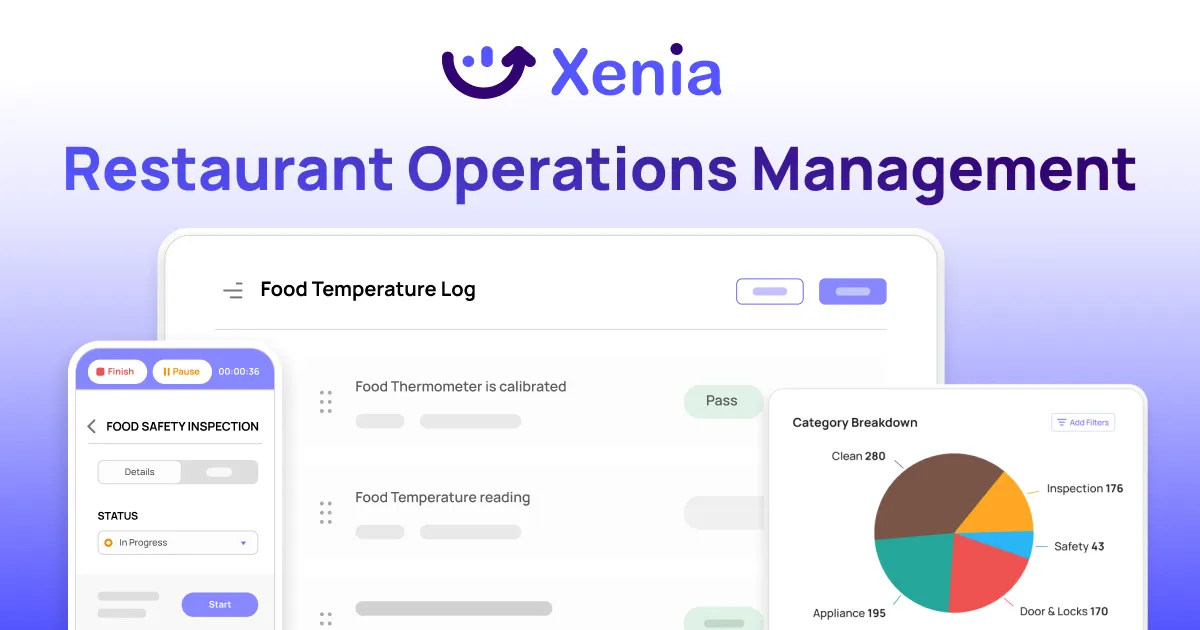
Platforms like Xenia are built around this kind of operator workflow, designed to support closed-loop corrective actions, multi-brand permissions, and portfolio-wide visibility without requiring your team to work around the tool to get things done. When you bring these questions to a demo, the answers either hold up or they do not.
For a deeper look at what a strong restaurant operations management system should include as core capabilities, it is worth reading alongside this evaluation framework.
Conclusion
Buying restaurant management software is not a features decision. It is an accountability decision. The platform you choose will either give your team visibility across every location or it will create one more thing to manage around.
These 14 questions exist to cut through the pitch. Bring them to every demo. Score the answers. Make the decision based on what vendors show you in a live environment, not what they promise for next quarter.
The right restaurant operations platform is out there. These questions will help you find it faster.
Bring these 14 questions to a Xenia demo and see how the answers hold up.
Frequently Asked Questions
Got a question? Find our FAQs here. If your question hasn't been answered here, contact us.
How long does it take to roll out a restaurant operations platform across 50 locations?

Most operators are live in 60 to 90 days with a proper implementation team. The technical setup is rarely the bottleneck. Getting GMs and hourly staff to actually use it is where rollouts slow down.
What should I look for in a restaurant tech stack for a growing multi-unit group?
Tools that talk to each other, work offline, and do not get more expensive every time you hire someone. What you pick at 10 locations follows you to 40.
How many platforms should I demo before making a decision?
Three to five. Any more and you stop evaluating and start going in circles. Score every demo against the same 12 questions and compare answers, not feelings.


A Modern, AI-Powered Platform Built for Restaurant Operations
Xenia brings kitchen operations, food safety, audits, and team communication into one mobile-first platform. Restaurant teams execute daily work consistently, maintain compliance, and resolve issues faster, while leadership gets real-time visibility across all locations.
.webp)
Why Restaurant Operators Choose Xenia:
🤖 AI-Powered Operations, Convert paper logs instantly and verify food presentation and kitchen cleanliness automatically. Get instant answers about food safety trends without building reports.
🍽️ Food Safety & Compliance, Track line checks and temperature logs with automated alerts. Trigger corrective actions when readings exceed safe ranges. Maintain audit-ready records for health inspections.
📊 Multi-Location Control, Monitor food safety compliance and task completion across regions. Benchmark locations to identify training needs. Export reports for operational reviews.
One platform for kitchen operations, food safety, and compliance across all locations.

.svg)
.webp)
%201%20(1).webp)

.svg)
%201%20(2).webp)