
.webp)
Post Summary
Your GM starts her shift by opening four tabs. One for the daily checklist. One for the work order system. One for team communications. One for the compliance dashboard, if she checks it at all.
A prep cooler flags out of range on the line check. She notes it. Closes the tab. Opens the work order tool. Creates a ticket manually. By the time it reaches facilities, two hours have passed, and nobody in the compliance system knows the issue was ever flagged.
That's what running restaurant operations software across four disconnected tools actually looks like at the ground level. Not a technology problem. A daily friction problem that compounds across every shift, every location, every week.
This article is about what that fragmentation costs, where the operational gaps live between disconnected tools, and how to build the internal case for consolidating onto one platform.
.webp)
.svg)

Priced on per user or per location basis
Available on iOS, Android and Web


Recommended resources
- Why operators switch off Google Sheets for restaurant audits
- The best restaurant audit and inspection software for multi-unit operators
- How closed-loop corrective actions work in multi-unit restaurants
- Scaling restaurant operations from 5 to 50 locations
What does it actually cost to run restaurant ops across four separate tools?
Most operators think about tool costs as line items. Checklist tool: $X per month. Work order system: $Y per month. Communications platform: $Z per month. Add them up and that's the stack cost.
That's not the real cost. The real cost is what happens between the tools.
Platform subscription stacking. Four tools mean four contracts, four renewal cycles, four vendor relationships, and four sets of per-user pricing that each scale independently as your headcount grows.
A restaurant workforce management software contract at $8 per user per month across 200 staff members is $1,600 monthly before you've paid for anything else. Multiply that across four platforms and the subscription cost alone becomes a significant line item that grows faster than your location count.
Manager time switching contexts per shift. Every time a GM moves between platforms, there's a cognitive reset. They close one context, open another, find their place, complete the task, and move back.
Research on workplace context switching puts the average recovery time at over 20 minutes per switch. A GM switching between four tools three times per shift is losing over an hour of productive management time daily to platform friction alone.
Data that never syncs across systems. The line check lives in one tool. The work order lives in another. The compliance record lives in a third. When a VP of Ops wants to understand whether a location's recurring equipment issue is showing up in both the line check data and the maintenance log, there's no view that shows both. Someone has to export from one system, pull from another, and reconcile manually. That's not analysis. That's data assembly.
Here's what the two models look like side by side:
**
Fragmented tool stack, What a unified platform should deliver
4 separate subscriptions-4 renewal cycles, One contract covering all operational workflows
Manager switches contexts 3 or more times per shift, All workflows accessible from a single interface
Line check and work order data never connect, Operational data connected across all workflow types
Compliance record incomplete without manual assembly, Compliance record complete without manual data assembly
VP compiles cross-tool report manually, Portfolio-level reporting available without manual compilation
**
What to do about it
Before you can build the internal case for consolidation, you need to quantify the current cost. Add up your active subscriptions. Estimate the manager time lost to context switching per shift across your location count. Calculate how many hours per week your ops director spends assembling cross-tool reports manually. Those three numbers put together make the ROI case for a unified restaurant operations platform more clearly than any feature comparison.
Xenia's single-platform model eliminates all three cost categories at once.
Where do the operational gaps live between disconnected tools?
The subscription cost is visible. The gaps between tools are where the real operational damage happens, and they're much harder to see until something goes wrong.
Audit flags don't auto-create work orders. A manager marks a piece of equipment as non-compliant on the internal audit. In a disconnected stack, that finding stays in the audit tool.
The facilities team doesn't know about it unless someone manually creates a work order in a separate system. That manual step gets skipped under pressure, which means equipment failures identified on audits go unaddressed until they show up on a health inspection or break down entirely.
Line check failures are invisible to the facilities team. The morning line check flags a cooler temp out of range. That flag lives in the line check tool. The facilities manager doesn't have access to the line check tool.
The work order system doesn't receive the flag automatically. The facilities team finds out about the cooler issue when the cooler fails or when a manager remembers to send a message. Neither is a reliable system.
Training completion is absent from the ops dashboard. Your training completion data lives in your learning management system. Your ops compliance dashboard lives somewhere else. A VP of Ops reviewing location compliance scores has no visibility into whether the GM who just failed three audit items has also missed three required training modules.
The connection between training gaps and compliance failures is invisible because the data lives in two systems that don't talk to each other.
What to do about it
Map your current tool stack against these three gaps specifically. For each gap, estimate how many times per week a failure in that connection creates a manual step, a missed follow-up, or a compliance blind spot. The number is almost always higher than expected.
Xenia closes all three gaps by connecting audit flags to work orders, line check data to the compliance record, and training completion to the ops dashboard, without adding any steps to the manager's workflow.
How does tool fragmentation change the way your managers actually work?
The ops gap is measurable. The behavioral change is harder to quantify but more damaging over time.
Reactive vs proactive management patterns. When your managers are spending their shift navigating between four tools, they're not managing proactively. They're responding to what each tool surfaces when they open it.
The line check tool shows today's completion. The work order tool shows open tickets. The compliance tool shows last week's audit score. None of it is connected. None of it tells the GM what needs attention right now. The result is a management style driven by whatever is loudest, not whatever is most important.
GM cognitive load from context switching. Four tools mean four mental models, four sets of notifications, four places to check for updates. A GM at a high-volume location is already managing a full kitchen, a front-of-house team, and a lunch rush.
Every additional platform they have to track adds cognitive load that comes at the direct expense of floor presence and team management. The best restaurant management software eliminates that load, not adds to it.
Compliance blind spots between systems. The most dangerous gaps in your compliance record aren't the ones where something was checked and failed.
They're the ones where something was never checked because the tool that should have caught it didn't connect to the tool where the record lives. A compliance blind spot between a line check tool and a work order system is invisible until a health inspector or a franchisor audit finds it.
One director of ops at a McDonald's franchisee group with twenty locations described the reality plainly: living in one app for one workflow, then another app for the next, then another, with no single view connecting any of it, and no clear picture of what was happening across the portfolio at any given time.
That's not an unusual situation. It's the default state for most multi-unit restaurant groups running a fragmented restaurant tech stack.
What to do about it
The behavioral fix isn't training managers to use four tools more efficiently. It's reducing the tools. A single mobile interface where the GM handles daily checks, flags issues, creates work orders, and communicates with the team means the cognitive load drops to one mental model.
Frontline accountability improves not because expectations changed but because the system stopped making compliance harder than it needed to be. Xenia's single mobile interface consolidates every manager workflow into one place, which means adoption follows naturally because the alternative is worse.
What does the business case for consolidation actually look like?
Getting internal buy-in for platform consolidation requires more than a feature comparison. It requires a financial and operational argument that connects the current tool stack to a measurable cost and a clear picture of what changes when the stack is unified.
Time-to-close on incidents drops significantly. In a fragmented stack, an incident identified on a line check becomes a work order only after a manual handoff. That handoff adds time, and under shift pressure it often gets skipped entirely. In a connected system, the audit flag auto-creates the work order immediately. The time-to-close gap between those two models, multiplied across every incident at every location every week, becomes a meaningful operational efficiency number.
Compliance audit trail completeness goes from partial to full. A complete compliance audit trail requires data from the line check, the internal audit, the corrective action, and the resolution, all connected.
In a fragmented stack, each of those lives in a different tool. The completeness rate of your compliance record is almost always lower than operators expect when they actually measure it. For why this matters operationally, why operators switch off Google Sheets for restaurant audits covers the documentation gap in detail.
Manager adoption improves when there's less friction. A tool that requires a separate login and a separate mental model gets used inconsistently. A single platform where every workflow lives in one interface gets used because the alternative is worse. Higher adoption means better data quality, which means better compliance visibility that justifies the platform investment.
District managers stop flying blind. A DM overseeing twelve locations can see checklist completion rates, open work orders, audit scores, and corrective action status across their full territory in one dashboard. No phone calls. No manual reports.
The operational picture is available before the DM makes a single call. One owner at a ten-location restaurant group described the fragmented model clearly: everything was reactive rather than proactive, with no connected view of what was happening across the portfolio until something had already gone wrong.
End-to-end incident-to-closure visibility replaces cross-tool reconciliation. From the moment a line check flags an issue to the moment the corrective action is closed with photo evidence, every step is visible in one record.
The VP of Ops doesn't need to cross-reference three systems to understand what happened at a location last Tuesday. And when a franchisor audit, a regulatory request, or an insurance inquiry asks for compliance history, it's exportable from one place in one format rather than assembled manually from four disconnected tools.
How does Xenia replace your restaurant operations tool stack?
The cost of fragmentation isn't abstract. It's the manager hour lost to context switching, the work order that never got created because the audit tool didn't connect to the facilities system, the compliance record that couldn't be produced because the data lived in four places.
Xenia is built to close every one of those gaps in a single platform.
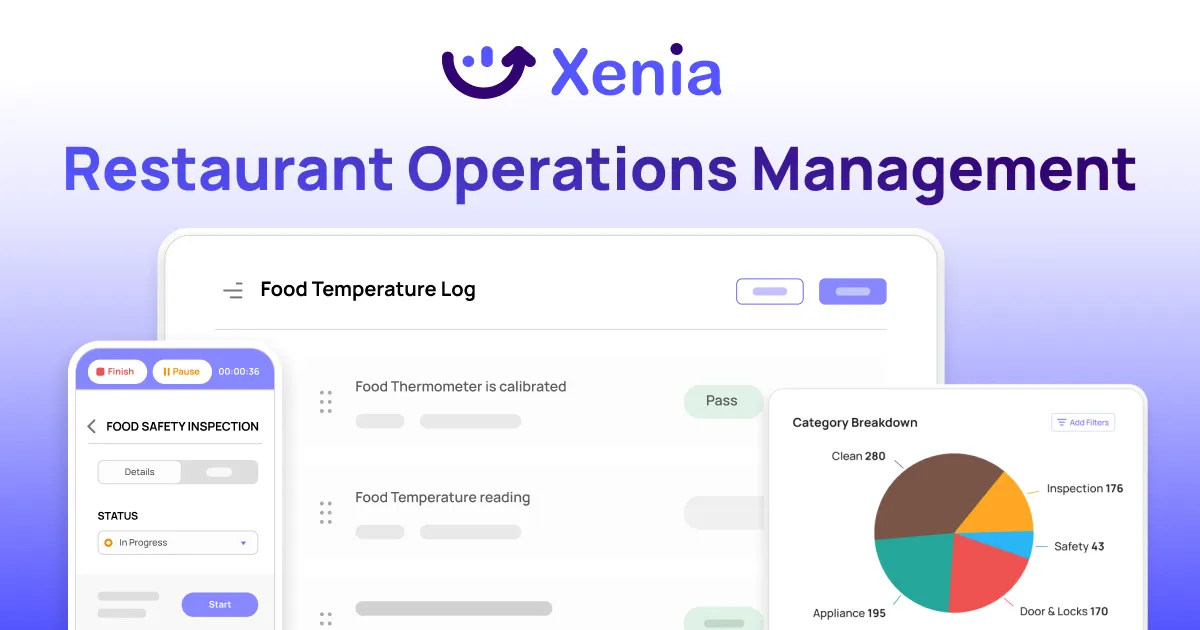
Audit flag auto-creates a work order, no manual step. When a checklist item is marked non-compliant in Xenia’s digital checklists, a corrective task is created automatically, assigned to the right person, and given a deadline. The finding and the fix are connected inside the same system from the moment the issue is flagged.
Four logins become one. Daily ops, compliance, communications, work orders, and reporting all live inside one mobile interface. The GM handles every workflow in one place. The cognitive load of four tools drops to one mental model, and platform adoption follows.
Line check and audit data siloed becomes one connected daily record. Every line check, every audit, every temperature log feeds the same compliance layer. The connection between daily ops data and formal audit records exists without anyone having to build it manually.
Training completion becomes visible in the ops dashboard. Training completion data feeds the same dashboard as audit scores and checklist completion. A VP reviewing a location's compliance performance can see whether training gaps are contributing to audit failures without switching tools.
Manager context switching becomes a single mobile interface for all tasks. In Xenia, every workflow, checklists, line checks, work orders, communications, and compliance reporting, lives inside one app.
A GM who flags a cooler temp out of range on the line check creates the corrective task in the same interface without switching tools. One login. One screen. No context reset between workflows.
Real-time executive summary requiring no manual exports. In Xenia, leadership gets a live view of operational performance across the full portfolio without anyone compiling a spreadsheet. Checklist completion rates, audit scores, open corrective actions, and work order status update in real time. The summary exists before anyone asks for it.
Compliance visibility that scales with your location count. As you add locations, the compliance record grows with them automatically. There's no additional tool to license, no new integration to manage, and no new data silo to reconcile. The platform scales as the operation does.
Every dollar spent on four overlapping subscriptions is a dollar not spent on growth. Every hour a manager spends switching contexts is an hour not spent on the floor. Every compliance blind spot between disconnected tools is a liability that shows up on an inspection or a franchisor audit.
When the stack consolidates onto one platform, those costs stop. Managers work in one system. Compliance records are complete by default. Leadership has visibility without asking for it. And the ops team that was managing four vendor relationships and four renewal cycles is managing one.
You don’t need a better checklist tool, you need a restaurant operations model that runs on one connected system instead of four disconnected ones.
See how Xenia replaces your existing tool stack.
Conclusion
Most restaurant groups didn't build a fragmented stack on purpose. Each tool solved a problem at a specific moment. The result is four subscriptions, four logins, four data stores with no connection between them, and a management team navigating the gaps instead of running the restaurant.
Consolidation doesn't require rebuilding your operations. It requires moving them onto a platform where the workflows you're already running are connected by default.
Xenia closes the loop from line check to work order to compliance report in one place.
See how one platform replaces your entire ops stack.
Frequently Asked Questions
Got a question? Find our FAQs here. If your question hasn't been answered here, contact us.
Why does manager adoption improve with fewer tools?

Adoption is inversely proportional to friction. A single platform where every workflow lives in one interface gets used because switching between four tools is the worse alternative. Higher adoption means better data quality, which means better compliance visibility across the portfolio.
What workflows should a unified restaurant operations platform cover?
Daily checklists, line checks, internal audits, corrective action tracking, work order creation and routing, team communications, and compliance reporting. The platform earns its consolidation value when an issue identified on a daily check auto-creates a work order and feeds the compliance record without any manual steps between systems.
How do you build the internal case for restaurant tech stack consolidation?
Quantify three numbers: current subscription costs across all active tools, manager hours lost to context switching per week, and hours spent assembling cross-tool reports manually. Those three figures make the ROI case more clearly than any feature comparison.
What is the difference between restaurant management software and a restaurant operations platform?
Restaurant management software typically covers one functional area. A restaurant operations platform covers the full workflow from daily line checks through corrective actions to compliance reporting, in one connected system. The gaps between single-function tools are where most operational failures happen.
What does tool fragmentation cost a multi-unit restaurant group?
Three things. Subscription stacking across four or more tools with independent per-user pricing. Manager time lost to context switching, estimated at over an hour per shift per GM. And compliance blind spots between disconnected systems that only surface during inspections or audits.
What is restaurant operations software?
A platform that connects daily checklists, audits, inspections, work orders, in-app communications, and compliance reporting into one system. The key distinction is whether those workflows talk to each other or live in separate tools with no connection between them.


A Modern, AI-Powered Platform Built for Restaurant Operations
Xenia brings kitchen operations, food safety, audits, and team communication into one mobile-first platform. Restaurant teams execute daily work consistently, maintain compliance, and resolve issues faster, while leadership gets real-time visibility across all locations.
.webp)
Why Restaurant Operators Choose Xenia:
🤖 AI-Powered Operations, Convert paper logs instantly and verify food presentation and kitchen cleanliness automatically. Get instant answers about food safety trends without building reports.
🍽️ Food Safety & Compliance, Track line checks and temperature logs with automated alerts. Trigger corrective actions when readings exceed safe ranges. Maintain audit-ready records for health inspections.
📊 Multi-Location Control, Monitor food safety compliance and task completion across regions. Benchmark locations to identify training needs. Export reports for operational reviews.
One platform for kitchen operations, food safety, and compliance across all locations.

.svg)
.webp)
%201%20(1).webp)

.svg)
%201%20(2).webp)