
.webp)
Post Summary
Jolt has been a fixture in restaurant operations for years. For a 3-location operator, it works. Digital checklists get completed. Tasks get logged. That is enough at that scale.
But something changes around 10 to 15 locations.
You need reporting that aggregates across every site. You need audit workflows that connect findings to corrective actions. You need temperature logs your DoH inspector will actually accept. You need an operations dashboard that a district manager can open without logging into each location separately.
That is when operators start searching for Jolt alternatives.
There is another reason operators are looking right now. In August 2025, Digi International acquired Jolt for approximately $145.5 million and folded it into its SmartSense IoT business unit. For operators built around Jolt, that raises fair questions about where the product is headed.
The challenge is not finding options. There are dozens of tools calling themselves restaurant operations software. The challenge is figuring out which Jolt competitor actually closes the operations execution gap, and which ones are just dressed-up checklist apps.
This article is a straight restaurant task management software comparison. You will see what each Jolt software alternative does well, who it is built for, and what multi-unit operators should prioritize that Jolt does not fully deliver.
.webp)
Recommended Resources
- How to manage tasks across multiple restaurant locations
- How to choose the right food safety compliance software for your operation
- The best restaurant audit and inspection software in 2026
- A practical guide to restaurant operations management
Why operators look for Jolt alternatives
Most operators who evaluate Jolt competitors are not leaving because Jolt broke. They outgrew what it was built for.
Here are the most common reasons:
Reporting gaps at scale
Jolt's reporting works at the location level. Shift completions, individual task logs, daily digital checklists. But a district manager covering 12 locations needs aggregated data across all of them in one operations dashboard. That cross-location rollup is where Jolt runs thin.
No real audit workflow loop
Jolt is solid on checklist completion. It does not natively connect a failed item to an assigned corrective action with a due date and a resolution trail. For multi-unit management, that closed-loop audit workflow is not optional. It is the difference between documenting a problem and actually fixing it.
Pricing pressure at scale
A per-location model that makes sense at 3 locations looks different at 20. Operators scaling quickly run that math early, and it accelerates the search for Jolt software alternatives.
The consolidation push
Many operators running Jolt are also managing separate tools for food safety logs, team communications, and facilities requests. The appeal of switching is consolidating into one mobile-first operations platform rather than juggling four.
What to look for in a Jolt alternative
**
Criteria, Why it matters
Multi-location operations dashboard, District managers need a single cross-location view-not individual logins per site
Connected audit workflows, Failed items should auto-generate assigned-tracked corrective actions
Food safety module depth, DoH-compliant logging requires timestamps-threshold alerts and historical records
Mobile-first operations design, Frontline adoption depends on a fast-simple experience that works offline
Scalable pricing, The platform should make financial sense at 3x your current location count
Task management platform depth, Daily task assignment-recurring schedules and real-time completion tracking at scale
**
The best Jolt alternatives for restaurant operators in 2026
This restaurant task management software comparison evaluates platforms on what actually matters to multi-unit operators. Not feature counts. Real operational capability at scale.
**
Platform, Best for, Key strength
Xenia, Multi-unit restaurant and food service, Full audit workflows-cross-location reporting-food safety module
Zip Checklist, Single-location or small restaurant teams, Simple digital checklists and task accountability
FoodDocs, Safety-focused restaurants, HACCP auto-generation-regulatory depth
Taqtics, Visual multi-site management, Live heatmaps-performance dashboards
Bindy, Audit-focused retail and food service operators, Branded audit forms-scheduled visit workflows
**
.svg)
.webp)

1. Xenia: Best for multi-unit restaurant and food service operators
Best for: Multi-unit restaurant groups (10 to 300+ locations), QSR franchise operators, casual dining chains, C-store food service.
Xenia is a mobile-first operations execution platform built for multi-unit operators who have outgrown basic checklist tools. It is purpose-built for restaurant groups running 10 to 300+ locations where district managers need visibility across every site without logging in location by location, failed audit items need to become tracked corrective actions automatically, and food safety documentation has to hold up under a health department inspection.
Operators who move to Xenia from basic checklist tools typically see two things happen quickly. DoH inspection prep that used to take hours gets cut down to a single report pull. District managers stop spending their week chasing GMs for status updates and start spending it on the locations that actually need attention.
.webp)
Where Xenia goes beyond Jolt
Major differentiators
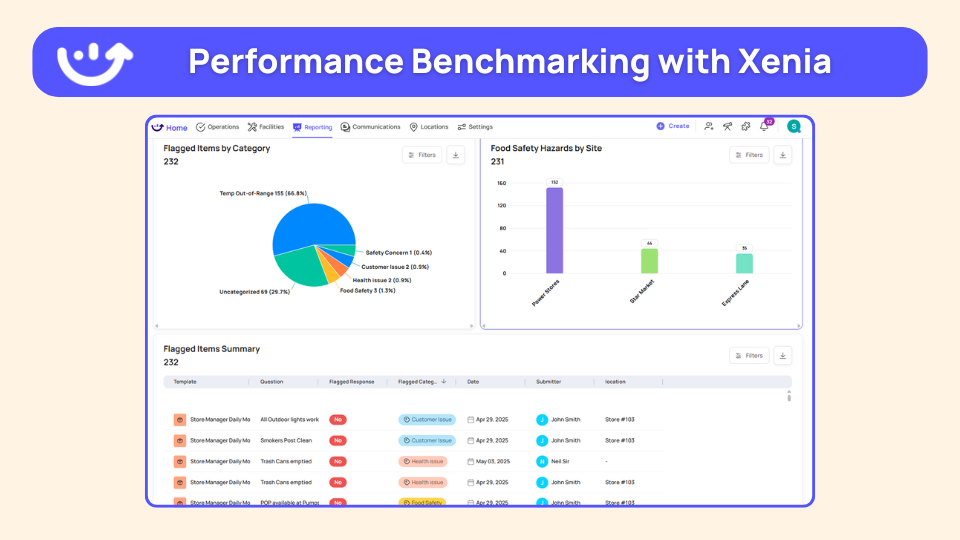
Robust reporting and analytics
Custom dashboards built with drag-and-drop widgets give district and regional managers a single view across all locations: audit scores, task completion rates, and flagged item trends. The AI Analytical Agent lets managers ask questions in plain language and get answers without building a report manually. AI-powered operational summaries are pushed to stakeholders on a schedule, no manual compilation required.
Closed-loop audit workflows
Xenia closes the full chain: weighted scoring assigns point values based on criticality, a failed item auto-generates a corrective action assigned to a specific person with a due date, before and after photo verification confirms resolution, and multi-level approval is required before the loop closes. Nothing falls through.
.webp)
Food safety
Temperature logging syncs directly from Bluetooth thermometers, including ThermoWorks devices, eliminating manual entry errors. Out-of-range readings trigger automated alerts and route to the right person immediately. 24/7 sensor monitoring generates maintenance tickets automatically when thresholds are exceeded. HACCP documentation is timestamped and formatted for health department inspections.
.webp)
Conditional logic and escalation
A failed checklist item auto-creates a corrective task. A temperature out of range triggers an alert and routes it to the right person. Conditional logic runs in the background so your team responds to the right issues without a manager manually triaging every flag.

Unified operations platform
Tasks, audits, team communications, maintenance work orders, and food safety documentation all live in one system with a full audit trail. No toggling between apps. No separate tools for separate functions.
Communication
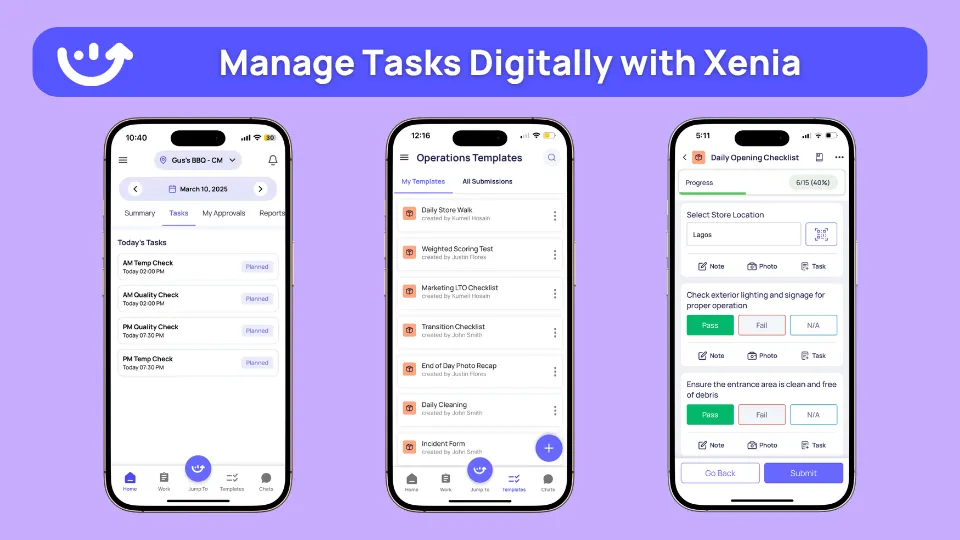
Corrective actions, SOP updates, shift notes, and announcements all live in the same mobile app. Mandatory sign-off on announcements means you know exactly who read what and when. Every interaction is logged.
.webp)

Priced on per user or per location basis
Available on iOS, Android and Web


2. Zip Checklist
Zip Checklist is a task management tool built for restaurants that need to move from paper to digital checklists quickly. It covers task assignment, completion tracking, real-time notifications, and basic reporting. For single-location operators or small teams who need accountability on daily SOPs without a lot of setup, it gets the job done.
What it does well:
- Customizable digital checklists with task assignment and completion tracking
- Real-time alerts and notifications for pending or overdue tasks
- Simple mobile-first interface that frontline staff can pick up quickly
- Low implementation lift, fast to deploy
What to know: Zip Checklist is a checklist tool, not an operations execution platform. It does not have weighted audit scoring, closed-loop corrective action workflows, cross-location reporting dashboards, or a food safety module built for DoH documentation. For operators managing multiple locations who need audit trails, temperature logging, or any kind of above-store visibility, it will hit its ceiling fast.
3. FoodDocs
.webp)
FoodDocs is a dedicated food safety platform built for restaurants that need regulatory compliance documentation above all else. It auto-generates HACCP plans, manages temperature logs, and creates audit trails for health department inspections.
What it does well:
- Automatic HACCP plan generation tailored to your specific operation
- Temperature monitoring forms with corrective action workflows built into the food safety module
- Audit trails formatted for EU and US regulatory requirements
- Flat monthly pricing at around $215 per month, straightforward for budget planning
What to know: FoodDocs is purpose-built for food safety compliance. It is not a broader operations execution platform.
If you also need a task management platform, team communications, or a multi-location operations dashboard, you will need other tools alongside it. For operators whose primary need is regulatory food safety documentation depth, it delivers on that specific use case.
4. Taqtics
.webp)
Taqtics is a multi-location restaurant operations software platform with a strong emphasis on visual dashboards and performance metrics. If your district managers are data-driven and want heatmap-style visibility into location performance, Taqtics is built for that use case.
What it does well:
- Live heatmaps showing task and shift compliance performance by location
- Task management platform with assignment and real-time tracking
- Visual operations dashboard for district managers and operations leaders
- Good fit for retail-adjacent or franchise-style multi-unit management
What to know: Taqtics is newer to the market with an emerging 4.5 rating on G2. The visual dashboard strength is genuine. Food safety module depth and corrective action audit workflows are lighter compared to platforms built specifically for restaurant compliance. Worth evaluating if operational visibility is your primary need rather than food safety logging depth.
5. Bindy

Bindy is an audit and inspection platform built for retail and food service operators who need structured field audit workflows and branded visit reports. It is popular with franchise-style businesses that run regular site visits and need clean documentation of brand standard compliance.
What it does well:
- Branded audit forms and visit report templates
- Scheduled and unannounced site visit workflows
- Photo documentation and signature capture on mobile
- Action plan tracking tied to specific audit findings
What to know: Bindy is an audit-first tool. It covers inspections and visit documentation well but does not go deep on daily task management, food safety logging, team communications, or cross-location reporting dashboards. Operators who need a full operations execution system will run into gaps quickly. Bindy is a reasonable fit if structured field visits are your primary use case and you have other tools handling everything else.
How to evaluate a Jolt alternative for your operation
The right platform depends on what you are actually outgrowing. Not on which Jolt competitor has the longest feature list.
Work through these five questions before committing.
1. Does it cover all functions in one system?
The goal for most operators doing this restaurant task management software comparison is consolidation. If the new platform still requires a separate food safety module or a separate communications app, you have not simplified anything. Map your current tool stack before you start demos.
This is exactly where Xenia stands out. It brings food safety compliance, task management, audit workflows, and team communications into one app. No separate tools. No switching between apps. If consolidation is your primary goal, it is worth putting Xenia at the top of your evaluation list.
2. What happens the moment an audit workflow item fails?
Ask every vendor to walk you through that specific scenario live. Does the platform auto-generate a corrective action? Does it assign it to a specific person? Does it track to resolution? That answer separates genuine operations execution platforms from checklist tools with a dashboard.
3. What does the operations dashboard look like for a district manager?
Log into the demo yourself as a district manager covering 12 locations. If you have to navigate location by location to build a picture of your area, it is a single-unit tool sold to multi-unit operators. Real multi-unit management means one view, all locations, in real time.
4. Will frontline staff actually use it during a busy Friday dinner service?
The best platform is the one kitchen staff opens without being asked. That means mobile-first operations design, simple login, and offline functionality for sites with weak signal. Ask to see the frontline worker experience specifically, not just the manager view.
5. What does pricing look like at 3x your current location count?
Run the numbers for where you are going, not where you are today. A platform that looks affordable at 8 locations can become a significant cost at 25 if the model is per-seat rather than per-location. Factor in your 2-year growth plan before signing.
Common mistakes when switching from Jolt
Going top-down without GM buy-in
Platforms rolled out without general manager input rarely stick past 60 days. GMs determine whether a task management platform becomes part of daily operations or gets quietly abandoned. Bring your top GMs into the evaluation before you sign anything.
Migrating everything at once
Start with one function. The food safety module. Or daily opening digital checklists. Prove the platform works for your team in one area before migrating everything. Full migrations done all at once create confusion and make it easy to fall back to old habits.
Choosing on feature lists instead of your actual gap
The Jolt software alternative with the longest feature list is not always the right one. Pick the platform that solves the specific problem you are trying to fix. If the gap is the operations dashboard and cross-location reporting, optimize for that. If it is audit workflows and corrective actions, lead with that criterion.
Ignoring shift compliance and frontline adoption rates
A platform your team does not use creates a false sense of operational control. During any pilot, track actual completion rates and shift compliance scores in the first two weeks. If adoption is low early, find out why before rolling out to all locations.
Conclusion
There is no universal best Jolt alternative. The right platform is the one that closes the specific gaps Jolt leaves open for your operation, whether that is cross-location reporting, a real audit-to-corrective action loop, or food safety documentation that satisfies DoH requirements.
For operators managing 5+ locations who want to consolidate task management, auditing, food safety compliance, and team communications into one platform, Xenia is purpose-built for exactly that.
Want to see how Xenia compares to Jolt for your operation?
Frequently Asked Questions
Got a question? Find our FAQs here. If your question hasn't been answered here, contact us.
What should I look for in a restaurant task management software comparison?

Focus on five things: a multi-location operations dashboard, connected audit workflows with corrective action tracking, a food safety module that meets DoH documentation requirements, mobile-first operations design for frontline adoption, and pricing that scales predictably with location growth.
These are the areas where Jolt competitors most commonly differentiate from one another.
Is Xenia a good Jolt alternative?
Xenia is a strong Jolt alternative for multi-unit restaurant operators whose primary gaps are on the operations execution side. It covers audit workflows, food safety compliance, task management, and multi-location visibility in one mobile-first operations platform.
What is the difference between Jolt and its competitors?
Jolt handles digital checklists, task management, and basic food safety logging well. Where most Jolt competitors differentiate is on multi-unit management depth: cross-location operations dashboards, connected audit workflows that close into corrective actions, and food safety modules built for DoH documentation requirements.
For operators at 3 to 5 locations, those differences matter less. At 10 to 15+ locations, they matter a lot.
What are the best Jolt alternatives for multi-unit restaurant operators in 2026?
The top Jolt alternatives are Xenia, Zip Checklist, FoodDocs, Taqtics, and Bindy.
Xenia is purpose-built for multi-unit management with full audit workflows, a food safety module, and a cross-location operations dashboard.
FoodDocs goes deepest on food safety compliance. Taqtics is strong on visual performance dashboards. Bindy suits operators who primarily need structured audit visit documentation. Zip Checklist works for small teams that need simple digital checklists without much operational complexity.


A Modern, AI-Powered Platform Built for Restaurant Operations
Xenia brings kitchen operations, food safety, audits, and team communication into one mobile-first platform. Restaurant teams execute daily work consistently, maintain compliance, and resolve issues faster, while leadership gets real-time visibility across all locations.
.webp)
Why Restaurant Operators Choose Xenia:
🤖 AI-Powered Operations, Convert paper logs instantly and verify food presentation and kitchen cleanliness automatically. Get instant answers about food safety trends without building reports.
🍽️ Food Safety & Compliance, Track line checks and temperature logs with automated alerts. Trigger corrective actions when readings exceed safe ranges. Maintain audit-ready records for health inspections.
📊 Multi-Location Control, Monitor food safety compliance and task completion across regions. Benchmark locations to identify training needs. Export reports for operational reviews.
One platform for kitchen operations, food safety, and compliance across all locations.

.svg)
.webp)
%201%20(1).webp)

.svg)
%201%20(2).webp)