

Post Summary
Something went wrong in your operation.
A failed audit. A safety violation. A customer complaint.
What you do next matters more than the problem itself.
Most managers fix the immediate issue. Then move on. The same problem happens again next week.
Corrective action is different.
You fix the problem. Find why it happened. Prevent it from happening again.
This guide shows you exactly how.
.svg)

Priced on per user or per location basis
Available on iOS, Android and Web


What is a Corrective Action?
A corrective action is a systematic approach to fixing problems permanently.
Here's the corrective action definition: It's a planned action taken to eliminate the cause of a detected problem or nonconformity.
Think of it like this.
Your restaurant fails a health inspection. Walk-in cooler is at 45°F instead of 41°F.
Quick fix? Adjust the temperature dial.
Corrective action? Figure out why the cooler ran warm. Fix the broken door seal. Set up maintenance checks. Document everything. Verify it worked.
That's the difference.
The corrective action meaning goes beyond quick fixes. It's about permanent solutions.
Corrective Action vs Preventive Action
People confuse these constantly.
Here's the simple difference:
**
Corrective Action, Preventive Action
Fixes problems that already happened, Stops problems before they occur
Reacts to detected issues, Proactively eliminates risks
Triggered by failures or incidents, Triggered by risk assessments
Example: Fix broken equipment after it fails, Example: Scheduled maintenance before equipment fails
Example: Retrain staff after complaint, Example: Train all staff to prevent complaints
**
Both matter. But corrective action is your priority when problems surface.
Why Corrective Action Management Matters
Without proper corrective action management, you're stuck in a loop.
Same problems keep recurring. Audit scores stay low. Customers complain about identical issues. Equipment breaks down repeatedly.
You're fighting fires instead of preventing them.
Good corrective action management changes this.
You track every issue. Assign clear responsibility. Follow through until resolved. Document everything properly.
The benefits are real:
- Fewer recurring problems
- Better compliance scores
- Lower costs from repeated issues
- Happier customers
- Regulators love documented corrective actions
OSHA, FDA, and ISO standards all require this.
How to Write a Corrective Action
Writing effective corrective actions follows a simple formula.
Start with the problem. Be specific about what happened.
Identify the root cause. Not the symptom. The actual underlying reason.
Define actions that address the root cause. Make them specific and measurable.
Assign clear responsibility. One person owns it.
Set realistic deadlines. Based on complexity and resources.
Plan verification. How will you know it worked?
Document results. What actually happened?
Keep language simple and factual. Anyone should understand it.
The Corrective Action Process: Step-by-Step
Here's how to establish corrective actions that actually work.
Step 1: Identify the Problem
You can't fix what you don't know about.
Problems come from audits, customer complaints, employee reports, equipment failures, or safety incidents.
Document clearly. What happened? When? Where? Who was involved?
Be specific. "Poor cleanliness" isn't specific. "Walk-in cooler has visible mold on back wall" is specific.
Step 2: Take Immediate Action
Stop the bleeding first.
Equipment unsafe? Take it offline. Product contaminated? Quarantine it. Process broken? Halt it.
This immediate action prevents worse problems. But it's not the full solution yet.
Step 3: Find the Root Cause
This is where most managers fail. They stop at the immediate fix.
Don't ask "What went wrong?" Ask "Why did it go wrong?"
Use the 5 Whys technique:
Example: Walk-in cooler too warm.
- Why? Temperature controller isn't working.
- Why? Controller wasn't calibrated.
- Why? No maintenance schedule exists.
- Why? Company doesn't have preventive maintenance program.
Root cause: Lack of preventive maintenance program.
The root cause is rarely the obvious answer. Learn more about failure reporting and analysis.
Step 4: Develop the Corrective Action Plan
Now you know the root cause. Time to fix it permanently.
Your corrective action plan needs:
- Specific actions to take
- Who's responsible
- Deadline for completion
- Resources needed
- Success criteria
Be concrete. "Improve training" isn't a plan. "Retrain all kitchen staff on temperature monitoring by March 15" is a plan.
Step 5: Implement the Solution
Execute your plan. Assign tasks. Track progress. Remove obstacles.
Document everything. What you did. When you did it. Who did it.
This documentation proves you took action. Regulators want to see this.
Step 6: Verify Effectiveness
Did it work?
Check after a reasonable period. Equipment fixed and working? Staff following new procedures?
This verification step separates real corrective action from wishful thinking. Use a CAPA effectiveness check to confirm results.
Step 7: Prevent Recurrence
Update procedures. Change training. Modify processes.
Make sure this specific problem can't happen again.
That's the whole point.
Corrective Action Examples
Let's look at real corrective action examples.
Restaurant Example
Problem: Multiple customer complaints about undercooked chicken.
Immediate Action: Retrain line cooks on proper cooking temps.
Root Cause: Thermometers weren't calibrated. Staff didn't know proper technique.
Corrective Action Plan:
- Calibrate all thermometers immediately
- Create a monthly calibration schedule
- Retrain all kitchen staff on temp checking
- Add temperature checks to opening checklist
- Manager verifies temps during each shift
Verification: Zero undercooked chicken complaints for 30 days.
Retail Example
Problem: Stockroom inventory doesn't match system inventory.
Immediate Action: Conduct full physical count.
Root Cause: Staff not scanning items during receiving.
Corrective Action Plan:
- Retrain receiving staff on scanning procedures
- Add receiving checklist requiring manager signoff
- Install barcode scanner at receiving dock
- Weekly spot checks for first month
Verification: Inventory accuracy improves from 85% to 97%.
These corrective action examples show the complete process in action.
An example of a corrective action is fixing not just the symptom, but the underlying cause.
Corrective Action Report Sample
A corrective action report documents the entire process.
Here's what a complete corrective action report sample looks like:
- Report ID: CA-2026-0045
- Date: February 10, 2026
- Location: Store #142, Chicago IL
- Issue: Food Safety - Walk-in Cooler Temperature
Problem Description: Walk-in cooler at 46°F during audit. Safe temperature is 41°F or below. 40 lbs chicken, 30 lbs ground beef at unsafe temperature.
Immediate Action:
- All protein products discarded ($450 loss)
- Cooler adjusted to 38°F
- Staff instructed not to stock until verified stable
Root Cause:
- Door gasket seal damaged
- No preventive maintenance schedule for coolers
- Staff not trained on reporting thresholds
Corrective Actions:
- Replace door gasket (Completed 2/10/26)
- Daily manager verification of cooler temps
- Add cooler to quarterly maintenance schedule
- Retrain all staff on temp monitoring
- Install automated temperature alerts
Responsible: Store Manager James Wilson
Deadline: All actions by 2/15/26
Verification: District Manager verifies 2/20/26
Results: Cooler stable at 38-40°F for 14 days. Staff logs show 100% compliance.
Status: CLOSED - Verified Effective
That's a complete example of corrective action documentation.
Using a Corrective Action Plan Template
Start with a corrective action plan template.
Templates ensure you don't miss critical steps.
A good template includes:
- Problem identification
- Immediate action taken
- Root cause analysis
- Corrective action details
- Responsibility assignment
- Due dates
- Verification method
- Sign-off section
Xenia offers customizable corrective action templates built for operations teams.
Templates save time. They ensure consistency. They make documentation easier.
How Xenia Automates Corrective Action Management
Manual corrective action tracking is painful.
Spreadsheets get lost. Emails get buried. Nobody knows who's responsible. Nothing gets verified. That’s where a corrective action app like Xenia comes handy.
Xenia automates the entire process.
.webp)
Automatic Task Creation: Failed audits automatically create corrective action tasks. No manual entry.
Smart Assignment: Tasks route to the right person based on location, role, or issue type.
Deadline Tracking: Everyone sees due dates. System sends reminders. Overdue items escalate automatically.
Photo Documentation: Staff attach before and after photos. Proof is built in.
Verification Workflows: Managers verify completion. System tracks status. Nothing falls through cracks.
Trend Analysis: See which issues recur most. Which locations struggle. What needs attention.
Compliance Reporting: Generate corrective action reports instantly. Perfect for audits.
Learn how to create a corrective action in Xenia.
Conclusion
You now know how corrective action works.
The process is simple. Identify problems. Take immediate action. Find root causes. Implement solutions. Verify effectiveness. Prevent recurrence.
The challenge isn't knowing what to do. It's doing it consistently.
Manual tracking doesn't work. Digital systems make it automatic.
Xenia is a platform for operations teams managing corrective actions across multiple locations.
Start your free trial or get a demo.
Stop fighting the same problems repeatedly. Start fixing them permanently.
Frequently Asked Questions
Got a question? Find our FAQs here. If your question hasn't been answered here, contact us.
When should corrective action be taken immediately?

Take immediate action for serious issues. Safety hazards that could injure people. Food safety violations. Dangerous equipment. Major compliance problems. Minor issues can follow normal timelines.
What is a corrective action plan for an employee?
It's a clear plan to fix an employee's performance or behavior issue. Explain what needs to improve. List the steps to fix it. Set a timeline. State the consequences if it continues. Monitor progress and document everything.
When should corrective action be taken?
Immediately for safety hazards, food safety issues, or compliance violations. Other issues can follow normal timelines based on how serious they are.
How do you verify corrective action effectiveness?
Check after a reasonable period. Review your metrics. Conduct follow-up audits. Verify the problem hasn't come back. Document everything. Use a CAPA effectiveness check to confirm results.
Who is responsible for corrective actions?
Store managers handle location problems. Department heads handle process issues. District managers oversee multi-location patterns. Always assign clear ownership to one person.
How long does corrective action take?
It depends on the problem. Simple issues resolve in days. Complex problems might take weeks. Set realistic deadlines based on what you're fixing.
What's the difference between corrective and preventive action?
Corrective action fixes problems that already happened. Preventive action stops problems before they occur. Both are important for quality management.

A Modern, AI-Powered Platform Built Specifically for Frontline Operations
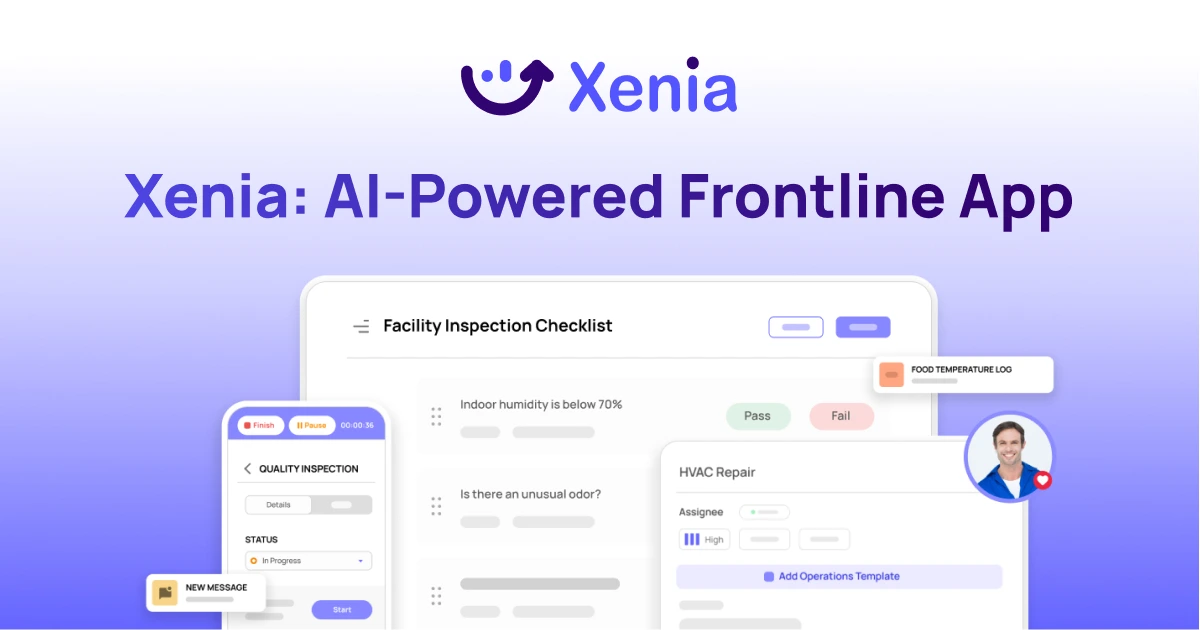
Xenia brings daily operations, maintenance, audits, and compliance into one mobile-first platform. Frontline teams execute work consistently across locations while leadership gets real-time visibility.
Why Multi-Location Operators Choose Xenia:
🤖 AI-Powered Operations, Create digital checklists instantly or convert paper forms with AI. Verify compliance automatically with photo analysis and get instant answers from your operational data.
✅ Daily Operations & Maintenance, Assign work across hundreds of locations in minutes. Report and route issues instantly. Schedule preventive maintenance to catch problems before downtime.
📊 Real-Time Visibility, Track completion, work orders, and performance across all locations through dashboards. Filter by site or asset to spot trends and take action.
Manage operations, maintenance, and compliance across all your locations from one platform

.svg)
.webp)
%201%20(1).webp)

.svg)
%201%20(2).webp)