


Post Summary
Brand consistency is often treated as a marketing concern. Logos, colors, tone of voice. Important, but incomplete.
In 2026, brand consistency is something far more fundamental: a risk reduction strategy.
For multi-location businesses in retail, restaurants, convenience stores, and hospitality, consistency determines whether customers trust you enough to choose you again, pay a premium, and forgive occasional mistakes. When execution varies from one location to the next, the brand stops feeling reliable. And unreliable brands don't scale safely.
Operators who outperform their peers understand this shift. They don't pursue uniformity for aesthetics. They pursue it because consistency reduces uncertainty, for customers, employees, and the business itself.
This article explains why brand consistency matters more than ever, what causes "brand drift" in growing organizations, and how leading brands are moving toward a 2026 model of adaptive consistency.
.webp)
.svg)

Priced on per user or per location basis
Available on iOS, Android and Web


What Is Brand Consistency and Brand Uniformity?
Brand consistency means giving customers the same experience every time they interact with your brand.
That includes:
- How the space looks and feels
- How staff behave and communicate
- How reliably processes are executed
- How problems are handled when things go wrong
Brand uniformity doesn't mean every location is identical. It means customers know what to expect, and that expectation is met often enough to build trust.
From the customer's perspective, consistency answers a simple question:
"Is this a safe choice?"
When customers feel sure, they decide quickly. When they don't, they move on.
Why Brand Consistency Matters in 2026
Brand consistency matters more today because customers have way too many choices.
Customers today face:
- Dozens of similar brands
- Infinite online reviews
- Constant price comparisons
Customers prefer brands that do what they expect, every time.
Consistency reduces cognitive load. Customers don't have to evaluate you from scratch each visit. They rely on memory and pattern recognition instead.
That's why consistent brands see measurable business impact:
- Higher repeat visit rates
- Stronger customer loyalty
- Greater tolerance for price increases
- Faster recovery from service failures
Across retail, restaurants, and hospitality, brands that maintain strong brand uniformity routinely outperform inconsistent competitors by 10% or more in revenue growth, driven primarily by repeat business and pricing power.
The Importance of Brand Consistency as Trust Infrastructure
Trust isn't built through promises. It's built through repetition.
Every consistent interaction reinforces the belief that:
- "They know what they're doing."
- "They won't surprise me in a bad way."
- "I can bring others here without risk."
In multi-unit operations, trust compounds. Each location becomes a validator of the brand.
But inconsistency breaks trust just as quickly:
- One dirty restroom
- One poorly executed promotion
- One location that "feels different"
Customers don't downgrade a single store. They downgrade the brand.
This is why brand consistency functions like infrastructure. When it's strong, everything else performs better. When it's weak, problems spread.
Brand Consistency Challenges: The Hidden Cost of Brand Drift
Brand consistency also reduces multiple forms of operational risk:
- Revenue risk from customer churn
- Reputation risk from uneven experiences
- Operational risk from unclear standards
- Expansion risk when opening new locations
When things are consistent, there are fewer surprises. That makes planning easier, builds trust, and supports steady growth.
Consistency matters most when conditions are unstable. Strong brands benefit during economic downturns, supply chain disruptions, staffing shortages, and rapid expansion in three ways:
- Crisis resilience - Customers are more forgiving when expectations are usually met.
- Pricing power - Predictable experiences justify premiums, even in competitive markets.
- Operational clarity - Teams know what "right" looks like, reducing decision friction.
In contrast, inconsistent brands feel risky precisely when customers are least willing to experiment.
During staffing shortages, supply disruptions, or service failures, customers fall back on past experience. If a brand has been consistent, customers are more patient. They assume the problem is temporary, not a sign of deeper issues.
Inconsistent brands do not get that benefit. When something goes wrong, it feels expected. Customers lose trust faster and move on sooner.
Brand Consistency Examples
The best way to understand brand consistency is to see it in action across frontline operations.
- Shucking Good Hospitality runs Blue Island Oyster Bar and Seafood across three locations. Before, their standards were getting lost between managers. Clipboards and spreadsheets weren’t cutting it. Now they hit 90%+ completion on daily checklists. Food quality, restroom cleanliness, and guest service. All consistent across every location.
- Demos Restaurants & PDK Southern Kitchen operates six restaurants and needed every location to deliver the same experience. They put QR codes throughout their restaurants so employees could access checklists and safety logs instantly. The result? 100% adherence to operating standards and 50% faster rollout when they update processes. Customers get the same quality whether they're at the original location or the newest one.
- Power Market manages 360+ convenience stores across the West Coast. Different formats, different regions. Beer caves, car washes, you name it. They ditched paper-based systems and went digital. Now every store follows the same standards for pricing, merchandising, and compliance. Store managers verify tasks with photos. Customers get the same experience no matter which location they visit.
These brands don't pursue uniformity for aesthetics. They pursue it because consistency reduces uncertainty and builds the kind of trust that drives repeat business and pricing power.
The 2026 Shift: From Rigid Brand Uniformity to Adaptive Brand Consistency
The old model of brand consistency was rigid replication. Same layout. Same script. Same execution everywhere.
That approach breaks down in modern operations.
In 2026, leading brands practice adaptive consistency:
- Core standards are non-negotiable
- Local context is allowed where it doesn't affect trust
- Execution is measured, not assumed
Adaptive consistency answers a critical question:
"Which elements must never vary, and which can flex without breaking trust?"
For example:
- Cleanliness, safety, and service fundamentals stay fixed
- Layouts or offerings may adapt to local demand
- Tone remains consistent even if delivery varies
This balance lets brands grow while staying flexible and organized.
How Brand Standards Enable Consistency (Without the Mechanics)
Brand consistency doesn't happen through intention alone. It requires clearly defined standards and regular evaluation.
This is where brand standards act as the connective tissue between strategy and execution. They translate abstract brand promises into observable behaviors.
The first practical step toward consistency is understanding how well standards are actually being executed today, not how well they're written.
In practice, this is where many multi-location brands struggle. Standards live in documents, but execution happens on the floor. Without a clear way to observe, verify, and follow up on daily execution, even strong standards break down over time.
This is why modern operators rely on operations execution platforms like Xenia to act as the connective layer between brand intent and real-world execution. Instead of assuming consistency, teams gain visibility into how standards are performed across locations, where drift is emerging, and what needs attention before customers feel it.
Xenia's platform provides real-time dashboards, automated task management, and inspection capabilities that help multi-unit operators maintain consistency without constant manual oversight. The goal is not more oversight, it's fewer surprises.
.webp)
Frequently Asked Questions
Why is brand consistency important for customer loyalty and repeat business?
Brand consistency matters because it removes doubt from the customer’s decision. When people know what to expect, they don’t have to rethink their choice every time they visit. Familiar experiences build comfort. Comfort builds trust. Over time, that trust turns into repeat behavior.
What makes brand consistency hard to maintain in a decentralized workforce?
The problem usually isn’t missing standards. It’s how differently those standards get followed.
In decentralized teams, each manager interprets things their own way. Small shortcuts start to feel acceptable. Feedback from leadership takes time to reach the floor. Teams also don’t always have a clear example of what “right” looks like. Without regular checks and feedback, consistency slowly fades even when standards are well documented.
Can brand consistency really help during a crisis?
Yes, this is when it matters most.
When staffing is tight or service slips, customers fall back on past experience. If a brand has been consistent, customers are more patient and understanding. They assume the issue is temporary. Brands that lack consistency don’t get that grace. When something goes wrong, customers expect it and lose trust faster.
How does brand consistency affect pricing power?
Consistency makes customers more comfortable paying a higher price. When they trust the experience, the risk feels lower.
Brands that deliver consistently feel more reliable and professional. Customers choose them even when cheaper options exist. Inconsistent brands rely more on discounts because price becomes the only reason to choose them. Over time, that hurts margins and slows growth.
Conclusion
Brand consistency isn’t about being perfect. It’s about being reliable.
In 2026, the brands that grow steadily aren’t always the loudest or most creative. They’re the ones customers trust to deliver the same core experience every time.
Consistency lowers risk for customers. It builds trust, encourages repeat visits, and supports stronger pricing. But it only works when it’s treated as part of daily operations, not as a set of guidelines sitting in a slide deck.
If customers can’t clearly explain what your brand delivers, they won’t depend on it. In crowded markets, being dependable is often the biggest advantage.
Platforms like Xenia help teams turn brand consistency into everyday execution. By linking standards, verification, and corrective action, operators get the visibility they need to stay consistent as they grow.
Frequently Asked Questions
Got a question? Find our FAQs here. If your question hasn't been answered here, contact us.

Looks like there's no data available in our FAQ section at the moment.

A Modern, AI-Powered Platform Built Specifically for Frontline Operations
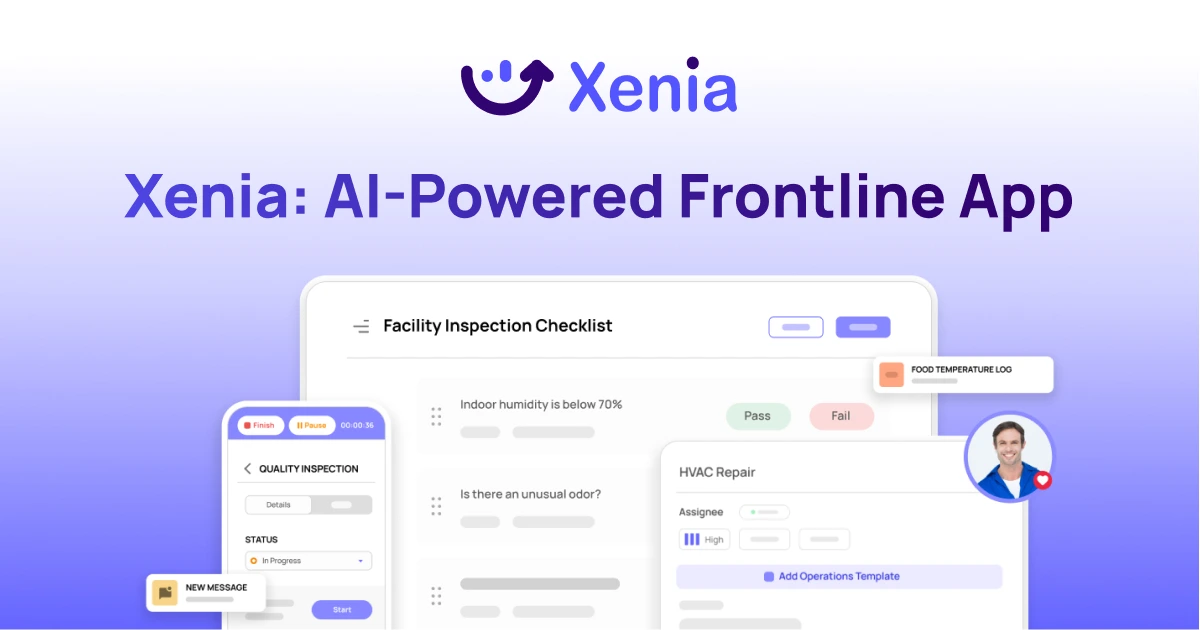
Xenia brings daily operations, maintenance, audits, and compliance into one mobile-first platform. Frontline teams execute work consistently across locations while leadership gets real-time visibility.
Why Multi-Location Operators Choose Xenia:
🤖 AI-Powered Operations, Create digital checklists instantly or convert paper forms with AI. Verify compliance automatically with photo analysis and get instant answers from your operational data.
✅ Daily Operations & Maintenance, Assign work across hundreds of locations in minutes. Report and route issues instantly. Schedule preventive maintenance to catch problems before downtime.
📊 Real-Time Visibility, Track completion, work orders, and performance across all locations through dashboards. Filter by site or asset to spot trends and take action.
Manage operations, maintenance, and compliance across all your locations from one platform

.svg)
.webp)
%201%20(1).webp)

.svg)
%201%20(2).webp)