

Post Summary
Your location in Chicago runs differently from your location in Dallas.
Different manager. Different team. Different standards. Same brand.
That gap is a workforce management problem. And it only gets worse as you grow.
Here are the best practices that close it.
.svg)

Priced on per user or per location basis
Available on iOS, Android and Web


What Is Workforce Management?
Workforce management is not just scheduling.
It is how you plan, track, and optimize the way your people work across every location you run.
That means task assignment, training, communication, and performance tracking. Everything that determines whether your teams are actually doing what they are supposed to do.
A restaurant chain making sure every location runs the same opening checklist. A retail group completing store audits across 50 locations on time. A convenience store tracking overnight safety checks without a manager present.
That is workforce management.
Enterprise workforce management just gives you that visibility and control at scale, across every location, not just the one you happen to be standing in.
12 Best Practices in Workforce Management
1. Define Every Role Clearly
If a task has no owner, it does not get done.
That is what happens when roles are vague. You need to document what every person is responsible for before their first shift. Daily tasks, who to escalate to, and what good performance looks like.
Simple and specific. Nothing more.
For example, a shift lead at a quick-service restaurant should know they own the opening checklist, equipment temperature logs, and the first 15-minute floor check. Not "help where needed." Specific tasks, every shift.
2. Schedule Around Demand, Not Habit
Most operators schedule based on last week. That is not a strategy.
Look at your last 90 days of operations data. Sales volume by hour, foot traffic patterns, and labor reports by location. When are your busiest windows? Which locations consistently run short on a Friday night? Which ones are overstaffed every Tuesday morning?
Build schedules around those patterns. You cut labor waste and close service gaps at the same time.
3. Standardize Onboarding Across Every Location
Every location training new hires differently is one of the most common and costly mistakes in multi-location operations.
Different trainers. Different standards. Different habits that stick for years.
A standardized employee onboarding checklist fixes this. One process, every location, no exceptions.
4. Make Communication Structured
Most multi-location businesses communicate through personal texts, group chats, and verbal updates.
That does not work at scale.
You need one channel. Digital announcements with acknowledgment tracking. A full record of what was sent and who received it. That is what structured frontline communication looks like.
**
Old Way, Better Way
Personal texts and calls, One centralized platform
Verbal updates in huddles, Digital announcements with receipts
Emails that get ignored, Mandatory acknowledgment tracking
**
5. Use Mobile-First Tools
Your frontline teams are not at desks.
Any tool that is not built for mobile is a tool they will not use. Mobile workforce management gives your deskless workers everything they need on their phone or tablet. Tasks, checklists, training, updates. All in one place.
6. Build Accountability Into Every Task
A task without an owner is a task that will not get done.
Every assignment needs three things. A clear owner. A deadline. A completion record leadership can actually see. Task scheduling software automates all of it. Nothing falls through the cracks, and no manager needs to manually follow up.
7. Verify Completion, Not Just Assignment
A checkmark on a dashboard does not mean the work was done correctly.
One of the biggest problems in multi-location operations is pencil whipping. That is when employees mark tasks as complete without actually doing them. It happens more than most operators realize, and it creates a false picture of how your locations are actually running. You think everything is fine. The audit tells a different story.
The fix is requiring real proof. Use a staff management checklist app that requires photo verification and mandatory steps before a task can be marked done. If the walk-in cooler temperature check requires a photo of the display reading, that step cannot be skipped. Real proof of completion, not just a status update.
8. Train Continuously, Not Just at Onboarding
Onboarding gets people started. Ongoing training keeps standards from slipping.
Keep it simple:
**
Training Type, Frequency
Role-specific refreshers, Monthly
Safety reviews, Quarterly
Compliance updates, As needed
New process rollouts, When introduced
**
Digital checklists make this easier to enforce. Instead of a manager printing updated SOPs and hoping every location reads them, you push the new process through a digital checklist and it shows up on every employee's phone at the start of their next shift. Completion is tracked. Nothing gets missed.
Short and regular beats long and annual every time.
9. Give Managers Real-Time Visibility
Regional managers cannot be at every location every day. They need data.
Good workforce management gives them live dashboards showing task completion rates, training compliance, overdue items, and inspection scores across every location.
But visibility is only half of it. What managers do with that data is what moves the needle.
When a district manager sees that one location has had three consecutive weeks of incomplete opening checklists, they can get ahead of it before it becomes a compliance issue.
When they see two locations consistently outperforming the rest, they can identify what those teams are doing differently and roll it out everywhere.
That is the difference between reacting to problems and actually running a better operation.
10. Standardize Before You Scale
Do not scale and then standardize. Standardize and then scale.
Every new location you open takes whatever inconsistencies exist in your current operation and multiplies them. Document your SOPs, build them into digital checklists, and make every location follow the same workflow before you open the next one.
That is how you grow without losing control.
11. Create a Frontline Feedback Loop
Your frontline teams see problems that leadership never sees.
The shift lead knows the fryer takes 20 extra minutes to heat up. The cashier knows customers always ask for a product that has been out of stock for three weeks. That information rarely makes it up the chain because there is no real structure for it to travel through.
Give them a structured way to flag issues. Not a suggestion box that nobody checks. A digital process where issues get logged, assigned to someone, and followed up on with a clear timeline. When employees see that their input actually changes something, they flag problems earlier. And they stick around longer.
That is the kind of feedback loop that improves your operation from the ground up.
12. Review Performance Data Every Month
Collecting data means nothing if you do not act on it.
**
Metric, What It Shows
Task completion rate, Are daily operations consistent?
Training compliance, Is your team up to standard?
Inspection scores, Which locations need attention?
Labor utilization, Are you staffing efficiently?
**
Review these monthly. Use them to coach underperforming sites and recognize teams doing great work.
These 12 practices are not a transformation project. They are operational basics that most multi-location businesses have never put in one place at the same time. When you do, the difference shows up fast. Fewer dropped tasks. More consistent locations. Managers who lead instead of chasing.
If you want to put all of this into practice without building it from scratch, Xenia gives you the tools to do it.
Signs Your Workforce Management Needs Attention
Most operators do not realize something is off until it shows up in an audit or a resignation letter.
Here are the signs to watch for.
Tasks keep getting missed. No clear owner. No deadline. No follow-up. The same things fall through the cracks every week.
Inspection scores are inconsistent. One location passes easily. Another struggles every time. When results vary that much, execution is depending on the manager on duty, not a standard process.
Turnover is high in specific locations. When it keeps happening at the same sites, it usually points to unclear expectations and a lack of structure, not bad luck.
Everything runs through one manager. When that person is out, nothing moves. That is a single point of failure your operation cannot afford.
Training only happened at onboarding. If your team has not been retrained since their first week, standards have drifted. It is that simple.
These are not signs of a failing operation. They are signs of a system that needs tightening.
Final Thoughts
Good workforce management is not complicated.
Clear roles. Consistent processes. The right tools. Real-time visibility.
Get those four things right across every location and your operation runs itself. Your managers stop firefighting and start leading. Your frontline teams stop guessing and start executing.
If you are running 25 or more locations and your current setup relies on spreadsheets, group chats, and manual follow-ups, that is the gap to close.
Xenia gives multi-location operators one platform to manage tasks, compliance, training, and communication across every site. See how it works.
Frequently Asked Questions
Got a question? Find our FAQs here. If your question hasn't been answered here, contact us.
What is the difference between workforce management and HR management?

HR is about the employee. Hiring them, paying them, developing them, letting them go.
Workforce management is about the work. Who is doing it, when they are doing it, and whether it is being done to the right standard.
Two different problems. Two different solutions. Both essential.
How much does WFM cost?
Small businesses can start cheap. Larger operators invest in dedicated platforms. Pricing is usually per user or per location.
The more useful question is what poor workforce management costs you right now. Wasted payroll, compliance incidents, and high turnover add up to a lot more than any software subscription.
What is enterprise workforce management?
It is workforce management at scale. Enterprise workforce management gives large organizations one system to manage scheduling, tasks, compliance, and HR across every location they run. Less chaos, more consistency, full visibility.
What is mobile workforce management?
It is workforce management built for people who are never at a desk. Your frontline teams get everything they need on their phone. Tasks, schedules, training, updates. All in one place. No paper. No chasing. Just clarity on what needs to get done.
What are the most important workforce management strategies for multi-location businesses?
The ones that create consistency. Standardized processes across every location. Mobile-first tools frontline teams actually use. Real-time visibility for managers. And structured communication that reaches every employee without relying on someone passing a message along.

A Modern, AI-Powered Platform Built Specifically for Frontline Operations
Xenia brings daily operations, maintenance, audits, and compliance into one mobile-first platform. Frontline teams execute work consistently across locations while leadership gets real-time visibility.
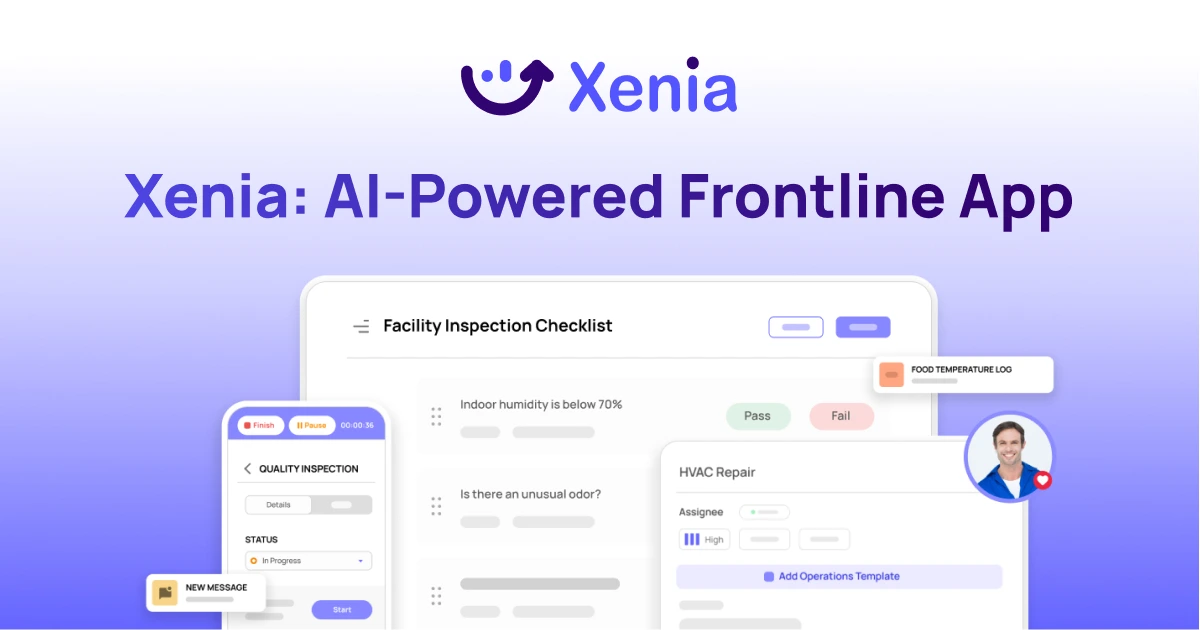
Why Multi-Location Operators Choose Xenia:
🤖 AI-Powered Operations, Create digital checklists instantly or convert paper forms with AI. Verify compliance automatically with photo analysis and get instant answers from your operational data.
✅ Daily Operations & Maintenance, Assign work across hundreds of locations in minutes. Report and route issues instantly. Schedule preventive maintenance to catch problems before downtime.
📊 Real-Time Visibility, Track completion, work orders, and performance across all locations through dashboards. Filter by site or asset to spot trends and take action.
Manage operations, maintenance, and compliance across all your locations from one platform

.svg)
.webp)
%201%20(1).webp)

.svg)
%201%20(2).webp)