
.webp)
Post Summary
Your district manager gets a call at 9 am on a Saturday.
A customer slipped at location seven. Nobody logged the floor inspection that morning. The incident report is incomplete. The store manager has never been trained on what to do after an injury.
That's not bad luck. That's a gap that was always going to cost someone.
If you run multiple retail locations, this is your reality. You can't be everywhere. Risks don't wait for you to show up. And the stores that hurt you most are rarely the ones you're watching closely.
This guide gives you the playbook to fix that.
.svg)

Priced on per user or per location basis
Available on iOS, Android and Web


What Is Retail Risk Management?
Retail risk management is identifying and controlling threats to your business before they become losses.
Those threats are everywhere. A wet floor nobody marked. A compliance certificate that expired last month. A cash process that changes every shift because nobody wrote it down. A theft pattern running for two months because nobody saw the data.
At one store, a good manager catches most of this by being present. At ten stores, presence doesn't work. Process does.
Retail risk management is what replaces presence with a system that runs at every location, every day.
The 4 Types of Risk in Retail
Most operators think about risk in general terms. General thinking leads to general responses. General responses don't stop specific losses.
Here are the four types and what each one costs you.
**
Risk Type, What It Covers, What It Costs You
Operational, Equipment-daily processes-staffing, Spoiled stock-service failures-customer complaints
Financial, Shrink-cash errors-pricing mistakes-fraud, Margin loss-P&L gaps-audit exposure
Compliance, Health codes-labor laws-fire safety-age verification, Fines-license loss-legal liability
Reputational, Public incidents-bad reviews-poor complaint handling, Customer loss-brand damage across all stores
**
Operational risk shows up in the c-store where the walk-in cooler hasn't been logged in three days.In the apparel store where the receiving process changes based on who's working. This is what happens when execution depends on individual judgment instead of a clear standard.
Financial risk is the most undercounted. Shrink alone costs the retail industry over $100 billion a year, according to the National Retail Federation. And shrink has three faces: external theft, internal theft, and inventory inaccuracy. They all look the same on a P&L until you break it down by store. Without that breakdown, you're guessing.
Compliance risk has the highest stakes. A failed health inspection can shut a store down the same day. An age verification failure at a store can trigger a license review. A wage violation can open the company to a lawsuit. For multi-location operators, this is harder because rules vary by city and state. What passes in one market can fail in another.
Reputational risk comes after everything else. A food safety incident handled badly becomes a news story. A theft situation mismanaged by a store manager ends up on social media. One store's bad reviews start hurting search results for every other location. Nineteen stores running well won't save you from the one that goes public.
How to Build a Retail Risk Management Plan That Works
Most guides list the steps. They skip the part where they explain what each step actually takes to work in a real operation.
Here's what it looks like in practice.
Get Clear on Scope First
Before you identify a single risk, know what you're covering. Which stores? Which functions? Which time period?
A district manager with twelve stores across three states has a completely different scope than someone running two stores in the same city. The risks are different. The rules are different. The staffing is different. Define your scope first, or your plan will be too broad to help anyone.
Find Risks From Three Places, Not One
Most retail store risk assessments only use structured audits. Audits are useful, but they only catch what the auditor knows to look for.
You need three sources:
- Store inspections covering safety, inventory, security, and compliance at every location
- Incident and near-miss history from the past twelve months at each store
- Frontline employee input from the people who see what managers miss
That third one is where most programs lose the most value. The associate opening the freezer every morning knows it's been slow to reach temperature for two weeks. The cashier knows which self-checkout has a blind spot. The shift supervisor knows which closing step gets skipped on Friday nights.
That information exists in your stores right now. It just has no way to reach you. Build a simple channel. A mobile form. A question in the shift handoff. Anything that gets that information moving upward.
Score Every Risk
Once you have your list, rate each risk on two things.
Likelihood: How likely is this to happen? Score 1 to 5, from rare to almost certain.
Impact: How bad would it be? Score 1 to 5, from minor to critical.
Multiply the two numbers to get a priority score.
**
Priority Score, Level, What to Do
16 to 25, High, Fix immediately with a named owner and deadline
9 to 15, Medium, Schedule a fix within 30 to 60 days
1 to 8, Low, Document and review every quarter
**
Without scoring, everything feels equally urgent. A cracked floor tile gets the same attention as a cash handling gap that's been running for six weeks. Scoring stops that.
Put a Name on Every Risk
A risk without an owner will not get fixed.
Not "store management." Not "the team." One specific person, with a specific deadline, and a clear path for what happens if that deadline passes.
Write it down. The moment ownership is only verbal, it disappears the next time that person has a hard week.
Make Your Controls Real
A control only works if it has all three of these things.
- Documentation: A written process that says exactly what needs to happen, who does it, and how it gets recorded
- Training: Every person responsible has been shown how to do it and that's on record
- Verification: Someone is checking that it's actually being done, not just assumed
Here's a real example. "Staff should check expiration dates daily" is not a control. A written procedure defining what to check, what to remove, and how to log it, plus training records for every relevant employee, plus a weekly log review by the store manager, is a control. Take away any one of those three things, and you have a policy that exists nowhere except a document nobody reads.
Monitor on a Schedule
Don't wait for something to go wrong before you check in.
- Weekly: Review incident and near-miss reports from every store. Look for patterns, not just one-off events
- Monthly: Pull audit scores and compare each store against its own history and against the rest of the portfolio. A store dropping from 85% to 71% is a signal before an incident is a fact
- Quarterly: Review shrink by store, reassess your top risks, and update owners and status
Store managers need daily visibility. District managers need weekly summaries. Leadership needs monthly trends. Build this structure now, not after something goes wrong.
Retail Risk Management Best Practices
The steps above give you the structure. These habits are what make the structure actually work.
Layer your audits
Daily checks catch what went wrong this morning: a spill, a blocked exit, a temperature out of range. Weekly spot checks confirm the daily checks are actually being done. Monthly audits score each store against a full standard. Quarterly reviews find the patterns across your whole portfolio.
Each layer catches something the others miss. You need all four.
Track near-misses, not just incidents
An incident has already cost you something. A near-miss is a warning that got to you before the cost did.
The associate who almost slipped on an unmarked floor. The cashier who caught a pricing error before it went through. The supervisor who spotted a blocked fire exit on the morning walkthrough. These are signals. They show you where the next incident is coming from.
Most retail loss prevention programs only track actual incidents. Build a simple near-miss reporting process and respond to every report with either a fix or a clear reason why one isn't needed. When staff see their reports lead somewhere, they keep reporting. When nothing happens, they stop.
Standardize before you try to manage
If every store manager runs cash reconciliation differently, you don't have one financial risk profile. You have as many as you have stores.
Retail task management only creates accountability when the tasks are the same everywhere. Standardization doesn't mean every store is identical. It means the important processes are clear enough that when someone deviates, it shows up as a deviation and not just "how we do it here."
Once you have a standard, problems become visible. Without one, you can't tell a compliant store from a non-compliant one.
Match your plan to your vertical
A grocery store's risks are not the same as a c-store's or an apparel chain's.
- C-store: Age verification, fuel safety, fresh food rotation, overnight staffing
- Apparel: Fitting room theft, return fraud, planogram compliance, seasonal resets
- Hospitality retail: Guest safety, sanitation, service consistency at peak times
- Grocery: Cold chain, health inspections, food handler certifications, temperature logs
Build your risk template around what actually applies to your business. A checklist made for all retail fits none of it properly.
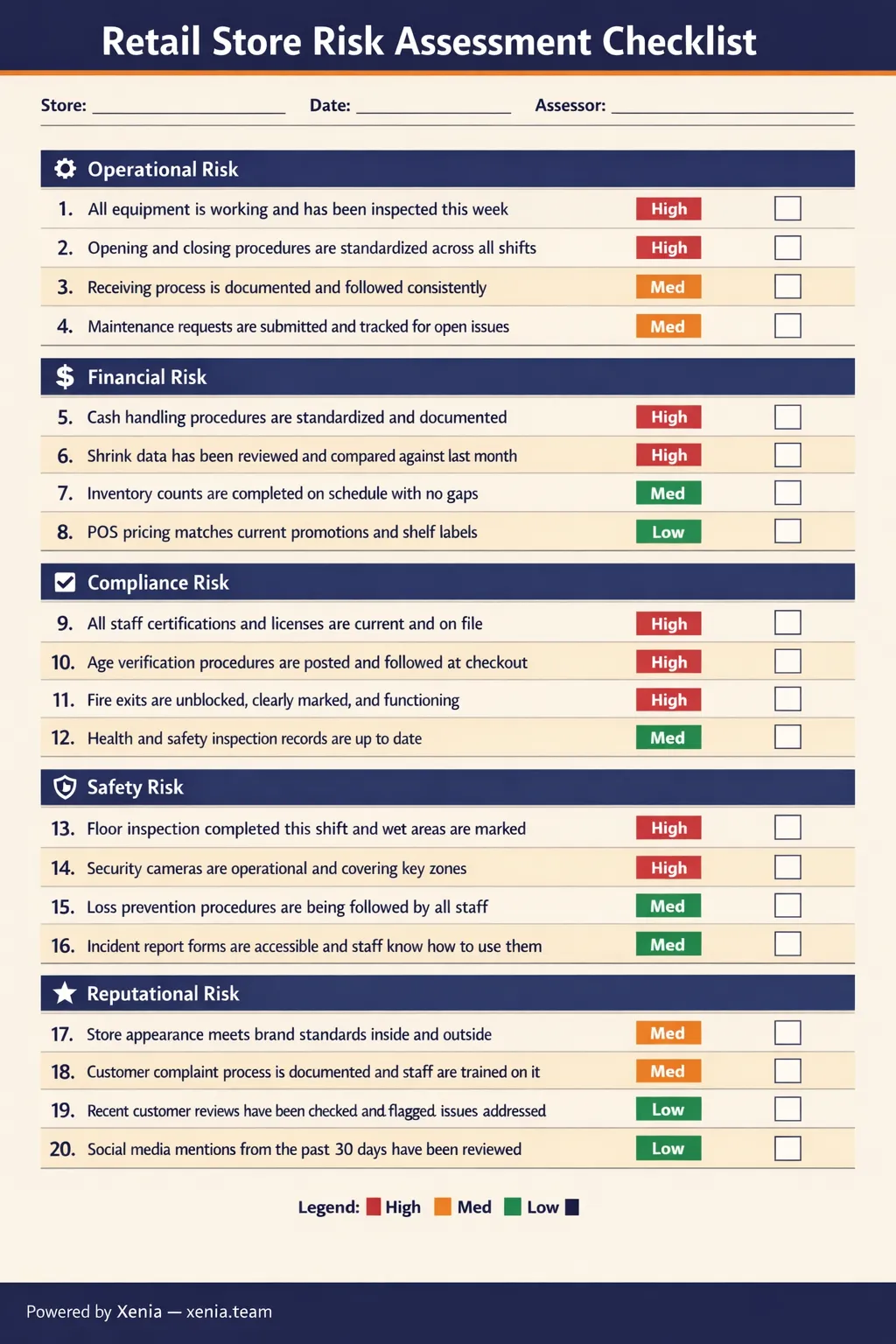
That's where Xenia helps. Build custom risk checklists for each vertical, assign the right checks to the right locations, and update them as your operation evolves.
Meanwhile, here is one useful template to start with:
Close the visibility gap with technology
The biggest problem in multi-location retail risk management isn't finding risks. It's the time between when a risk appears and when someone who can act on it finds out.
Paper logs close that gap in hours. Digital tools close it in minutes. When a store associate flags a temperature alert through a digital checklist at 7am, the district manager sees it at 7:01, before product is lost and before there's a compliance issue on record.
AI in Retail Risk Management
AI is changing what's possible for operators running multiple locations. Here's where it actually makes a difference.
AI-driven retail risk management starts with prediction. AI looks at patterns across audit scores, staffing data, and incident history to flag stores with rising risk before anything goes wrong. A store with three straight audit score drops, high turnover, and a holiday weekend coming up is a combination AI can surface in time to act on.
AI for risk management in retail also handles compliance automatically. Keeping up with certification renewals, inspection deadlines, and filing dates across twenty locations manually is nearly impossible without something slipping. AI sends alerts before deadlines are missed.
Anomaly detection is where AI in risk management finds financial red flags. Unusual void patterns at one register. A recurring inventory gap in one category. Cash handling numbers that don't add up. AI finds these patterns in your data faster than any manual review can.
One important note: AI is only as good as the data behind it. If your stores aren't filling out checklists consistently, if different managers score the same audit question differently, AI gets noisy and loses accuracy. Get your data clean and consistent first. Then AI becomes genuinely useful.
Conclusion
Risk doesn't wait for a good time.
The inspector shows up on a Thursday. The slip happens Saturday morning before the manager gets in. The theft pattern that ran for ten weeks shows up in month-end numbers with no trail left to follow.
The retailers who stay ahead aren't the ones with the most policies. They're the ones with consistent processes at every store, a named owner on every risk, and real visibility into what's happening across their whole portfolio.
Start with your highest-priority risks. Name an owner for each one. Build the monitoring rhythm. Then go one layer deeper on every step until your team can act without guessing.
If you want to see how Xenia helps multi-location retail teams run consistent inspections, assign clear ownership, and get real-time visibility across every location, schedule a demo.
Frequently Asked Questions
Got a question? Find our FAQs here. If your question hasn't been answered here, contact us.
How does staff turnover increase retail risk?

More turnover means more undertrained people handling critical tasks. Every time a trained employee leaves, your risk goes up until the new person is fully up to speed. High turnover makes it very hard to keep your risk controls actually running.
What should a retail incident response plan include?
Who gets notified, how the incident gets documented, what the store manager does in the first 30 minutes, and when to bring in legal or HR. Most stores don't have a plan until something happens. By then it's too late to build one.
What is the difference between risk management and loss prevention in retail?
Loss prevention focuses on theft and shrink. Risk management covers safety, compliance, financial controls, and brand reputation on top of that. Loss prevention is one part of a complete risk management plan, not a substitute for one.
Who is responsible for risk management in a retail store?
Responsibility is shared, but ownership must be clear. Store managers own the day-to-day execution. District managers own portfolio monitoring. Leadership owns the overall strategy. When everyone assumes someone else is handling it, nothing gets handled.
How often should a retail store conduct a risk assessment?
At least once a quarter. High-volume stores or locations going through big changes should do it more often. A quarterly cadence keeps your risk picture current without overwhelming your team.

A Modern, AI-Powered Platform Built for Retail Operations
Xenia brings store operations, merchandising, audits, and loss prevention into one mobile-first platform. Store teams execute daily work consistently, maintain brand standards, and resolve issues faster, while regional and corporate leadership get real-time visibility across all locations.
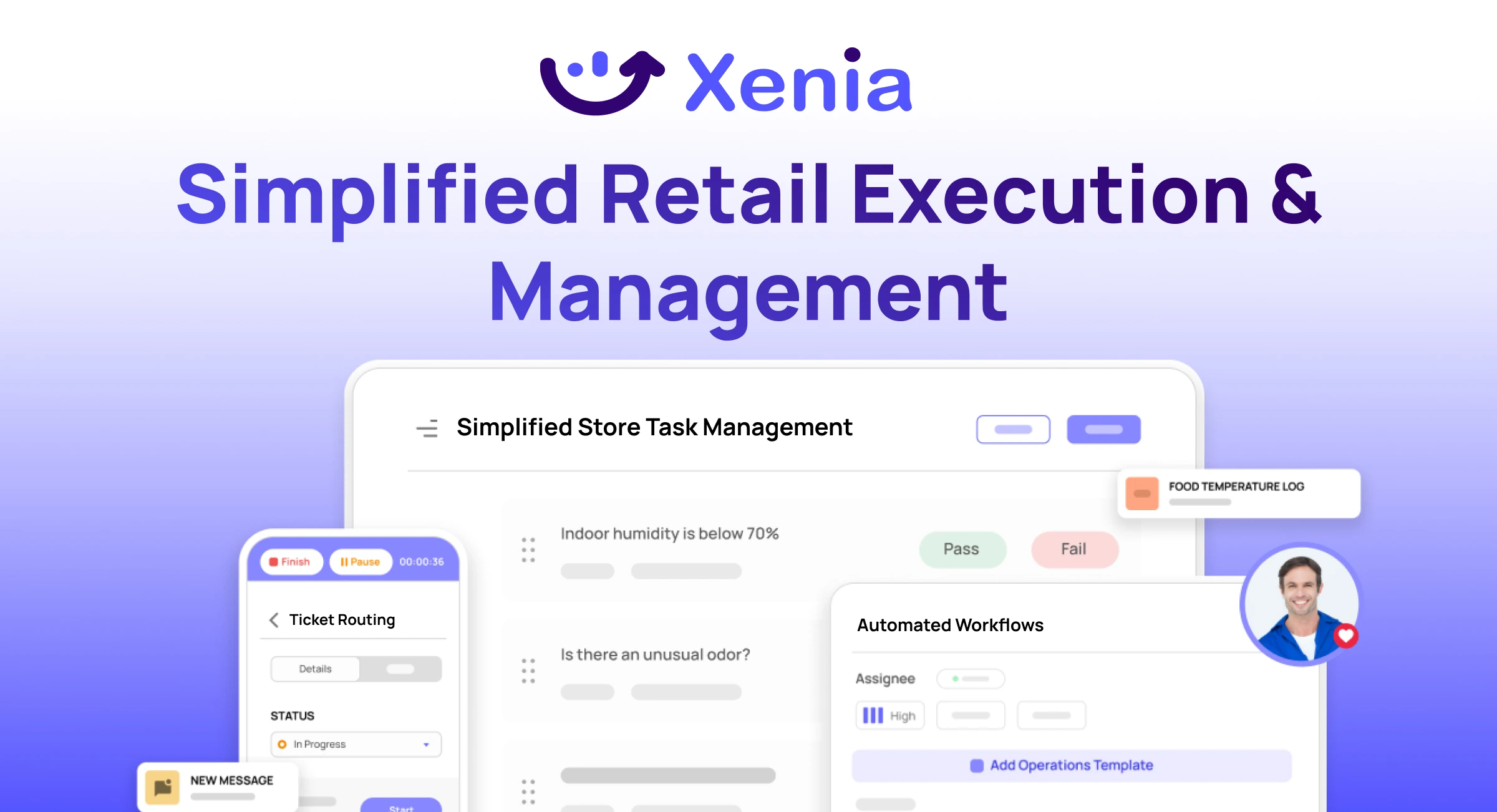
Why Retail Operators Choose Xenia:
🤖 AI-Powered Merchandising, Verify planograms, displays, and brand standards automatically with AI photo analysis. Build digital checklists instantly or convert existing merchandising guides.
🏬 Operations & Loss Prevention, Assign opening procedures, store walks, and resets across locations. Track theft, cash discrepancies, and security incidents with evidence and approval workflows.
📊 Real-Time Visibility, Compare audit scores and task completion across stores. Identify top and underperforming locations. Export reports for leadership reviews.
One platform for operations, merchandising compliance, and loss prevention across all locations.

.svg)
.webp)
%201%20(1).webp)

.svg)
%201%20(2).webp)