

.webp)
Post Summary
It is Sunday night. The schedule is due tomorrow.
A store manager opens a blank spreadsheet. Three time-off requests. One new hire not yet fully trained. Friday night still uncovered. Labor budget already over.
So they do what most managers do. Copy last week, move a few names, and hope for the best.
That is how most schedules get built. From habit, not data. And it is exactly why the same gaps show up on the same shifts every single week.
This article is a step-by-step playbook for building schedules that actually work. Right coverage, right budget, no repeat problems. For the broader strategy and multi-unit systems layer, see the employee scheduling guide.
.webp)
.svg)

Priced on per user or per location basis
Available on iOS, Android and Web


What you need before you build the schedule
Before you open the schedule grid, five inputs need to be confirmed. Gather these first. Then build.
**
Input, What to confirm before you start
Last week's sales or traffic data, What did each day and shift window look like? Any known differences next week?
Confirmed employee availability, Who has restrictions? Who has approved time off? Confirmed-not assumed
Overtime status per employee, Who is close to 40 hours? Schedule them short or create avoidable overtime
Role requirements by shift, Specific roles needed per shift-beyond a headcount target
Compliance constraints, Predictive scheduling windows-break rules-minor work restrictions by market
**
Last week's sales or traffic data by day-part
Pull the actual numbers for what each shift window looked like last week. Then check what is different next week.
A Tuesday with a local event nearby needs a different schedule than a normal Tuesday. Data is the anchor. Habit is not.
Confirmed employee availability
Not assumed availability. Confirmed.
Who has restrictions next week? Who submitted availability changes? Who is on approved time off? Resolve all of this before a single name goes on the grid. Discovering a conflict after the schedule is drafted means rebuilding it from scratch.
Current overtime status per employee
Who is already close to 40 hours coming into the new week?
Scheduling someone sitting at 35 hours for a full five-day week creates overtime exposure that was entirely avoidable. Know the numbers before you build. Not after payroll closes.
Role requirements by shift
List the roles that need to be filled before you assign any names.
A closing shift needs a closer, a kitchen lead, and someone trained on POS. Write that list first. Filling names before defining roles is how you end up with coverage that looks right on paper and falls apart at 9 pm.
Compliance constraints for your market
Predictive scheduling notice windows, break requirements, minor work hour restrictions. These vary by jurisdiction.
They need to be in the schedule from the start. Adding them as corrections after the fact is how violations happen.
How to schedule employees: step by step
Eight steps. In sequence. This is the actual process. What a manager does when they sit down to build the week.
.webp)
Step 1: set your labor budget for the week
Before any names go on the grid, know the labor number you need to hit.
What is the budget for this location this week? What percentage of forecasted sales does that represent? Every scheduling decision flows from this number. Managers who skip this step find the overage in payroll, not in the schedule.
Example: If your location forecasts $50,000 in sales and your labor target is 28%, your budget is $14,000. Every shift you add either fits inside that number or does not.
Step 2: map your demand by shift window
Break the week into shift windows: morning, midday, evening, closing. Note the expected traffic or sales volume for each.
High-demand windows need more coverage. Low-demand windows need less. This is where last week's sales data becomes directly useful. Gut feel is not a substitute for actual numbers.
Example: Your POS data shows Tuesday midday averages $800/hour but Friday evening averages $2,400/hour. Those two shifts need different staffing levels. Building them the same way costs you on Friday and wastes money on Tuesday.
Step 3: define role requirements per shift
For each shift window, list the roles that must be filled. Not the number of bodies. The actual roles.
A Friday evening might need: 1 shift lead, 2 kitchen staff, 3 servers, 1 host. That is the target before any names go in.
**
Shift window, Roles required, Minimum headcount
Opening, Shift lead-2 floor staff-kitchen lead, 4
Midday, Floor staff-kitchen-cashier, 3
Evening peak, Shift lead-3 floor-2 kitchen-host, 7
Closing, Closer-kitchen lead-1 floor, 3
**
Step 4: load availability and time-off first
Mark who is unavailable before assigning anyone. Block approved time off. Flag restricted availability.
Now the schedule grid only shows available employees. This one step eliminates the rebuild that happens when a conflict shows up after the schedule is already drafted.
Example: Three employees have Tuesday restrictions you did not load first. You build the schedule, then discover the conflicts. Now you are rebuilding half the week on Sunday night. Loading availability first takes five minutes. Rebuilding takes two hours.
Step 5: assign your most critical shifts first
Fill the hardest shifts to cover before the easy ones. Friday night. Saturday morning. The shift nobody wants.
Build those first and the rest of the week fills around them. Managers who save the hard shifts for last run out of available, qualified people. Every time.
Example: You need a trained shift lead for Friday, 5 pm close. Only two people qualify. Assign that shift first. If you fill Tuesday morning first, you may have already used both of them elsewhere.
Step 6: check overtime before you finalize
Before publishing, run a total hours check per employee. Anyone at or approaching 40 hours needs to be adjusted.
One hour of preventable overtime per employee per week across a full location is a real annual number. It shows up in payroll, not on the schedule. That is why it keeps happening. Use task management tools that track execution alongside scheduling so both are visible in one place.
Example: An employee is sitting at 38 hours going into Saturday. You schedule them for a 6-hour closing shift. That is 4 hours of overtime you could have avoided by checking before publishing and swapping in someone at 28 hours.
Step 7: use a template for predictable weeks
Once a schedule works well for a normal week, save it.
The following week, adjust for exceptions instead of rebuilding from scratch. Use scheduling templates as the starting point. Templates are not rigid. They are a floor. The manager starting from a template spends 20 minutes adjusting. The one starting from blank spends two hours guessing.
Step 8: publish early and communicate changes
Publish at least seven days in advance. Earlier in jurisdictions with predictive scheduling notice requirements.
When changes happen after publishing, tell the affected employee directly. Updating the schedule without a direct message is not communication.
For operations leaders managing multiple locations, time-off requests and scheduling are the same problem. Our time-off request policy guide covers how to build call-out processes and blackout dates so schedule conflicts stop happening in the first place.
Employee schedule template
Building from scratch every week wastes time. Start with a working template and adjust for exceptions.
Here is a simple weekly schedule template you can adapt for any shift-based location:
What to include in every schedule template:
.webp)
- Employee name and role
- Shift start and end times for each day
- Days off clearly marked
- Total weekly hours per employee
- Any notes on training restrictions or availability limits
A few things that make templates actually useful:
- Save a separate template for your peak week and your standard week. They are different builds
- Flag which shifts require specific roles or certifications so you never accidentally assign an unqualified employee
- Add a column for overtime status so it is visible before you publish, not after payroll runs
Use scheduling templates to get started with pre-built formats for standard weeks, peak periods, and seasonal surges.
Common scheduling challenges and how to handle them
Every manager faces these. Here is what actually works.
Last-minute call-outs
The best defense is a schedule published far enough in advance that employees can arrange coverage swaps themselves.
Beyond that, maintain an on-call list. Employees who have signaled availability for extra shifts can be contacted when a gap opens. The manager calling around at 6am has already run out of good options.
Chronic understaffing on high-demand shifts
If certain shifts are consistently hard to fill, one of three things is usually true:
- The shift is unpopular and nobody wants it
- The pay differential is not enough to make it worth taking
- The rotation is unfair and the same people always end up with it
Rotating shifts equitably distributes the burden. It also removes the perception of favoritism, which is its own morale and retention problem.
Overtime that keeps happening despite awareness
Recurring overtime is almost never a willpower problem. The manager fills gaps with available people who are already near 40 hours because there is literally nobody else.
The fix is upstream. Cross-train more employees to expand the coverage pool. More qualified people available means more options when gaps appear, and less pressure to use people who are already over.
New employees who are not fully available yet
New hires in training should be scheduled alongside experienced employees. A new hire placed in a role-dependent shift they cannot hold independently creates a quality problem even when headcount looks correct.
Schedule new staff to learn. Not to cover.
How to make a schedule employees will actually show up for
Scheduling is one of the top drivers of frontline turnover. Most managers do not realize it. Three practices make a measurable difference.
Publish on time, every week
Consistency in schedule publishing is its own form of respect.
Employees who get their schedule reliably, at the same time each week, plan their lives around it. Employees who never know when the schedule will drop show up less reliably. That connection is direct and well-documented.
Rotate undesirable shifts fairly
When the same employees always work the hardest shifts, they leave.
A rotation system that distributes closing shifts, weekend shifts, and early mornings across the full team reduces both resentment and the perception of favoritism. Both are retention killers.
Give employees visibility into their hours
Employees who can see their schedule, request swaps, and flag availability changes without chasing down their manager feel more in control of their time.
That sense of control is directly linked to retention in hourly frontline environments. It costs nothing to provide. The cost of not providing it shows up in turnover numbers.
For district and regional leaders managing multiple locations, shift structure directly affects call-outs and turnover. Our types of work shifts guide covers rotating, split, and compressed schedules and how each one impacts retention.
Related resources
- Workforce Scheduling Guide
- Shift Swap Policy
- Time Off Request Policy
- Predictive Scheduling Laws
- Types of Work Shifts
- Overtime Laws Explained
- Task Management Software
- Operations Leaders Tools
- General Manager Tools
- Frontline Teams Software
Conclusion
Next Sunday night, the schedule does not have to be built from memory.
It starts with last week's sales data, confirmed availability, role requirements by shift, and a template from a week that worked. The decisions get easier when the inputs are ready before the grid opens.
For managers working within a larger operation, the workforce scheduling guide covers the systems and visibility layer above the store level.
Build the schedule the right way and you stop fixing the same problems every week. See how Xenia works to bring scheduling, task execution, and operations software together in one place.
Frequently Asked Questions
Got a question? Find our FAQs here. If your question hasn't been answered here, contact us.
How do you handle scheduling during peak seasons or understaffed periods?

Do not wait until you are already short. Build a cross-trained backup pool during slower periods. Identify your peak windows early, and publish those schedules further in advance than normal to reduce last-minute call-outs.
Should managers let employees self-schedule or swap shifts freely?
Yes, but with a written policy. Peer-to-peer swaps solve coverage gaps before they reach the manager. Without a policy, you get overtime violations, unqualified staff in key roles, and missing documentation. A clear shift swap policy handles all of that.
How many shifts should one employee work per week?
Four to five for full-time. Three or fewer for part-time. Watch for back-to-back closing and opening shifts. They are a fast track to call-outs and burnout. Some markets require written consent for clopening shifts before the schedule posts.
How do you schedule part-time and full-time employees on the same team?
Build around full-time commitments first, then fill gaps with part-time hours. Track both separately. The common mistake is treating everyone the same and accidentally pushing part-timers over ACA thresholds or leaving full-timers under their guaranteed minimum.
What is the best day of the week to publish employee schedules?
Most managers publish on Friday or Saturday. That gives employees the weekend to review and arrange swaps before Monday. The specific day matters less than picking one and sticking to it every week.

A Modern, AI-Powered Platform Built Specifically for Frontline Operations
Xenia brings daily operations, maintenance, audits, and compliance into one mobile-first platform. Frontline teams execute work consistently across locations while leadership gets real-time visibility.
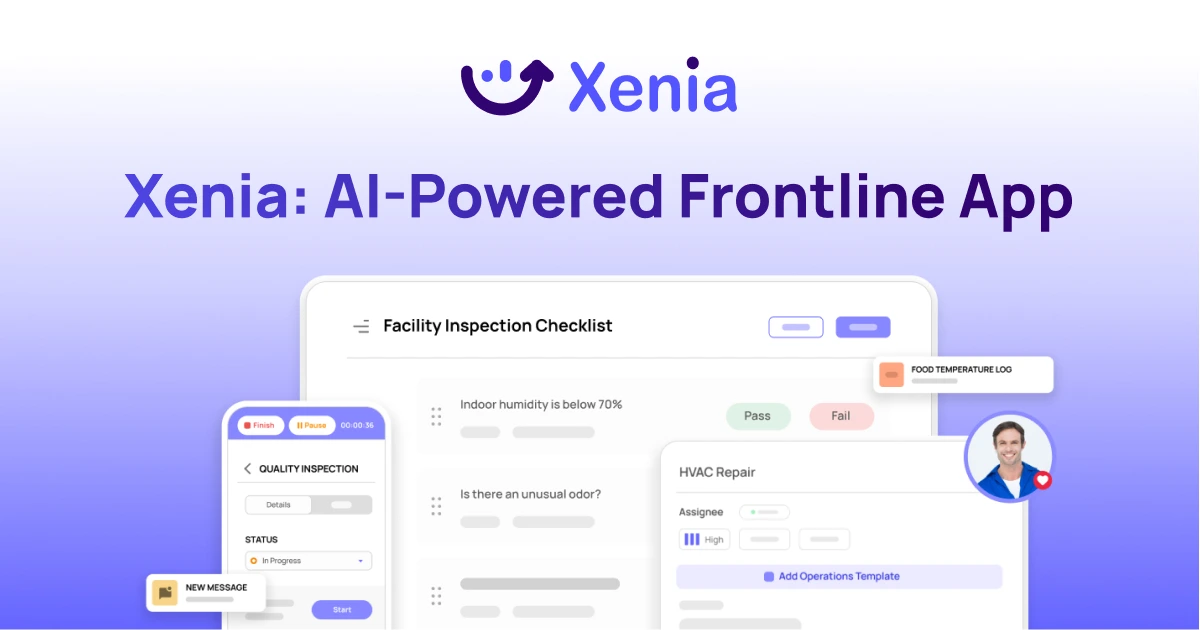
Why Multi-Location Operators Choose Xenia:
🤖 AI-Powered Operations, Create digital checklists instantly or convert paper forms with AI. Verify compliance automatically with photo analysis and get instant answers from your operational data.
✅ Daily Operations & Maintenance, Assign work across hundreds of locations in minutes. Report and route issues instantly. Schedule preventive maintenance to catch problems before downtime.
📊 Real-Time Visibility, Track completion, work orders, and performance across all locations through dashboards. Filter by site or asset to spot trends and take action.
Manage operations, maintenance, and compliance across all your locations from one platform

.svg)
.webp)
%201%20(1).webp)

.svg)
%201%20(2).webp)