
.webp)
Post Summary
A district manager approves eight schedules on a Monday morning. Does not review a single one. Shifts look covered on paper. By Thursday, labor is 11% over budget.
Nobody flagged it before it ran.
This is not unusual. Labor is the largest controllable cost in frontline operations. For restaurants, it is one of the highest labor-to-revenue ratios of any industry. For retail, it takes up a significant share of every dollar earned.
A 2% scheduling inefficiency at a 50-location operation spending $20M on labor is $400,000 in avoidable cost. It shows up slowly. One overscheduled shift at a time.
This guide covers the fundamentals, challenges, and systems behind employee scheduling at scale. For the step-by-step process of building a schedule at the store level, see how to schedule employees effectively.
How mature is your scheduling operation?
- Do managers build schedules from demand data, or copy last week?
- Does your district manager review labor cost before approving, or just headcount?
- Do you have one scheduling standard applied consistently across every location?
- Can you see labor budget tracking in real time, before payroll closes?
- Do employees get their schedules at least seven days in advance, every week?
If you answered no to more than two, keep reading.
.svg)

Priced on per user or per location basis
Available on iOS, Android and Web


What is employee scheduling and why does it matter?
Employee scheduling is the process of assigning employees to shifts, roles, and locations based on demand, availability, compliance, and labor budget.
That is the definition. Here is why it matters more than most operators treat it.
Scheduling is not an HR admin task. It is an operations decision made dozens of times per week, across every location, by managers with different skill levels and no shared standard.
Get it right and labor stays within plan, coverage matches demand, and the team runs without firefighting. Get it wrong and the costs show up fast.
The cost of a bad schedule
**
Problem, Direct cost, Compounding effect
Overstaffing, Labor hours paid without revenue to support them, Repeated weekly across all locations
Understaffing, Lost sales-poor service-employee burnout, Turnover increase-training cost increase
Overtime exposure, 1.5x or 2x pay for unplanned hours, Compounds across large hourly workforces
Compliance gaps, Fair workweek violations-minor labor violations, Fines-back wage liability-DOL exposure
Late schedule publication, No-shows-call-outs-last-minute scrambling, Overtime to cover gaps-productivity loss
**
The components of an effective employee schedule
A completed schedule is not the same as an effective schedule. Most schedules look complete on paper and fall apart in execution because they skipped one or more of these components.
Shift coverage mapped to demand
Headcount is not coverage. Four people on a shift is not coverage if none of them are trained for the key station. Or if the shift window does not match the demand window.
A Friday evening needs different coverage than a Tuesday midday. A holiday weekend needs different coverage than a standard week. Coverage that is not mapped to demand produces either over-staffing or under-staffing on a predictable, repeating cycle.
The fix: break the week into shift windows and map coverage requirements to what each window actually needs, not to a default headcount.
Employee availability and time-off requests
Availability should be confirmed before the schedule is built, not discovered while filling shift slots.
An employee scheduled for hours they cannot work is a conflict waiting to happen. Three of those in the same week and the schedule has to be rebuilt from scratch. That is exactly the scenario from the intro.
For the full process on collecting and managing availability, see the employee availability guide.
Skill and certification matching
The right number of bodies on a shift is not the same as the right skill mix.
A closing shift needs a closer. A kitchen shift needs someone trained for that station. A shift supervisor role cannot be filled by a new hire three days into onboarding. A schedule that ignores skill requirements looks fine until the shift starts.
Effective schedules assign by role requirements first. Availability is a prerequisite, not the only criteria.
Compliance rules baked in
Compliance requirements belong in the schedule before it publishes, not as corrections after.
What needs to be applied at build time:
- Overtime thresholds: who is approaching 40 hours this week
- Minor labor laws: hour restrictions and prohibited shift types by age
- Fair workweek notice windows: how far in advance the schedule must be published
- Break and meal period requirements: these vary by state and must be built in, not added after
Compliance issues caught at build time are free to fix. Compliance issues caught after payroll runs cost money and sometimes legal exposure.
For overtime classification context, see the salary vs hourly guide. For shift length cost implications, see the double time pay guide.
Publication timing
A schedule published two days before the week starts produces more no-shows and call-outs than one published seven days out.
Employees who get their schedule late plan around other commitments. Managers who publish late spend the first two days of the week filling gaps.
Some jurisdictions require advance notice under predictive scheduling laws. Everywhere else, publishing early is the cheapest reliability improvement any manager can make.
For the step-by-step process a store manager follows to build a schedule that hits coverage and stays in budget, see how to schedule employees effectively.
Employee scheduling for small business vs enterprise operations
The fundamentals of scheduling do not change by size. The problems that dominate attention do.
Small business (1-5 locations)
The biggest need is simplicity. One manager, one schedule, minimal overhead.
Free tools cover the basics: a shared calendar, a simple grid, mobile access. They work for small teams with stable demand and low compliance exposure.
What they do not cover: forecast integration, HRIS sync, compliance engines, rollup reporting, or real-time labor budget tracking.
For five employees at one location, those gaps are fine. For a growing operation heading toward 10 locations, they start to matter fast.
Mid-market (5-50 locations)
Coordination across managers becomes the core problem. Each manager builds their own schedule their own way. Inconsistency in quality, compliance, and labor cost compounds across the portfolio.
The tool is not the constraint. The process and the standard are. An operation with 20 locations and no shared scheduling standard is running 20 different scheduling operations. Most mid-market operators have no visibility into which end of that quality range they are on.
Enterprise (50+ locations)
Scheduling is a data problem at this scale.
An operator spending $40M on labor where 1-2% inefficiency costs $400K-$800K does not need a better grid. They need:
- Forecast ingestion connected to the scheduling layer
- HRIS integration with Workday, ADP, and UKG
- A compliance engine that applies state-specific rules by location automatically
- Rollup reporting that surfaces labor variance by district before the week closes
- District manager visibility into schedule quality before approving, not after
The operators who protect margin at this scale treat scheduling as infrastructure, not administration.
AI-assisted schedule generation shifts the manager's role from building from scratch to reviewing a data-informed draft. That is where Xenia's predictive scheduling operates: giving operators schedule intelligence before shifts run, not after payroll closes.
Why complexity compounds with location count
At one location, a skilled manager can hold all of this in their head. At five locations, inconsistency appears. At 20, the range between the best and worst manager's schedules becomes a measurable cost gap. At 100 locations, scheduling is a data problem. Gut feel does not scale.
**
Location count, What breaks
1-5 locations, Individual manager skill determines schedule quality
5-20 locations, No shared standard produces inconsistent outcomes across sites
20-100 locations, No real-time visibility means problems show up in payroll-not in schedules
100+ locations, Without data infrastructure-scheduling decisions are made blind
**
For the systems and visibility layer above the store level, see the workforce scheduling guide.
Employee scheduling challenges in multi-unit operations
Single-location scheduling problems are visible and fixable. Multi-unit scheduling problems compound quietly across every pay period before anyone sees them.
Schedule quality variance across managers
Every operation has a best scheduler and a worst scheduler. At one location, that difference is manageable. At 30 locations, the gap is a real number in the P&L. Most operators cannot tell you which locations are generating that variance.
Without a shared standard and visibility at the location level, quality variance is invisible. It shows up in labor variance reports weeks later.
District managers approving schedules without reviewing them
This is the most common accountability gap in multi-unit scheduling.
A district manager approving eight schedules in a Monday morning inbox review is not reviewing schedules. They are rubber-stamping them. There is no labor cost review. No overtime flag. No coverage quality check. Just a tap to approve.
Real approval requires seeing labor cost against budget, overtime exposure, and coverage quality before the schedule runs. Most district managers do not have that view because the tools do not surface it.
No real-time labor budget visibility during the week
By the time a weekly labor variance shows up in a report, the money is already spent and the week is over.
Real-time labor tracking during the week gives managers and district managers a chance to adjust before payroll closes. Without it, the only feedback loop is historical. And historical feedback does not prevent next week's overage.
High turnover disrupting schedule continuity
In hourly frontline operations, turnover is a scheduling problem as much as an HR problem.
New employees need to be scheduled against their actual skill level and training status. Not the role requirements of the position they were hired for. A new hire placed in a role-dependent shift they cannot hold creates a quality coverage problem even when headcount looks correct.
Employees floating across multiple locations
An employee working at two locations owned by the same employer in the same workweek has their hours aggregated for overtime purposes. A manager at one location scheduling that employee without visibility into their hours at the other location is creating overtime exposure they cannot see.
Multi-unit operators need total weekly hours per employee across all sites, not per site in isolation.
Inconsistent policy application across locations
OT rules, break policies, premium pay, fair workweek notice windows. Inconsistent application creates compliance exposure at the inconsistent sites. Legal liability follows if it surfaces in a claim or audit.
For the step-by-step scheduling process at the store level, see how to schedule employees effectively.
Employee scheduling software: what to look for
This is not a product review. It is a buyers' framework for evaluating any scheduling tool against what your operation actually needs.
**
Capability, Why it matters, Who needs it most
Mobile-first access, Frontline managers and employees need schedule access on their phones, Everyone
Demand and forecast integration, Builds schedules from actual data-not last week's copy, 10+ locations
HRIS and payroll sync, ADP-Workday-UKG-Paylocity-7shifts. Eliminates double entry, Any operation with dedicated HR systems
Compliance engine, State-specific OT rules-fair workweek-minor labor laws applied automatically, Multi-state operators
Real-time labor budget tracking, Managers see cost against budget before publishing-not after payroll, Any operator managing to a labor budget
Shift swap and drop, Employee self-service reduces manager overhead on schedule changes, High-volume hourly environments
Rollup reporting for DMs, District and regional visibility into schedule quality and labor cost, 5+ locations
AI schedule generation, Draft schedules built from demand data and historical patterns, Enterprise operators at scale
**
On free tools
Free scheduling tools work for small operators who need a shared grid and mobile access. They do not provide forecast integration, compliance automation, HRIS sync, or multi-location visibility. The constraint is not cost. It is capability. What works at five employees does not work at 500.
Recommended resources
- How to Schedule Employees Effectively
- Employee Availability Guide
- Workforce Scheduling Guide
- Shift Swap Policy
- Time Off Request Policy
Conclusion
Scheduling is the most repeated operational decision in a frontline business. Made weekly. Across every location. By managers with varying skill levels and no shared standard.
The gap between the best and worst scheduler in a 30-location operation is a real number in the P&L. Most operators find out which locations are creating labor variance after payroll closes. Not before.
The operators who protect margin at scale treat scheduling as a data problem. They build from demand. They check budget before publishing. They give district managers visibility before shifts run.
That is what good scheduling looks like. Not a grid. A system.
See how Xenia helps multi-unit operators build smarter schedules, track labor budgets in real time, and give district managers the visibility they need before shifts run.
Frequently Asked Questions
Got a question? Find our FAQs here. If your question hasn't been answered here, contact us.
What is a scheduling policy and does every operator need one?

A scheduling policy defines how schedules are built, published, and changed across your operation. Every multi-location operator needs one in writing. Without it, each manager runs their own informal standard. That inconsistency is both a compliance risk and a quality problem.
How do you handle scheduling across different time zones?
Track everything in local time at the location level. Hours are still aggregated across sites for overtime purposes. Scheduling systems need to display local time per location to avoid coverage errors and compliance gaps.
What records do employers need to keep for employee scheduling?
Published schedules, actual hours worked, and any post-publication changes. The FLSA requires payroll records for at least three years. Fair workweek jurisdictions require additional documentation. These records matter most when a wage claim or audit surfaces.
Can managers schedule employees for split shifts without their consent?
In most US. states, yes. Some states like California require a split shift premium when total wages fall below the minimum wage threshold. Verify the rules in each market before making split shifts a standard rotation.

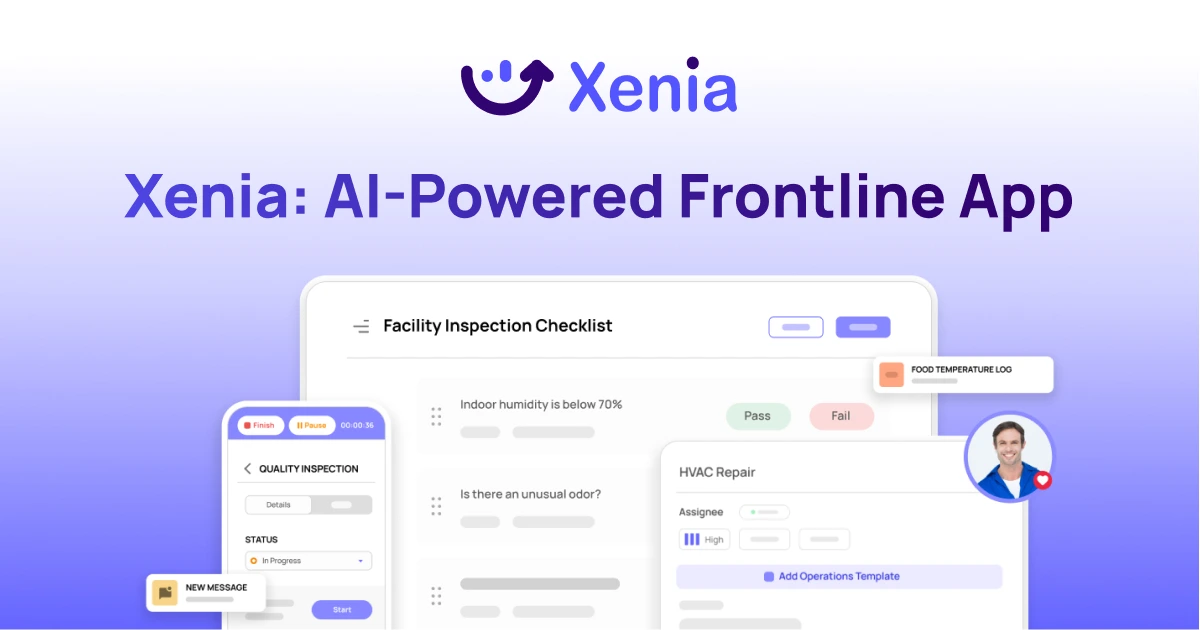
A Modern, AI-Powered Platform Built Specifically for Frontline Operations
Xenia brings daily operations, maintenance, audits, and compliance into one mobile-first platform. Frontline teams execute work consistently across locations while leadership gets real-time visibility.
Why Multi-Location Operators Choose Xenia:
🤖 AI-Powered Operations, Create digital checklists instantly or convert paper forms with AI. Verify compliance automatically with photo analysis and get instant answers from your operational data.
✅ Daily Operations & Maintenance, Assign work across hundreds of locations in minutes. Report and route issues instantly. Schedule preventive maintenance to catch problems before downtime.
📊 Real-Time Visibility, Track completion, work orders, and performance across all locations through dashboards. Filter by site or asset to spot trends and take action.
Manage operations, maintenance, and compliance across all your locations from one platform

.svg)
.webp)
%201%20(1).webp)

.svg)
%201%20(2).webp)