

.png)
Post Summary
The payroll manager did not catch it right away.
A multi-location hospitality group had salaried shift managers across several properties. All paid a flat weekly rate. No overtime tracked. No exemption analysis ever done.
When someone finally ran the numbers, the problem was clear. Those shift managers did not meet the federal exemption threshold. Every overtime hour they worked over the past two years may have been owed at 1.5x their regular rate. Across multiple locations. Retroactively.
That is not a payroll error. That is a compliance gap that compounded quietly across the portfolio until it became a liability.
This article covers what overtime law requires, when double time applies, what hazard pay means, and where multi-unit operators most commonly get it wrong.
.webp)
.svg)

Priced on per user or per location basis
Available on iOS, Android and Web


What federal overtime law actually requires
The Fair Labor Standards Act sets the floor for overtime in the United States. Every employer must meet it regardless of state. States can go higher. They cannot go lower.
The core rule: non-exempt employees must be paid at least 1.5 times their regular rate for every hour worked over 40 in a workweek.
In practice, operators get tripped up on three things: what a workweek is, what counts as hours worked, and what goes into the regular rate. All three are worth understanding before you build any scheduling or payroll process around them.
The 40-hour workweek threshold
Federal overtime triggers at 40 hours per workweek. Not per day. Not per pay period. Per workweek.
A workweek is a fixed, recurring 168-hour period that the employer sets. Once set, it cannot be changed to avoid overtime. Three things operators often get wrong here:
- You cannot average hours across two weeks to avoid an overtime obligation
- A biweekly pay period does not change the weekly calculation
- Each workweek is calculated on its own
An employee working 50 hours one week and 30 hours the next is owed 10 hours of overtime for week one. The average across both weeks is irrelevant.
What counts as hours worked
Hours worked goes beyond what the clock shows. Under FLSA, it includes any time the employer requires, suffers, or permits an employee to work.
In frontline operations, that often means more than most operators expect:
**
Activity, Counts as hours worked?
Pre-shift opening procedures, Yes-if required by employer
Post-shift closing tasks, Yes-if required by employer
Required training, Yes
On-call time (restricted), Yes-if employee cannot use time freely
Meal breaks (30+ min, fully relieved), No
Voluntary overtime without authorization, Depends on employer knowledge
**
Multi-unit operators with mandatory opening and closing procedures need to make sure that time is captured in every location's timekeeping system. This is one of the most common sources of wage claims in frontline industries.
What goes into the regular rate
The regular rate is not always the base hourly wage. This is where a lot of overtime calculations go wrong.
Non-discretionary bonuses, shift differentials, and certain other compensation must be included in the regular rate before the overtime multiplier is applied. A flat lump sum payment does not satisfy overtime obligations regardless of the dollar amount.
What belongs in the regular rate:
- Base hourly wage
- Non-discretionary bonuses (performance-based, attendance bonuses)
- Shift differentials
- Certain commissions
What does not belong:
- Discretionary bonuses
- Gifts not tied to hours or performance
- Expense reimbursements
Use a time and a half calculator to apply the correct rate once you have confirmed what goes into it.
Exempt vs non-exempt: who overtime law covers
This is where most multi-unit operator errors begin. Exemption is a legal test. It is not a choice and it is not a job title.
Calling someone a manager does not make them exempt. Paying someone a salary does not make them exempt. Three tests must all be met at the same time:
**
Test, What it requires
Salary level, Must earn at or above the federal minimum salary threshold
Salary basis, Must receive a fixed salary not tied to hours worked
Duties test, Must primarily perform executive-administrative or professional duties
**
Two things to verify before applying any exemption:
- The salary threshold has been subject to regulatory changes and legal challenges. Confirm the currently enforceable figure at DOL.gov before applying it
- Some states set higher thresholds than the federal. Multi-state operators must apply whichever standard is higher
The duties test is where most misclassification happens in restaurants and retail. A shift manager who primarily runs a register or works alongside hourly staff may not qualify for the executive exemption. Title and pay level do not determine it.
For the full classification framework, role-by-role risk breakdown, and duties test detail, see salary vs hourly classification.
Overtime vs double time: what the law requires
Federal law does not require double time. It requires time and a half for hours over 40 per workweek. Double time is either a California state law requirement or an employer policy obligation. These are not the same thing.
Here is how the pay tiers map to legal requirements:
**
Pay rate, Multiplier, When required
Regular pay, 1x, Standard scheduled hours
Time and a half, 1.5x, Federal law: hours over 40 per workweek
Daily overtime, 1.5x, California: hours over 8 in a single workday
Double time, 2x, California: hours over 12 in a workday or 7th consecutive day
Double time, 2x, Employer policy or collective bargaining agreement
**
California is the only state that mandates double time by law. Outside California, it is a policy or contractual obligation. Legal requirements cannot be waived. Policy obligations can be changed with proper notice. Knowing which category applies at each location matters before any policy change is made.
For the full California breakdown, calculation formulas, and cost modeling at scale, see double time pay.
Overtime rules for salaried employees
A salary does not equal overtime exemption. If a salaried employee fails the duties test or the salary level threshold, they are non-exempt and owed overtime for every hour over 40.
This is exactly the situation from the intro. Salaried shift managers. Flat weekly rate.
No overtime tracked. No exemption analysis run. The back wage exposure built quietly across two years.
There are two methods for calculating overtime for non-exempt salaried employees. The method must be established in writing before it is applied.
The fluctuating workweek method
Under this method, a fixed salary covers all hours worked in a week regardless of how many. Overtime is paid at a half-time premium on top of the salary, because the salary already covers the straight-time portion of those hours.
What operators need to know before using this method:
- Must be clearly established in writing with the employee's agreement
- Some states do not permit this method
- Verify state-specific permissibility before implementing
- The calculation is less intuitive and can create confusion for employees
Fixed salary for fixed hours
Under this method, a salary covers a defined number of hours per week. If the employee works more, overtime is calculated on the hourly equivalent at 1.5x for hours over 40.
This approach is more consistent and easier to explain across multiple locations. Employees understand what their salary covers and what triggers additional pay.
For multi-unit operators running large workforces across different markets, that clarity reduces payroll errors and employee disputes.
What is hazard pay and when is it required?
No federal law requires hazard pay. The FLSA does not mandate it. Employers who pay it do so by policy or contract.
Some states enacted temporary hazard pay mandates for certain industries during public health emergencies. Whether any are currently active depends on jurisdiction and timing. Verify current state-level requirements before publishing.
The compliance point most operators miss: non-discretionary hazard pay must be included in the regular rate before calculating overtime. Paying hazard pay on top of base wages while calculating overtime on base wages alone is a compliance gap.
Overtime rules for 12-hour shifts
Federal law does not restrict shift length. There is no federal cap on daily hours. A 12-hour shift is legal. Overtime triggers at weekly hours over 40, not daily shift length.
California is the exception to all of this.
Federal rule: weekly threshold only
Under federal law, a 12-hour shift does not automatically trigger overtime. What matters is total weekly hours:
**
Weekly schedule, Total hours, Overtime owed
Four 12-hour shifts, 48 hours, 8 hours at 1.5x
Three 12-hour shifts, 36 hours, None
Five 10-hour shifts, 50 hours, 10 hours at 1.5x
**
State meal and rest break laws apply separately. Long shifts trigger break obligations in many states regardless of overtime status.
California and daily overtime
California has its own set of rules that apply on top of federal law:
- Time and a half for hours over 8 in a single workday
- Double time for hours over 12 in a single workday
- Both obligations apply regardless of total weekly hours
A 12-hour shift in California triggers daily overtime for hours 8 through 12 and double time beyond hour 12. A scheduling model built purely around the federal 40-hour threshold will be wrong in California.
Where multi-unit operators get overtime wrong
These are the four mistakes that show up most often across multi-unit operations.
Applying one classification standard across all locations
Duties vary by location even when the job title is the same. A blanket exempt classification across 50 locations may hold up at 40 of them and fail at 10.
Each location's actual role must independently satisfy the duties test. Title-based classification without a location-level review is what puts operators in front of a DOL auditor.
Missing state overtime rules that exceed federal
Several states require daily overtime, have lower weekly thresholds, or mandate double time beyond what federal law requires. Operators in California, Alaska, Nevada, and other states must apply the higher state standard.
Overtime triggered across multiple locations in the same workweek
If an employee works at two locations owned by the same employer in the same workweek, those hours are aggregated for overtime purposes. The employer cannot treat each location as its own separate weekly calculation.
Multi-unit operators must track total weekly hours per employee across all sites. This gap shows up most often in operations where scheduling is managed at the location level with no cross-site visibility.
No audit trail for hours worked
When a DOL investigation happens, the employer needs records. If records are incomplete or missing, the employee's own account of hours worked may be accepted as evidence.
Employee accountability systems that capture time, tasks, and shift documentation build the paper trail that makes the employer's position defensible. Compliance tracking across every location means documentation exists before it is needed, not assembled under pressure after a complaint is filed.
Related resources
- Double Time Pay
- Salary vs Hourly Pay Guide
- Timesheet Guide
- Types of Work Shifts
- Workforce Management Best Practices
Conclusion
The payroll manager who found the misclassified shift managers was not dealing with fraud. Nobody skipped overtime on purpose. They just treated everyone with that job title the same way without checking if the duties actually matched at each location. That gap built up across two years.
That is how most overtime compliance problems happen in multi-unit operations. One wrong assumption, applied at 30 locations, creates a liability no single store would have hit on its own.
Xenia helps multi-unit operators manage HR workflows, compliance tracking, and employee accountability across every location. Book a demo to see how it works.
Frequently Asked Questions
Got a question? Find our FAQs here. If your question hasn't been answered here, contact us.
Are overtime violations covered by a statute of limitations?

Yes. Under the FLSA, employees have two years to file a claim. Willful violations extend that to three years. State laws may go longer. For multi-unit operators with systemic errors, exposure runs backward from the date of the claim.
What is the difference between daily overtime and weekly overtime?
Weekly overtime triggers at 40 hours per workweek regardless of how hours are spread across days. Daily overtime is a state rule. California, Alaska, and Nevada require overtime beyond a daily threshold, usually 8 hours, regardless of total weekly hours. An employee in California can work 35 hours in a week and still owe daily overtime.
Does overtime apply to tipped employees?
Yes. Tipped non-exempt employees are owed overtime at 1.5x their regular rate for hours over 40. The regular rate includes both the cash wage and the tip credit. Calculating overtime on the cash wage alone is a common mistake.
Can an employer change the workweek to avoid overtime?
No. Once established, a workweek cannot be changed to avoid overtime. The DOL treats a pattern of shifting workweek boundaries around high-hour periods as an audit red flag. Any legitimate change must be applied consistently and documented.

A Modern, AI-Powered Platform Built Specifically for Frontline Operations
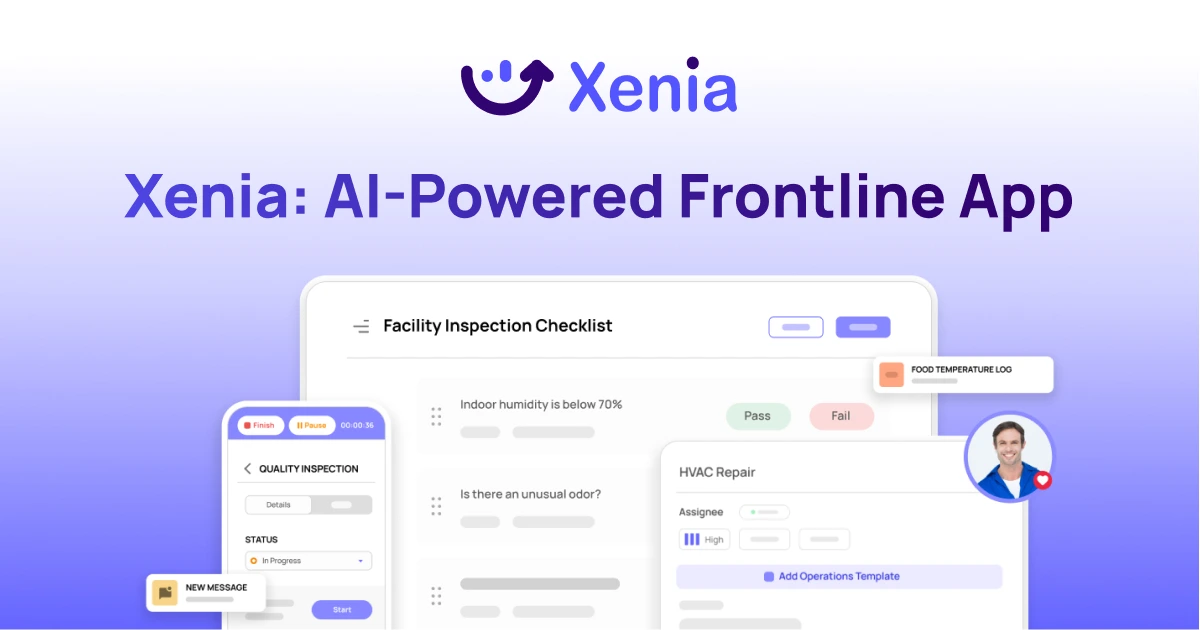
Xenia brings daily operations, maintenance, audits, and compliance into one mobile-first platform. Frontline teams execute work consistently across locations while leadership gets real-time visibility.
Why Multi-Location Operators Choose Xenia:
🤖 AI-Powered Operations, Create digital checklists instantly or convert paper forms with AI. Verify compliance automatically with photo analysis and get instant answers from your operational data.
✅ Daily Operations & Maintenance, Assign work across hundreds of locations in minutes. Report and route issues instantly. Schedule preventive maintenance to catch problems before downtime.
📊 Real-Time Visibility, Track completion, work orders, and performance across all locations through dashboards. Filter by site or asset to spot trends and take action.
Manage operations, maintenance, and compliance across all your locations from one platform

.svg)
.webp)
%201%20(1).webp)

.svg)
%201%20(2).webp)