

Post Summary
The manager needs to complete a disciplinary form. The only tablet available is the one near the register, the same one floor staff use all shift for checklists and task completions.
She logs in, opens the form, and starts filling it in. When she is done, she walks away. The tablet stays at the counter.
The next person who picks it up and logs in is a floor staff employee. Depending on how the platform is configured, they may be able to navigate to the same HR section. The disciplinary record. The incident report. The coaching note from last week.
Not because they went looking for it. Because there is nothing stopping them from finding it.
Shared devices are standard in multi-location retail, restaurant, and c-store operations. One tablet per location is cheaper than one per role. But when HR workflows and frontline ops workflows live on the same device without role-based access control, any logged-in user can access any form the platform holds.
The answer is not buying more tablets. The answer is role-based access control implementation that determines what each login can see, at the platform level, on any shared device.

.svg)

Priced on per user or per location basis
Available on iOS, Android and Web


Related Resources
- How to roll out an operations platform to frontline teams without adoption failing
- How multi-unit operators manage location hierarchy and permissions
- How HR workflows connect to frontline operations
- What the full operations execution layer actually includes
Why do shared tablets create HR form privacy risks in multi-location operations?
Most multi-location operators run one or two shared tablets per location. That makes sense for daily ops. A checklist app near the prep station. A task completion tool at the manager's desk. Floor staff and managers use the same device throughout the shift.
The problem starts when HR workflows move onto the same device.
A coaching record after a customer complaint. A disciplinary form following a policy violation. An incident report for a workplace injury. These documents are confidential. In most jurisdictions, they carry legal protections. Employees have rights around who can access records about them.
On a shared tablet without role-based access control, confidentiality depends entirely on whoever happens to be nearby when the form is open. There is no technical barrier between a floor staff login and a manager-only form. If the session is left open, anyone can scroll. If the device gets picked up between tasks, whatever is on screen is visible.
The typical workaround is a separate device for HR workflows. A dedicated tablet that only managers can access. That solves the privacy problem but creates a hardware problem: procurement, device management, and IT overhead at every location in the portfolio.
RBAC implementation at the software layer solves it without any additional hardware. For operators who are also thinking about how platform consolidation affects access control decisions, how restaurant operations tool consolidation works in practice covers the broader platform context.
What does role-based access control actually mean on a shared ops tablet?
Role-based access control, or RBAC, means what a user can see and do on a platform is determined by their login role, not by which device they are using.
On a shared tablet ops environment, it works like this:
**
Login role, What is visible, What is hidden
Floor staff, Opening checklists-task completions-ops forms, HR forms-disciplinary records-incident reports
Shift manager, All floor staff views plus HR forms for their location, HR forms for other locations-admin settings
District manager, All location views in their portfolio, Admin-level platform settings
Admin, Full platform access, Nothing
**
The floor staff employee logs in. They see the ops workflows for their role. The HR section does not appear. It is not hidden behind a password prompt. It simply does not exist in their view.
The manager logs in on the same device. Their role surfaces the manager-only forms alongside the standard ops workflows. They complete the disciplinary form. They log out.
The next floor staff employee picks up the tablet. They see their own view. The previous session is gone. The HR form is invisible.
That is what role based access control looks like in practice on a shared device. Same hardware. Different access layer. Different experience per login.
Auto-logout on inactivity is the other half of this. If a manager walks away mid-session, the platform logs them out after a configured inactivity window. No open session. No browsing residue for the next person to inherit.
What does the compliance risk look like when access control is absent?
The legal exposure from uncontrolled access to HR forms on shared devices is not theoretical. It shows up in three specific ways.
An employee sees their own disciplinary record before a formal review. A floor staff member scrolls past an open form and sees notes from their manager documenting a performance issue. Even if the documentation is accurate, the manner of disclosure creates grounds for a hostile workplace claim. The content is not the issue. The access is.
An incident report is visible before an investigation is closed. A workplace injury or harassment complaint under active investigation should not be accessible to anyone outside that process. On a shared device without tablet access control, the form is one screen tap away from anyone who picks up the device.
There is no audit log proving who accessed what. When a privacy complaint surfaces weeks later, the question is not just who saw the document. It is whether you can prove who did not. Without a timestamped access log, the answer is usually no. That absence of documentation becomes its own liability.
HR form privacy is not just an operational preference. It is a compliance requirement in most multi-location environments. It needs to be enforced at the platform level, not through behavioral expectations on a shared device.
This is one reason why how location hierarchy and permissions work at the platform level matters beyond just operational visibility.
How do you implement RBAC for HR forms without a separate MDM deployment?
Mobile device management, or MDM, is the traditional IT answer to shared device control. It works at the hardware level: locking apps, restricting screen access, managing device enrollment. It is also expensive, IT-intensive, and requires ongoing management per device at every location.
RBAC implementation at the platform level does not require MDM. It works regardless of how the device is managed at the hardware layer. Here is what the implementation involves.
Step 1: Define your role taxonomy
Most multi-location operators need three to four roles. Floor staff, shift manager, location manager, and district or regional manager. Each role gets a defined permission set. Build the roles around how your organization actually works, not how a generic IT template describes it.
Step 2: Assign form-level visibility by role
Every form and workflow in the platform gets a role assignment. Ops checklists visible to all roles. HR forms, disciplinary records, incident reports, and coaching documentation assigned to manager roles and above. Floor staff role never surfaces those forms.
Step 3: Configure inactivity auto-logout at the org level
Set a session timeout that applies across all locations from a single configuration. When a device is inactive past the defined window, the platform logs out the current user automatically. No manual setup per site.
Step 4: Enable access logging for sensitive forms
Every interaction with a sensitive form, view, edit, or submission, generates a timestamped log attributed to the logged-in user. That log answers questions in an investigation or legal review without anyone having to reconstruct events from memory.
Here is how the two approaches compare:
**
Approach, Cost, IT overhead per site, Access by role, Audit trail
Separate device per role, High-hardware purchase, Medium-device enrollment, Yes, No
MDM on shared device, Medium-licensing, High-per-device config, Partial, No
Platform-level RBAC, Low-no hardware, None after initial setup, Yes, Yes
**
Platform-level RBAC is the only approach that gives you role-separated access and a documented audit trail without adding hardware or per-site IT work.
For operators rolling out a new ops platform at the same time, how frontline platform rollouts connect to access control decisions is worth reading alongside this implementation guide.
What does consistent role-based access control make possible across a multi-location group?
When RBAC is implemented at the platform level and enforced across all locations, three things change.
Managers complete HR forms on any tablet at any location. A district manager visiting a store fills out a coaching record on the local shared tablet. Their role determines what they see. The next floor staff employee who picks it up sees nothing they should not see.
The org-wide access policy enforces itself without IT intervention per site. The permission structure is set once at the platform level. Every location inherits it. Adding a new location does not require a separate device configuration.
The audit trail is ready for HR investigations and legal review. Who accessed which form, when, and what they did with it. That documentation is the difference between a defensible position and an avoidable exposure.
The broader picture of how HR workflows connect to frontline operations in a unified platform shows why access control and operational workflows belong in the same system.
How does Xenia solve HR form privacy on shared operations tablets?
Xenia solves this at the login level, not the device level.
HR forms do not appear in a floor staff session. They do not exist in that view. The manager logs in and sees manager-only forms alongside standard ops workflows. The floor staff employee logs in on the same device and sees only what their role permits. No second device needed.
Role-gated workflows run on a single shared tablet. Every HR form interaction is logged with a timestamp and user attribution automatically. That log is available for HR investigations and legal review without any manual tracking.
The permission structure is set once and applied to every location automatically. A new location inherits the same access rules as every other site without any per-site configuration.
Book a demo with your HR and ops use case.

Conclusion
Shared tablets make operational sense. The problem is what happens when HR workflows and floor staff workflows share the same device without any access control between them.
Role-based access control at the platform level fixes this without new hardware or MDM. The login role determines the view. The session clears on inactivity. The audit trail tracks every sensitive interaction. The policy enforces itself across every location.
Xenia is built for exactly that. One platform, role-separated workflows, org-wide permissions, and an access log that protects the business.
Book a demo with your HR and ops use case and see the role-based access workflow live.
Frequently Asked Questions
Got a question? Find our FAQs here. If your question hasn't been answered here, contact us.
How does shared tablet RBAC work when a manager covers a different location?

The role travels with the login, not the device. A manager logging into a tablet at a different store sees the same manager-level forms they would at their home location, as long as their permissions cover that location.
What happens to existing HR forms when RBAC is first implemented?
They need to be assigned to the correct role visibility before go-live. Start locked down and open access up as needed. Starting open and trying to restrict later is the riskier approach.
How does role-based access control connect to wrongful termination documentation?
If a termination is disputed, one of the first questions is who had access to disciplinary records and when. An RBAC audit log answers that with evidence. Without it, you are explaining from memory.
Can RBAC on a shared tablet replace the need for separate manager devices?
For most HR workflows, yes. If the platform enforces role-gated access, auto-logs out on inactivity, and keeps an audit trail, a shared tablet under RBAC gives the same practical protection as a dedicated device without the hardware cost.
What is the difference between RBAC and password-protecting a single form?
A password is one point of failure. One person shares it and the control is gone. Role based access control ties visibility to the login itself. The form does not appear for the wrong role regardless of what anyone knows.
What types of businesses need RBAC on shared tablets most urgently?
Any business where managers and floor staff share the same device. Restaurants, c-stores, and retail are the most common. The risk grows with location count. At five locations you can manage it manually. At 50 you cannot.


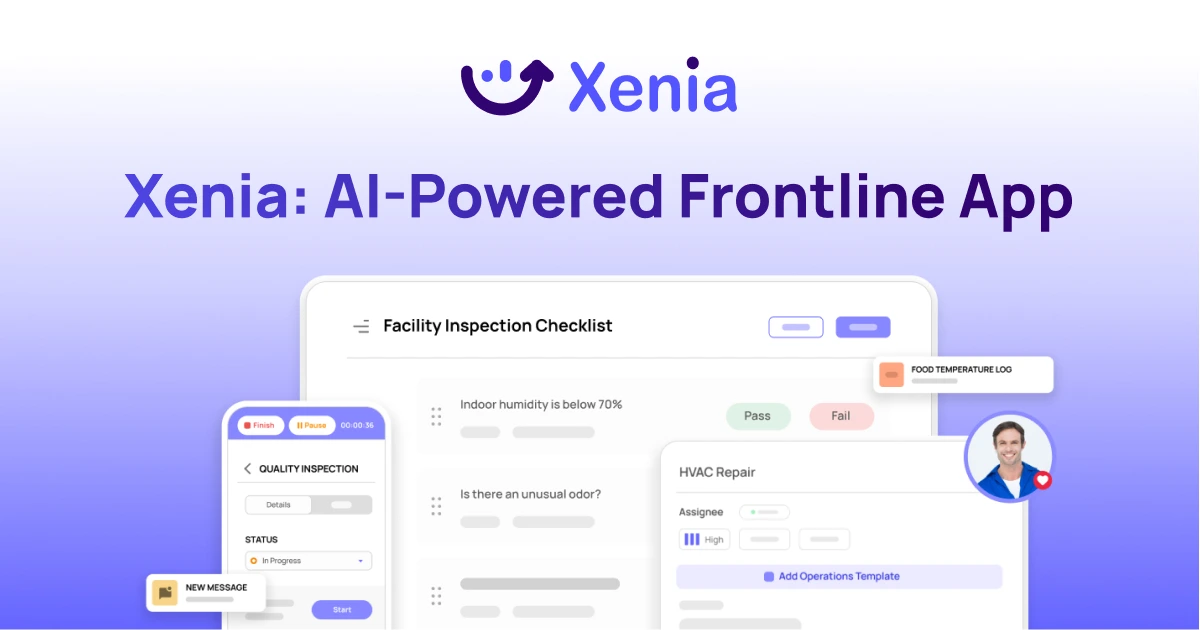
A Modern, AI-Powered Platform Built Specifically for Frontline Operations
Xenia brings daily operations, maintenance, audits, and compliance into one mobile-first platform. Frontline teams execute work consistently across locations while leadership gets real-time visibility.
Why Multi-Location Operators Choose Xenia:
🤖 AI-Powered Operations, Create digital checklists instantly or convert paper forms with AI. Verify compliance automatically with photo analysis and get instant answers from your operational data.
✅ Daily Operations & Maintenance, Assign work across hundreds of locations in minutes. Report and route issues instantly. Schedule preventive maintenance to catch problems before downtime.
📊 Real-Time Visibility, Track completion, work orders, and performance across all locations through dashboards. Filter by site or asset to spot trends and take action.
Manage operations, maintenance, and compliance across all your locations from one platform

.svg)
.webp)
%201%20(1).webp)

.svg)
%201%20(2).webp)