

Post Summary
A health inspector walked into a 12-location restaurant group and asked for the last 30 days of temperature logs.
The manager handed over a clipboard. Eleven of the 30 days were blank. Three others had readings that looked identical, down to the decimal. The inspector flagged it as pencil whipping. The fine was over $3,000. The franchise agreement triggered a formal corrective action plan.
The operator had been running paper-based operations for six years without a serious incident. Then one inspection changed everything.
This is the paper records compliance problem most multi-unit operators never see coming. The records exist. The process feels adequate. Then a regulatory trigger exposes what the paper trail cannot actually prove.
This article names the specific legal thresholds where paper records fail, by trigger type, so operators know exactly what is at risk before something forces the issue.

.svg)

Priced on per user or per location basis
Available on iOS, Android and Web


Related Resources
- What the full operations execution layer should include beyond task management
- How automated corrective action management works for food safety compliance
- How digital food safety management replaces paper-based systems
- How to roll out a digital operations platform to frontline teams
What makes paper-based operations records legally vulnerable?
Paper records feel like documentation. In a legal or regulatory context, they often are not.
The following structural problems make paper records difficult to defend.
No timestamp or authentication. A paper log shows a number written in a box. It does not show who wrote it, exactly when, or whether it was written at the time of the event or filled in later. Regulators treat undated, unauthenticated records as unverifiable. That is not a technicality. It is an evidentiary gap that can decide the outcome of an enforcement action.
Pencil whipping. Pencil whipping is the regulatory term for falsifying compliance logs. It is very common in multi-location operations because there is no mechanism to detect it on paper. Temperature readings that are identical across 14 consecutive days raise an obvious question. A paper log cannot answer it. A digital record with timestamped entries can.
No searchable history. When a regulator, plaintiff attorney, or franchisor auditor asks for all documentation related to a specific date, employee, or piece of equipment, paper records require someone to physically locate, review, and compile the relevant documents, which is not a simple task. In most multi-location environments, that is not reliably possible. Records are stored at the location, in a binder, and sometimes lost entirely.
Single-location physical copy. A flood, fire, renovation, or staff turnover event can destroy paper records permanently. Once gone, they are gone. For regulated industries, destroyed records are treated the same as missing records: evidence of non-compliance.
Understanding how digital checklists and audit trails work in practice makes the structural gap between paper and digital documentation concrete for operators who have not yet experienced a compliance trigger.
What are the 3 legal liability triggers that paper records routinely fail?
This is where paper records compliance becomes a real business risk. Not a theoretical one. Here are the three specific triggers, with the regulation behind each.
Trigger 1: Food safety regulation
The FDA's documentation requirements under FSMA are detailed in the FDA FSMA Final Rule for Preventive Controls for Human Food. Records must be retained for a minimum of two years and made available to inspectors within 24 hours of a request.
Paper HACCP logs fail this requirement in practice for one specific reason: they cannot prove when they were created. A digital record with a server-side timestamp can. A paper log with a handwritten time cannot. In an inspection or enforcement action, that difference is what the case turns on.
State health codes add requirements on top of FSMA. Most require documented corrective actions when a food safety violation is identified. A paper log that records a failed temperature reading without a documented corrective action is evidence of a violation, not evidence of compliance.
For operators who want to understand how temperature excursion corrective action documentation specifically connects to this compliance requirement, how automated temperature excursion response creates a defensible compliance record, and covers that specific workflow.
Trigger 2: Employment law and EEOC documentation
EEOC regulations require employers to retain personnel records related to any discrimination charge, lawsuit, or government investigation until the matter is resolved. Workers' compensation claims require a documented incident chain: initial report, investigation, medical referral, and follow-up.
The EEOC's record retention requirements are outlined in 29 CFR Part 1602, which governs recordkeeping and reporting under Title VII, the ADA, and the ADEA. Personnel records related to a charge must be preserved until final disposition of the charge or action.
Paper disciplinary records filed in a binder at a specific location need to be producible months or years later. Across a 30-location operation with manager turnover, that is rarely possible. When a plaintiff attorney requests personnel records in discovery and the operator cannot produce them, the inference drawn is not favorable.
Progressive discipline documentation is the most common failure point. Paper write-ups that cannot be located, authenticated, or connected to a documented warning history leave operators without a defensible record when a wrongful termination claim is filed.
Trigger 3: Franchisor audit requirements
Most franchise agreements require franchisees to maintain standardized documentation, produce records during brand audits, and demonstrate consistent compliance across locations. Paper records fail this for two reasons.
First, they are not standardized. Each location's manager fills them out differently. Format inconsistencies make it impossible to demonstrate consistent compliance across the portfolio.
Second, they cannot be produced quickly. A franchisor auditor asking for six months of food safety documentation from all locations in a district cannot be answered the same day with paper records. Digital records answer that request in minutes.
**
Legal trigger, What is required, What paper provides, The gap
FDA FSMA, Timestamped-authenticated records on demand, Handwritten logs-single copy-no authentication, Unverifiable-not reproducible
EEOC and employment, Complete personnel record chain retained indefinitely, Paper files at single location-often incomplete, Not producible in discovery
Franchisor audit, Consistent format-producible across all locations, Variable format-physical copy only, Cannot demonstrate portfolio-wide compliance
**
What does the compliance threshold actually look like by location count?
The risk exists at any size. But it scales fast.
1 to 5 locations
Paper records are risky but manageable at this scale. The owner usually has direct oversight of most locations. Missing documentation is more likely to be caught before it becomes a liability. The exposure exists but the probability of a catastrophic outcome is lower.
10 to 30 locations
This is where multi-unit compliance management gaps become regulatory exposure. No single person has visibility into what is being documented at all locations. Staff turnover means the person who filled in last month's logs is often no longer there to explain them. Audit trail gaps are no longer recoverable with a phone call.
At this size, a single location's documentation failure can trigger a franchise compliance review for the entire group. One EEOC charge at one location requires records from every location that the employee worked at.
50 and above
At 50-plus locations, missing records at one location affect the whole portfolio. Franchise agreements often contain portfolio-level audit clauses. Health departments in some jurisdictions consider the compliance history of sister locations when evaluating enforcement actions. Workers' compensation insurers review multi-location incident documentation patterns when pricing renewals.
Operators at this scale describe the same frustration. They are physically walking stores, conducting audits on paper, and leaving with no photo evidence, no timestamped record, and no way to prove what they found or what was corrected. The audit happened. The proof did not get captured. That gap is exactly what creates exposure when an inspector, auditor, or attorney asks for documentation later.
How do multi-unit operators get blindsided by the paper compliance gap?
The blindside always follows the same pattern. Something normal happens. The documentation does not exist to show it was handled correctly.
Incident happens, record does not exist. A customer alleges a food safety issue. The operator produces the temperature logs for that day. Three hours are missing. No corrective action is documented after the lunch rush. The absence of documentation is treated as evidence of a violation, not as a record-keeping gap.
Franchisor audit reveals inconsistent formats. Location 4 uses one format for opening checklists. Location 11 uses a different one. Location 22 has no opening checklist on file for the past two weeks. The franchisor issues a compliance notice for the entire group based on inconsistency, not just the individual locations with problems.
Health inspection produces a clipboard instead of records. The inspector asks for 90 days of temperature documentation. The manager produces three clipboards with partial records, two of which have missing days. The inspector issues violations for inadequate record-keeping. The corrective action plan now requires documented evidence of a fixed system.
Employment claim, no documented progressive discipline trail. A terminated employee files a wrongful termination claim. The defense requires showing a documented warning history. The paper write-ups from 14 months ago cannot be located. The one that exists has no date or manager signature. The defense is weakened before it starts.
What does closing the paper compliance gap actually require?
The gap is not closed by simply digitizing existing paper forms. It closes when the documentation system creates records with the attributes that regulators and auditors actually require.
That means records with server-side timestamps created at the moment of the event. Records attributed to a specific logged-in user. Records searchable by date, location, employee, and equipment. Records stored in a system that is not vulnerable to physical loss at a single location.
It also means consistent documentation format across all locations. Every location uses the same checklist structure. Every corrective action follows the same documented workflow. When a franchisor auditor, or health inspector asks for records, the documentation looks the same regardless of which location it came from.
Platforms like Xenia generate this documentation layer automatically. Every checklist submission, corrective action, and incident report carries a timestamp, a user attribution, and a photo record. When an inspector or auditor asks for records, the response is a filtered export rather than a physical search through binders at 30 different locations.

If you are at the point of evaluating which platform closes these specific documentation gaps, the questions to ask before buying a restaurant operations platform gives you a framework for stress-testing vendor documentation capabilities before you commit.
And for operators thinking about how to get frontline teams to actually adopt a new documentation system, how to roll out an operations platform to frontline teams without adoption failing covers that transition in detail.
Conclusion
Paper records feel like compliance. In most multi-location environments, they are not.
The gap is invisible until a regulator, auditor, or plaintiff attorney asks for records that cannot be produced, authenticated, or verified. By then, the documentation failure is already a legal problem.
The triggers are specific. FDA FSMA requires timestamped, authenticated records available on demand. EEOC and employment law require a complete and producible personnel record chain. Franchise agreements require consistent documentation format across all locations.
Paper records fail all three at scale. Digital operations documentation does not.
See how Xenia closes your paper compliance gaps. Book a demo focused on your documentation requirements.
Frequently Asked Questions
Got a question? Find our FAQs here. If your question hasn't been answered here, contact us.
What is the compliance liability difference between one location and a multi-unit group?

A single location's documentation failure affects that location. A multi-unit group's failure at one location can trigger a portfolio-level audit, affect insurance pricing across all locations, and violate franchise terms that apply everywhere. The liability scales with location count in ways most operators underestimate.
How does digital documentation hold up in employment litigation compared to paper?
Much better. Digital records carry metadata paper cannot replicate: login identity, timestamp, device location, editing history. Paper produces whatever survived in a binder at one location, often incomplete and unauthenticated.
What is the difference between compliance documentation and operations documentation?
Operations documentation tracks whether tasks were completed. Compliance documentation tracks whether they met a standard, who completed them, when, and what happened when they did not. Most multi-unit operators have the first and lack the second.
Can paper records ever work for franchise compliance audits?
At small scale, sometimes. Past ten locations, rarely. Franchise agreements require consistent format across all locations and records producible on demand. Paper fails both. Most franchise documentation failures are not about the content of the records. They are about the inability to produce them quickly and consistently.
What counts as adequate corrective action documentation?
A record that something went wrong is not enough. You need to show what happened, when it was identified, what action was taken, who took it, and when the situation was resolved. A temperature log with a failed reading and no documented response is evidence of a violation, not compliance.
What specific records does FSMA require food operators to keep?
Hazard analysis, preventive controls, monitoring procedures, corrective actions, and verification activities. Most must be retained for at least two years and produced to FDA within 24 hours of a request. Paper records at a single location cannot meet that 24-hour production requirement across a multi-location portfolio.


A Modern, AI-Powered Platform Built Specifically for Frontline Operations
Xenia brings daily operations, maintenance, audits, and compliance into one mobile-first platform. Frontline teams execute work consistently across locations while leadership gets real-time visibility.
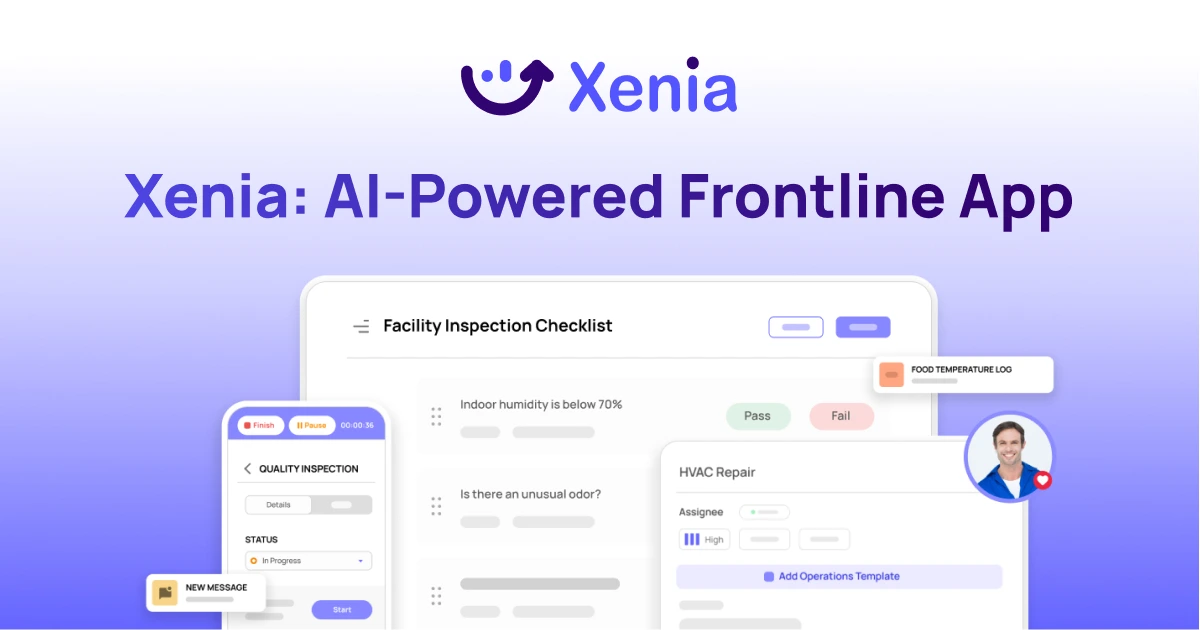
Why Multi-Location Operators Choose Xenia:
🤖 AI-Powered Operations, Create digital checklists instantly or convert paper forms with AI. Verify compliance automatically with photo analysis and get instant answers from your operational data.
✅ Daily Operations & Maintenance, Assign work across hundreds of locations in minutes. Report and route issues instantly. Schedule preventive maintenance to catch problems before downtime.
📊 Real-Time Visibility, Track completion, work orders, and performance across all locations through dashboards. Filter by site or asset to spot trends and take action.
Manage operations, maintenance, and compliance across all your locations from one platform

.svg)
.webp)
%201%20(1).webp)

.svg)
%201%20(2).webp)