

Post Summary
An HVAC work order landed in the pest control vendor's inbox.
Nobody caught it until the next morning. The ops manager spent two hours untangling the mistake, finding the right vendor, explaining the issue from scratch, and rescheduling the visit. The original problem sat unresolved for 24 hours. The equipment was a commercial refrigeration unit at a location that needed it running by lunch service.
Unfortunately, this is not a rare situation.
It happens in multi-location operations almost every week. Work order management software gets purchased. The routing still fails. Not because the software does not work, but because the routing logic was never built.
This article maps that routing logic layer. Equipment taxonomy, location-vendor mapping, priority tiers. The things that need to be in place before any facility management work order system can reliably get a request to the right person.

.svg)

Priced on per user or per location basis
Available on iOS, Android and Web


Related Resources
- How closed-loop work order management connects to operations execution
- How ServiceNow integration automates work order routing in c-store environments
- What multi-unit operations execution actually requires
- How facility management connects to the full operations platform
Why do work orders go to the wrong vendor, and what does it actually cost?
The problem is not carelessness. It is structure. Or rather, the absence of it.
Most multi-location operations start with a single maintenance inbox. All requests go in. Someone on the ops team reads them and forwards each one to the right vendor manually. At five locations, this is manageable. At 20 it is a bottleneck. Wonder what it’ll be at 50? Daily crisis.
Ops leaders at multi-location restaurant groups describe the same situation. Too many locations, not enough people, and no reliable way to track which ticket is open, what is overdue, and who is handling it. The maintenance inbox becomes the de facto system of record, and it was never designed for that job.
No equipment taxonomy means every request looks the same. An HVAC failure, a plumbing leak, and a broken door hinge all arrive as plain text in the same inbox. The person triaging does not always know the right vendor. They guess, or they call someone to ask. Time passes.
The cost shows up four ways:
**
Problem, What happens, Cost
Wrong vendor assigned, Ticket re-routed manually after initial error, 24-hour average delay per incident
No priority distinction, Critical failures wait behind low-priority requests, Service impact during peak hours
No location context, Vendor calls before dispatching, Additional delay before first visit
No escalation path, Missed SLAs invisible until ops manager checks, Failures compound overnight
**
Across 50 locations, even a modest misrouting rate turns into a serious operational impact. The math is not complicated. The solution is. This is a core reason why multi-unit operations execution requires a connected maintenance layer, not just a standalone work order inbox.
What does work order routing logic actually require before software helps?
This is the insight most work order management software articles skip entirely. Routing is a rules problem, not a software feature. The software can only route correctly if the rules exist first.
Four things need to be in place.
Equipment category taxonomy
Not all maintenance requests are the same. An equipment category taxonomy assigns every equipment type a category, and every category a vendor type.
**
Equipment category, Vendor type
Refrigeration and cold chain, Cold chain specialist
HVAC and climate control, HVAC contractor
Plumbing and drainage, Licensed plumber
Electrical systems, Licensed electrician
Fuel and dispensing equipment, Fuel systems specialist
General building maintenance, General contractor
**
Without this taxonomy, every request is undifferentiated. With it, the category on the ticket determines the routing destination automatically.
Location-vendor mapping
The right vendor for a refrigeration failure in Chicago is not the same vendor for the same failure in Atlanta. Regional contractors cover specific territories. Some vendors have exclusive contracts for certain equipment types in certain markets.
Location-vendor mapping connects each location to the approved vendor for each equipment category in that geography. When a ticket comes in from store 47 for a refrigeration issue, the routing rule knows which vendor covers refrigeration in that region.
Priority tiers with SLA definitions
Every work order needs a priority. Every priority tier needs a defined response expectation.
**
Priority tier, Definition, Expected response
Emergency, Operations halted or safety risk, Vendor contact within 1 hour
Urgent, Equipment failing-service impacted, Vendor contact within 4 hours
Routine, Non-critical repair or preventive work, Vendor contact within 24 hours
**
Without defined tiers, everything defaults to the same urgency. Critical failures wait behind low-priority repairs.
Escalation rules for missed SLAs
When a vendor does not respond within the SLA window, someone needs to know. Automatically. Escalation rules define who gets notified, when, and how when a ticket goes past its threshold without movement.
Without escalation rules, missed SLAs are invisible until the ops manager happens to check the inbox.
How do you build the routing logic layer for your portfolio?
Building the routing logic before implementing work order management system software takes upfront effort but eliminates manual work order triage permanently. Four steps.
Step 1: Audit all equipment categories across all locations
List every equipment type across the portfolio. Group similar equipment into categories. Start with the categories that generate the most maintenance requests. Refrigeration, HVAC, plumbing, and electrical cover most of the volume in restaurant and c-store environments.
Step 2: Map vendors to equipment category and geography
For each equipment category, identify which vendors are approved for which locations. Build the matrix: category on one axis, location or region on the other, vendor name in the cell. This is the source of truth for routing decisions.
Step 3: Define priority tiers and SLA expectations
Agree on what constitutes an emergency, urgent, and routine request. Write the definitions clearly enough that a store manager can apply them without calling anyone. Attach response time expectations to each tier.
Step 4: Set escalation rules by tier
For each priority tier, define the escalation path if the SLA is missed. Emergency tickets with no vendor response in one hour escalate to the facilities manager. Urgent tickets with no movement in four hours escalate to the district manager. Routine tickets past 48 hours surface on the weekly report.
This is the routing logic layer. The work order management software applies the rules. You build the rules first.
What visibility does auto-routing give district managers across a multi-location portfolio?
When routing is automated, and every ticket carries consistent category, priority, and location data, the district manager views changes.
They stop triaging and start monitoring.
A multi-location facilities management dashboard shows every open work order across the portfolio, sortable by priority, location, equipment category, and SLA status. A district manager covering 20 locations sees at a glance which locations have overdue tickets, which equipment categories generate the most failures, and which vendors have the worst acceptance rates.
Without routing logic, that data is too inconsistent to trust. Requests arrive as unstructured text. Priorities are implied, not assigned. Locations are sometimes missing. The dashboard exists but the underlying data is unreliable.
With routing logic in place, data is structured from the moment the ticket is created. The dashboard shows what is actually happening.
Specific metrics that become visible with automated work order triage:
- Open tickets by location, sorted by SLA status
- SLA breach alerts before they become critical failures
- Recurring failure patterns by equipment type and location
- Vendor performance: acceptance rate and average time to close per vendor
This is what best work order management software actually delivers at scale. Not just a place to log requests. A system that surfaces what matters without anyone going to look for it.
For operators where temperature excursions are a primary trigger for emergency work orders, how automated temperature excursion response connects to the maintenance escalation path shows how detection and routing connect in a single workflow.
What does a fully automated work order routing system make possible at scale?
When routing logic is in place and the software applies it automatically, three things change.
The ops team removes manual triage from their daily workflow. Every ticket routes itself based on equipment category and location. The ops manager does not touch routine requests. Their time goes to exception handling.
The right vendor gets the right context on the first send. Equipment category. Location. Asset ID. Priority flag. SLA deadline. The vendor receives a complete ticket. No clarifying calls. No wrong-location visits. The first visit is prepared.
The district manager sees portfolio maintenance health without calling anyone. Open tickets, overdue SLAs, recurring failures, and vendor performance are visible in one dashboard updated in real time.
How does Xenia automate work order routing across your locations?
Every gap described in this article has a direct solution in how Xenia handles work order routing logic. Here is how it maps.

Equipment category rules route every ticket to the correct vendor automatically. When a work order is created in Xenia, the equipment category assigned to the ticket determines the routing destination. Refrigeration failures go to the cold chain vendor. HVAC failures go to the HVAC contractor. The rule decides. Nobody on the ops team forwards anything.
Manual triage is removed from the ops team's workflow entirely. Once routing rules are configured in Xenia, every incoming maintenance request routes itself. The ops team sees the dashboard. They do not manage the inbox.
Priority flags trigger SLA-based escalation without manual follow-up. Every work order in Xenia carries a priority flag: emergency, urgent, or routine. Each tier has a configured SLA. When a ticket passes its threshold without vendor response, it gets escalated to the right person automatically.
Every ticket arrives with location profile and asset ID already attached. Xenia work orders inherit the location profile and asset data by default. The vendor receives the ticket with store number, asset ID, equipment history, and failure description. No clarifying calls required.
Work order history and routing log are visible per asset. Every equipment item in Xenia has a service history showing all previous work orders, vendors assigned, resolution times, and routing paths. When the same unit fails for the third time, that pattern is visible before the next ticket is created.
District managers see all open work orders across the portfolio in one dashboard. The Xenia multi-location operations dashboard shows open tickets across all locations, sortable by priority, SLA status, equipment category, and vendor. No calls. No compiled reports. The information is just there.
Vendors close tickets with a required completion photo. When a vendor closes a work order in Xenia, a completion photo is required before the ticket can be marked resolved. The ops team has documentation the work was done without a separate verification step.
See how Xenia's work order routing works across your locations. Book a facilities management demo.
Conclusion
Work orders go to the wrong vendor because the routing logic does not exist, not because the software failed.
Build the four things first: equipment taxonomy, location-vendor mapping, priority tiers, and escalation paths. Then let the work order management software apply them. Manual triage disappears. The right vendor gets the right ticket. District managers see what is open without asking anyone.
Xenia is built for exactly that. Equipment category routing, SLA escalation, asset context on every ticket, and a portfolio dashboard that shows what is open, overdue, and recurring.
Book a demo and see the routing workflow live.
Frequently Asked Questions
Got a question? Find our FAQs here. If your question hasn't been answered here, contact us.
How does maintenance request routing connect to compliance documentation?

Every routed and closed work order is a timestamped record showing a reported issue was addressed. When a health inspector asks whether a flagged equipment issue was resolved, the work order history gives the documented answer. Paper logs cannot provide that level of traceability.
Can work order auto-routing work for a mixed portfolio with corporate and franchise locations?
Yes. Franchise locations often manage their own vendors. Corporate locations route through approved lists. The routing rules handle both by assigning different vendor mappings to each location type within the same system.
How do priority tiers connect to vendor contracts?
SLA thresholds in your routing logic should match the response commitments in your vendor contracts. When escalation rules fire because a ticket missed its window, you have documentation that the vendor missed a contractual commitment, not just an internal expectation.
What is the difference between a facility management work order system and a CMMS?
A CMMS covers asset lifecycle, maintenance scheduling, and budget tracking. A work order system covers the operational layer: creating, routing, tracking, and closing requests. Most multi-location operators are missing the routing layer, not the asset management layer.
How do you handle routing when one vendor covers multiple equipment categories?
Map them to each category separately in your location-vendor matrix. The routing logic treats each category independently. If the same vendor handles refrigeration and HVAC at a location, they appear in both rows. The ticket routes by category, not by vendor relationship.
What happens when a vendor rejects or ignores a work order?
The escalation rule fires. If a vendor does not accept a ticket within the SLA window, the system alerts the next person automatically, whether that is a backup vendor, the facilities manager, or the district manager. Without that rule, a rejected ticket sits silently until someone notices.


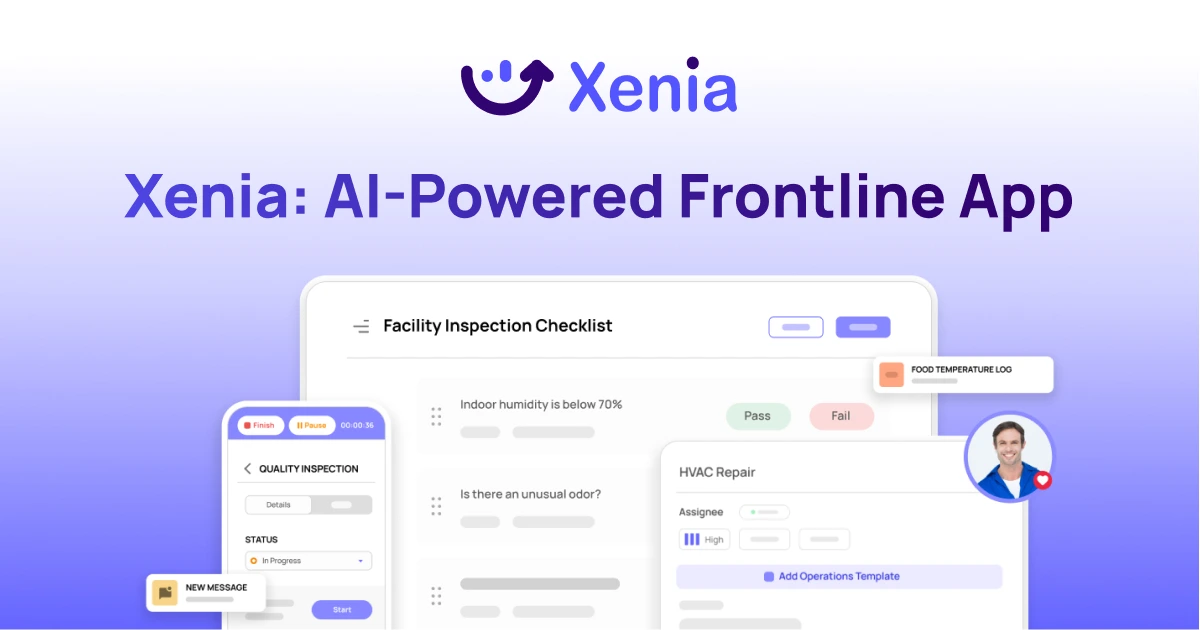
A Modern, AI-Powered Platform Built Specifically for Frontline Operations
Xenia brings daily operations, maintenance, audits, and compliance into one mobile-first platform. Frontline teams execute work consistently across locations while leadership gets real-time visibility.
Why Multi-Location Operators Choose Xenia:
🤖 AI-Powered Operations, Create digital checklists instantly or convert paper forms with AI. Verify compliance automatically with photo analysis and get instant answers from your operational data.
✅ Daily Operations & Maintenance, Assign work across hundreds of locations in minutes. Report and route issues instantly. Schedule preventive maintenance to catch problems before downtime.
📊 Real-Time Visibility, Track completion, work orders, and performance across all locations through dashboards. Filter by site or asset to spot trends and take action.
Manage operations, maintenance, and compliance across all your locations from one platform

.svg)
.webp)
%201%20(1).webp)

.svg)
%201%20(2).webp)