
.webp)
Post Summary
A district manager pulls up last week's coverage data. Three locations ran short-staffed during peak hours. The other five were fine. Same shift structure across all eight sites.
The problem was not the people. It was the shift type.
The structure worked at five locations because their demand matched it. At the other three, it did not. That mismatch shows up in overtime, call-outs, and gaps that nobody planned for.
This guide is for operators who already know what shifts are. You need to know which ones work, which ones break, and which ones create compliance exposure when you scale.
.webp)
.svg)

Priced on per user or per location basis
Available on iOS, Android and Web


What is a work shift?
A work shift is a defined block of time an employee is scheduled to work.
Simple definition. But the decision behind it is one of the highest-leverage calls a multi-unit operator makes.
Get the shift structure wrong at one location, and you have a scheduling problem. Get it wrong across a portfolio, and you have a labor cost, coverage, and retention problem that compounds every single week.
The FLSA requires accurate records of hours worked for every non-exempt employee. That floor applies no matter what shift structure you run. Shift type does not change the compliance obligation. It changes how easy or hard that obligation is to meet.
For operations leaders building workforce systems from the ground up, our workforce scheduling guide walks through the complete framework for building schedules that balance coverage, labor costs, and employee retention across multiple locations.
Types of work shifts
At one location, choosing the wrong shift type is a fixable mistake. Across 50 locations, it becomes a systemic cost that shows up in overtime, turnover, and coverage gaps nobody planned for.
Here is how all seven shift types compare at a glance.
**
Shift type, Best for, Common in, Key watch-out
Fixed, Supervisors-skill-critical roles, All industries, No flex when demand shifts or staff call out
Rotating, Cross-trained hourly staff, Restaurants-retail-hospitality, Backward rotation drives burnout
Split, Roles tied to multi-peak demand, Restaurants-hospitality, Unpaid gap consumes the employee's full day
Compressed, Roles needing longer coverage windows, Retail-hospitality-C-stores, Daily OT liability in California
Opening/Closing, All frontline operations, All industries, Clopening is a retention and quality risk
Flexible/On-call, Variable demand locations, All industries, On-call income unpredictability drives turnover
Kelly schedule, 24-hour operations, C-stores-hotels-hospitality, Not suited to retail or restaurant formats
**
Fixed shift
Same days. Same hours. Every week.
A shift supervisor at a QSR works Monday through Friday, 6 am to 2 pm, no variation. The team knows who is opening. The manager can forecast labor cost to the dollar.
**
Aspect, Fixed shift
Works well when, Demand is consistent. Role needs the same skill set every shift. Volume does not change week to week.
Watch out for, No rotation pool when someone calls out. Overstaffing risk at lower-volume sites if template is copied.
Best fit for, Shift supervisors-senior frontline staff-skill-critical roles
**
Rotating shift
A rotating shift cycles employees through different shift windows (day, evening, night) on a set pattern. No one is permanently stuck on one window.
There are two rotation directions. Most operators do not know the difference. They should.
Forward rotation moves day to evening to night. It follows the body's natural adjustment direction. Employees adapt faster, miss fewer shifts, and burn out slower. In physically demanding frontline roles, this is the rotation to run.
Backward rotation moves night to evening to day. Harder on the body. Absenteeism goes up. Burnout comes faster. Many operators inherited this structure without knowing there was a better option. If your turnover is unusually high on rotating teams, check the rotation direction first.
Rotating weekends deserve their own mention. Employees alternate weekend availability on a defined cycle so no one is permanently assigned every Saturday and Sunday. Weekend shifts are the hardest to fill in most frontline operations. A fair rotating weekend structure is one of the most effective retention tools available. It is also one of the most overlooked.
Here is what a four-week rotating weekend cycle looks like in practice:
**
Week, Employee A, Employee B, Employee C, Employee D
Week 1, Weekend ON, Weekend OFF, Weekend ON, Weekend OFF
Week 2, Weekend OFF, Weekend ON, Weekend OFF, Weekend ON
Week 3, Weekend ON, Weekend OFF, Weekend ON, Weekend OFF
Week 4, Weekend OFF, Weekend ON, Weekend OFF, Weekend ON
**
Every employee works two weekends out of four. No one carries the permanent burden. That fairness is what makes it a retention lever.
**
Aspect, Rotating shift
Works well when, Coverage needed across multiple shift windows. Workforce is cross-trained. Fairness across shifts matters for retention.
Watch out for, Backward rotation driving burnout. Cycles that change too fast for employees to plan around. Heavy demand concentrated in one window.
Best fit for, Cross-trained hourly staff at locations needing coverage across day-evening and weekend windows
**
Split shift
A split shift breaks one workday into two separate blocks with a significant unpaid gap between them.
A line cook works 10am to 2pm for lunch, goes home, and comes back 5pm to 9pm for dinner. Six hours of pay across a nine-hour window.
That gap is the problem for a lot of employees.
**
Aspect, Split shift
Works well when, Demand peaks are predictable and clearly separated. Employees live close to the location. Commute between blocks is short.
Watch out for, Unpaid gap consuming the employee's full day. For staff with childcare or long commutes-this becomes a direct turnover driver.
Best fit for, Restaurant and hospitality roles tied to predictable lunch-dinner demand patterns
Compliance flag, California requires a split shift premium when total daily pay does not exceed minimum wage by at least one additional hour's wages. Model this before deploying in California.
**
Compressed shift
A compressed shift completes full weekly hours in fewer days. Most common version: four 10-hour days instead of five eight-hour days.
A retail associate works Tuesday through Friday, 7am to 5pm. Three-day weekend every week. That is a real draw for a lot of frontline workers.
**
Aspect, Compressed shift
Works well when, Demand is consistent across longer daily windows. Employees value consecutive days off. Fewer shift handoffs reduce operational friction.
Watch out for, Fatigue in physically demanding roles. Injury risk increases in the back half of a 10-hour shift.
Best fit for, Retail-hospitality and C-store roles where longer daily coverage windows reduce disruption
Compliance flag, California daily OT kicks in after 8 hours. Four 10-hour days creates daily OT liability on every shift at a California location. Model this before deploying.
**
For more on how California's daily overtime rules interact with different shift structures, see our double time pay guide that breaks down the specific thresholds and calculations.
Opening and closing shifts
The opening shift is the first shift of the day. Setup, pre-open procedures, inventory checks, system readiness before customers arrive.
The closing shift is the last. End-of-day procedures, securing the location, cash reconciliation, handoff documentation.
These are role assignments within any shift structure, not standalone shift types. But one failure point is worth calling out specifically.
The clopening. An employee closes one night and opens the next morning. It is a retention risk and an operational quality risk. A fatigued employee running pre-open procedures is not the same as a rested one. Pre-open standards suffer. Customer-facing hours start behind.
**
Aspect, Opening/Closing shifts
Works well when, Clear task lists exist for both shifts. Accountability is assigned to specific roles.
Watch out for, Clopening: closing one night and opening the next morning. Fatigue hits pre-open quality hard.
Best fit for, All frontline operations
Compliance flag, Several states require minimum rest periods between shifts. Clopening is restricted in some markets. Check local requirements before scheduling back-to-back.
**
For restaurant operators specifically, opening and closing procedures are where execution either sets the day up for success or puts it behind from hour one. Our restaurant operations management guide covers how to build accountability into these critical shift transitions.
Flexible and on-call shifts
Flexible scheduling gives employees input on start and end times within an operator-defined window. On-call shifts make employees available but do not guarantee hours.
On-call sounds useful. In practice, it is a turnover driver when used as a primary structure.
Employees who cannot predict their weekly income cannot plan their lives. Childcare, rent, a second job. They leave for operators who give them predictability. On-call works as a backup coverage tool. It does not work as the main structure for hourly frontline staff.
**
Aspect, Flexible/On-call shifts
Works well when, Flexible: genuine demand variability-employee-driven availability helps. On-call: backup for unexpected absences or demand spikes.
Watch out for, On-call income unpredictability is a direct turnover driver. Do not use on-call as a primary scheduling structure.
Best fit for, Flexible for variable-demand locations. On-call as a backup tool only.
Compliance flag, Chicago-New York City-Seattle-Philadelphia-San Francisco and Oregon statewide have active predictive scheduling laws. Advance notice typically required 10 to 14 days out. Late changes trigger premium pay. Audit scheduling practices before expanding into these markets.
**
The Kelly schedule
The Kelly schedule is a rotating pattern built for 24-hour operations. Three teams work in a 9-day cycle. Each team works 3 days on, gets 6 days off, and the rotation repeats.
Every hour stays covered. No team runs consecutive shifts. For a 24-hour C-store, it is the structure that keeps coverage intact without burning anyone out.
**
Team, Day 1-3, Day 4-6, Day 7-9
Team A, ON, OFF, OFF
Team B, OFF, ON, OFF
Team C, OFF, OFF, ON
**
**
Aspect, Kelly schedule
Works well when, Operation runs 24 hours. Coverage cannot drop. Consecutive days off matter for retention.
Watch out for, Extended shift variants carry health and safety risk. Those work for emergency services-not retail or hospitality.
Best fit for, 24-hour C-stores-hotel properties-large hospitality operations that never close
**
How to choose the right shift type for your operation
Most operators pick a shift structure when they open and never revisit it. Coverage gaps and overtime costs are usually what force the conversation.
The right structure depends on four things.
Demand pattern by location. Peak hours differ by site. Map actual demand at each location before choosing a structure. A compressed schedule that works at a high-volume urban location creates daily OT exposure at a lower-volume site. One template does not work across a portfolio.
Role type and cross-training level. Fixed shifts for supervisors and skill-critical roles. Rotating shifts for cross-trained hourly staff. Split shifts for roles tied to predictable multi-peak demand. A restaurant can run fixed shifts for kitchen leads and rotating shifts for line staff, all at the same location.
Workforce demographics and the local labor market. Weekend rotation fairness matters more in tight labor markets where employees have options. Compressed schedules attract people who want consecutive days off. Flexible scheduling widens the applicant pool but needs more infrastructure to manage consistently.
Compliance environment. This is the one most operators address last and should address first. Predictive scheduling laws, California daily OT exposure, and minimum rest period requirements all live at the shift structure level. Catching them after deployment is expensive. For operators managing compliance across multiple locations, multi-unit operations tools make it possible to track these decisions in one place.
Here is a quick reference for matching shift type to role and context:
**
Role or context, Recommended shift type
Shift supervisors/skill-critical roles, Fixed
Cross-trained hourly/multi-window coverage, Rotating
Lunch-dinner restaurant roles, Split
Retail or hospitality needing long coverage windows, Compressed
24-hour operations, Kelly schedule
Variable demand with workforce input, Flexible
Backup coverage for unexpected absences, On-call
**
Related Resources
- Multi-Unit Operations Software
- Frontline Communication Tools
- Task Management for Frontline Teams
- Workforce Management Best Practices Guide
- Staff Management Checklist App
Conclusion
That district manager at the start of this guide had an eight-location problem. But the real issue was one decision made once, applied everywhere, and never revisited.
The right shift type at the right location for the right role is one of the highest-leverage decisions a multi-unit operator makes. Most make it once and move on. Coverage gaps, overtime costs, and turnover are usually the first signs that something needs to change.
Xenia helps multi-unit operators build, communicate, and execute shift structures consistently across every location, with task management and frontline communication tied directly to how each shift is built and deployed. See how it works for multi-unit operations.
Frequently Asked Questions
Got a question? Find our FAQs here. If your question hasn't been answered here, contact us.
Can different roles in the same location run different shift structures?

Yes. And in most operations, they should. A kitchen lead needs a fixed shift. A cross-trained line cook fits better on a rotating one. A catering coordinator may need flexible scheduling. Running one structure across every role creates gaps or overstaffing, depending on where demand lands. Built by role, not by location.
How do shift structures affect employee turnover?
More than most operators think. Unpredictable schedules, permanent weekend assignments, and on-call shifts with no guaranteed hours are three of the fastest ways to lose hourly staff.
People leave when they cannot plan their lives around their income. A fair weekend rotation, a predictable weekly structure, and advance notice cost nothing to implement. They do more for retention than most operators realise.
What is a split shift and is there a pay premium for it?
One workday, two blocks, unpaid gap in between. Common in restaurants between lunch and dinner. California requires extra pay if total daily wages do not clear minimum wage plus one hour. Other states have their own rules. Check your state before rolling it out.

A Modern, AI-Powered Platform Built Specifically for Frontline Operations
Xenia brings daily operations, maintenance, audits, and compliance into one mobile-first platform. Frontline teams execute work consistently across locations while leadership gets real-time visibility.
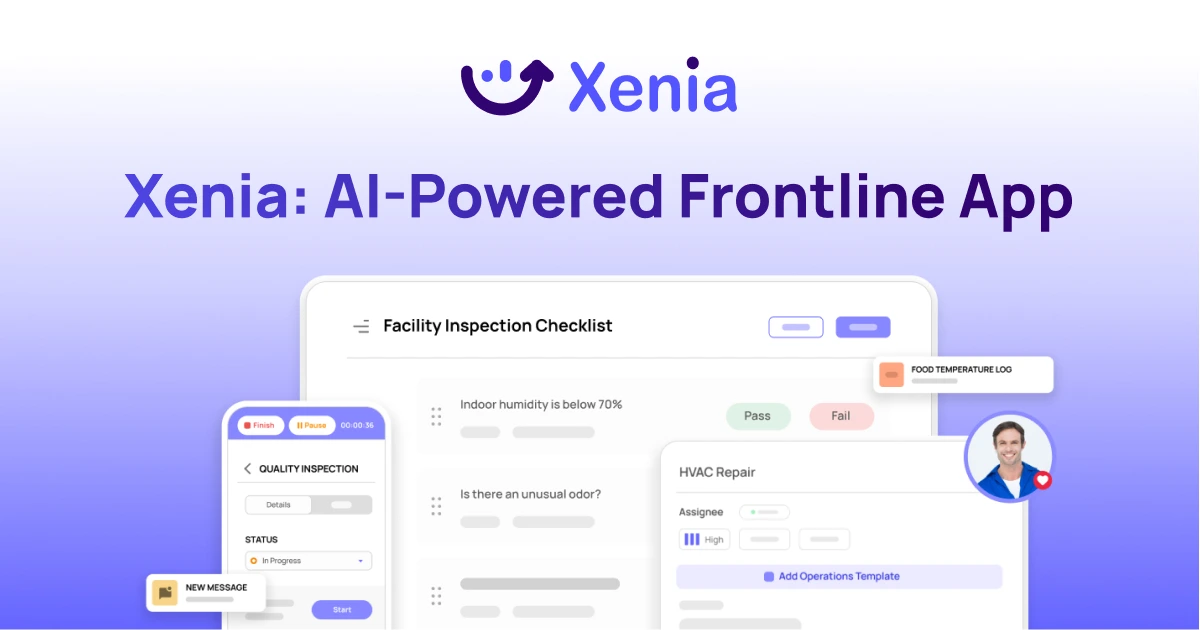
Why Multi-Location Operators Choose Xenia:
🤖 AI-Powered Operations, Create digital checklists instantly or convert paper forms with AI. Verify compliance automatically with photo analysis and get instant answers from your operational data.
✅ Daily Operations & Maintenance, Assign work across hundreds of locations in minutes. Report and route issues instantly. Schedule preventive maintenance to catch problems before downtime.
📊 Real-Time Visibility, Track completion, work orders, and performance across all locations through dashboards. Filter by site or asset to spot trends and take action.
Manage operations, maintenance, and compliance across all your locations from one platform

.svg)
.webp)
%201%20(1).webp)

.svg)
%201%20(2).webp)