
.webp)
Post Summary
It is a Friday morning. A district manager gets a call from Location 7.
The shift is covered. Headcount looks fine on paper. But the manager who approved the swap did not check whether the replacement had completed food safety certification. The shift runs. Customers complain. An incident gets logged.
That was not a staffing problem. It was a policy problem. The swap happened because nothing in the process stopped it.
This guide is for operators managing shift swap requests across 30 or 50 locations, not one. At that scale, the real problem is not individual swaps. It is rubber-stamp approvals, skill mismatches nobody catches, overtime exposure compounding quietly across sites, and compliance traps in regulated markets. A policy that holds at one location often collapses at thirty.
This guide covers how to build one that does not.
.svg)

Priced on per user or per location basis
Available on iOS, Android and Web


What is a shift swap?
A shift swap is when one employee exchanges their scheduled shift with another employee. Both agree. The schedule changes. The shift stays covered.
Simple enough at one location. At thirty, the approvals happening without a policy behind them are where the costs quietly add up.
Most operators treat all schedule changes the same way. That is the first problem. A bilateral swap and an open shift claim are operationally different. They carry different approval requirements, different overtime risks, and different compliance implications. Treating them identically creates policy gaps that compound across every location.
Shift swap
A bilateral exchange. Employee A takes Employee B's shift. Employee B takes Employee A's. Both schedules change at the same time. The approver has to verify eligibility and overtime exposure for two employees at once, not one.
Open shift
A unilateral drop. Employee A cannot work their shift and posts it into an open pool. Any eligible employee can claim it. Only one schedule changes. The approver verifies the claiming employee only.
Operators running both processes without a policy that defines each end up with managers guessing which one applies. That inconsistency is what creates approval confusion, skill mismatches, and compliance gaps at scale. It also makes it nearly impossible to audit what is actually happening across the portfolio.
Note on terminology: some operators refer to this as a shift switching policy. Swap and switch are used interchangeably across the industry. The mechanics and policy requirements are the same.
Why shift swap policies break down at scale
A policy that works at one location is not automatically a policy that works at fifty. The failure mode changes when you scale, and most content on this topic does not address what actually goes wrong.
Rubber-stamp approvals
At a single location, a manager knows the team. They know who can cover what role, who holds certification, who shows up when called. That personal knowledge fills the gap the policy should cover.
At thirty locations, area managers approve swaps for teams they have never worked alongside. They approve because approving is faster than investigating. Skill mismatches slip through. Certification gaps go unchecked. Nobody catches it until the shift is already running or a complaint is already logged.
Overtime exposure nobody catches
An employee picks up a swapped shift and crosses 40 hours for the week. Nobody flagged it at approval. The overtime shows up on the payroll report three days later. Multiply this across a portfolio and unmanaged swap-driven overtime becomes a real and invisible labor cost line.
Understanding how overtime thresholds work across different scenarios is essential for effective swap policy enforcement. Our double time pay guide covers California's daily and weekly overtime rules that apply even when shifts are swapped.
Swap frequency as a hidden signal
High swap rates at a specific location are not a people problem. They are a scheduling problem. Employees are swapping out of shifts that do not fit their actual availability because the base schedule was built wrong. Most operators never look at swap frequency as a diagnostic signal. A location with consistently high swap volume after policy rollout is telling you the schedule needs to be rebuilt, not that employees need another reminder about the process.
Compliance traps in regulated markets
In cities with predictive scheduling laws, a manager-approved swap can trigger a premium pay obligation if it changes the employee's schedule within the required advance notice window. Most operators in Chicago, New York City, and Seattle do not know this until they receive a violation notice. The swap looked routine. The exposure was not visible from the approval screen.
Shift swap vs open shifts: which should your policy cover?
Both. And separately.
**
Aspect, Shift swap, Open shift
How it works, Two employees exchange shifts directly, One employee drops a shift into a pool
Who initiates, Both employees by mutual agreement, The employee who cannot work
Who claims, Fixed: Employee B takes Employee A's shift, Open: any eligible employee
Approval required, Verify eligibility and OT for two employees, Verify eligibility and OT for one employee
Overtime risk, Applies to both employees simultaneously, Applies only to the claiming employee
Best used when, Employees have already arranged coverage, Coverage needed-no replacement lined up yet
**
Use a bilateral swap process when two employees have already worked out the exchange and just need approval. Use an open shift process when someone needs coverage but has not found a replacement, and the shift goes to whoever is eligible to claim it first.
Most operators run both simultaneously with no policy that treats them differently. The result is inconsistent manager behavior across locations, approval confusion, and compliance exposure that open shift requests can create if they are not caught before posting. For communicating open shifts to teams at scale, frontline communication tools make it possible to post and manage them consistently across every location.
What to include in a shift swap policy
Everything before this section leads here. A policy that covers eligibility and definitions but skips overtime monitoring is not a policy. It is a document that gives managers false confidence.
Seven components every shift swap policy needs are below. These are also what the downloadable template covers.
Scope and eligibility
Define which locations, roles, and employee classifications the policy covers. Specify which roles can swap with which. A certified trainer cannot be replaced by an uncertified employee regardless of mutual agreement. Cross-location swaps need their own eligibility rules because pay rate, certification requirements, and local compliance obligations may all differ by site.
Swap vs open shift definitions
Both definitions belong inside the policy document itself. Employees and managers need to know which process applies before they start the approval chain. Without written definitions, every manager defaults to their own interpretation. Those interpretations differ across locations, and over time that inconsistency becomes a liability.
Advance notice requirements
Define the minimum notice window. Typically 24 to 72 hours depending on the operation. Define the emergency exception process separately and be explicit that it is a last resort, not a workaround managers can apply loosely. In regulated markets, tie the notice window directly to local predictive scheduling law requirements.
Approval chain and verification checklist
Define who approves. Store manager, area manager, or both for cross-location swaps. Define what the approver must verify before approving: eligibility, certification match, overtime impact, and compliance window.
Approval without verification is not approval. It is exposure with a signature on it.
Overtime and hours monitoring
The policy must state that no swap or open shift claim will be approved if it pushes the claiming employee over 40 hours for the week. Define who is responsible for checking and which system they use to verify current hours before the approval goes through. This is the step most operators skip. It is also where swap-driven overtime accumulates invisibly across the portfolio.
Compliance notes by market
For operators in predictive scheduling markets, the policy needs to explicitly state that schedule changes within the advance notice window may trigger premium pay obligations. Active markets: Chicago, New York City, Seattle, Philadelphia, San Francisco, and statewide in Oregon. Managers in these markets need to flag these cases before approving, not after.
Disciplinary procedure
Define what happens when an employee swaps without authorization, fails to show for a claimed shift, or repeatedly misuses the swap system. The escalation path needs to be clear, consistent, and documented the same way at every location. Inconsistent discipline across sites creates legal exposure.
Here is how the seven components map to what they protect against:
**
Policy component, What it prevents
Scope and eligibility, Skill mismatches-certification gaps
Definitions, Approval confusion-inconsistent process
Advance notice, Predictive scheduling violations
Approval chain, Rubber-stamp approvals-unchecked swaps
Overtime monitoring, Unbudgeted labor cost
Compliance notes, Premium pay violations in regulated markets
Disciplinary procedure, Repeat misuse-no-shows after claiming
**
How to roll out a shift swap policy across multiple locations
The most common rollout failure looks like this: the policy gets written at corporate, emailed to store managers, and never touched again. Six months later, half the locations are running the old informal process and the other half are applying the new policy inconsistently.
That is what happens when rollout is treated as a communication task instead of a behavior change problem.
Audit swap behavior before writing anything
Pull swap frequency data by location before the policy is finalized. Which locations have the highest swap rates? Those are scheduling problem signals. Which have the most unapproved or last-minute swaps? Those are compliance exposure locations. Build the policy around what is actually happening across the portfolio, not what corporate assumes is happening.
Build one policy, not a policy per location
Location-level variations create two problems. Employees working across multiple sites hit different rules depending on where they are scheduled. Area managers applying different standards create inconsistency that drives grievances and legal exposure.
One policy. One approval chain. One eligibility matrix. Customize only where local predictive scheduling law requires it.
Give managers a one-page decision card
Store managers will not read a seven-page policy document before approving a swap request at 7 AM on a Saturday. They need a one-page reference covering eligibility rules, certification match requirements, the hours-to-overtime threshold, and the compliance window for their market.
The full policy document lives in the handbook. The decision card lives at the manager station. For deploying and tracking decision card receipt across locations, task management tools make it possible to assign, confirm, and audit at scale.
Review swap frequency monthly as a scheduling diagnostic
After rollout, set a monthly review at the area manager level. Locations with consistently high swap rates after the policy is in place are not a discipline problem. They are a scheduling problem. Swap data is one of the most underused diagnostic signals in multi-unit operations. The operators who review it monthly catch scheduling mismatches before they become a budget line.
**
What you find, What it means, What to do
High swap rate at one location, Base schedule does not match staff availability, Rebuild the schedule for that site
Unapproved swaps spiking, Managers skipping the process, Retrain-tighten the approval chain
Swap-driven OT recurring, Hours not checked at approval, Add OT verification to the checklist
Last-minute swaps increasing, Notice window not being enforced, Clarify and enforce the advance notice rule
**
For district and regional leaders managing scheduling policies across a portfolio, visibility into swap patterns is essential. Our workforce management best practices guide covers how to build the reporting infrastructure that surfaces these patterns before they become cost problems.
Shift swap policy template
Most operators build their shift swap policy after something goes wrong. An overtime violation. A certified role covered by someone without the right credentials. A predictive scheduling complaint from an employee in a market where the operator did not know the law applied.
The policy gets written reactively and it shows. Gaps in eligibility rules. No compliance language. No escalation path. Nothing that tells a manager exactly what to check before approving.
.webp)
Related resources
- Workforce Scheduling Guide
- Workforce Management Best Practices
- Double Time Pay Guide
- Types of Work Shifts Explained
- Frontline Communication Tools
- Task Management for Frontline Teams
Conclusion
A shift swap policy that works at one location is not the same as one that holds across a portfolio.
The difference is specificity. Clear eligibility rules. A defined approval chain with a verification checklist. Overtime monitoring that happens before the swap is approved, not after payroll runs. Compliance flags for regulated markets. Without that specificity, managers improvise, skill mismatches slip through, and overtime accumulates invisibly across every location.
Xenia helps multi-unit operators communicate schedules, manage task execution, and keep frontline teams aligned across every location. Book a demo to see how it works.
Frequently Asked Questions
Got a question? Find our FAQs here. If your question hasn't been answered here, contact us.
How do you prevent employees from abusing the shift swap system?

Write the rules clearly inside the policy itself. Swapping without authorization, no-showing after claiming a shift, and repeatedly dodging the same assignments should each have a defined escalation path. Same path at every location.
Then look at the data monthly. An employee swapping out of the same shift pattern over and over is usually not gaming the system. They are responding to a schedule that does not work for them.
High swap frequency is a scheduling problem first. The data will tell you which one you are dealing with.
What are the legal risks of shift swapping in predictive scheduling markets?
In markets with predictive scheduling laws, approving a swap can trigger a premium pay obligation. It happens when the swap changes an employee's schedule within the required advance notice window, typically 10 to 14 days out.
This applies in Chicago, New York City, Seattle, Philadelphia, San Francisco, and statewide in Oregon.
Most operators find this out after their first violation. The compliance language needs to be in the policy before you enter these markets, not after the fact.
Can shift swaps trigger overtime pay?
Yes, and it catches operators off guard more than almost anything else.
If an employee picks up a shift that pushes them past 40 hours for the week, overtime pay is owed under the FLSA. In California, Alaska, and Nevada, daily overtime thresholds also apply regardless of the weekly total.
The fix is simple: check current hours before the swap goes through. You can catch it at approval. You cannot catch it once the payroll report runs.
Do managers have to approve every shift swap?
Yes. Every time.
Before confirming any swap or open shift claim, the approver needs to check four things: eligibility, certification match, current hours against the overtime threshold, and the compliance window if the location is in a regulated market.
Skipping this check is where most skill mismatches and surprise overtime come from. Clicking approve without looking is not approval. It is a liability.
What is the difference between a shift swap and an open shift?
A shift swap is a trade. Two employees agree to switch shifts. Both schedules change at the same time.
An open shift works differently. One employee cannot work and posts their shift to a pool. Whoever is eligible can claim it. Only one schedule changes.
These are not the same process. They have different approval steps and different overtime risks. A policy that only covers one of them leaves the other wide open.

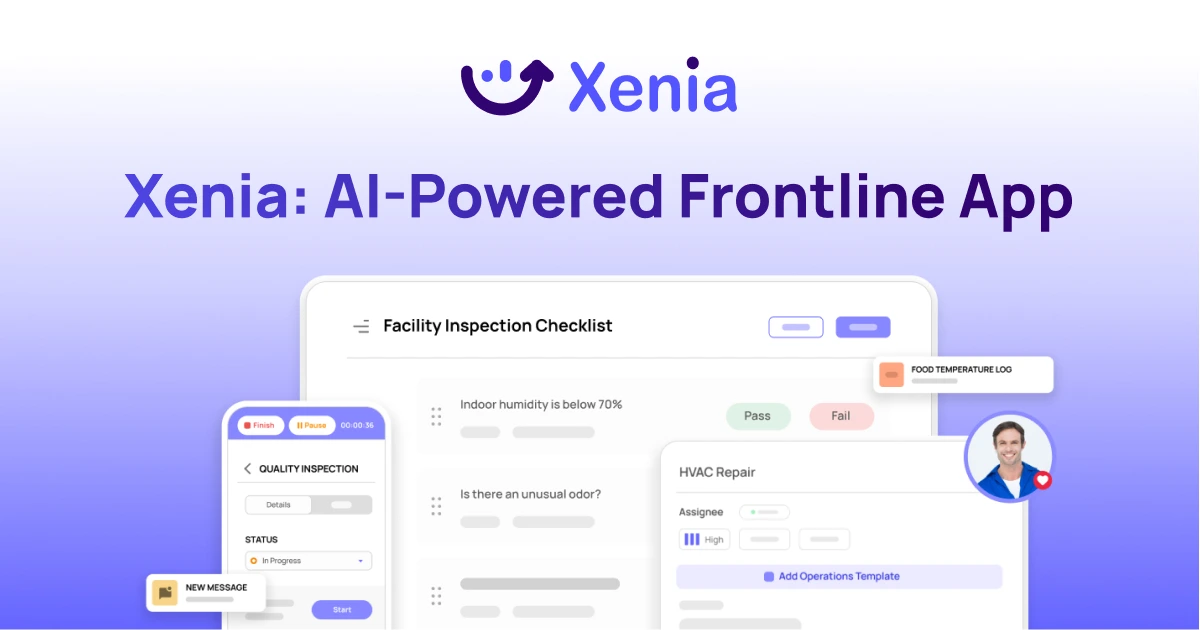
A Modern, AI-Powered Platform Built Specifically for Frontline Operations
Xenia brings daily operations, maintenance, audits, and compliance into one mobile-first platform. Frontline teams execute work consistently across locations while leadership gets real-time visibility.
Why Multi-Location Operators Choose Xenia:
🤖 AI-Powered Operations, Create digital checklists instantly or convert paper forms with AI. Verify compliance automatically with photo analysis and get instant answers from your operational data.
✅ Daily Operations & Maintenance, Assign work across hundreds of locations in minutes. Report and route issues instantly. Schedule preventive maintenance to catch problems before downtime.
📊 Real-Time Visibility, Track completion, work orders, and performance across all locations through dashboards. Filter by site or asset to spot trends and take action.
Manage operations, maintenance, and compliance across all your locations from one platform

.svg)
.webp)
%201%20(1).webp)

.svg)
%201%20(2).webp)