
Post Summary
In 2026, AI in the food industry is mainly used to automate critical day-to-day operations like temperature checks, staff scheduling, and compliance reporting.
Leading brands rely on “Invisible AI” that works in the background, removing the need for manual data entry.
This use of AI in food service cuts food waste by up to 30% and keeps businesses fully audit-ready by automatically flagging issues and triggering corrective actions.
.svg)

Priced on per user or per location basis
Available on iOS, Android and Web


Why AI Matters to Your Business
Your 25-location restaurant group loses $4.5 million every year to food waste.
Not because you do not have procedures. You do.
You lose that money because Store #12 follows temperature checks religiously, while Store #28 has not logged temps in three days. Store #5's team photographs every task. Store #19 pencil whips their checklists during lunch rush.
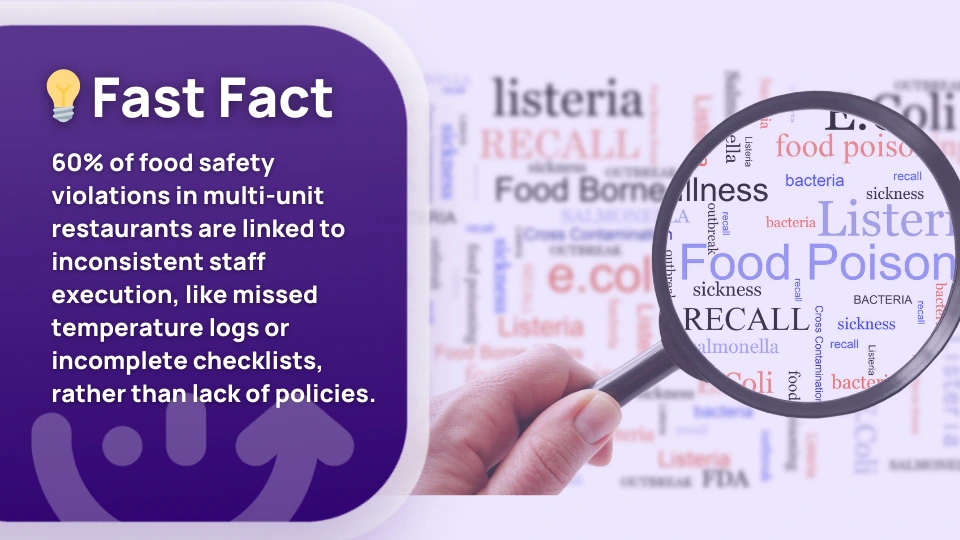
This execution gap is exactly what AI in the food service industry is designed to close.
- $162 billion - What US restaurants spend annually on waste-related costs
- 75-80% - Annual turnover rate across restaurants
- 82% - Restaurants actively hiring right now
- $200-$10,000+ - Health inspection fines per violation
This is where food safety automation platforms with AI change everything as invisible systems that catch failures before they cost you money.
From Pilot Programs to Fully Automated Invisible AI in 2026
AI is no longer a “nice to have.” AI in food service is a survival tool for restaurants operating on razor-thin margins.
Restaurant margins are usually 3-5%, so even small improvements can make a real difference. Reducing food waste helps restaurants keep more of what they already earn. With better visibility into temperatures, prep, and inventory, many operators save thousands of dollars per location each year.
Staying on top of food safety also protects revenue. When inspections go smoothly, teams spend less time fixing issues and more time serving guests.
Consistent compliance builds customer trust, supports positive reviews, and helps brands grow without disruption. Instead of reacting to problems, operators can run day-to-day operations with confidence and control.
Even a small improvement in waste management directly boosts survival. That is why AI went from a “luxury” in 2024 to an operational necessity in 2026.
Can AI Improve Training and SOP Compliance in Restaurants?
Full-service restaurants are still short by 168,000 staff compared to 2020, with annual turnover at 75 to 80%.
With 82% of restaurants actively hiring and recruitment being a top challenge for many, relying on manual oversight to maintain consistent operations is no longer realistic. This is where AI in food service operations becomes essential.
The math is brutal. If you employ 25 people per location across 25 restaurants, you are hiring and training 469 people annually just to maintain staffing. Each new hire requires 2-3 weeks to reach basic competency.
That is 938 weeks, 18 years' worth of training time, compressed into one year.
Manual training does not scale. Paper checklists get lost. Veteran employees forget steps. New hires learn shortcuts from whoever trains them, not actual procedures.
Modern restaurant training platforms help teams learn faster and perform consistently from day one. AI-guided checklists walk new hires through opening procedures, closing protocols, and food safety checks with exact specifications, photo examples, and verification requirements.
Every employee gets the same training.
Every procedure includes the "why" behind each step. Every completion generates proof that it happened correctly. This is how AI in food service standardizes SOPs across distributed teams experiencing constant turnover.

Agentic AI: How Back-of-House Systems Now "Think" and "Act" Without Human Prompts
Agentic AI doesn't just alert, it automatically initiates automated corrective action workflows. This evolution of AI in the food industry moves systems from passive monitoring to active execution.
When a walk-in cooler hits unsafe temperatures at 2 AM, traditional monitoring sends an alert that sits until morning. By then, you have lost inventory.
Agentic AI in food service automatically creates work orders, assigns maintenance personnel with escalation protocols, documents incidents for HACCP compliance, and logs resolution times, without human action.
Example: Walk-in cooler reaches 43°F at 2:17 AM. System detects threshold breach. Within 60 seconds:
- Work order created with equipment ID, location, current temp, threshold violation
- Assigned to on-call maintenance tech via SMS
- Escalated to the facility manager if no acknowledgment within 15 minutes
- The kitchen manager was alerted to check and relocate the inventory
- HACCP log automatically updated with incident details
- Resolution tracked with photo verification of repairs
This is the execution infrastructure that enables AI in food service to deliver food safety at scale for multi-unit operators.
4 Critical Use Cases for AI in the Food and Beverage Industry
1. Automated Temperature Monitoring & Spoilage Prevention
Manual HACCP logs are the most commonly falsified records in restaurants. "Pencil whipping" happens when staff fill logs from memory rather than conducting actual checks.
Store #12's cooler loses cooling overnight. Morning shift discovers $8,000 in spoiled inventory. Logs show "38°F" penciled in at 10 PM for checks that never happened.
Traditional 2-3 manual checks per shift miss the 21 hours between checks. Problems develop undetected. Spoilage happens. Revenue evaporates.
The AI Solution
AI in the food industry deploys comprehensive temperature monitoring that combines manual verification and continuous automation:
- Bluetooth Line Checks - Thermometers sync readings directly into mobile checklists during opening, mid shift, and closing routines. Staff scans equipment with Bluetooth thermometer. Reading automatically populates into the checklist with a timestamp and a geo stamp. No transcription, no errors, complete accuracy.
- 24/7 IoT Monitoring - Wireless LoRaWAN sensors track walk-ins, freezers, and reach-ins continuously. Temperature drift outside safe ranges triggers instant automated alerts to managers and maintenance teams.
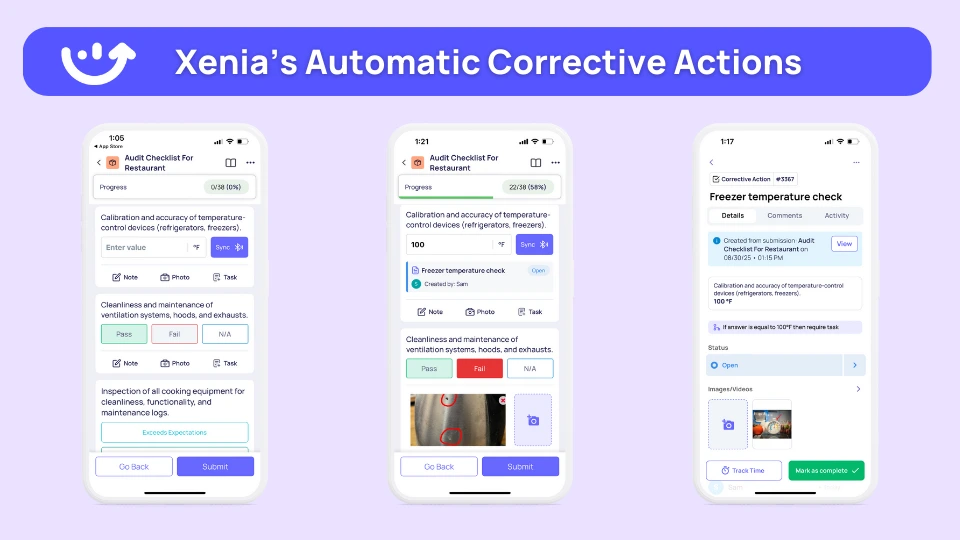
- Automated Corrective Actions - Temperature excursions do not just alert, they automatically create work orders assigned to maintenance personnel with location details, current readings, and escalation protocols if not acknowledged within 15 minutes.
- Digital HACCP Documentation - System generates complete compliance records, time-stamped temperature logs, alert timestamps, corrective actions taken, resolution times, all accessible instantly during health inspections through mobile-ready reports. No paper hunting.
- Predictive Analytics - By tracking temperature trends over time, the system can detect when a refrigeration unit is running warmer than normal. For example, if a walk-in cooler at Store #22 starts trending 2-3 degrees higher over a couple of weeks, the system flags it for maintenance before food is lost or the unit fails.

2. Computer Vision for Hygiene & Quality Control
You can't watch every shift, ensure handwashing protocols are followed, gloves are worn correctly, or plating meets brand standards. Store #5 delivers perfect plates. Store #22 lets portions slide during rush.
Manual oversight does not scale. District managers can't be everywhere. Quality suffers at locations between visits.
The AI Solution
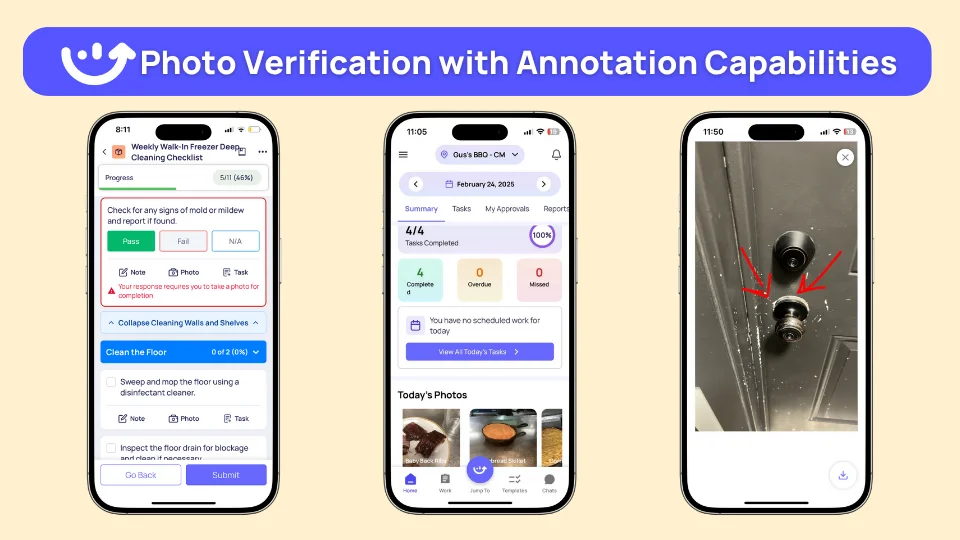
AI photo analysis transforms mobile inspection photos into actionable intelligence through automated object recognition:
- Automatic PPE Compliance Detection - When staff photograph line checks or opening procedures, AI photo analysis automatically detects whether proper gloves, hairnets, and aprons are visible in food prep areas. Missing PPE triggers instant notifications to managers without manual review.
- Food Presentation Verification - AI analyzes photos of plated dishes against brand standard reference images, automatically detecting portion inconsistencies (6 oz when the standard is 8 oz), improper plating, or presentation violations. The system provides instant feedback, enabling faster coaching.
- Cleanliness & Contamination Detection - Object recognition identifies potential contamination risks in kitchen photos: uncovered food containers, improper storage, cross-contamination risks, and cleaning chemical proximity to food. AI automatically flags these issues in scored audits before health inspectors notice.
- Damaged Product Recognition - During inventory checks and receiving procedures, AI analyzes photos, detecting damaged packaging, expired product labels, or quality issues requiring immediate attention.
What You Need
Build mandatory photo requirements into mobile checklists and inspections. Platform timestamps and geo stamps each photo.
Instead of managers manually reviewing hundreds of photos daily, dashboards surface critical issues: "7 PPE violations detected across 4 locations today" with direct links to flagged photos and automated corrective tasks already assigned.
3. Predictive Compliance & Automated Corrective Actions
Reactive compliance finds problems when health inspectors show up. By then, you have served unsafe food and put permits at risk.
Traditional approach: Health inspector arrives. Discovers violations. Issues citations. You scramble to fix problems. Reputation damaged. Revenue lost during closure.
The AI Solution
Critical questions every food safety director should answer:
- Can you prove Store #67 completed their checklist this morning?
- Do you know which locations missed kitchen inspections this week?
- When temperature alerts occur, do investigations happen automatically?
If you can't confidently answer "yes," you have an execution gap.
Score-Based Triggers
Deploy scored audit programs where critical food safety items (temperature control, cross-contamination prevention, handwashing compliance) get weighted higher than minor issues (storage organization, labeling consistency).
When Store #22 scores below the threshold (73/100 vs 91/100 chain average), automated corrective action workflows immediately trigger with assigned tasks, deadlines, and escalation for overdue items.
Real-Time Compliance Tracking
Live dashboards show completion status across all locations. When Store #28 shows 60% completion vs 94% chain average, district managers intervene before inspectors arrive.
System displays:
- Which locations completed opening procedures
- Temperature log compliance rates
- Overdue corrective actions by location
- Declining audit score trends
- Equipment maintenance status
Automated Corrective Actions
Temperature sensors don't just alert when thresholds breach; they trigger complete corrective action workflows automatically:
- Work order creation with equipment details
- Maintenance assignment with contact info
- Manager notification with urgency level
- HACCP documentation with incident details
- Verification requirements before closure
- Escalation protocols for delayed response
Pattern Recognition Analytics
When similar violations appear across locations, analytics make patterns visible immediately.
AI identifies when violations cluster: "Temperature control issues at 7 locations during dinner rush 6-9 PM" or "Cross contamination violations on Sunday closing shifts across 12 stores."
This reveals systematic problems requiring targeted intervention, training gaps, inadequate staffing during peak hours, or equipment maintenance issues rather than treating each violation as an isolated incident.
Predictive Risk Scoring
AI analyzes operational data across locations:
- Task completion rates are trending down over 30 days
- Increasing frequency of temperature excursions
- Slower response times to corrective actions
- Declining audit scores compared to chain averages
- Staff turnover rates at specific locations
When a location's risk score crosses 75 (on 1-100 scale) automated alerts notify district managers. Dashboard shows exactly which factors are driving risk, allowing targeted intervention.
4. Demand Forecasting to Slash Food Waste
Store #8 orders the same produce every Monday based on "what we usually need." Rainy weather keeps customers home, $1,200 in produce hits dumpsters by Thursday.
Store #14 under orders before local concert, runs out of key ingredients at 7 PM, turns away customers during peak hours.
Static ordering based on historical averages misses the dynamic factors affecting daily demand.
The AI Solution
AI-powered forecasting analyzes multiple data sources simultaneously:
- Sales data by item, day of week, and time period
- Weather forecasts (cold weather drives soup sales up 40%)
- Local events
- Seasonal trends
- Historical waste patterns by item and location
- Menu mix changes and promotions
What You Can Implement Now
Digital Inventory Management - Track actual consumption rates through regular counts on mobile devices. When Store #8 orders 50 lbs of tomatoes but uses 35 lbs, the variance becomes visible. The system calculates actual usage rates vs theoretical usage based on sales.
Categorized Waste Tracking - Log waste by category: prep waste (trim loss, expired ingredients), spoilage (temperature issues, over ordering), over production (made too much), plate waste (customer leftovers). Different categories require different solutions. Build tracking into daily closing procedures.
FIFO Rotation Verification - Build first-in-first-out verification into opening checklists with photo requirements showing properly dated, rotated product. AI photo analysis can detect improperly rotated stock or expired date labels.
Predictive Ordering - AI analyzes patterns, predicting when high-use items will run low, generating automatic reorder recommendations before stockouts. System factors in lead times, minimum order quantities, and upcoming demand spikes.
Manual vs AI-Powered Operations Comparison
**
Operational Factor, Traditional Manual Process, AI-Powered Process
Data Accuracy, Manual entry prone to human error & pencil whipping, Real-time digital verification with timestamps and geo stamps
Staff Training, Multi-day onboarding with paper manuals & inconsistent instructions, AI-guided task checklists with photo examples and step-by-step verification
Compliance Proof, Paper binders & manual signatures. Difficult to locate during inspections, Immutable & timestamped PDF reports accessible instantly via mobile device
Reaction Time, Post-incident discovery. Hours or days delayed, Instant automated corrective actions with escalation protocols
Temperature Monitoring, 2-3 manual checks daily & 21-hour blind spots, 24/7 IoT monitoring with instant alerts and automatic work orders
Photo Verification, Managers manually review hundreds of photos, AI automatically detects violations and triggers corrective actions
Compliance Prediction, Discover problems during inspections, Predictive analytics identify high-risk locations before inspectors arrive
Task Completion, Unknown until something goes wrong, Real-time dashboard across all locations with completion percentages
Waste Management, Monthly P&L shows losses after fact, Daily dashboards by location & category show cause with predictive reordering
**
The difference is the gap between hoping procedures are followed and knowing they are completed with proof. This is exactly what food safety with Xenia delivers, moving from reactive firefighting to proactive prevention.
Why Leading Restaurant Chains Use Frontline Operations Platforms
The difference between restaurants controlling food costs and those accepting waste comes down to systematic execution infrastructure.
Xenia is an AI-powered food safety platform built for multi-unit food service:
- AI Photo Analysis - Automatic object recognition detecting PPE violations, cleanliness issues, presentation problems, contamination risks in operations photos without manual review.
- Integrated Temperature Monitoring - 24/7 continuous monitoring with Bluetooth/LoRaWAN sensors, automated alerts, and instant work order creation for temperature excursions.

- Automated Corrective Actions - Temperature failures and low audit scores automatically trigger workflows with assigned tasks, deadlines, and escalation protocols without manager intervention.
- Predictive Analytics - Identify high-risk locations through declining task completion and increasing equipment alerts, anticipate equipment failures through performance pattern analysis, and recognize violation patterns before health inspections.
- AI-Powered Operational Summaries - Daily dashboards automatically highlight critical food safety issues, trending problems, and compliance gaps across all locations without manual data review.
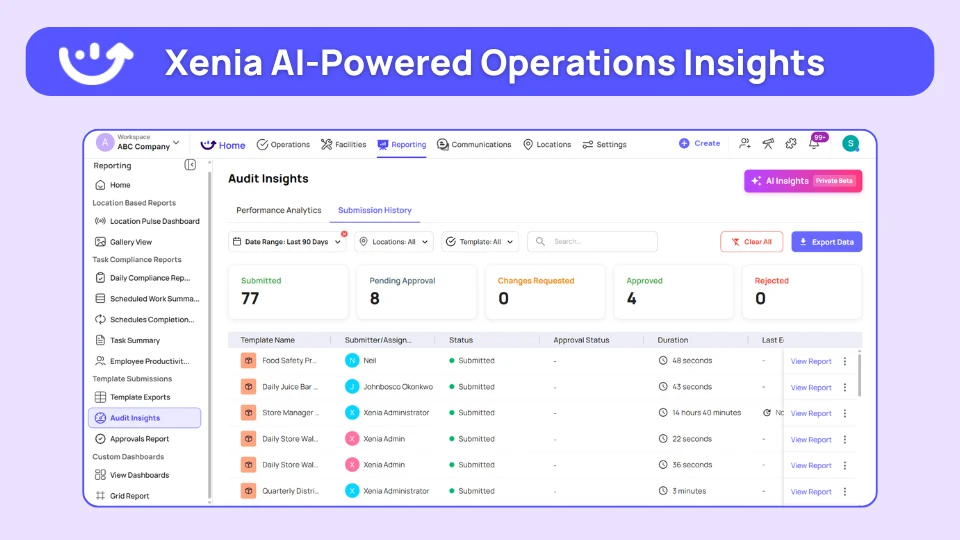
- Digital HACCP Documentation - Time-stamped compliance records with instant mobile access for health inspections. No paper hunting. Complete audit trail for regulatory requirements.
Additional Capabilities:
- Templates for instant checklist and SOP generation
- Mobile checklists with mandatory photo verification
- Scored audits with weighted criticality for food safety priorities
- Multi-unit management mirroring your org structure from stores to districts to regions
- Work order management with automated routing and tracking
- Equipment tracking with maintenance history and predictive alerts
- Team communication centralizes all operational updates
Frequently Asked Questions
How does AI reduce food waste in restaurants?
AI reduces waste through predictive analytics forecasting demand (achieving a 25-30% reduction) and 24/7 temperature monitoring, preventing spoilage (achieving a 30% reduction from equipment-related losses). Multi-unit operators report 4-6 month payback periods.
What is the impact of AI on food safety compliance?
AI ensures 100% compliance by automating HACCP logs with photo verification proving procedures were followed. Multi-unit chains report a 60-80% reduction in health violations and average inspection score improvements from mid-80s to mid-90s.
Is AI in the food service industry replacing human workers?
No. With turnover at 75-80% and 82% of restaurants actively hiring, AI acts as a "copilot" for humans, automating tedious administrative work like temperature logging and compliance documentation so staff can focus on food preparation and guest experience.
What is AI photo analysis in food service?
AI photo analysis uses computer vision and object recognition to automatically detect PPE compliance violations, food presentation issues, cleanliness problems, and contamination risks in photos captured during daily operations, eliminating subjective assessments and providing objective, instant feedback.
How do automated corrective actions work?
Temperature excursions, failed audit scores below threshold, or AI-detected violations automatically trigger workflows: work orders create themselves with equipment and location details, tasks are assigned to responsible personnel with deadlines, escalations occur automatically for overdue items, and completion requires photo verification before closure.
Close Your Execution Gap
Your food safety strategy is only as good as your ability to verify it is being followed across every location, every shift, every day.
Multi-unit operators achieving measurable improvements in 2026 are not doing it through better policies; they are relying on AI in the food industry to enforce execution at scale.
- Automatically detects violations through photo analysis before customers or inspectors notice
- Predicts failures before they occur through equipment performance monitoring
- Triggers corrective actions without manager intervention through automated workflows
- Provides daily operational intelligence across all locations through AI-powered summaries
- Creates digital HACCP documentation instantly accessible during inspections
The shift from pilot programs to "invisible AI" is complete. The question is no longer whether to implement AI; it's how quickly you can close your execution gap before competitors do.
Schedule a demo to see how restaurants achieve measurable improvements in food safety compliance across multi-unit operations using AI-powered operations platforms.
Frequently Asked Questions
Got a question? Find our FAQs here. If your question hasn't been answered here, contact us.

Looks like there's no data available in our FAQ section at the moment.

A Modern, AI-Powered Platform Built Specifically for Frontline Operations
Xenia brings daily operations, maintenance, audits, and compliance into one mobile-first platform. Frontline teams execute work consistently across locations while leadership gets real-time visibility.
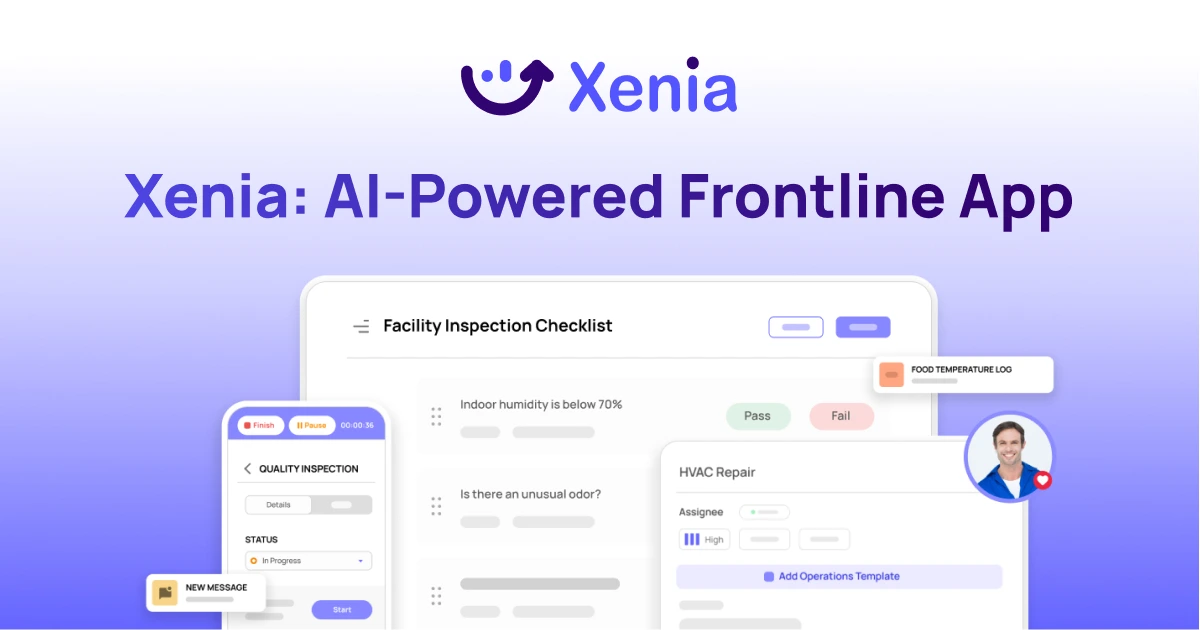
Why Multi-Location Operators Choose Xenia:
🤖 AI-Powered Operations, Create digital checklists instantly or convert paper forms with AI. Verify compliance automatically with photo analysis and get instant answers from your operational data.
✅ Daily Operations & Maintenance, Assign work across hundreds of locations in minutes. Report and route issues instantly. Schedule preventive maintenance to catch problems before downtime.
📊 Real-Time Visibility, Track completion, work orders, and performance across all locations through dashboards. Filter by site or asset to spot trends and take action.
Manage operations, maintenance, and compliance across all your locations from one platform

.svg)
.webp)
%201%20(1).webp)

.svg)
%201%20(2).webp)