

.webp)
Post Summary
A location comes in 22% over labor budget. Nobody flagged it. The CFO pulls the report and finds three employees who hit double time on back-to-back shifts. The shifts were approved. The payroll ran. By the time anyone noticed, the money was already gone.
That is what unmanaged double time looks like at scale. It does not show up as one big problem. It shows up as dozens of small ones, quietly compounding across every location, every pay period.
This guide covers exactly what double time pay is, when it legally kicks in, how to calculate it, and what it costs when nobody is watching.
.webp)
.svg)

Priced on per user or per location basis
Available on iOS, Android and Web


What is double time pay?
Double time pay is exactly what it sounds like. It is two times an employee's regular hourly rate.
If someone earns $18 per hour, their double time rate is $36 per hour. Every hour worked at double time costs you twice what a regular hour costs.
It is not the same as overtime. A lot of people mix these up. Overtime is 1.5x the regular rate, also called time and a half. Double time is 2x. Different triggers, different costs, different legal rules.
Here is how all three rates look across the most common hourly wages:
**
Regular Rate, Time and a Half (1.5x), Double Time (2x)
$15.00/hr, $22.50/hr, $30.00/hr
$18.00/hr, $27.00/hr, $36.00/hr
$20.00/hr, $30.00/hr, $40.00/hr
$25.00/hr, $37.50/hr, $50.00/hr
**
What is double time and a half?
Double time and a half is 2.5x the regular rate. At $18/hr, that comes out to $45/hr. It is not required by any federal or state law. It shows up mostly in union contracts and some company holiday pay policies.
What is double overtime?
"Double overtime" is not a legal term. Some people use it to mean double time. Others use it loosely for any pay above standard overtime. In most conversations, it means the same thing as double time: 2x the regular rate.
When does double time pay apply?
Federal law (FLSA)
Federal law does not require double time. Full stop.
The Fair Labor Standards Act only mandates overtime at 1.5x for hours beyond 40 in a workweek. Anything above that, including double time, is up to the employer or state law.
California mandatory double time rules
California is the one exception in the USA. State law requires double time in two specific situations, and they are not optional.
**
Situation, When Double Time Kicks In
Long daily shifts, Any hours worked beyond 12 in a single workday
7th consecutive workday, Any hours worked beyond 8 on the 7th straight day of the workweek
**
Here is how the California pay tiers break down on a long shift:
- Hours 1 to 8: Regular rate (1x)
- Hours 9 to 12: Daily overtime (1.5x)
- Hours 13 and beyond: Double time (2x)
On the 7th consecutive workday, the first 8 hours are paid at 1.5x. Everything after hour 8 is paid at 2x.
These rules apply to all non-exempt employees in California, regardless of industry. If you are opening locations in California or already operating there, this needs to be built into your payroll system before the first shift runs.
Voluntary double time outside California
Outside California, double time is a choice. Many operators offer it for holidays, overnight shifts, or emergency coverage. That is perfectly legal.
The problem is inconsistency. This is the one that catches operators off guard most often. If one location pays double time on Sundays and the one across town does not, you have a policy gap. And policy gaps create wage claim exposure, even when you were not legally required to pay double time at all.
Whatever you decide, make it consistent across every location and put it in writing.
Who is eligible for double time pay?
Double time applies to non-exempt employees. These are hourly workers, and salaried employees classified as non-exempt, who qualify for overtime protection under the FLSA.
Exempt employees, generally salaried managers and professionals earning above the FLSA salary threshold, are not entitled to overtime or double time under federal law.
Here is a quick breakdown:
**
Employee Type, Eligible for Double Time?
Non-exempt hourly workers, Yes
Non-exempt salaried workers, Yes
Exempt salaried employees, Generally no
Independent contractors, No
**
The misclassification trap for multi-unit operators
This is where operators with high location counts run into real trouble: shift supervisors and assistant managers.
These roles get classified as exempt all the time based on the job title alone. But title does not determine classification. Job duties do.
If a shift supervisor spends most of their time running the register, stocking shelves, or covering stations rather than managing people, they are likely non-exempt. A misclassified employee working 14-hour shifts without double time pay is a wage claim in waiting.
If you have dozens of these roles across your portfolio, a legal review of how they are classified is worth the time.
How to calculate double time pay
The formula is simple:
Double Time Pay = Regular Hourly Rate x 2 x Double Time Hours Worked
Let's walk through three examples at increasing complexity.
Example 1: Simple holiday shift
An employee earns $17/hr. Your company policy pays double time on holidays. They work an 8-hour shift.
$17 x 2 x 8 = $272
A regular shift would have cost $136. The double time policy doubled that cost for one employee on one day.
Example 2: California 14-hour shift
An employee in California earns $20/hr and works a 14-hour shift.
**
Hours, Rate, Calculation, Total
Hours 1–8, Regular (1x), $20 x 8, $160
Hours 9–12, Overtime (1.5x), $30 x 4, $120
Hours 13–14, Double time (2x), $40 x 2, $80
Total, -, -, $360
**
A standard 8-hour shift would have cost $160. The extra 6 hours added $200.
Example 3: Portfolio-level exposure
One double time event per location per month, 2 hours each, at $18/hr, across 50 locations.
$18 x 2 x 2 hours = $72 per event $72 x 50 locations x 12 months = $43,200 per year
That is the conservative case. Double time events cluster around holidays, short-staffed weeks, and seasonal peaks. The real number is usually higher.
One thing most operators miss: bonuses and commissions
If an employee earned a non-discretionary bonus or commission during the pay period, those earnings must be included when calculating their regular rate before applying the double time multiplier. The regular rate goes up, and so does the double time rate. This is one of the most common payroll calculation errors in hourly operations, and it rarely gets caught until a wage claim surfaces.
Double time vs overtime vs time and a half
People use these terms as if they mean the same thing. They do not. Here is exactly how they differ:
**
Pay Type, Multiplier, Federally Required, Common Trigger
Regular pay, 1x, N/A, Standard scheduled hours
Time and a half, 1.5x, Yes-over 40 hrs/week, Weekly overtime (FLSA)
Double time, 2x, No (except California), 12+ hrs/day in CA-voluntary policy elsewhere
Double time and a half, 2.5x, No, Union contracts-select company policies
**
A question that comes up often: is overtime the same as double pay?
No. Federal overtime is 1.5x. Double pay is 2x. They are not the same rate, they do not have the same triggers, and they do not have the same legal requirements. The confusion happens because people hear both terms together and assume they mean the same thing.
What double time costs multi-unit operators at scale
Most conversations about double time focus on compliance. That is understandable. But compliance is not actually the expensive part for most operators. The expensive part is exposure that builds up before anyone sees it.
There are four places where that happens:
1. No pre-shift visibility
A manager approves a 13-hour shift or a back-to-back that pushes an employee into double time territory. There is no flag in the system. No alert. The shift runs, payroll processes, and the cost shows up in a variance report three days later. Nothing can be reversed at that point.
2. Area managers approving blind
Area managers often sign off on schedules across five to ten locations at once. They are looking at whether shifts are covered, not whether specific employees are approaching double time thresholds. They are approving hours. Nobody is tracking cost exposure. That is a process problem, not a people problem.
For a deeper look at how to build visibility into scheduling before shifts run, our workforce scheduling guide shows how to catch labor cost problems before payroll closes.
3. Inconsistent policies across locations
One location pays double time on Sundays. Another does not. A third has a manager who started doing it informally years ago and never stopped. When an employee transfers between locations, the inconsistency surfaces. Inconsistent application of voluntary double time policies can create liability even where no legal requirement exists.
4. California expansion without payroll reconfiguration
A brand running 40 locations in Texas opens two in California. The payroll system is not updated to trigger California's daily overtime and double time rules automatically. The first quarter of California operations quietly generates underpayment exposure that only shows up in an audit.
How to avoid unplanned double time pay
This is not just a payroll issue. It is an operations and HR issue. Here are five practices that reduce unplanned exposure:
**
Practice, What It Does
Shift length caps with approval thresholds, Flags any shift over 10–12 hours before it is approved
Portfolio-level consecutive day tracking, Catches 7th-day California triggers across locations
Written double time policy, Creates consistency and a legal paper trail across every location
Double time in labor budget modeling, Puts the cost in the plan before the schedule is built
Quarterly payroll audits, Catches miscalculated rates for bonus and commission earners
**
Related Resources
- Employee Accountability Software
- Task Management for Frontline Teams
- Enterprise Workforce Management Guide
- Staff Management Checklist App
- Optimize Staff Scheduling for Peak Hours
Conclusion
Double time is not a niche payroll topic. For any operator running an hourly workforce across multiple locations, it is a cost management problem that hides in plain sight.
The CFO who finds three employees with unplanned double time in a labor variance report is not looking at a one-location mistake. They are looking at the visible edge of a pattern that repeats everywhere, every time a manager approves a long shift without knowing what it costs.
The fix is straightforward. Visibility before shifts run. Not after payroll closes.
Xenia gives multi-unit operators real-time labor tracking and scheduling accountability across every location so the cost of every shift is visible before anyone clocks in. See how it works.
Frequently Asked Questions
Got a question? Find our FAQs here. If your question hasn't been answered here, contact us.
Can salaried employees receive double time pay?

It depends on how they are classified. Exempt salaried employees generally do not qualify. Non-exempt salaried employees do. The common trap in multi-unit operations is classifying shift supervisors and assistant managers as exempt based on title alone when their day-to-day work is mostly non-managerial. That is a misclassification risk worth reviewing.
Does double time apply on holidays?
Only if your company policy says so. Federal law does not require holiday pay. Neither does California. California's double time rules are based on how many hours someone works in a day, not whether it is a holiday.
How do you calculate double time and a half?
Take the employee's regular hourly rate and multiply it by 2.5. If someone earns $20/hr, double time and a half is $50/hr. No law requires this rate. It mostly shows up in union contracts and some holiday pay policies.
What is the difference between double time and overtime?
Overtime is 1.5x your regular rate. Double time is 2x. Federal law requires overtime after 40 hours a week. Double time is not federally required. California is the exception, it requires double time for shifts over 12 hours and on the 7th consecutive workday.
Is double time pay required by federal law?
No. Federal law only requires overtime at 1.5x after 40 hours in a workweek. Double time is only legally required in California. Everywhere else, it is your call as an employer.

A Modern, AI-Powered Platform Built Specifically for Frontline Operations
Xenia brings daily operations, maintenance, audits, and compliance into one mobile-first platform. Frontline teams execute work consistently across locations while leadership gets real-time visibility.
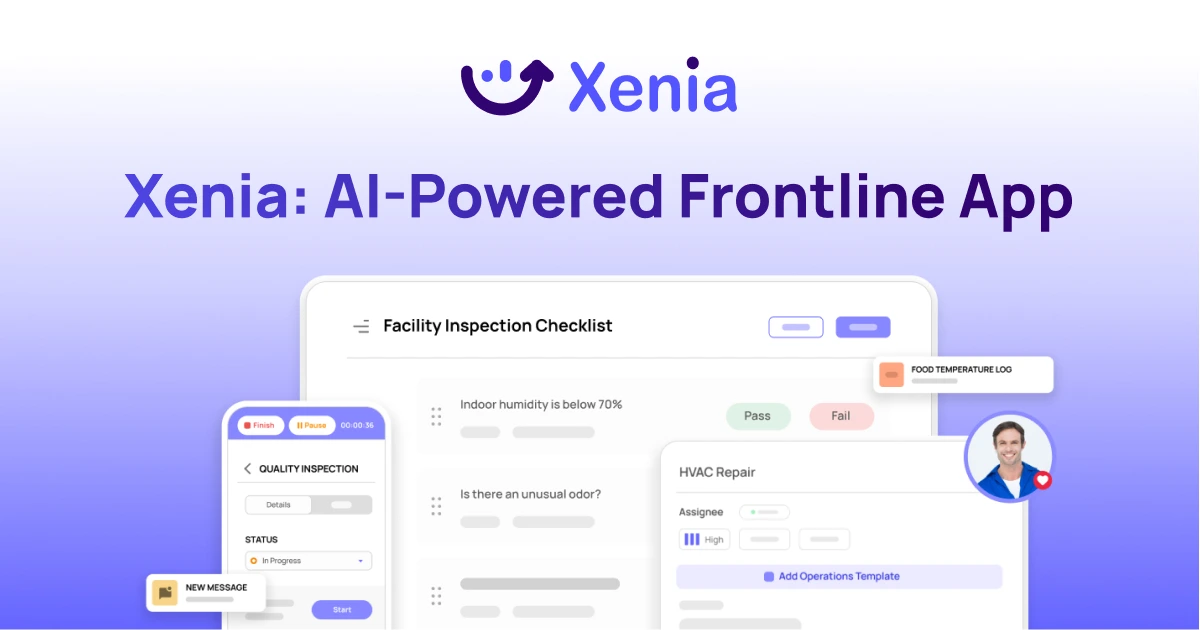
Why Multi-Location Operators Choose Xenia:
🤖 AI-Powered Operations, Create digital checklists instantly or convert paper forms with AI. Verify compliance automatically with photo analysis and get instant answers from your operational data.
✅ Daily Operations & Maintenance, Assign work across hundreds of locations in minutes. Report and route issues instantly. Schedule preventive maintenance to catch problems before downtime.
📊 Real-Time Visibility, Track completion, work orders, and performance across all locations through dashboards. Filter by site or asset to spot trends and take action.
Manage operations, maintenance, and compliance across all your locations from one platform

.svg)
.webp)
%201%20(1).webp)

.svg)
%201%20(2).webp)