

.webp)
Post Summary
One assistant manager. Misclassified as exempt. 3 locations made the same call. By the time anyone flagged it, the wage claim had already crossed district lines.
That is how classification errors travel. Quietly. And by the time the damage is visible, it is already expensive.
This guide is for operators making pay structure decisions across multiple locations and need those decisions to hold up legally.
.webp)
.svg)

Priced on per user or per location basis
Available on iOS, Android and Web


What is the difference between salary and hourly pay?
Salary pay is a fixed amount. Work 38 hours or 50, the paycheck stays the same.
Hourly pay is simple. More hours, more pay. Fewer hours, less pay.
That difference affects overtime, scheduling, payroll costs, and legal risk.
**
Aspect, Salaried, Hourly
Pay structure, Fixed regardless of hours, Based on hours worked
Overtime eligibility, Exempt if qualifications met, Required at 1.5x over 40 hrs/week
Benefits access, Typically full benefits, Often limited or threshold-based
Payroll predictability, High, Varies with scheduling
**
Salaried and exempt are not the same thing. A lot of operators get this wrong.
Salaried means how someone gets paid. Exempt means they do not get overtime. An employee can be salaried and still owe overtime if they fail any of the three federal tests. That is where most misclassification problems start.
Federal guidelines for salaried vs hourly employees
The FLSA sets the rules. And they are stricter than most operators expect.
To classify someone as exempt, they must pass all three tests below. Fail any one and overtime applies.
**
Test, What It Requires
Salary Level Test, Must earn at least $684/week ($35568/year)
Salary Basis Test, Must receive a fixed salary not tied to hours or performance
Duties Test, Must primarily perform executive-administrative or professional duties
**
Here is what catches operators off guard: the Duties Test is not about title. It is about what the person actually does day to day.
A shift supervisor with a manager title who mostly runs the register and stocks shelves is almost certainly non-exempt. Call them exempt, and you owe overtime every week they cross 40 hours. Across 20 or 30 locations, that gets expensive fast.
Here is how the risk breaks down by role:
**
Role, Common Classification, Risk Level
District Manager, Exempt, Low
General Manager, Exempt, Low to medium
Assistant Manager, Often classified exempt, High
Shift Supervisor, Often classified exempt, Very high
Crew Member / Associate, Non-exempt hourly, Low
Maintenance Tech, Non-exempt hourly, Low
**
Shift supervisors and assistant managers are the two highest-risk roles in multi-unit operations. They carry managerial titles but do mostly non-managerial work. That gap between title and duties is where wage claims come from.
Salary vs hourly: pros and cons for multi-unit operators
There is no universally correct answer here. Any operator who tells you that salaried is always better for managers or hourly is always better for frontline has probably not dealt with a misclassification claim. The right structure depends on the role, the location, and how much cost flexibility you actually need.
Salaried pay from the operator's perspective:
**
Pros, Cons
Predictable payroll cost, Higher fixed cost per role
Stronger retention for management, Less flexibility if role scope changes
No overtime liability if properly exempt, Misclassification risk if duties shift over time
Easier to budget across locations, Hard to scale down during slow periods
**
Hourly pay from the operator's perspective:
**
Pros, Cons
Labor cost scales with actual demand, Overtime exposure across locations
Easier to adjust headcount, ACA 30-hour threshold complexity
More scheduling flexibility, Higher turnover cost for frontline roles
Simpler to manage part-time workforce, Requires tighter ongoing schedule management
**
One thing worth calling out on the hourly side: the ACA 30-hour threshold surprises operators more than almost anything else.
Under the Affordable Care Act, hourly employees who average 30 or more hours per week are considered full-time and trigger benefits eligibility. In a large hourly workforce, a scheduling decision that feels routine, adding a few hours to cover a gap, can quietly push a group of employees over that threshold. By the time benefits costs show up in the budget, the pattern has been running for months.
For more on how to build schedules that track these thresholds before they become cost problems, our workforce scheduling guide shows how to catch labor cost issues before payroll closes.
The mixed workforce reality in multi-unit operations
Most multi-unit operators do not run one pay structure. They run both at the same time.
Salaried managers at the top. Dozens of hourly frontline workers per location underneath. That sounds manageable until you see how it actually plays out across dozens of locations.
The first problem is classification inconsistency. When each location makes its own call on how to classify roles, the same job ends up treated differently at different sites. One assistant manager is salaried exempt. Another doing the exact same job three miles away is hourly non-exempt. Nobody flagged the gap. It just happened over time. And now it is both a legal exposure and a conversation you do not want to have with an employee who finds out.
The second problem is area managers approving overtime without any visibility into the bigger picture. An area manager signing off on schedules across eight locations may not know that three hourly employees across different sites are collectively racking up serious overtime hours. Each approval looks fine in isolation. The cumulative cost does not exist anywhere until payroll closes.
The third problem is state-level rules that only apply to hourly workers. California requires daily overtime after 8 hours in a single workday, not just after 40 hours in a week. When operators run a single policy across multiple states, the California rules are the ones that get missed. And those are exactly the locations where the hourly workforce is largest and the exposure is highest.
When to use salary vs hourly
Classification should be a deliberate decision, not a default based on what the last operator did or what title sounds right. Four factors worth working through:
**
Factor, Questions to Ask
Workload consistency, Is the role stable week to week or does it flex with demand?
Managerial discretion, Does this person genuinely make independent decisions or follow a script?
State compliance requirements, What are the salary thresholds in every state this role operates in?
Budget predictability, Do you need cost certainty or scheduling flexibility for this role?
**
Here is how common multi-unit roles typically map based on those factors:
**
Role, Typical Classification, Key Watch-Out
District Manager, Salaried exempt, Verify duties test is genuinely met
General Manager, Salaried exempt, Watch if duties shift toward operational work
Assistant Manager, Often salaried exempt, High misclassification risk-review duties
Shift Supervisor, Often salaried or hourly, Very high risk-duties frequently non-exempt
Crew Member / Associate, Hourly non-exempt, Overtime and ACA threshold tracking
Maintenance Tech, Hourly non-exempt, Overtime-California daily rules if applicable
**
What is hazard pay and how does it apply?
Hazard pay is extra pay for working in dangerous or difficult conditions.
No federal law requires it. Employers offer it by choice, or a union contract or local law requires it.
For restaurant, retail, convenience, and hospitality operators, it usually comes up during bad weather, public health situations, or physically risky roles. It does not come up often, but when it does, most operators calculate the overtime wrong.
Here is what gets missed. When you pay hazard pay to an hourly worker, it raises their regular rate for that week. That changes the overtime calculation. If they also worked overtime that week, the overtime rate must be based on the higher regular rate, not just their base wage.
Time and a half and overtime: what operators need to track
For any hourly non-exempt employee, overtime starts after 40 hours in a workweek at 1.5x the regular rate. California, Alaska, and Nevada also trigger overtime after 8 hours in a single day.
One employee at $18/hr working 5 overtime hours costs an extra $135 that week. Across 50 locations where 2 employees each average 5 overtime hours per week, that is $675,000 in extra labor cost per year. Most operators do not see it until payroll closes.
Use our time and a half calculator to run these numbers before the week starts.
Untracked overtime is not a one-location problem. It compounds every pay period.
Related Resources
- HR Workflows for Frontline Teams
- Employee Accountability Software
- Enterprise Workforce Management Guide
- Staff Management Checklist App
- Optimize Staff Scheduling for Peak Hours
Conclusion
Classification decisions do not stay contained to one location. One misclassified shift supervisor becomes the template every other location follows. One missed California overtime rule becomes a liability at every California location in the p ortfolio.
The operators who manage this well are not necessarily the ones with the largest HR teams. They are the ones who have visibility into what is actually happening at the location level before payroll closes.
Xenia gives multi-unit operators real-time visibility into hourly workforce accountability and labor cost exposure across every location, before payroll closes. See how it works.
Frequently Asked Questions
Got a question? Find our FAQs here. If your question hasn't been answered here, contact us.

Looks like there's no data available in our FAQ section at the moment.

A Modern, AI-Powered Platform Built Specifically for Frontline Operations
Xenia brings daily operations, maintenance, audits, and compliance into one mobile-first platform. Frontline teams execute work consistently across locations while leadership gets real-time visibility.
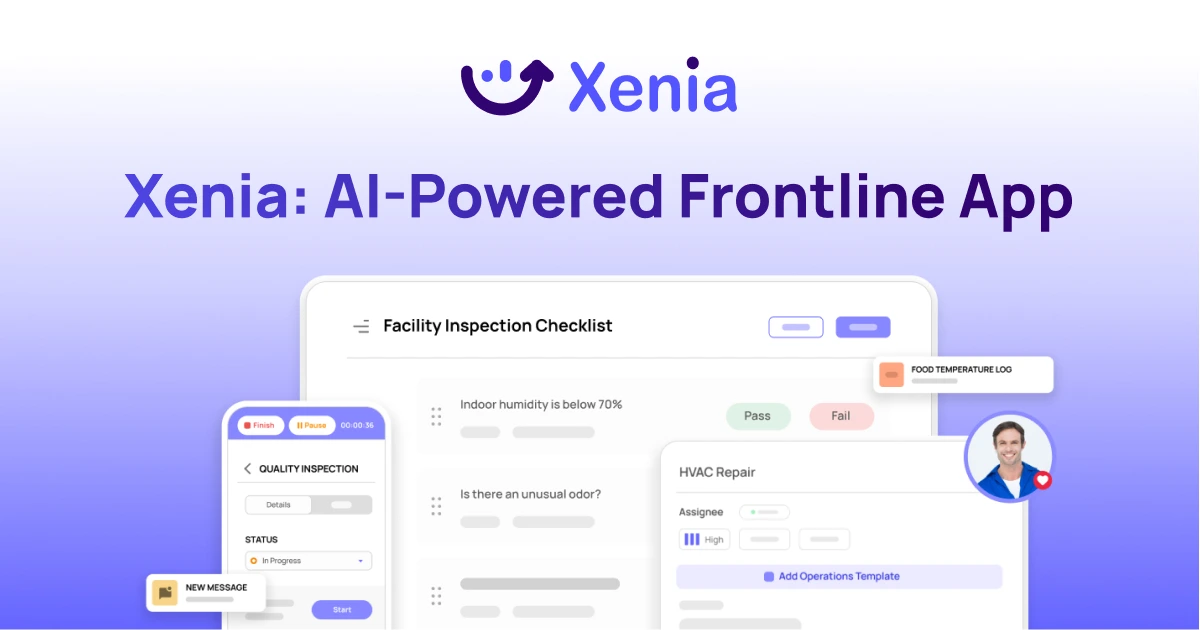
Why Multi-Location Operators Choose Xenia:
🤖 AI-Powered Operations, Create digital checklists instantly or convert paper forms with AI. Verify compliance automatically with photo analysis and get instant answers from your operational data.
✅ Daily Operations & Maintenance, Assign work across hundreds of locations in minutes. Report and route issues instantly. Schedule preventive maintenance to catch problems before downtime.
📊 Real-Time Visibility, Track completion, work orders, and performance across all locations through dashboards. Filter by site or asset to spot trends and take action.
Manage operations, maintenance, and compliance across all your locations from one platform

.svg)
.webp)
%201%20(1).webp)

.svg)
%201%20(2).webp)