

Summary
What is Building Operations Management?
Building operations management is the day-to-day work of keeping a building's physical systems running safely and efficiently. That covers HVAC, electrical, plumbing, life safety, security, and lighting, plus the cleaning and vendor work around them. In practice it means running a preventive maintenance schedule, working the queue when something breaks, completing inspections on a set cadence, and keeping the records that prove compliance to a fire marshal or an insurer.
Three terms carry most of the weight in this article, so define them once. A work order is the tracked record of a single repair or maintenance task, from request to sign-off. Preventive maintenance is scheduled work done before failure, based on time, usage, or manufacturer interval. Deferred maintenance is work that was needed, was not funded or scheduled, and is now sitting in a backlog.
The money at stake is not small. Buildings account for roughly 30% of global final energy consumption and more than half of global electricity use, per the IEA Energy Efficiency Policy Toolkit 2025. In the US, commercial buildings and manufacturing plants together use half of all national energy at a cost of more than $300 billion a year, per EPA ENERGY STAR. ENERGY STAR also estimates the average commercial building wastes about 30% of the energy it consumes, and that owners can cut consumption by up to 30% through low-cost or no-cost operational changes. That waste is an operations problem before it is a capital problem.
Building operations vs. facility management: what is the difference?
Building operations is the tactical, site-level layer. Facility management is the broader organizational function that sits above it. IFMA and ISO define facility management as an organizational function that integrates people, place, and process within the built environment (IFMA). Building operations is the part of that function you can walk through on a Tuesday morning.
|  | Building operations | Facility management |
|---|---|---|
| Scope | One building or site and its systems | Organization-wide, people plus place plus process |
| Time horizon | Daily and weekly. Inspections, PMs, reactive repairs | Multi-year. Capital planning, space strategy, policy |
| Who owns it | Building operations manager, chief engineer, site maintenance lead | Facility manager, director of facilities, VP of ops |
| Success metrics | Uptime, response time, PM completion, occupant complaints | Cost per square foot, space utilization, capital plan adherence |
| Typical toolset | Work orders, PM calendar, inspection checklists, alarm review | IWMS, CAFM, lease and portfolio systems, capital models |
The honest version for multi-site operators: most of you do not have separate people for these two columns. The area manager covering eight sites is doing both, from a phone, between other work. That is why the facility manager job description and the building operations job description read almost the same at companies under a few hundred locations. For the strategic half of the picture, see our guide to building facility management responsibilities.
Types of building management
- Commercial building management. Offices, retail centers, restaurants, and mixed-use sites where tenant or customer experience is tied directly to uptime.
- Residential building management. Apartments and condos, where the work order queue is driven by resident requests and turn cycles.
- Facility management. The organizational function above, covering space, capital, and vendor strategy across a portfolio.
- Corporate real estate management. Portfolio-level ownership of leases, occupancy, and site selection, with building operations executing underneath it.
Key Areas Addressed Through Building Facility Management
Building operations covers seven system families, and every one of them has an inspection cadence somebody has to own. Some cadences are set by code, some by the manufacturer, and some by your insurer or brand standard. The failure mode is almost never that a team does not know the cadence. It is that nobody assigned it, so it happens when someone remembers.
What systems does building operations cover?
| System family | What operations owns | Typical cadence | Regulatory or standards hook |
|---|---|---|---|
| HVAC | Filters, belts, coils, condensate, controls, setpoints | Monthly to quarterly by component | ANSI/ASHRAE/ACCA 180-2018, referenced by the 2024 IMC |
| Life safety and emergency systems | Extinguishers, exit routes, alarm panels, emergency lighting | Extinguishers: monthly visual, annual maintenance check | OSHA 29 CFR 1910.157(e) |
| Electrical and lighting | Panels, occupancy sensors, exterior and parking lighting, lamp replacement | Monthly walk, annual thermal survey | Local electrical code |
| Plumbing and water | Backflow, water heaters, grease interceptors, leak checks | Monthly to annual by component and jurisdiction | Local health and plumbing code |
| Security | Cameras, access control, door hardware, alarm test | Monthly function test | Insurer and brand standards |
| Building automation and metering | Alarm review, setpoint drift, trend logs, submetering | Weekly alarm triage | Internal standard |
| Cleaning, grounds, and vendor services | Janitorial scope, snow and landscaping, waste, pest | Daily to seasonal | Contract SLA |
Two of those rows are code-driven and worth quoting exactly. OSHA 29 CFR 1910.157(e) requires portable fire extinguishers to be visually inspected monthly and to receive an annual maintenance check, and it puts responsibility for inspection, maintenance, and testing on the employer. On the mechanical side, ANSI/ASHRAE/ACCA Standard 180-2018 sets minimum HVAC inspection and maintenance requirements and calls for a documented program with defined objectives, assigned responsibilities, and task frequencies per component. The 2024 International Mechanical Code references Standard 180 as the HVAC maintenance benchmark. Our commercial HVAC maintenance guide breaks those tasks down by component.
HVAC gets first attention for a reason. In EIA's most recent Commercial Buildings Energy Consumption Survey, space heating is roughly 32% of end use, ventilation roughly 10%, and lighting roughly 10% across 5.9 million US commercial buildings (EIA). If you are hunting operating cost, that is where it lives.
Where these systems actually fail
- Lighting. Exterior and parking-lot lamp-outs are the most common after-hours complaint and the most common small work request. They are also the easiest to leave unreported.
- Life safety. Blocked or obstructed exit routes show up on internal walk checklists more often than extinguisher gauges do, and they are a faster path to a citation.
- Building automation. Alarm flood is the real problem, not alarm absence. Hundreds of nuisance alarms nobody reviews trains the team to ignore the one that mattered.
- Security. Door hardware and access control fail far more often than cameras do, and a door that will not latch is a loss and safety issue the same night.
- Plumbing and water. Slow leaks, backflow test lapses, and grease interceptor neglect are cheap to prevent and expensive to discover.
What are hard services and soft services?
Hard services are the technical systems physically tied to the structure. Soft services are the occupant-experience services layered on top of it. Hard services cover mechanical, electrical, plumbing, fire protection, and structural work. Soft services cover cleaning, landscaping, waste, pest control, catering, and security staffing. The distinction matters at contract time, because hard services usually sit under a specialized vendor with code obligations, while soft services sit under a scope-of-work SLA you audit yourself. Most multi-site operators over-manage the hard side and under-manage the soft side, then get surprised when a janitorial scope quietly shrinks. A recurring building facility inspection checklist run on the same cadence at every site is what keeps both halves honest.
What this looks like by vertical
- Restaurant. The rooftop unit over the kitchen line, the grease interceptor, the hood system, and the walk-in compressor. A walk-in drifting warm is a food safety event before it is a maintenance ticket, which is why the restaurant hygiene audit and the maintenance queue have to talk to each other.
- C-store. Forecourt lighting, canopy, cooler doors, car wash bay equipment, tank monitors. A dark forecourt is a safety and sales problem the same night it happens.
- Retail. HVAC inside a multi-tenant mall envelope where the landlord owns half the system, fitting-room lighting, entry doors, exterior signage.
- Hotel. Guest-room PTAC units, boiler and domestic hot water, pool chemistry, elevator service contracts. A hotel's maintenance failures arrive as guest complaints before they arrive as work orders.
Best Practices for Buiding Operations Management
The fastest improvement in building operations comes from three moves: know what assets you own, schedule work against code and manufacturer intervals instead of memory, and make reporting a problem take under a minute. Everything below is downstream of those three.
- Build the asset register before you buy software. You cannot schedule PMs against equipment nobody listed. Capture asset tag, location, make, model, install date, and warranty end. See what belongs in an asset register.
- Set the reactive-to-preventive ratio as an actual published target. DOE's Federal Energy Management Program O&M Best Practices guidance puts typical federal sites at 40% to 60% reactive work, with the strongest programs under 10% and a realistic target of 20% to 30%. Publish your number and review it monthly.
- Build the PM calendar around the codes, not around convenience. Monthly extinguisher visual per OSHA 1910.157(e). HVAC tasks and frequencies per ASHRAE/ACCA 180. Set the rest by manufacturer interval. Our guide to preventive maintenance cadence by asset class covers how to space the intervals without doubling the workload.
- Measure PM compliance and hold 90%. Completed PMs divided by scheduled PMs, times 100. Fiix puts the top benchmark at 90%. Anything below 70% means the calendar is fiction. Start with PM compliance tracking.
- Make it trivially easy for whoever finds the problem to report it. The closing attendant who spots the cooler running warm at 11pm is not opening a laptop and logging into a maintenance system. That is the whole argument for QR-code work requests submitted without a login.
- Route by priority and skill, and escalate on a clock. Define severity levels and the escalation chain before the first emergency, not during it. See work order prioritization.
- Require a photo on submission and on close. The submission photo tells the tech what to bring. The closing photo is the vendor accountability record when a callback conversation starts.
- Manage the backlog as a number, not as a feeling. Deferred work compounds quietly. GAO watched federal deferred maintenance and repair backlogs more than double, from $171 billion to $370 billion between fiscal years 2017 and 2024, and added building condition to its High-Risk List in 2025 (GAO-25-108400). GSA's own backlog passed $17 billion as of March 2025.
- Staff for the labor market you actually have. An estimated 2.1 million skilled trades positions could go unfilled by 2030, and for every five workers who retire only two enter (JLL). Procedure quality is what lets a less experienced tech close the job right the first time. Our facilities management best practices guide covers the documentation side, and the phases of planned maintenance explain how to sequence the rollout.
Request-to-resolution flow
- Detect. Someone finds it. A store manager on the opening walk, a housekeeper on a room turn, a building automation alarm, or a scheduled inspection question that fails.
- Submit. The finder scans the QR code on the asset. The form opens with the asset, location, and category already filled in. No app install, no login. They describe the problem and attach a photo.
- Triage. The request lands in the queue with a severity level. The manager approves, sets priority, and either assigns in-house or routes to the vendor of record.
- Assign. Routing runs on region, priority, and skill. The assignee gets the photo, the asset history, and the deadline.
- Execute. Tech or vendor works the order, logs time, and closes with a completion photo.
- Verify and close. The site manager confirms the fix. The record lands in that asset's service history.
- Learn. Repeat failures on the same asset surface on the dashboard, then become either a PM frequency change or a replace-versus-repair decision.
Xenia is the frontline layer of that flow: submission, routing, PM scheduling, inspections, checklists, and team comms in one app, on the phone the site already has. Store staff and third-party vendors submit work requests by QR code without logging in, the form auto-populates asset and location, and the manager approves and routes by region, priority, and skill. Several maintenance platforms now offer some form of no-account request portal, Limble included, so the differentiator is not the portal by itself. It is the combination of no-login intake plus audits, daily checklists, and frontline comms in the same app, on flat per-location pricing with no per-seat or per-form charge. Conditional visibility helps more than most operators expect here: one building inspection template can cover sites with a boiler and sites without, sites with a pool and sites without, and the units that do not have the asset are not scored against it. If your inspection procedures still live in PDFs, the AI-powered SOP writer converts them into digital forms.
Two live examples from property and site operations: Aspen Management uses digital task management and real-time communication for property operations, and ServiceSource uses Xenia audits and inspections for compliance and site operations.


Priced on per user or per location basis
Available on iOS, Android and Web


Benefits of Building Operations Management Software
Building operations management software earns its keep by converting scattered findings into scheduled, tracked, and evidenced work. Before the benefits, it helps to name what a complete program actually covers, because software only supports the program you have defined.
A complete building operations program covers eight areas: maintenance techniques and strategy, contractor start-up and handover, owning and operating costs, risk assessment, energy and sustainability improvements, HVAC controls, commissioning and testing, and health and safety. Software touches all eight, but it does not create any of them.
What the software actually changes:
- Fewer emergency call-outs. Shifting work from reactive to preventive saves 12% to 18% over a purely reactive program, and adding condition-based predictive work adds a further 8% to 12%, per DOE's Federal Energy Management Program guidance.
- Lower utility spend without capital. O&M programs aimed at energy efficiency save 5% to 20% on energy bills with no significant capital investment (same source), against an ENERGY STAR baseline where the average commercial building wastes 30% of what it consumes.
- A backlog you can see. The alternative is the GAO scenario: a number that grows for seven years because nobody was reporting it. Start with maintenance backlog management.
- Compliance evidence that already exists when the inspector arrives. Timestamped, photo-backed inspection records against OSHA and ASHRAE cadences beat a clipboard binder every time. This is the same argument as audit trail compliance evidence on the inspection side.
- Faster reporting from the people who find problems. No-login submission removes the friction that keeps small issues unreported until they turn into large ones.
- Vendor accountability. Photo at submission, photo at close, and service history per asset makes the callback conversation short.
- Less admin load on a shrinking crew. In NFPA's 2026 State of the Skilled Trades survey, 38% of skilled trades workers expect technology to reduce mundane tasks and 37% cite quick access to jobsite information as the main benefit (NFPA).
BMS vs. CMMS vs. IWMS vs. frontline ops app
Buyers lose weeks to this confusion, so here is the disambiguation in one table.
| Category | What it does | Who buys it | Where Xenia sits |
|---|---|---|---|
| BMS or BAS | Controls and monitors HVAC, lighting, and life safety hardware, and generates alarms | Chief engineer, controls contractor | Xenia does not control hardware. It is where the alarm becomes a work order somebody owns |
| CMMS | Work orders, PM scheduling, asset history, parts inventory | Maintenance manager, reliability lead | Xenia covers frontline submission, routing, and PM. It does not match Limble or ServiceChannel on parts inventory, depreciation, or vendor invoicing depth |
| IWMS or CAFM | Space, lease, portfolio, and capital planning | Corporate real estate, VP of facilities | Out of scope |
| Frontline ops platform | Inspections, daily checklists, work requests, comms, and training on the phone the site already has | Multi-site ops leader, area manager, store or property manager | This is Xenia |
If you are still deciding between categories, read work order software vs. CMMS, then compare features in our building maintenance management software breakdown. The full cluster of routing, escalation, and closure guides sits in the work order management library.
Summing It All Up!
Building operations management is the tactical layer that decides whether a building costs what it should. Facility management sets the strategy. Building operations executes it every day, one inspection and one work order at a time.
The short version to take to your next ops review:
- What it covers. Seven system families, from HVAC and life safety to the soft services layer of cleaning, grounds, waste, and pest.
- Where the money leaks. Energy waste (roughly 30% of consumption in the average commercial building), an unmeasured deferred maintenance backlog, and a reactive ratio nobody publishes.
- What to measure. PM compliance against a 90% benchmark, percentage of work that is reactive against a 20% to 30% target, and backlog age.
- The first three moves. Build the asset register. Set the PM calendar against OSHA and ASHRAE cadences. Then make reporting a problem take less time than ignoring it.
Start with the calendar. Download the free preventive maintenance calendar to map cadences across HVAC, life safety, plumbing, and grounds at every site you run. When you are ready to see QR-code work requests, inspections, and PM scheduling running in one app, book a Xenia demo.
FAQs Building Facility Management
These are the questions multi-site operators, property managers, and new building operations managers ask most often when they are setting up or rebuilding a program. Each answer below is grounded in the same primary sources cited throughout this guide: OSHA's inspection requirements for portable fire extinguishers, the ANSI/ASHRAE/ACCA 180 standard practice for HVAC inspection and maintenance, DOE's Federal Energy Management Program benchmarks for reactive and preventive work, and GAO's reporting on deferred maintenance backlogs. If you are building a program from scratch, read them in order. If you are fixing an existing one, start with the reactive maintenance question and work backward to the asset register.
Frequently Asked Questions
Got a question? Find our FAQs here. If your question hasn't been answered here, contact us.
What are facility management services?

What does a building operations manager do day to day?
How often do commercial building systems need to be inspected?
What is a good PM compliance rate for a building operations program?
How do you get a deferred maintenance backlog under control?
How do you run building operations across multiple sites without adding headcount?

A Modern, AI-Powered Platform Built for Facility Operations
Xenia connects maintenance, safety, inspections, and daily operations into one mobile-first platform. Facility teams respond faster, prevent downtime, and maintain compliance, while leadership tracks performance across all buildings in real time.
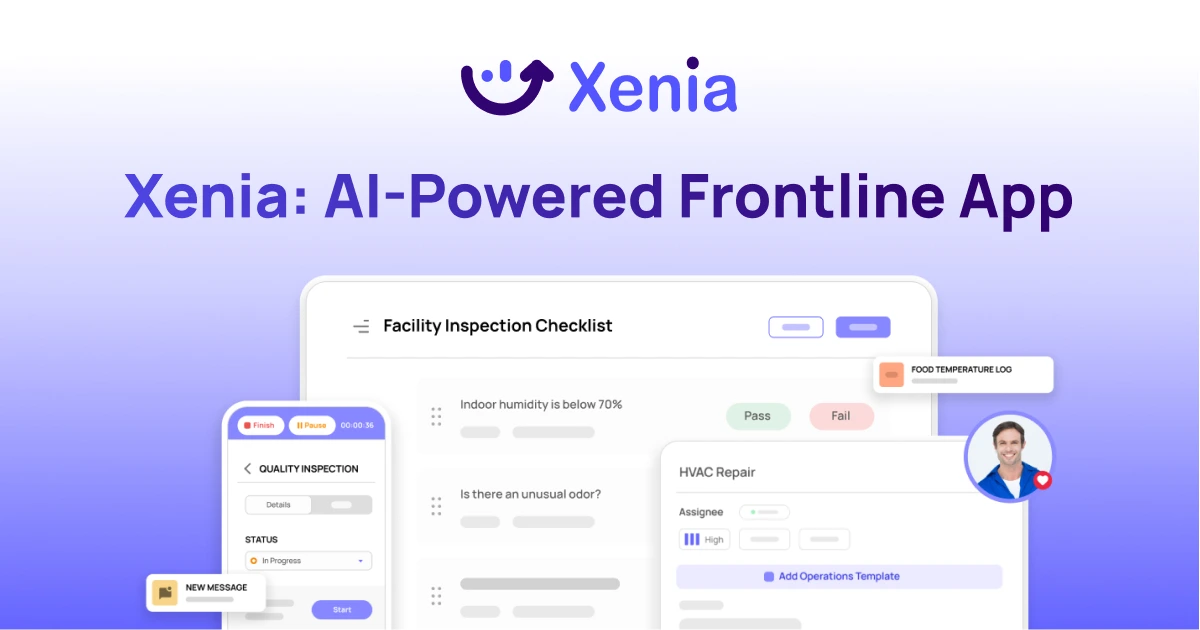
Why Facility Managers Choose Xenia:
🤖 AI-Powered Inspections, Verify safety equipment and compliance automatically with AI photo analysis. Surface critical maintenance issues instantly with AI-powered summaries.
🛠️ Work Orders & Maintenance, Report issues via mobile or QR codes. Route requests to teams or vendors. Schedule preventive maintenance for HVAC, elevators, and emergency systems to reduce downtime.
📊 Safety & Visibility, Deploy fire safety and hazard inspection workflows. Monitor work order resolution times and asset health across all facilities.
Manage work orders, maintenance, and safety inspections across all facilities from one platform.


