
.webp)
Post Summary
Every vendor demo looks the same right now.
The sales rep pulls up a screen. AI photo analysis for every food safety check. Real-time compliance monitoring across all your locations. Autonomous corrective actions the moment a temperature reading goes off. It looks good. The deck is clean. The demo environment is perfect.
Then you go back to your restaurants. And none of it works the way it did on screen.
This is where most operators land with restaurant technology today. AI is in every pitch. It is much narrower in production. That gap is costing restaurants real money in wasted software spend and misplaced trust in tools that are not actually doing what they claim.
This article is an honest breakdown. What restaurant AI tools work reliably today. What is still catching up to the marketing. And how to tell the difference before you sign anything.
.webp)
.svg)

Priced on per user or per location basis
Available on iOS, Android and Web


Related Resources
- What a restaurant operations platform should include beyond task management
- 12 questions to ask before buying a restaurant operations platform
- How restaurant corrective actions should connect to your compliance trail
- How AI is changing restaurant operations
- A complete guide to restaurant management software
What does AI in restaurant compliance actually mean today?
Not all AI in restaurant technology solutions is the same. Before you evaluate any vendor claim, you need to understand what type of AI they are describing.
There are three types:
Automation. The software does something automatically based on a rule. A task gets assigned when a checklist fails. A work order generates when the temperature is out of range. This is not AI. It is conditional logic. Useful, but lots of vendors label it AI because it sounds better. Do not get fooled by this.
Analysis. This is where real AI starts. The software processes data to surface patterns a human would miss or take a long time to find. Location #7 has failed the same line check four times in 30 days. Audit scores drop every time a specific manager runs the shift. That is genuine machine learning applied to real operational data.
Generation. The most recent category and the most overhyped. The software creates something: a summary, a template, a suggested corrective action, an answer to a query. Large language models sit behind most of this. Quality ranges from genuinely useful to unreliable, depending on the task and the data behind it.
When a vendor says their restaurant technology is "AI-powered," they could mean any of these three. Ask which one. Then ask to see a real output from a live customer.
A good reference point here is understanding what the full restaurant operations execution layer actually includes, because AI features that are not connected to live operational data are usually just demos.
Which AI compliance capabilities actually work in real restaurant environments?
Here is the honest breakdown. Production-ready today versus still catching up.
**
AI capability, Production-ready?, What it actually does
AI-assisted checklist builder, Yes, Converts PDF or paper templates into digital checklists fast
Audit summary generation, Yes, Summarizes a 200-question inspection into key findings
Anomaly detection in compliance trends, Yes, Flags locations or items with unusual failure patterns
Natural language compliance queries, Yes, Answers questions like "which location had the most failures this month"
Photo-based food safety verification, Partial, Works for some object recognition-not reliable for all safety checks
Fully autonomous compliance monitoring, Not yet, Requires sensor coverage most restaurants do not have
AI-generated corrective actions for complex SOPs, Not yet, Works for simple items-breaks down on nuanced procedures
**
Now the four AI capabilities that work today in detail.
1. AI-assisted checklist builder
This is one of the most useful restaurant AI tools right now. Most operators have years of paper forms, PDF templates, and Word documents with perfectly good compliance procedures. Getting them into a digital system has always meant manual recreation.
AI template builder reads an existing document and generates a digital checklist from it in minutes. In most cases you still review and adjust, though simpler documents often need very little editing. Either way, instead of starting from scratch you are editing a first draft. For a group running 20 locations with 15 operational checklists, this is not a minor time saving. It cuts implementation time significantly.
2. Audit summary generation
A district manager completes a 200-question brand standards audit. Results come back as raw scores and flagged items. Someone has to read through all of it, find the critical issues, and write up an action summary.
AI does that automatically. It reads the audit responses, identifies the highest-severity failures, and produces a plain-language summary in seconds. The DM still makes the judgment calls. But the time spent extracting meaning from raw data drops fast.
This is one of the clearest examples of compliance automation that works today. The input is structured. The output expectation is clear. The human reviews the result before acting on it.
3. Anomaly detection in compliance trend data
When you have 30 or 40 locations submitting checklists, audits, and temperature logs every day, the data volume is too large to review manually. Nobody is reading 800 daily submissions.
AI scans that data continuously and flags what is off. A location that was 95 percent compliant for six months suddenly drops to 70 percent. A specific checklist item fails at three times the portfolio average. A temperature log is submitted at irregular intervals that suggest it is being filled in retrospectively.
These are patterns a human reviewer would not catch quickly. This is where restaurant operations AI adds real value at scale. It connects directly to how food safety monitoring works across multiple locations in a way that manual review simply cannot keep up with.
4. Natural language query on compliance history
Instead of building a custom report, an operator types a question. "Which locations had open corrective actions for more than 48 hours last month?" The system returns an answer in plain language with the supporting data.
This reduces the time between a question and a decision. It does not replace operational judgment. It removes the friction of getting to the data.
Where do AI compliance tools fall short, and why does it matter?
This is the part most vendor content skips. Here is where restaurant AI tools are not ready for production today.
Photo-based food safety AI
This gets demonstrated the most aggressively. The idea is that a photo taken during a line check is automatically analyzed to verify compliance. Is the food stored correctly? Are containers labeled? Is the prep area clean?
The technology works in lab conditions. In real kitchens, it breaks down. Lighting varies. Photos get taken at different angles. AI models trained on controlled images fail unpredictably when real-world input does not match training conditions.
Operators who have tried this with multiple vendors describe the same experience. The demo looks convincing. The production reality does not match it. The gap between what the feature does in a controlled environment and what it does during an actual line check is significant enough that most operators who have tested it have stopped relying on it.
This capability will get there. It is not reliable enough to trust today.
Fully autonomous compliance monitoring
The pitch is that AI monitors compliance continuously without human involvement. In practice this requires temperature sensors on every unit, IoT devices throughout the kitchen, and consistent connectivity. Most restaurants do not have that infrastructure. Even where they do, autonomous monitoring needs significant calibration before it runs reliably. This is a roadmap feature, not a production reality for most operators.
AI-generated corrective actions for complex SOPs
For simple failures, AI can suggest a reasonable corrective action. Temperature out of range: re-check equipment, document, escalate. That works fine.
For complex operational failures that involve multiple steps, specific training requirements, or judgment calls about severity, the suggestions are generic. A generic corrective action on a serious food safety violation is worse than no suggestion because it looks like action without being one. This is why how corrective actions actually work in restaurant operations matters before you trust any AI to generate them automatically.
How do you evaluate AI claims in a vendor demo?
Most vendor demos show the best-case scenario. Here is how to cut through it fast.
Step 1: Ask one direct question
Is this feature in production at current customers, or is it on your roadmap?
A confident vendor answers this directly. If you hear "we're rolling it out," "it's in beta," or "we're expanding that capability," you have your answer. It is not in production.
Step 2: Ask for a real output from a live customer
Not a canned example. Not a demo account. An actual output from real operational data. An audit summary from a real inspection. An anomaly flag from a real location's compliance data. If they cannot show you this live, the feature is not mature enough to rely on.
Step 3: Watch how they describe "AI-powered" features
If a vendor calls a conditional workflow "AI," that is a red flag. Submitting a failed checklist item to automatically create a work order is automation logic. It is useful. It is not AI. A vendor who cannot draw this line clearly is applying the AI label to features that do not involve machine learning.
Use this table in your next demo:
**
AI claim, Question to ask, Green flag, Red flag
AI photo analysis, Show me a live output from a real location, Live demo from actual customer data, Canned demo with perfect studio images
Anomaly detection, What triggers a flag and how was it tested?, Specific thresholds from real data, Vague description of "intelligent monitoring"
Audit summarization, Generate a summary right now from real data, Instant output from live inspection, "We can send you an example later"
Checklist builder, Convert this PDF right now, Immediate editable draft output, "Let us set that up and get back to you"
Autonomous monitoring, What sensor coverage is required?, Honest answer about infrastructure needs, Claims it works without sensor integration
**
What does the practical AI compliance roadmap look like for operators in 2025 and 2026?
Here is the most useful framing. Start with AI that automates documentation. Do not start with AI that makes decisions.
Start here: documentation and pattern detection
These capabilities are production-ready and carry low risk because a human reviews the output before acting on it.
- AI checklist generation from existing paper or PDF forms
- Audit summary reports after long inspections
- Anomaly flagging across location compliance data
- Natural language queries on compliance history
Watch this space: advanced analysis
These are developing and worth revisiting in 12 to 18 months.
- Photo-based safety verification in real kitchen conditions
- Predictive compliance risk scoring by location
- AI-generated corrective action recommendations for complex SOPs
Not yet: autonomous action
Do not budget for this in a platform purchase today unless you have seen a production deployment in a restaurant environment like yours.
- Fully autonomous compliance monitoring without human review
- AI-driven corrective action execution without manager approval
- Real-time photo verification at every food safety checkpoint
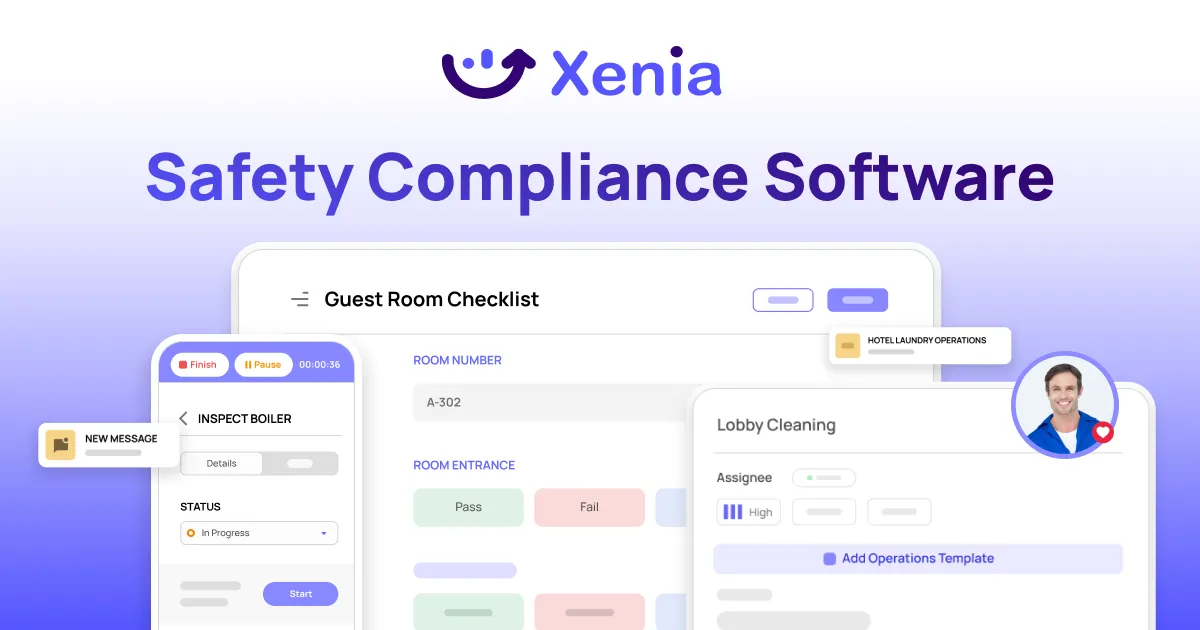
Platforms like Xenia have built their AI features around this distinction. The production-ready capabilities, including audit summarization from long inspection reports, anomaly flagging in compliance trend data, and the AI checklist builder that converts paper and PDF templates into digital forms, are all live on real customer data.
The more advanced capabilities have honest timelines attached. That transparency is what to look for in any innovative restaurant technology solution you evaluate.
For a structured way to stress-test AI claims in a vendor demo, the 12 questions to ask before buying a restaurant operations platform includes specific questions designed to separate live features from roadmap promises.
Conclusion
AI is going to matter a lot in restaurant compliance. It already matters in the right places.
Start with AI that removes documentation friction. Checklist generation. Audit summaries. Anomaly detection in compliance trends. These work today. They save real time. They reduce real risk.
Be skeptical of anything that promises autonomous compliance monitoring or photo-based food safety verification as a production feature. Ask to see live outputs. Ask what is in production versus what is on the roadmap. The vendors who answer those questions directly are worth your time. The ones who pivot back to the demo are not.
The gap between restaurant technology trends and restaurant technology reality is closing. Right now the operators who get the most out of AI are the ones who know exactly where that line sits.
See Xenia's AI compliance features in action. Book a demo and ask us what is live versus what is roadmap.
Frequently Asked Questions
Got a question? Find our FAQs here. If your question hasn't been answered here, contact us.
Is restaurant technology ready for fully automated HACCP documentation?

Partially. AI can automate HACCP records when data comes from digital sources like Bluetooth thermometers and digital checklists. It cannot verify that procedures were actually followed without full sensor coverage. Most restaurants should be running hybrid documentation today: digital records with human verification.
What is the risk of trusting AI compliance tools too early?
False confidence. A tool that looks like it is monitoring compliance but misses real violations is worse than no tool at all. This is the exact problem with photo-based food safety AI today. It looks convincing in a demo. It fails in a real kitchen.
How does AI fit into a restaurant compliance audit trail?
It does not replace it. It makes it faster to act on. Instead of reading 200 raw inspection responses, AI pulls out the critical failures and surfaces trends across audits. The documentation still exists. You just get to the important parts quicker.
What data does a restaurant AI system need to actually work?
Consistent, structured data over time. Regular temperature logs. Audit scores across locations. Checklist completions by shift. The more consistent the input, the more reliable the output. AI built on patchy data gives patchy insights.
Can small restaurant groups benefit from AI compliance tools?
Yes. The checklist builder and audit summarization work at any size. You do not need 50 locations to save time converting paper forms. Anomaly detection gets more valuable as you grow because manual review stops being possible.
What is the difference between AI in restaurant technology and traditional workflow automation?
Automation follows a rule you set. AI finds patterns you never thought to look for. Most vendors blur this line on purpose. Now you know how to tell them apart.


A Modern, AI-Powered Platform Built for Restaurant Operations
Xenia brings kitchen operations, food safety, audits, and team communication into one mobile-first platform. Restaurant teams execute daily work consistently, maintain compliance, and resolve issues faster, while leadership gets real-time visibility across all locations.
.webp)
Why Restaurant Operators Choose Xenia:
🤖 AI-Powered Operations, Convert paper logs instantly and verify food presentation and kitchen cleanliness automatically. Get instant answers about food safety trends without building reports.
🍽️ Food Safety & Compliance, Track line checks and temperature logs with automated alerts. Trigger corrective actions when readings exceed safe ranges. Maintain audit-ready records for health inspections.
📊 Multi-Location Control, Monitor food safety compliance and task completion across regions. Benchmark locations to identify training needs. Export reports for operational reviews.
One platform for kitchen operations, food safety, and compliance across all locations.

.svg)
.webp)
%201%20(1).webp)

.svg)
%201%20(2).webp)