
.webp)
Post Summary
A QSR franchise operator with 22 locations got a health inspection citation for improper food storage at Location 11. The GM was told. The issue was fixed. Eight months later, the same citation came back at the same location.
In between: no corrective action record. No root cause analysis. No re-verification. No closed loop. Just a conversation that everyone remembered differently.
This is not rare. Four separate operators described this exact scenario during Xenia discovery calls. The pattern shows up across operator types and sizes: issue found, verbal fix, no documented proof the loop ever closed. One Wingstop franchisee operator asked it best: "If a store gets a C, will it auto-trigger a re-audit in 72 hours?"
That question captures everything wrong with how most restaurants handle corrective actions today.
Most restaurant operators have some form of restaurant corrective action process. Almost none have a closed-loop corrective action system where every finding is documented, assigned, verified as complete, and tracked for recurrence.
This article covers the closed-loop corrective action lifecycle for multi-unit restaurant operators, from initial finding through root cause analysis to verified resolution and trend monitoring.
.webp)
.svg)

Priced on per user or per location basis
Available on iOS, Android and Web


Recommended Resources
- Restaurant Audit Checklist: How to Run Consistent Internal Inspections
- How to Pass a Restaurant Health Inspection: The Complete Prep Guide
- Restaurant Food Safety Compliance: How to Build a System That Passes Every Time
- Restaurant Operations Management: The Multi-Unit Operator's Complete Playbook
What is a closed-loop corrective action system?
A closed-loop corrective action system is a documented process that begins when a compliance or operational issue is identified and does not end until three things happen:
- The specific issue is corrected
- The correction is verified by someone other than the person who caused the issue
- A root cause analysis produces a documented change that prevents recurrence
Most restaurants today run an open-loop process. Here is what that difference looks like side by side:
**
Process type, What it looks like
Open loop (most restaurants today), Issue found → verbal correction → verbal confirmation → everyone moves on
Closed loop (what the system should be), Issue found → documented finding → assigned corrective action with named person and due date → independent verification → root cause documented → prevention measure implemented and confirmed
**
An open-loop process just looks like compliance, but nothing actually gets fixed. An inspector can flag the same issue twice, and there’s no record showing it was fixed the first time. That makes the second violation much more serious.
A re-audit trigger shows how a closed-loop system should work. If a location scores below a set level, it should automatically schedule a re-audit within a set time. No manual work. No forgetting.
Open-loop is reactive, something breaks, then you respond. Closed-loop actually fixes the problem and makes sure it doesn’t happen again.
What does a complete corrective action record contain?
A corrective action record is not a comment typed into an audit app. It is a structured document that produces a defensible compliance history. Each field serves a purpose.
**
Field, Why it matters
Finding description, Specific-not generic. "Walk-in cooler at 47°F at 7:30 AM" not "temperature issue"
Severity classification, Critical (food safety risk) or non-critical (operational gap)
Date and time found, Establishes the timeline for corrective action response
Assigned to (name and role), Creates accountability. "The team" is not accountable. A named person is.
Due date, Critical items: 24 to 48 hours. Non-critical: within 7 days
Corrective action taken, Specific: "Cooler repaired by vendor-returned to 39°F at 2:30 PM"
Verified by (name and date), A designated reviewer confirms resolution. Not the person who caused the finding.
Root cause and prevention measure, What caused this and what systematic change prevents it from recurring
**
The issue most operators run into is not that they lack a process. It is that their process stops at step one. The finding gets recorded but the loop never closes.
One Director of Operations at a multi-brand franchisee group put it plainly: "I was sending out these maintenance issues. We would have to send these weekly reports and I would enter all the information, but nothing would be done about it."
That is the corrective action record problem. Documentation without the accountability assignment. The finding exists. The closure never comes.
Here is what a non-compliant corrective action entry looks like compared to a closed-loop corrective action record:
**
Non-compliant entry, Closed-loop corrective action record
"Walk-in temp issue noted", Walk-in cooler #2 at 47°F at 7:30 AM opening shift
No severity noted, Critical: food safety risk-proteins stored inside
No due date, Due by end of shift-3:00 PM
"Team to fix", Assigned to: Chef Marcus-GM to verify
No verification, Verified by GM at 2:45 PM-cooler at 38°F-photo attached
No root cause, Door gasket failing. Maintenance work order created. Gasket replaced 4/7.
**
In a health inspection, a franchise audit, or a pattern violation review, the closed-loop record is what protects the operator. The verbal correction protects no one.
Why corrective action systems fail in restaurant operations
Even operators who know what good looks like run into the same breakdown points.
The verbal fix trap. This is the most common corrective action failure across every operator size and type. Issue found, verbally addressed, mentally marked done. No record. No verification. No prevention.
Four separate operators described this exact scenario in Xenia discovery calls. It is not a people problem. It is a process problem.
Corrective actions assigned to no one. Findings that say "management team to address" produce nothing. Without a named individual and a concrete due date, the finding sits in a list and ages out without resolution.
No verification step. The person who caused the finding claims it is resolved and the loop closes on their word. This produces false closure. The issue may not actually be fixed. Even if it is, there is no record that it was verified by anyone independent.
Pattern blindness. An operations lead at a 9-concept restaurant group described the problem directly: "The thing that I keep coming back to is that we'd like to be able to come up and say, hey, for the last three months you guys have had this issue."
When corrective actions are managed location by location in isolation, nobody ever sees that nine of fifteen locations have the same finding. The systemic cause goes unaddressed.
The end-of-day report problem. Corrective actions documented in a weekly or monthly report have already lost their corrective potential. By the time the report is written, the window for root cause action has closed. The issue likely recurred before anyone reviewed the log.
The five-step closed corrective action process
A closed-loop corrective action process is not bureaucracy. It is the minimum system required to actually fix a problem rather than just respond to it.
Step 1: Document the finding immediately, in writing
Not in a group chat. Not in a verbal conversation. A written record with all required fields, time-stamped, specific. This step is where most open-loop processes fail. The finding happens but the documentation does not.
Step 2: Assign with specificity
Every finding gets a named person, a specific correction requirement, and a due date. "Someone needs to fix this" produces nothing. "Chef Javier to re-label all unlabeled items in cooler 2 by end of shift today" produces a verifiable action with a named person who can be followed up with.
Step 3: Verify completion by a designated reviewer
The person who did the fix cannot mark it as complete. Instead, the GM, district manager, or assigned compliance person must check it, using a photo, a second measurement, or by looking in person. This step is what makes a fix truly verified instead of just claimed.
Step 4: Document the root cause
Why did this happen? Not "it was busy" or "they forgot." Structural root causes: training gap, missing SOP reminder, unclear procedure, equipment failure, scheduling gap. The root cause analysis determines what actually needs to change to prevent recurrence.
Step 5: Implement and confirm the prevention measure
Finding the cause of a problem isn’t enough on its own. You need to add a prevention step like updating the procedure, checklist, or training, and make sure it’s actually done. This step makes the fix permanent, not just temporary.
The Wingstop operator's question about the 72-hour re-audit trigger is the natural extension of Step 5.
When a location falls below a defined threshold, a re-audit within 72 hours is not optional. It is built into the system. The closed-loop corrective action workflow requires it. No manual scheduling, no forgetting. The threshold triggers the audit.
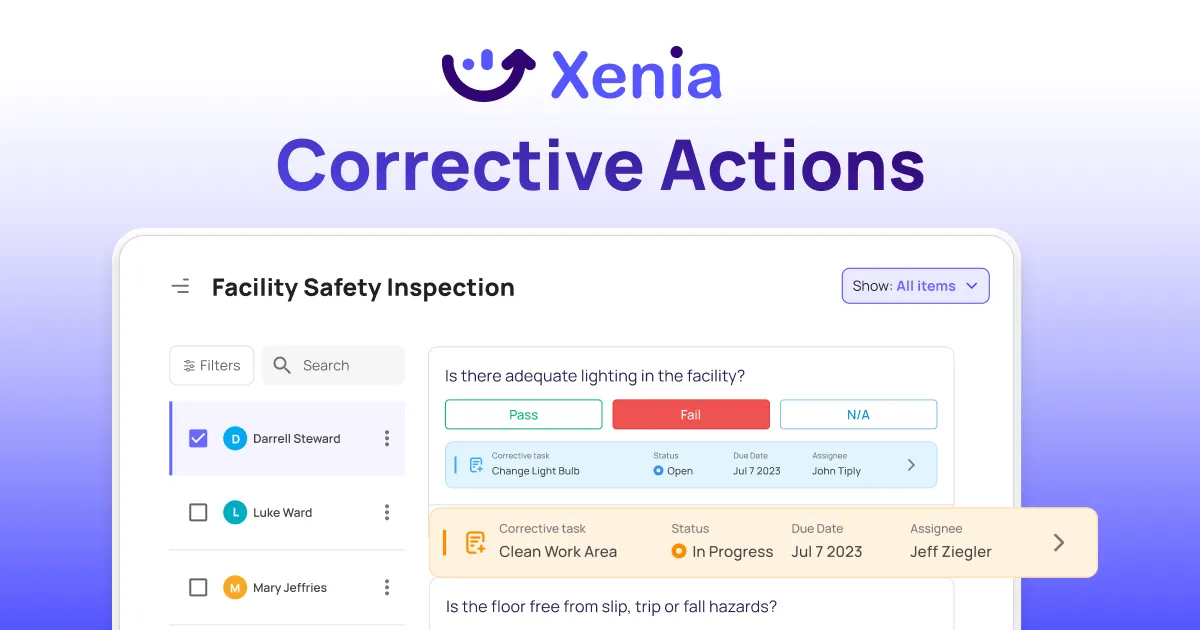
Xenia's corrective action workflow generates a task record automatically when an audit item fails. It is assigned to the responsible party, visible to the district manager, and requires verification before the item can be marked resolved.
The five-step process runs in the background of every completed audit, without the coordinator having to manage it manually.
Running corrective actions verbally across 10 or 20 locations and wondering why the same problems keep showing up? See how Xenia closes the loop automatically.
.webp)
How multi-unit operators track corrective actions across all locations
A single corrective action is manageable. A portfolio of corrective actions across 20 locations is a data management problem.
How operators handle that problem determines whether systemic issues get caught early or stay invisible until a health inspection or brand audit surfaces them.
There are four visibility requirements for multi-location corrective action management:
Centralized tracking, not location by location. Every open corrective action across every location needs to be visible to the district manager and regional director in a single view. Location-level tracking means the pattern never surfaces.
Status visibility in real time. Which findings are open, which are past due, which are verified as closed needs to be visible without a phone call or a weekly report. By the time the weekly report is written, past-due corrective actions have already missed their window.
Pattern identification across locations. When the same finding appears at three of fifteen locations within a 60-day window, it is not a location issue. It is a systemic issue.
This pattern is invisible without cross-location corrective action data. One operations lead described exactly this: he wanted the ability to say "for the last three months you guys have had this issue" across locations, not just at one store.
Escalation logic for past-due items. A corrective action that passes its due date without verification should automatically escalate to the district manager or regional director. Manual follow-up on past-due items at 20 locations is not a sustainable process.
The 72-hour re-audit model captures all four of these requirements in one.
A location that falls below a defined threshold triggers a re-audit within 72 hours automatically. No manual scheduling. No relying on a GM to self-report. The operations accountability loop is built into the system at the audit level.
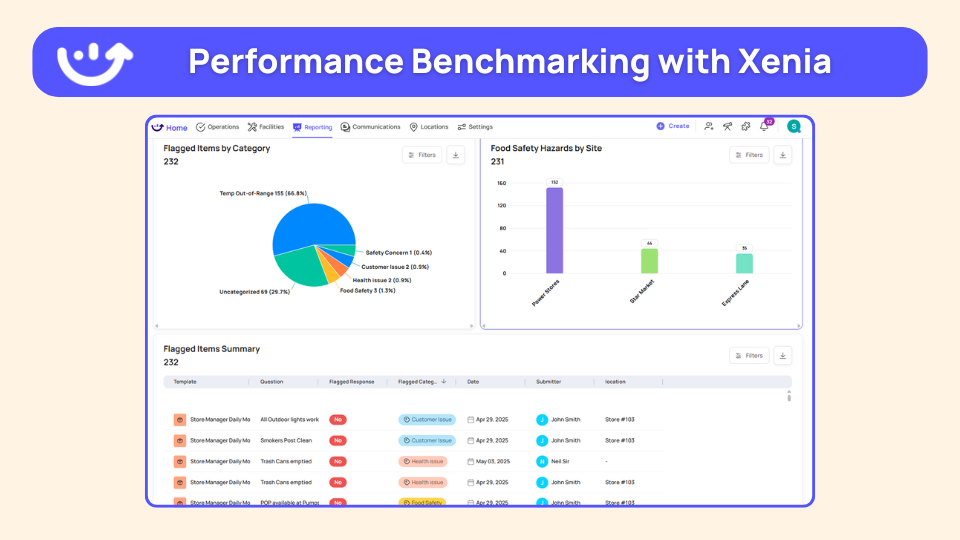
Xenia's corrective action dashboard gives regional directors a portfolio-level view of all open findings, with status, assignee, and days overdue, without requiring individual location check-ins. When an item passes its due date, the escalation happens automatically.
How Xenia closes the corrective action loop across every location
Xenia is an operations execution platform, not a scheduling tool, not a payroll system, not an HR platform.
It works alongside those tools to handle what they do not: the corrective action documentation layer that proves issues were found, assigned, verified, and closed across every location.
When an audit finding is flagged in Xenia, a corrective action task is automatically created and assigned to the responsible person with a due date.
The district manager can see the open item without calling the GM. The task cannot be marked complete without verification. When a location falls below a defined threshold, the re-audit trigger can be built directly into the workflow.
For multi-unit operators, every location runs the same corrective action process, on the same documentation standard, with the same escalation logic.
A regional director can see the full portfolio of open corrective actions before a health inspection or brand audit, not after a citation arrives.
Xenia does not replace your scheduling or payroll systems. It is the operations accountability layer that runs between your daily audits and your compliance record.
See how Xenia's corrective action workflow works for multi-unit restaurants.
Conclusion
A corrective action system works when the loop actually closes.
Document the finding, assign it to a named person, verify the fix independently, document the root cause, and confirm the prevention measure is in place.
The operators who get this right are not the ones with the most rigorous staff. They are the ones with a system that makes consistent operations accountability the default.
Every properly closed corrective action is evidence the operation learned something. Every open loop is a repeat citation waiting to happen.
Want to build a corrective action system that actually closes across every location, every audit, every health inspection citation?
Xenia's corrective action workflow connects audit findings to assigned tasks, verified completions, and cross-location visibility. Schedule a demo.
Frequently Asked Questions
Got a question? Find our FAQs here. If your question hasn't been answered here, contact us.
How do district managers track corrective actions across 20 locations?

Through a centralized portfolio view that shows every open finding across every location with assignee, due date, and days overdue.
Without this view, DMs rely on weekly reports and phone calls, which means past-due corrective actions and pattern violations stay invisible until a health inspector or brand auditor finds them.
Why do repeat violations keep appearing in the same location?
Almost always because the original corrective action was never verified as closed, or because the root cause was never documented.
A verbal fix does not produce a corrective action record. Without a root cause and prevention measure, the same conditions that caused the original finding will produce the same finding again.
What is a 72-hour re-audit and when should it trigger?
A 72-hour re-audit is a follow-up inspection that happens automatically when a location falls below a defined compliance threshold, a health inspection citation, an internal audit score below the minimum, or a critical food safety finding.
The re-audit confirms the corrective action was completed and the issue is resolved. The 72-hour window keeps the closure loop tight.
What should a corrective action record include?
Eight fields: the specific finding with time and location, a severity classification, the date and time it was found, the name of the person assigned, the due date, the specific corrective action taken, the name of the person who verified it, and the root cause with the prevention measure. Missing any of these makes the record incomplete.
What is the difference between an open-loop and closed-loop corrective action?
An open-loop corrective action ends when someone says the issue is fixed.
A closed-loop corrective action ends when the fix is verified by a designated reviewer, the root cause is documented, and a prevention measure is confirmed.


A Modern, AI-Powered Platform Built for Restaurant Operations
Xenia brings kitchen operations, food safety, audits, and team communication into one mobile-first platform. Restaurant teams execute daily work consistently, maintain compliance, and resolve issues faster, while leadership gets real-time visibility across all locations.
.webp)
Why Restaurant Operators Choose Xenia:
🤖 AI-Powered Operations, Convert paper logs instantly and verify food presentation and kitchen cleanliness automatically. Get instant answers about food safety trends without building reports.
🍽️ Food Safety & Compliance, Track line checks and temperature logs with automated alerts. Trigger corrective actions when readings exceed safe ranges. Maintain audit-ready records for health inspections.
📊 Multi-Location Control, Monitor food safety compliance and task completion across regions. Benchmark locations to identify training needs. Export reports for operational reviews.
One platform for kitchen operations, food safety, and compliance across all locations.

.svg)
.webp)
%201%20(1).webp)

.svg)
%201%20(2).webp)