
.webp)
Post Summary
Your GM is running four tools before the lunch rush.
Schedules are in one app. Line checks are in another. Maintenance requests go to a group chat. Training documents sit in a shared drive nobody touches. Everything technically works. But when a health inspector walks in, or a fryer goes down at 6 pm on a Friday, the gaps show fast.
This is the real problem for most multi-unit restaurant groups today. Not a shortage of tools. Too many tools that never talk to each other.
Restaurant operations software gets described a lot of different ways. Checklist apps. Scheduling platforms. Workforce tools. The problem is that most of these labels describe only one piece of what operations actually need. And when your tools only cover one piece, accountability falls in the gaps between them.
This article defines what a real restaurant operations platform should cover. Not just the checklist layer. The full execution layer: audits, work order management, communications, training, and compliance reporting, working together in one place.
.webp)
.svg)

Priced on per user or per location basis
Available on iOS, Android and Web


Related Resources
- How to improve restaurant operations across multiple locations
- 12 questions to ask before buying a restaurant operations platform
- What restaurant corrective actions should look like end to end
- A complete guide to restaurant management software
- How multi-unit restaurants manage tasks across every location
What is a restaurant operations platform and what is not one?
Most software vendors will give you a version of this answer that sounds good but misses the point. A checklist tool with a mobile app. A task manager with some reporting. A scheduling platform that added a few compliance features last quarter.
None of those are a restaurant operations platform. They are starting points that got marketed upward.
Here is the actual line. Scheduling and HRIS tools are necessary. They handle who is working, when, and at what cost. They are foundational. But they do not tell you whether the line check happened correctly, whether the flagged equipment issue got resolved, or whether the new menu rollout was executed at every location. That is operations execution. It is a different layer entirely.
The operations execution layer sits above scheduling and below your accounting system. It is the daily operational layer where procedures get followed, issues get caught, corrective actions get assigned, and compliance gets documented. When that layer runs across five different tools, the data never connects.
A failed temperature check in one app never automatically generates a work order in another. A training gap spotted during an audit never triggers a retraining workflow. Issues get logged and forgotten.
The case for consolidating those tools into one system is its own conversation. What this article defines is what that single platform actually needs to include to cover the full execution layer. If you are still building that consolidation case internally, how multi-unit restaurant groups replace fragmented ops tools with a single platform covers that angle in full.
What are the five capabilities that define a complete operations platform?
Most platforms cover one or two of these well. A complete restaurant operations platform covers all five and connects them to each other. That connection is what separates an execution platform from a collection of features.
Here is the full picture:
**
Capability, What it covers, What breaks without it
Daily ops and checklists, Opening-closing-line checks-temperature logs, No enforcement-easy to skip or fake
Audit and compliance, Scored audits-compliance history-trend data, No visibility into recurring failures
Work order and facilities, Equipment issues-maintenance tracking-closed loop, Maintenance gaps surface during inspections
Team communications, Targeted announcements-read receipts-audit trail, Critical updates go unread and unverified
Training and SOP delivery, Onboarding-completion tracking-embedded SOPs, Compliance gaps develop invisibly over time
**
Now let's go deeper on each one.
1. Daily ops and checklists with enforcement logic
Every restaurant operations software platform starts with checklists. Opening procedures, closing procedures, food safety line checks, temperature logs. These are the backbone of daily execution.
The difference between a basic checklist tool and a real ops platform is enforcement logic. A basic tool records whether something was marked complete. A real platform knows what to do when it was not.
That means conditional workflows that trigger follow-up steps based on responses. Mandatory photo verification before a task can close. Required manager sign-off when a critical step fails. Automatic escalation when a deadline passes without completion.
A checklist that a GM can submit incomplete without consequence is not an accountability tool. It is a record-keeping tool. That distinction becomes painful at 30 locations when you cannot physically verify every submission.
2. Audit and compliance with scoring and history
Daily checklists verify routine execution. Audits verify standards. They are not the same thing.
A complete restaurant ops platform uses weighted scoring in audits so a failed food safety item carries more weight than a missed table setup step. It produces a documented compliance trail that a health inspector can review immediately. It tracks scores by location over time so a district manager can see which locations are trending down before a violation happens.
What most task management tools cannot do is connect audit findings to history. If location seven has failed the same line check item three times in 60 days, that pattern should surface at the portfolio level automatically. It should trigger a review. Without an audit and compliance layer that stores history, you are inspecting locations but not learning from them.
Understanding how restaurant audits and inspections work in practice makes it easier to see where most platforms fall short on this capability.
3. Work order and facilities management with closed-loop tracking
This is the capability most task management tools are missing entirely. And it is the gap operators feel most.
A kitchen fryer behaves inconsistently during a line check. The GM flags it. In a task management tool, that flag sits in a checklist response and stops there. Someone has to manually extract it, create a maintenance request somewhere else, assign it to a technician, and follow up to confirm it was fixed. That process involves at least two systems and several manual handoffs. Each one is a place where the issue can get dropped.
In a complete restaurant operations platform, a failed checklist item automatically generates a work order. That work order gets assigned to the right person, tracked through to resolution, and documented with a timestamp and photo. The loop closes inside the same system. Nothing falls through because there are no gaps between systems.
This closed-loop work order management is not optional for multi-location operators. It is the difference between a maintenance backlog that is visible and managed, and one that surfaces during a health inspection.
4. Team communications with read receipts and targeted delivery
Frontline communication in most restaurant groups breaks in a specific way. Important information goes through general channels, nobody confirms receipt, and when something goes wrong it is impossible to know whether the team knew about the policy change or the recall notice.
A complete restaurant operations platform includes a communications layer built for accountability. That means targeted message delivery so a food safety update goes to kitchen managers only, not every employee. It means mandatory read receipts for critical announcements. It means a searchable audit trail of what was communicated, to whom, and when.
This is not a group chat. Group chats have no targeting, no confirmation, and no history that connects back to operational records. When communications and operations live in the same platform, a message about a new procedure links directly to the checklist that implements it.
5. Training and SOP delivery with completion visibility
Staff turnover in restaurants is high. That is a fact of the industry. What it means operationally is that training is not a one-time event. It is a continuous process running at every location every week as new team members start.
A complete restaurant management software platform delivers training in the same environment where daily operations happen. New hire onboarding checklists that require manager sign-off. SOPs embedded directly into the tasks that reference them. Knowledge checks attached to training modules so that completion means demonstrated understanding, not just a ticked box.
The visibility piece matters as much as delivery. If a district manager cannot see which locations have incomplete training records, or which team members have not finished a new food safety module, the training program is invisible from above. That invisible layer is where compliance gaps develop.
This is why restaurant learning management systems built for frontline teams are increasingly part of the ops platform conversation rather than a separate tool decision.
Why do task management tools alone create accountability gaps?
Task management tools were not designed to close loops. They were designed to track completion.
Completion is not the same as resolution. A checklist marked complete tells you someone went through the steps. It does not tell you the temperature was in range, the corrective action was taken, or the issue documented last Tuesday was actually fixed by Wednesday.
One senior leader at a five-location fine dining group described their current setup plainly: "We have multiple different things we do here. We do line checks in Seven Shifts. We do housekeeping in Google Forms. One of the scenarios I'm looking at is if we had the ability to put this onto one platform."
That pull toward consolidation is real. But the challenge is not just bringing tools together. It is replacing task completion tracking with genuine accountability infrastructure.
Here is what breaks when daily ops checklists, audits, work orders, communications, and training run in separate systems:
- No cross-location compliance trend data without manual reporting
- No automatic connection from a failed audit item to a corrective action
- No escalation path when a task is overdue at a specific location
- No unified view of maintenance backlog across the portfolio
- No way to confirm that critical communications actually reached the right people
The accountability gap is not a people problem. It is a structural problem created by tools that were never designed to talk to each other.
What does multi-location visibility actually require from an ops platform?
A district manager covering eight locations cannot physically be in all of them. That is the defining reality of multi-unit restaurant management. The platform has to substitute for physical presence with real data visibility.
That means a district manager view that shows task completion rates, audit scores, open work orders, and flagged issues across all locations in a single dashboard. Not a summary email at the end of the day. A live view that updates as the shift progresses.
It means compliance reporting that breaks down by location, by region, and by brand for groups running more than one concept. If one brand consistently underperforms on food safety metrics, that pattern should be visible at the brand level, not buried in individual location reports.
It means escalation paths that are automatic, not manual:
**
Trigger, Automatic escalation
Task overdue past threshold, Alert to relevant supervisor
Audit score drops below benchmark, Notification to district manager
Work order open 48 hours without movement, Surfaces in operations dashboard
Critical communication unread after 24 hours, Follow-up alert to manager
Temperature log not submitted by deadline, Immediate escalation to GM
**
This is what multi-location visibility actually requires. Not a better reporting tool. A platform where operational data, compliance data, and maintenance data all live together and alert the right people at the right time.
What does a fully built operations execution platform make possible?
The practical outcomes are specific. Here is what changes when a restaurant operations platform covers the full execution layer.
A health inspector walks in. The GM opens the platform and pulls a full compliance audit trail showing every temperature log, every food safety check, and every corrective action taken in the past 90 days. All timestamped. All verified. All in one place. That conversation goes differently than one where the GM is digging through a binder.
The maintenance backlog is visible and tracked. Every open work order has a status, an assigned owner, and a due date. Equipment issues flagged during line checks automatically become tracked work orders. A regional director can see, without asking anyone, which locations have overdue maintenance items and what they are.
GMs run their restaurants instead of compiling reports. When the operational layer is connected, managers spend less time gathering information and more time acting on it. A GM who can see which tasks are behind, which issues are open, and which team members have incomplete training can make faster decisions with better information.
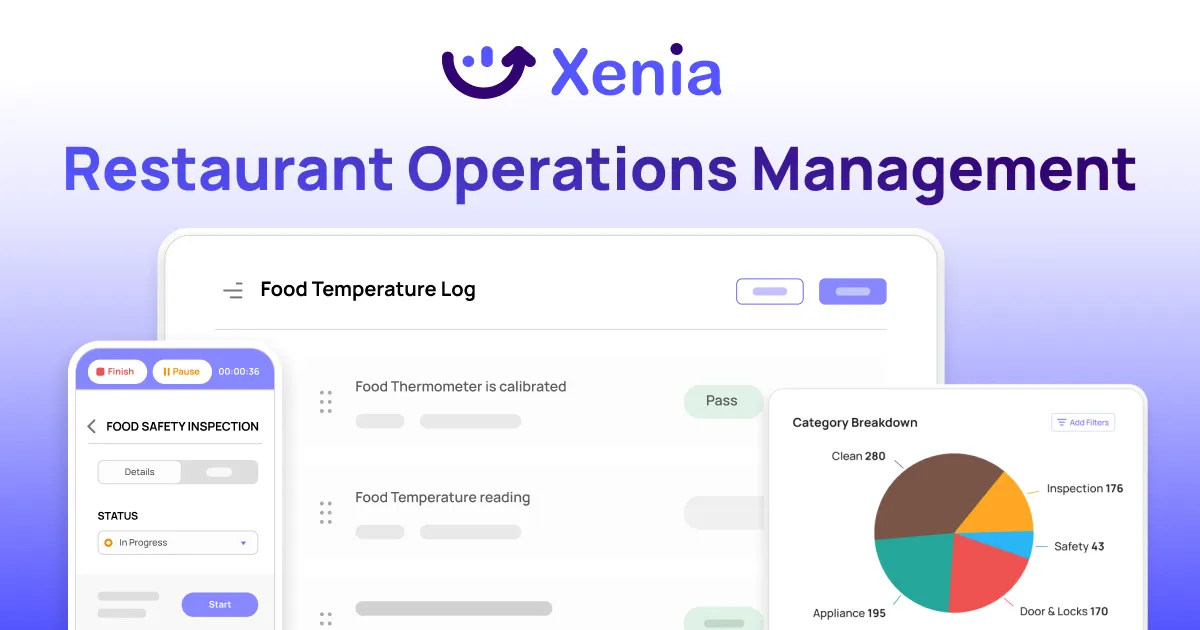
Platforms like Xenia are built around this full execution layer, connecting daily ops checklists, audits, work orders, team communications, and training into one system for multi-unit restaurant operators.
If you want a structured way to evaluate whether a platform genuinely covers all five capabilities, the 12 questions to ask before buying a restaurant operations platform gives you a framework to use directly in vendor demos.
How do you benchmark your current stack against the full execution layer?
Start with the five-capability check. Map your current tools against each capability and mark what you actually have.
**
Capability, Current tool, Covers it fully?, Gap
Daily ops and checklists with enforcement logic, -, Yes / Partial / No, -
Audit and compliance with scoring and history, -, Yes / Partial / No, -
Work order and facilities with closed-loop tracking, -, Yes / Partial / No, -
Team communications with read receipts, -, Yes / Partial / No, -
Training and SOP delivery with completion visibility, -, Yes / Partial / No, -
**
If your current stack covers three of five, you have a partial platform. Two capabilities are either handled manually, handled poorly, or not handled at all. The question is whether those gaps cause real problems. Most operators who do this exercise honestly find they do.
The decision from there is not always to replace everything at once. Some groups start by consolidating the two or three capabilities where gaps are most painful. Others evaluate a single platform that covers all five and migrate over time.
What does not work is staying still. The fragmented stack that feels manageable at five locations gets painful at fifteen. The manual workarounds that one strong ops director holds together do not scale when that person leaves. Building the full execution layer on a single restaurant operations platform is about making consistent operations repeatable across every location in your portfolio.
Conclusion
Scheduling tells you who is working. A task manager tells you what was checked off. A restaurant operations platform tells you whether your standards are actually being met, where the gaps are, and what happened when they were not.
Most groups discover the difference at the worst possible time. During a health inspection. After an equipment failure. When a compliance issue surfaces that should have been caught weeks earlier.
The five capabilities in this article are not aspirational. They are the baseline for what restaurant operations software needs to cover to give you real accountability across a multi-location portfolio. If your current stack does not cover all five, you know where the gaps are.
Xenia is built around all five. Audits, work orders, communications, training, and daily ops checklists in one platform, designed for multi-unit restaurant operators who need execution accountability across every location they run. Get started today.
Frequently Asked Questions
Got a question? Find our FAQs here. If your question hasn't been answered here, contact us.
What is the best restaurant management software for a group running multiple concepts?

One that supports brand-level permissions, separate audit templates per concept, and reporting that breaks down by brand, not just by location. Most tools are built for single-concept operators. If you run two or more concepts, test for multi-brand support specifically before signing anything.
What does restaurant workforce management software actually cover?
Scheduling, time tracking, and labor cost. It tells you who is on shift and what it costs. It does not tell you whether the line check happened or whether the new hire finished food safety training. Those need a separate operations execution layer on top.
How do you know if your current restaurant ops platform is missing capabilities?
Things get flagged and forgotten. Maintenance surprises you. Compliance reports require someone to manually pull data from three different places. If any of that sounds familiar, your platform is missing capabilities.
What is restaurant operations software supposed to do that a POS system cannot?
A POS handles transactions. Restaurant operations software handles everything else: food safety checks, equipment maintenance, staff training, and compliance audits. Most restaurants need both. They solve completely different problems.


A Modern, AI-Powered Platform Built for Restaurant Operations
Xenia brings kitchen operations, food safety, audits, and team communication into one mobile-first platform. Restaurant teams execute daily work consistently, maintain compliance, and resolve issues faster, while leadership gets real-time visibility across all locations.
.webp)
Why Restaurant Operators Choose Xenia:
🤖 AI-Powered Operations, Convert paper logs instantly and verify food presentation and kitchen cleanliness automatically. Get instant answers about food safety trends without building reports.
🍽️ Food Safety & Compliance, Track line checks and temperature logs with automated alerts. Trigger corrective actions when readings exceed safe ranges. Maintain audit-ready records for health inspections.
📊 Multi-Location Control, Monitor food safety compliance and task completion across regions. Benchmark locations to identify training needs. Export reports for operational reviews.
One platform for kitchen operations, food safety, and compliance across all locations.

.svg)
.webp)
%201%20(1).webp)

.svg)
%201%20(2).webp)