
.webp)
Post Summary
Stockouts cost retailers $1 trillion annually. Overstock ties up capital in products that won't sell. Store managers need better forecasting systems than spreadsheets and gut instinct.
The retailers succeeding right now use machine learning demand forecasting to predict customer demand accurately and optimize inventory across every location.
This guide shows you exactly how demand forecasting in retail industry works and how to implement systems your team will actually use.
.webp)
.svg)

Priced on per user or per location basis
Available on iOS, Android and Web


What Is Demand Forecasting in Retail Industry?
Demand forecasting in the retail industry is the process of using historical sales data, seasonal trends, and machine learning to predict future customer demand.
In 2026, leading retailers use predictive analytics to automate inventory ordering, reducing carrying costs by 20% and eliminating stockouts through real-time data synchronization.
Imagine this: Your customers always find what they need when they visit your store. Shelves are always stocked without excess inventory. Cash flow is streamlined because capital isn’t trapped in slow-moving stock. That’s possible by demand forecasting.
Weak forecasting shows up as empty shelves during peak demand, clearance markdowns on overstock, and frustrated customers who go to competitors.
The difference comes down to data. Retail demand forecasting machine learning analyzes patterns humans miss in spreadsheets and delivers predictions you can execute on.
Why Demand Forecasting Retail Strategies Matter in 2026
The retail environment changed dramatically in recent years. Three forces make accurate forecasting critical right now.
Inventory carrying costs increased significantly. Interest rates rose from near-zero to 5%+. Every dollar tied up in excess inventory costs more. Retailers need forecasting systems that optimize stock levels without stockouts.
Customer expectations keep rising. Shoppers expect products available when they want them. One stockout sends them to competitors. Product availability directly impacts customer satisfaction and repeat business.
Supply chain volatility continues. Lead times fluctuate. Supplier reliability varies. Weather events disrupt logistics. Demand planning in retail must account for uncertainty while maintaining product availability.
Demand forecasting retail isn't about incremental improvements anymore. It's about fundamental competitive positioning.
The retailers investing in predictive analytics gain market share. The ones managing through spreadsheet averaging and manual ordering fall behind.
4 Common Challenges That Impact Retail Demand Forecasting
1. Relying on Simple Historical Averaging
Most retailers start with basic averaging. They look at last year's sales for the same period and order similar quantities.
This approach misses critical patterns. It doesn't account for trends (growing or declining categories). It doesn't capture seasonality nuances (Easter shifts weeks between years). It can't adjust for external factors like weather or local events.
The impact: Products arrive too late or in wrong quantities. Popular items stock out while slow-movers accumulate. Markdown rates increase to clear excess inventory.
2. Managing Forecasts Across Multiple Store Formats
A grocery chain operates conventional stores, express locations, and specialty formats. Each format has different demand patterns.
The express location near office buildings sells sandwiches and coffee on weekday mornings. The suburban conventional store moves produce and meat on Friday through Sunday. The specialty format focuses on organic and prepared foods.
Simple chain-wide forecasting treats all locations identically. Store-specific adjustments require manual intervention.
The impact: Each format carries a wrong inventory mix. Express stores stock out of grab-and-go items during commute hours. Conventional stores over-order specialty products that don't match their customer base.
3. Incorporating External Factors Into Predictions
Sales patterns shift based on factors beyond historical data. Local events drive traffic. Weather impacts category demand. Competitor promotions affect market share.
Manual forecasting can't incorporate these variables consistently. Store managers might remember last year's festival boost, but the system doesn't capture it automatically.
The impact: Forecasts miss predictable spikes and valleys. Stores stock out during community events. Cold weather categories sit understocked when temperatures drop unexpectedly.
4. Connecting Forecasts to Execution Systems
Even accurate forecasts fail without execution integration. Predictions sit in spreadsheets while ordering happens in separate systems.
The disconnect creates delays. Buyers manually transfer forecast data into ordering platforms. Updates don't flow automatically to stores. Teams work from outdated predictions.
The impact: Accurate forecasts don't improve operations. Manual data transfer introduces errors. The time lag between prediction and execution reduces forecast value.
The common thread: These challenges stem from disconnected manual processes rather than integrated predictive systems.
How Machine Learning Improves Demand Forecasting Accuracy in Grocery Stores
Machine learning analyzes patterns across millions of transactions that manual processes miss. Here's how retail demand forecasting machine learning actually works.
Pattern Recognition Across Multiple Variables
Traditional forecasting looks at one or two factors. Frontline machine learning analyzes dozens simultaneously:
- Historical sales trends by SKU
- Day of week patterns
- Seasonal fluctuations
- Holiday impacts
- Weather correlations
- Local event calendars
- Promotional lift rates
- Competitor activity
- Economic indicators
The system identifies which variables impact demand for each product category. Bread sales correlate with weather (sandwiches on rainy days). Beverage sales spike with temperature. Prepared foods peak on specific weekdays.
You get forecasts that account for real demand drivers instead of simple averages.
Automatic Seasonality Adjustment
Grocery demand forecasting requires handling complex seasonality. Easter shifts weeks between years. School schedules vary by district. Local events happen on different dates annually.
Machine learning adjusts automatically. The system recognizes Easter-related demand patterns and applies them to this year's calendar dates. It identifies back-to-school timing for your specific market.
Store managers don't manually adjust forecasts for calendar shifts. The system handles it automatically.
Real-Time Forecast Updates
Traditional forecasting creates monthly or weekly predictions that don't adjust as conditions change.
Machine learning updates continuously. When actual sales deviate from predictions, the system adjusts future forecasts based on new information.
Unseasonably warm weather in February changes March predictions for seasonal categories. Higher-than-expected weekend traffic adjusts next weekend's forecast. The system learns from reality continuously.
Store-Specific Demand Profiles
Your suburban location has different demand patterns than your urban express store. Machine learning builds individual profiles for each location.
The system identifies which products move at each store, which days drive the highest volume, and how promotions perform differently by location. Forecasts adapt to local customer behavior.
You optimize inventory mix by location instead of applying chain-wide averages.
5 Essential Components of a Retail Demand Planning Strategy
Effective demand planning in retail requires more than prediction algorithms. Here's what actually works.
1. Clean Historical Data Foundation
Machine learning quality depends on data quality. Garbage in, garbage out.
What clean data requires:
**
Manual Tracking, Integrated System
Scattered across multiple spreadsheets, Centralized in one database
Incomplete transaction records, Every sale captured with full details
Missing SKU-level granularity, Product - location - time - quantity tracked
No promotion flagging, Promotional periods marked clearly
Manual data entry errors, Automated data capture
**
Clean data captures every transaction with complete context. The system knows which sales happened during promotions, which days had weather events, and which stores ran out of stock.
This matters for accuracy. Machine learning identifies patterns only when the data shows a complete picture.
2. Integration With Inventory Management
Forecasts drive retail ordering decisions. Integration connects predictions directly to inventory systems.
How integration works:
When the forecast predicts a demand increase, the system automatically:
- Calculates required order quantities based on current stock
- Accounts for lead times from your specific suppliers
- Considers minimum order quantities and case pack sizes
- Triggers purchase orders at optimal reorder points
- Adjusts for in-transit inventory already ordered
Store managers don't manually transfer forecast numbers into ordering spreadsheets. The system executes automatically based on predictions.
3. Exception-Based Management Workflows
Not every forecast requires human review. Focus manager's attention where it matters.
What exception-based workflows enable:
Normal situations (95% of SKUs): System handles automatically
- Forecast falls within expected ranges
- Sufficient inventory available
- Standard lead times apply
- Automated ordering proceeds
Exception situations (5% of SKUs): Alerts manager for review
- Forecast shows unusual spike or drop
- Potential stockout approaching
- Supplier delays affecting availability
- Promotional planning needed
Managers review exceptions, not every single SKU forecast. Their time focuses on high-impact decisions.
4. Collaborative Planning Across Teams
Demand forecasting retail isn't just a buyer function. Multiple teams contribute intelligence.
Who contributes to forecasts:
- Store managers provide local event intelligence and customer feedback
- Merchandising shares upcoming promotional plans
- Marketing indicates campaign timing and expected impact
- Suppliers communicate production constraints or opportunities
- Finance provides budget parameters and margin targets
The planning system incorporates input from all stakeholders. Marketing's Q2 campaign automatically adjusts beverage forecasts. Store manager's local festival note triggers a temporary demand increase.
5. Performance Measurement and Continuous Improvement
Track forecast accuracy to identify improvement opportunities.
Metrics that matter:
- Forecast accuracy rate by category and location
- Mean absolute percentage error (MAPE) showing average deviation
- Stockout frequency indicating forecast underestimation
- Excess inventory levels showing forecast overestimation
- Forecast bias revealing systematic over/under-prediction patterns
You see which categories forecast accurately and which need model refinement. The system improves continuously based on performance data.
This is how you build retail demand planning that actually improves operations.
How Xenia Connects Demand Forecasting to Retail Execution
Accurate forecasts deliver value only when connected to execution systems. Many retailers operate disconnected platforms:
- Demand forecasting in one system
- Inventory management in another platform
- Store execution tasks in separate software
- Temperature monitoring for perishables is tracked independently
- Separate analytics and reporting tools
Each disconnected system creates gaps. Forecasts don't automatically trigger restocking tasks. Inventory data doesn't update execution priorities. Perishable forecasting doesn't connect to temperature monitoring.
Xenia's retail execution software connects forecasting insights to store-level execution.

What unified platform integration delivers:
**
Function, How It Works in Xenia
AI-Powered Analytics, Identifies demand patterns and surfaces restocking priorities automatically
Task Automation, Creates receiving and restocking tasks based on forecast-driven orders
Temperature Monitoring, Adjusts perishable forecasts based on actual cooler performance and product movement
Inventory Verification, AI-powered photo verification confirms planogram compliance matches forecasted product mix
Real-Time Updates, Actual sales data feeds back to forecasting models continuously
**
Store managers see forecast-driven tasks in the same interface as managing all operational work. District leaders get unified visibility connecting predictions to execution across locations.
When forecasts predict a demand spike for specific categories, the system automatically creates merchandising verification tasks. Managers confirm product positioning matches forecast assumptions. Execution aligns with predictions.
This is how leading retailers connect retail demand analytics to operational excellence.
FAQs
How does machine learning improve demand forecasting accuracy in the grocery industry?
Machine learning analyzes patterns across millions of transactions that manual processes miss. It accounts for day-of-week patterns (higher weekend traffic), weather correlations (soup sales on cold days), seasonal shifts (Easter timing variations), and local events simultaneously.
What are the 5 essential components of a retail demand planning strategy?
The five essential components of a retail demand planning strategy are:-
- Clean historical data (complete transaction records with promotional context)
- Integration with inventory management (connecting predictions to automated ordering)
- Exception-based workflows (focusing manager attention on unusual forecasts only)
- Collaborative planning (incorporating intelligence from store managers, merchandising, and marketing)
- Performance measurement (tracking accuracy and continuously refining models based on results).
What is the difference between demand planning and retail forecasting?
Retail forecasting predicts future demand using historical data and analytics. Demand planning is the broader process that includes forecasting plus inventory optimization, supplier coordination, promotional planning, and execution integration. Forecasting answers "how much will we sell." Demand planning answers "how do we ensure products are available when customers want them while optimizing inventory investment."
Conclusion
The retailers succeeding in 2026 use machine learning to predict demand accurately and execute based on those predictions.
You don't need to forecast your entire assortment immediately. Start with one high-impact category. Clean your historical data. Integrate with ordering systems. Measure the results. Then expand.
Look for platforms that connect forecasting to execution instead of creating another disconnected tool.
When demand predictions flow directly into inventory management and store tasks, your teams spend less time managing spreadsheets and more time optimizing performance.
Xenia connects demand analytics to retail execution in one platform. Your forecasts automatically create restocking tasks. Store managers see priorities based on predicted demand. You get visibility across all locations without juggling multiple systems.
Want to see how it works? Book a demo.
Frequently Asked Questions
Got a question? Find our FAQs here. If your question hasn't been answered here, contact us.

Looks like there's no data available in our FAQ section at the moment.

A Modern, AI-Powered Platform Built for Retail Operations
Xenia brings store operations, merchandising, audits, and loss prevention into one mobile-first platform. Store teams execute daily work consistently, maintain brand standards, and resolve issues faster, while regional and corporate leadership get real-time visibility across all locations.
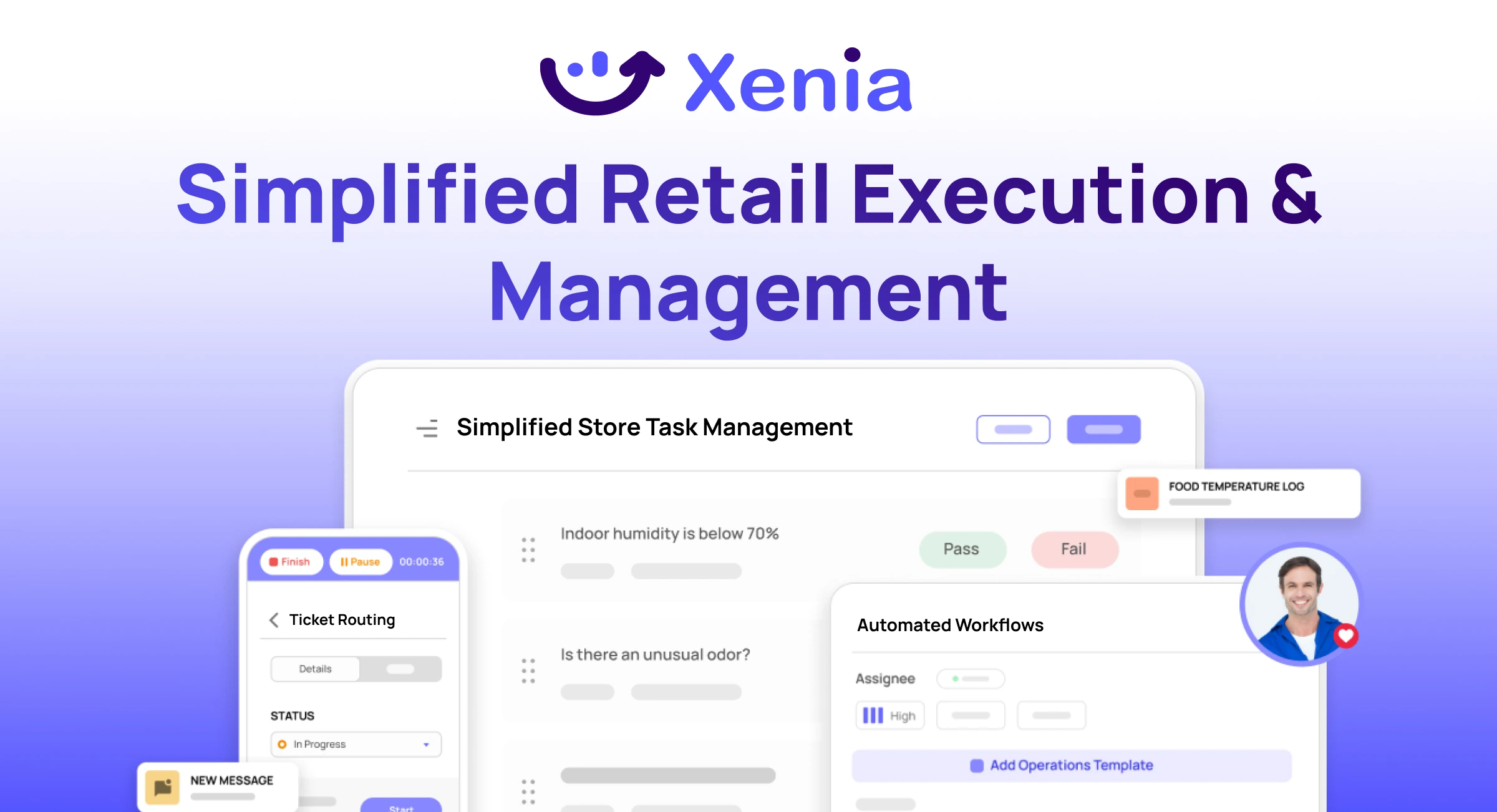
Why Retail Operators Choose Xenia:
🤖 AI-Powered Merchandising, Verify planograms, displays, and brand standards automatically with AI photo analysis. Build digital checklists instantly or convert existing merchandising guides.
🏬 Operations & Loss Prevention, Assign opening procedures, store walks, and resets across locations. Track theft, cash discrepancies, and security incidents with evidence and approval workflows.
📊 Real-Time Visibility, Compare audit scores and task completion across stores. Identify top and underperforming locations. Export reports for leadership reviews.
One platform for operations, merchandising compliance, and loss prevention across all locations.

.svg)
.webp)
%201%20(1).webp)

.svg)
%201%20(2).webp)