

.webp)
Post Summary
The payroll numbers did not look wrong at first glance.
An operations manager at a multi-location convenience store group was reviewing hours across her portfolio. No single location was dramatically over. No alerts had fired. No policy had been visibly broken.
But the hours clocked were consistently higher than the hours scheduled. Across several locations. Every pay period. The gap added up to a real number. And nobody had flagged it.
The hours were recorded. They just were not always worked.
That is time theft. In multi-unit operations, it rarely looks like one bad actor. It looks like a pattern that no individual system was built to catch. Small. Consistent. Invisible until you know what to look for.
This article covers every form of time theft common in frontline operations, how to spot it, and the specific operational changes that stop it.
.webp)
.svg)

Priced on per user or per location basis
Available on iOS, Android and Web


What is time theft?
Time theft happens when an employee is paid for time they did not actually work.
Simple definition. But the way it shows up in operations is rarely simple.
It is not always intentional. It is not always one person. At scale, it is mostly a systems problem. The gap stays invisible because attendance data and work execution data live in separate places.
Here is what time theft actually looks like day to day:
**
Type, What happens
Buddy punching, One employee clocks in on behalf of another who has not arrived yet
Early clock-ins, Employee clocks in before their scheduled start
Late clock-outs, Employee stays clocked in after stopping work
Extended breaks, Break windows run longer than scheduled without being recorded
Off-site clock-ins, Employee clocks in from outside the physical location
Task fabrication, Tasks marked complete without actually being performed
**
The behaviors look different. The root cause is almost always the same. The system tracks presence. It does not track work.
The most common forms of time theft in frontline operations
.webp)
Knowing the category is one thing. Knowing the signal at a specific location is what actually lets you catch it.
Buddy punching
One employee clocks in for another who is not there yet. This happens most in shared time clocks or PIN systems that do not check location.
The signal: Someone shows clocked in but is not on the floor. Their clock-in time and their first actual task do not line up.
Early clock-ins and late clock-outs
A few minutes per incident. Sounds trivial. Across dozens of locations and hundreds of employees, it compounds into a real payroll number every period.
The signal: A consistent pattern of clock-in times landing just before scheduled starts across multiple employees at the same location. One employee doing this is a habit. Ten employees doing it is a management visibility problem.
Extended or untracked breaks
Paid break windows run longer than scheduled. Unpaid breaks go unrecorded. Without task-level tracking, this is almost impossible to catch from payroll data alone.
The signal: Task completion rates drop during specific time windows with no corresponding schedule gap. The work stops. The clock does not.
Off-site clock-ins
Employees clock in from the parking lot, a nearby store, or home. Happens when you have no geo-fencing or location check.
The signal: Clock-in time does not match when they actually started work. They clocked in, but nothing proves they were there.
Pencil whipping and task fabrication
Marking tasks or checklists complete without performing them. Labor hours are paid. The work never happened. For a deeper look at how this plays out in frontline teams, see pencil whipping in frontline operations.
The signal: 100% task completion r ates at a location that consistently underperforms on quality audits. Perfect scores and poor results do not go together. Ever.
Why time theft is harder to catch across multiple locations
A single-location operator can walk the floor and see what is happening. A district manager running 15 locations cannot.
Most multi-unit operators review aggregate payroll reports. Not shift-level anomalies. Not location-by-location comparisons. By the time a problem surfaces in a payroll summary, it has been compounding for weeks. Sometimes months.
Three visibility gaps make this worse.
No cross-location payroll benchmarking
Reviewing locations one at a time hides the pattern.
One location running 4% over scheduled hours looks like noise. Five locations running 4-6% over in the same pay period is a systemic problem. The difference between those two reads is whether you are looking at locations in isolation or comparing them side by side.
Cross-location comparison surfaces outliers. Single-location review does not.
Clock-in and task completion living in separate systems
Here is the core problem most operators have.
Attendance data confirms an employee was present. Task execution data confirms work was done. When those two live in separate systems, the gap between them is completely invisible. An employee clocked in for eight hours with two hours of task records looks fine in a clock-only view. Nothing flags it. Nobody sees it.
Store-level managers without real-time visibility
A manager who is not on the floor during every shift cannot catch what they cannot see. Without automated anomaly surfacing, problems only appear at payroll review. By then, the pay period is closed and the hours are already paid.
For operations leaders running multiple locations, understanding how clock-in systems should work is essential. Our clock in clock out systems guide covers geo-fencing and location verification that prevents off-site punches before they happen.
How to prevent time theft without creating a culture of surveillance
This is where most operators get it wrong. They treat time theft as a trust problem and respond with monitoring. That creates friction, damages morale, and still does not fix the underlying system.
The real fix is structural. When the system requires physical presence to clock in, most of the time, theft behaviors disappear on their own.
Here is what that looks like operationally.
.webp)
Replace PIN-based clock-ins with location-verified check-ins
PIN-based clock-ins verify that someone knows a number. That is it. They do not verify presence.
Geo-stamped or QR scan-to-start check-ins require physical presence at the location. Buddy punching becomes structurally impossible. The system will not accept a clock-in without confirmed on-site presence.
Build this into employee accountability processes across every location, and it works consistently, without requiring a manager to be watching every shift.
Use QR scan-to-start for shift tasks
A QR code at a specific station or checklist creates a verified record of on-site presence at a specific point in time.
This is not surveillance. It is confirmation that the right work started in the right place. Off-site clock-ins get caught not by auditing clock data but by the absence of task-start records from the correct location.
Track task completion alongside clock time
Clock time confirms presence. Task management records confirm work. You need both.
When both are visible in the same view, the gap between paid hours and actual work output becomes measurable and obvious:
**
Clock hours, Task records, What it means
8 hours, 8 hours of work, Normal shift
8 hours, 2 hours of work, Time theft gap
8 hours, 8 hours in 20 minutes, Pencil whipping
0 hours, Tasks logged, Off-site fabrication
**
That same 8-hour shift with 2 hours of task records looks completely fine in a clock-only system. Nobody sees the gap unless both data sets are connected.
Set duration-based reporting for shifts
Duration-based reporting flags two things automatically:
- Shifts where time logged significantly exceeds tasks completed
- Tasks logged far faster than the shift window should allow
The second one is how pencil whipping surfaces as a number. A manager does not have to be present. The system flags it.
Build cross-location reporting into the weekly review
A weekly view ranking clock hours versus scheduled hours by location makes outliers immediately visible. One location at 5% over is a conversation. Six locations at 5% over is a process problem.
**
What to look for, What it signals
Consistently 5-8% over scheduled hours, Attendance tracking gap or manager visibility problem
100% task completion with poor audit scores, Pencil whipping at that location
Clock-ins with no matching task activity, Off-site clock-ins or buddy punching
Break windows with zero task activity, Extended or untracked breaks
**
Frontline reporting that surfaces this comparison at the portfolio level every week turns payroll review into an anomaly detection process. Problems surface before the pay period closes.
How to handle time theft when you find it
Finding the pattern is not the same as having a case. Do not jump straight to disciplinary action.
Document before you act
Pull timestamps, task records, clock logs, and shift history before any conversation happens. One anomaly is not a case. A documented pattern across multiple shifts is.
Data needs to be clean and organized before it enters a disciplinary process. Scrambling to assemble records after the fact creates gaps that undermine your position.
Address it as a policy issue first
Most of the time theft happens because nobody explained the rules clearly. Employees who never got clear guidance on clock-in steps, break times, or how to document tasks often do not know they are doing anything wrong.
Start with a policy conversation, not an accusation:
- What the clock-in process requires and why
- What break windows look like and how they are recorded
- What task completion documentation means in practice
Clear policies communicated at hire and reinforced consistently reduce ambiguity. Most first incidents resolve at this stage.
Know when it becomes a termination or legal matter
Repeated, intentional time theft after a documented policy conversation is a different situation. It is grounds for escalation.
Termination grounds vary by jurisdiction. Dollar thresholds and employment type affect how time theft is treated legally. For serious or repeated cases, involve HR or employment counsel before taking action. This article does not constitute legal advice.
For district and regional leaders managing employee accountability across locations, our workforce management best practices guide covers how to build reporting systems that surface payroll anomalies before they compound across multiple pay periods.
Related resources
- Clock In Clock Out Systems Guide
- Employee Accountability Software
- Frontline Reporting
- Workforce Management Best Practices
- Timesheet Guide
Conclusion
The operations manager eventually found the pattern. It was not one bad actor. It was a system that tracked clock-ins but not task execution, and reviewed each location separately instead of comparing them across the portfolio.
The gap was there every pay period. No individual location triggered an alert. The cross-location view made it obvious in one weekly report.
The fix was not a surveillance program. It was connecting attendance data to task execution data and making that comparison visible at the portfolio level, every single week.
Xenia helps multi-unit operators manage employee accountability, task execution, and frontline reporting across every location. Book a demo to see how it works.
Frequently Asked Questions
Got a question? Find our FAQs here. If your question hasn't been answered here, contact us.
How do you address time theft without accusing innocent employees?

Frame every change as a system improvement. Moving to location-verified check-ins to improve payroll accuracy lands very differently than implying employees cannot be trusted. Most people accept process changes when they are explained clearly and applied consistently across every location.
What is the difference between time theft and wage theft?
Opposite sides of the same problem. Time theft is an employee taking pay for time not worked. Wage theft is an employer withholding pay that was earned. Time theft benefits the employee. Wage theft benefits the employer. Both carry legal exposure.
Does time theft affect employee morale?
It does. Employees who watch coworkers get away with it while they put in full hours get resentful. It creates an uneven playing field that quietly erodes team culture. Fixing the system benefits everyone, not just the employer.
Can salaried employees commit time theft?
Yes. It is not limited to hourly workers. Salaried employees can do it by working fewer hours than expected, handling personal tasks during work time, or misreporting project hours. The signal is usually output: deliverables consistently falling short of what the role requires.

A Modern, AI-Powered Platform Built Specifically for Frontline Operations
Xenia brings daily operations, maintenance, audits, and compliance into one mobile-first platform. Frontline teams execute work consistently across locations while leadership gets real-time visibility.
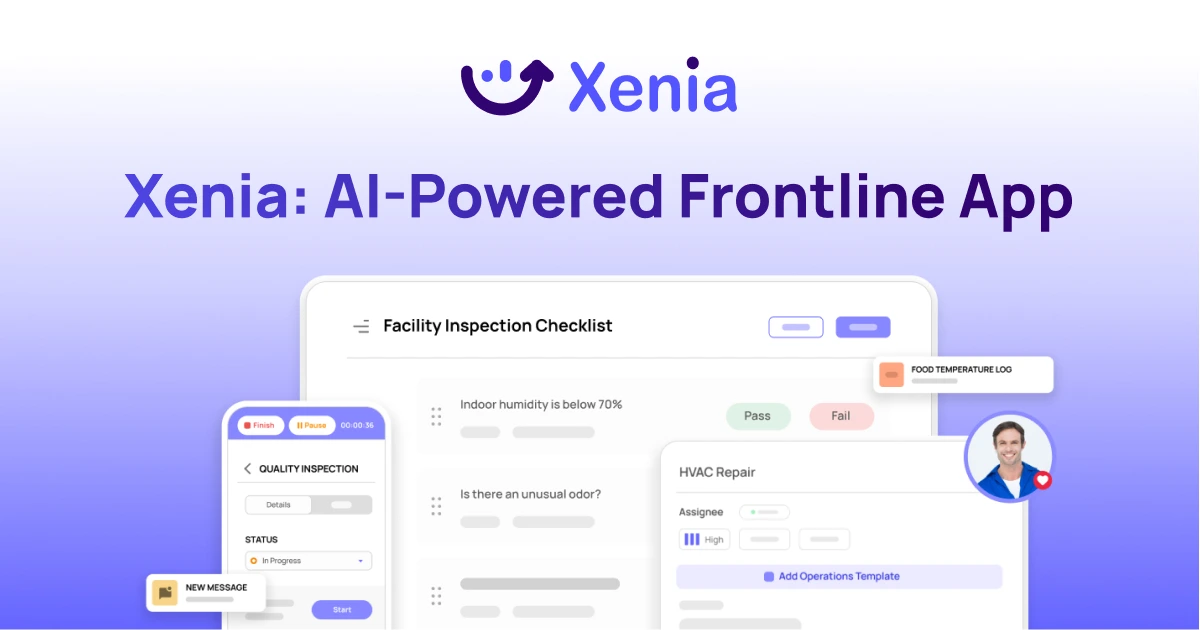
Why Multi-Location Operators Choose Xenia:
🤖 AI-Powered Operations, Create digital checklists instantly or convert paper forms with AI. Verify compliance automatically with photo analysis and get instant answers from your operational data.
✅ Daily Operations & Maintenance, Assign work across hundreds of locations in minutes. Report and route issues instantly. Schedule preventive maintenance to catch problems before downtime.
📊 Real-Time Visibility, Track completion, work orders, and performance across all locations through dashboards. Filter by site or asset to spot trends and take action.
Manage operations, maintenance, and compliance across all your locations from one platform

.svg)
.webp)
%201%20(1).webp)

.svg)
%201%20(2).webp)