
Post Summary
The frontline operations world is splitting into two camps right now.
One camp still treats AI like a science experiment, running impressive demos in corporate offices while their warehouse floors, retail stores, restaurant kitchens, and hotel lobbies run on clipboards and chaos.
The other camp is building what we call "Intelligent Ops." These are systems where AI operations management becomes the invisible operating system that makes multi-site frontline businesses run themselves. Not in boardrooms. On the actual floor where work happens.
Restaurants predicting equipment failures before the dinner rush. Retail chains auto-correcting compliance issues across 500 stores. Hospitality groups optimizing housekeeping schedules in real-time. Convenience stores preventing stockouts before customers notice.
This is AI built for deskless teams. Not data scientists.
The difference isn't about technical sophistication. It's about operational impact where frontline work actually happens.
.svg)

Priced on per user or per location basis
Available on iOS, Android and Web


What Is AI Operations Management and How It Works in 2026
AI operations management is how you use machine learning and predictive analytics to run multi-site operations with way less human intervention.
Instead of reacting to problems after they happen, AI-driven operations management spots patterns first. It predicts failures. And it triggers corrective actions automatically.
Think of it like the difference between a basic thermostat and a smart climate control system.
A thermostat just reacts when the temperature drops. An intelligent climate system learns your patterns. It predicts when you'll need heating. It adjusts for weather changes. And it optimizes energy use before you feel uncomfortable.
Traditional automation follows rigid if-then rules. AI in operations learns from your data. It adapts to changing conditions. And it improves over time.
A legacy temperature monitoring system sends alerts when freezers go out of range. An operation AI system recognizes the pattern of a failing compressor days before it dies. It automatically schedules maintenance during slow hours. And it alerts the vendor with equipment specs already attached.
Traditional Operations vs AI in Operations Management
**
Operations Area, Traditional Approach, Al-Driven Approach
Equipment Maintenance, Reactive repairs after breakdowns, Predictive alerts before failures
Inventory Management, Manual counts and gut-feel ordering, Real-time forecasting and auto-reordering
Labor Scheduling, Static schedules with overstaffing, Dynamic scheduling based on demand
Compliance Monitoring, Paper checklists and manual audits, Automated gap detection and instant fixes
Quality Control, Random manager spot checks, Al photo verification at scale
**
Using AI to Enhance Business Operations
AI operations work best when they become the connective tissue between all your existing systems. They're the invisible layer that turns disconnected data into coordinated action.
Demand Forecasting
Machine learning analyzes your historical sales data. It looks at weather patterns. It factors in local events and seasonal trends. All to predict exactly what each location needs.
A restaurant group using AI to enhance business operations significantly reduces food waste because prep quantities match actual demand. The system doesn't just predict. It automatically adjusts prep schedules and supplier orders.
Predictive Maintenance
Equipment doesn't fail randomly. It shows patterns.
AI in operations management spots those patterns before human eyes can. Temperature fluctuations in refrigeration units. Pressure changes in HVAC systems. Usage spikes in point-of-sale hardware.
The system flags issues. It creates work orders. And it schedules repairs during off-peak hours. All without manager intervention.
Self-Correcting Task Management
When AI ops detect a compliance gap, they don't just alert someone. They trigger the corrective workflow.
A health inspection finds a documentation issue at one location. The system immediately pushes updated checklists to all similar sites. It schedules compliance training for affected staff. And it tracks completion rates in real-time.
This is what using AI to enhance business operations means in practice. You're not replacing humans with robots. You're building systems that handle the predictable stuff. So humans can focus on the exceptional work.
Machine Learning Operations Management: The 3 Layers of AI Operational Efficiency
Effective AI in business operations runs on three distinct layers. They work together to deliver AI operational efficiency.
Layer 1: Data Integration and Pattern Recognition
Machine learning operations management starts by connecting your data sources. And finding patterns humans miss.
- Sales spike right before the local high school lets out
- Walk-in freezer temperatures drift higher on delivery days because trucks block airflow
- Task completion drops when certain managers aren't working
Modern AI operations management platforms pull data from POS systems, temperature sensors, task completion logs, and inspection records into unified dashboards. This creates the foundation for pattern recognition that drives intelligent automation.
Layer 2: Predictive Analytics and Decision Support
Once patterns are clear, AI operations move to prediction. What will happen based on current conditions? What should happen to optimize outcomes?
A convenience store chain uses operation AI to predict exactly when each location will hit peak traffic. It factors in weather. Local events. Historical patterns. The system doesn't just forecast demand. It recommends optimal staffing levels. It suggests inventory adjustments. And it flags potential issues before they impact customers.
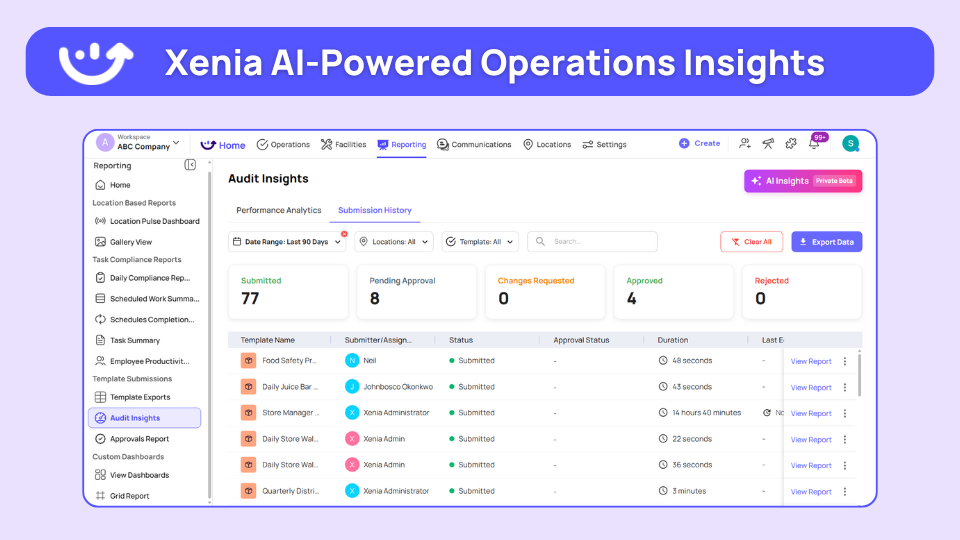
Operations leaders access this intelligence through custom dashboards that visualize trends across hundreds of locations.
Instead of digging through spreadsheets, directors see real-time performance metrics:
- Task completion rates by location
- Audit scores trending over time
- Equipment maintenance patterns
- All in one executive view that updates automatically
Layer 3: Automated Action and Continuous Improvement
The final layer is where AI operational efficiency delivers real ROI. The system doesn't just predict and recommend. It acts.
When AI-driven operations management detects a pattern that requires intervention, it triggers the appropriate workflow automatically:
- Equipment maintenance requests
- Staff retraining protocols
- Inventory reorders
- Compliance documentation
- Corrective action plans
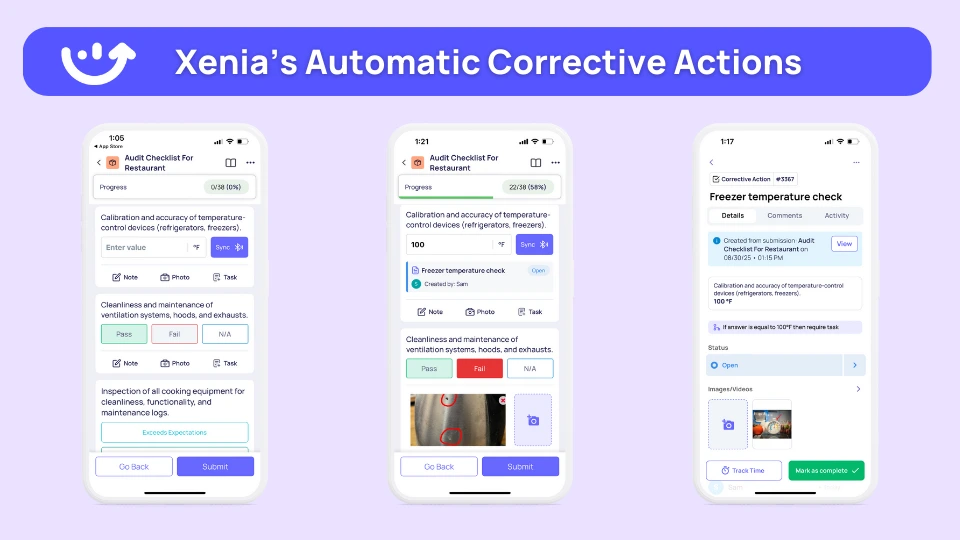
Here's where automated corrective actions change the game.
A district manager reviews her dashboard and sees that three locations failed the same food safety item during audits. Instead of manually creating action plans for each site, the system automatically generates corrective action tasks. It assigns them to the right managers. It sets deadlines. And it tracks completion.
When those tasks are done, the data flows back into the dashboard. The director sees compliance improving in real-time without sending a single email.
Every action feeds back into the learning system. The system gets smarter with each cycle.
What Is MLOps and Why It Matters for AI in Operations
What is MLOps? It's the practice of deploying, monitoring, and maintaining machine learning models in production environments.
For multi-site operations, this means ensuring your AI systems actually work consistently across hundreds or thousands of locations.
Here's the challenge:
A restaurant chain builds an AI model that perfectly predicts demand at its flagship location. Now deploy it across 200 sites in different markets. Different customer bases. Different seasonal patterns.
Without proper MLOps, that model fails at scale.
Effective MLOps handles three critical challenges:
- Model deployment across diverse locations
- Continuous monitoring and retraining as conditions change
- Version control with rollback capabilities when updates cause issues
Why AI Operations Pilots Fail to Scale
Most AI operations pilots succeed. Most AI operations deployments fail.
The gap isn't technical capability. It's operational readiness.
Consider this scenario:
A hospitality group pilots AI-driven maintenance scheduling at five properties. Results are impressive. Significant reduction in emergency repairs. Lower maintenance costs. Higher equipment uptime. The executive team approves rollout to all properties.
Months later, adoption is disappointing. Many properties still use the old system.
What happened?
The Data Quality Problem
Pilot locations had clean, consistent data because they were being watched closely. The broader rollout exposed data quality issues:
- Equipment IDs didn't match across systems
- Maintenance logs used inconsistent categorization
- Historical data had gaps
Artificial intelligence in operations management only works when the underlying data is trustworthy.
The Change Management Problem
Pilot teams were excited early adopters. The broader organization needed more convincing. Facilities managers who built careers on institutional knowledge needed to see the value. Success required strong training and support.
The opportunity: making AI updates seamless for frontline workers.
AI models improve as conditions change. The challenge is helping frontline teams adapt to these improvements smoothly.
A retail chain updates its inventory AI with better predictions. They need 2,000 workers across locations to use the improved system. Traditional approach means manuals, training sessions, and pulling people off the floor. That takes months.
What frontline workers actually need:
Your warehouse team needs to keep operations running. Your retail associates need to stay with customers. Your restaurant crew is constantly on their feet.
Frontline workers learn best when training fits into their actual workflow. Not in classrooms. Right when they're doing the work.
How modern systems enable this:
Smart platforms update AI models in the background. When workers need to know something improved, the system delivers bite-sized training automatically. Sixty-second videos. Visual guides on phones. Interactive checklists.
Platforms like Xenia use AI to create training that fits frontline reality. Workers watch a quick video. Complete a checklist that reinforces the change. Back to work. Two minutes total.
The technology handles complexity. Workers get simple guidance exactly when they need it. This is how AI improvements reach frontline teams smoothly and scale across operations.

The Integration Problem
The pilot ran alongside existing systems. The full deployment required replacing entrenched workflows. But the AI system didn't connect smoothly with work order management. Or procurement. Or scheduling. Or compliance tracking.
AI in Business Operations: The 2026 Deployment Framework
Moving artificial intelligence in operations from pilot to production requires a different approach. Here's the framework that actually works.
Start With the Operational Backbone, Not the AI Feature
Before deploying machine learning in business operations, ensure you have standardized processes across locations. If every site runs operations differently, AI can't find patterns.
Standardization doesn't mean rigidity. It means:
- Consistent data collection
- Unified task frameworks
- Shared operational language
Digital task management replaces paper-based systems and creates the data foundation AI needs to learn.
Deploy AI Where It Eliminates Pain, Not Where It Sounds Impressive
The boring AI operation that saves managers hours each week gets adopted instantly.
Don't start with AI-driven demand forecasting across your entire supply chain. Start with AI that auto-generates daily task lists based on weather, events, and historical patterns. Managers see immediate value. Adoption spreads organically.
Build Feedback Loops That Make AI Smarter Over Time
Your AI operations system should learn from every action taken or ignored:
- When a manager overrides an AI recommendation, capture why
- When predicted demand misses actual demand, feed that variance back into the model
- The system should get noticeably better every quarter
Measure Operational Outcomes, Not AI Performance
Track metrics that matter:
- Emergency repair frequency
- Food waste percentages
- Labor cost variance
- Compliance violation rates
- Customer wait times
- Revenue per labor hour
Operations executives need data dashboards that make these metrics visible across the entire organization. Not monthly reports that arrive two weeks late. Real-time dashboards that show what's happening right now. Which locations are struggling? Which processes need attention? What corrective actions are in progress?
If using AI to enhance business operations doesn't move these numbers, the deployment failed.
AI-Driven Operations Management: Real Use Cases That Deliver ROI
Here's where AI in business operations delivers measurable impact right now.
Dynamic Labor Optimization in Hospitality
A hotel chain uses AI operations to predict occupancy, event impact, and service demand. The system automatically adjusts housekeeping schedules. Front desk coverage. And F&B staffing.
Labor costs drop while guest satisfaction scores improve because service levels match actual needs. The operations director monitors labor efficiency across all properties through a single dashboard that benchmarks performance and highlights outliers.
Predictive Equipment Maintenance in Food Service
A restaurant group deploys AI in operations management to monitor refrigeration, HVAC, cooking equipment, and POS systems through IoT temperature sensors and usage patterns.
The system predicts failures days before they occur. Emergency repair costs drop significantly. Equipment downtime falls substantially. When the system detects a pattern, it automatically creates corrective action work orders. The maintenance team sees exactly what needs attention. No manual tracking required.
Intelligent Inventory Management in Retail
A convenience store operator implements machine learning in business operations to manage inventory across multiple locations. The system predicts demand by SKU, location, day, and time.
Out-of-stock incidents drop. Inventory carrying costs fall. Write-offs decrease. Regional managers access dashboards showing inventory health across their districts. Red flags appear automatically when any location deviates from optimal stock levels.
Automated Compliance Monitoring in Healthcare Facilities
A senior living organization uses AI-driven operations management to track health and safety compliance across their communities through digital auditing systems.
The system identifies compliance gaps in real-time. It triggers corrective workflows automatically. And it maintains audit-ready documentation. Violation rates drop substantially. Staff time on compliance reporting decreases dramatically.
The compliance director sees audit scores, flagged items, and corrective action status across all facilities on one executive dashboard.
The pattern across these use cases?
AI operations management works best when it connects data collection, pattern recognition, predictive analytics, and automated action into one continuous system. And it only works at scale when operations leaders can see everything happening across their organization through intelligent dashboards that surface what matters most.
The Future of AI Operations
The 2026 frontier in AI operations isn't better predictions. It's autonomous execution.
Agentic AI in Operations
Current AI operations mostly advise. "Here's what we predict will happen. Here's what you should do."
Agentic AI acts. It doesn't wait for human approval on routine decisions.
Here's how it works:
Equipment monitoring detects a failing compressor. Instead of alerting a manager who creates a work order, who contacts a vendor who schedules a technician, the system does all of this automatically:
- It checks the maintenance contract
- It identifies the authorized vendor
- It pulls equipment specifications
- It schedules service during off-peak hours
- And it notifies the site manager about the completed action
The district manager sees this on her dashboard. Not as an alert requiring action. As a completed corrective action, the problem was identified and resolved automatically. She only intervenes if something falls outside normal parameters.
Human oversight remains. Managers can review and override. But the default is execution, not escalation.
Connected Intelligence Across Locations
When AI learns something valuable at one location, it immediately applies that learning across similar sites. A quality issue pattern identified in one city triggers preventive measures in other locations before the same problem emerges.
The operations executive sees this intelligence flowing through their dashboard:
- Trends emerging across regions
- Best practices identified at high-performing locations
- Issues flagged before they become widespread problems
The system doesn't just report what happened. It shows what it's doing about it.
This is the self-healing operation. Systems that detect issues. Diagnose root causes. Execute corrections. And learn from outcomes. All without pulling managers away from strategic work.
Xenia AI brings these capabilities to frontline teams through unified operations management software. The platform combines AI photo analysis for compliance verification, an analytical agent that answers operational questions in plain language, automated summaries that surface critical insights, and a template builder that converts existing forms into digital workflows.
Xenia AI makes this transition practical for multi-site operators. No data science team required. No complex integrations. Just intelligent operations that learn from every task, audit, and issue across your locations.
Frequently Asked Questions
How does AI operations management improve ROI in multi-site retail and hospitality?
AI operations management cuts costs by matching staff to actual demand, reducing waste through better forecasting, and preventing equipment failures before they happen. Most multi-location businesses see measurable savings within two years. The key is tracking ROI through real-time dashboards that show labor efficiency, maintenance costs, and compliance rates across all locations.
What is the difference between traditional automation and AI-driven operations management?
Traditional automation follows fixed rules and reacts the same way every time. AI learns from your data and adapts to changing conditions. The big difference shows up when problems happen. Traditional systems send alerts. AI operations spot the issue, trigger corrective actions automatically, and track resolution without manual work.
How can machine learning predict equipment failure in a restaurant or facility setting?
Machine learning watches sensor data and usage patterns to learn what normal looks like for each piece of equipment. When temperature recovery slows down or compressor runtime increases, the system flags a potential failure days before breakdown. It then automatically creates maintenance work orders so your team can fix problems during slow periods instead of dealing with emergency repairs.
What are the first steps for a legacy business to implement an AI operations strategy?
Start simple. First, standardize your core processes across locations so you're collecting consistent data. Next, move from paper to digital systems. Then set up dashboards to see what's actually happening across your operation. Pick one high-impact use case like predictive maintenance or automated task scheduling. Get that working. Then scale it. Don't try to do everything at once.
How does AI-driven demand forecasting reduce food waste in food service operations?
AI predicts what each location will actually sell by analyzing past sales, weather, local events, and promotions. These forecasts update in real time and automatically adjust your prep lists and orders. Instead of guessing high to avoid running out, kitchens make what they'll actually sell. Most operations cut food waste significantly within the first year.
Conclusion
The gap between AI pilots and AI production isn't technical anymore. It's operational.
You don't need better algorithms. You need better data.
You don't need more features. You need smarter workflows.
You don't need another dashboard. You need one dashboard that shows you what matters.
The operations teams winning with AI right now aren't the ones with the biggest budgets or the fanciest technology. They're the ones who started with clean data, standardized processes, and clear metrics. They deployed AI where it solved real pain. And they built systems that got smarter every day.
This is where platforms like Xenia AI fit in. By combining AI-driven insights, automated task execution, real-time dashboards, and frontline-ready workflows into one unified system, Xenia helps multi-site operators move beyond pilots and into real operational impact.
No complex implementations. No data science team. Just intelligent operations that improve with every task, audit, and decision.
Frequently Asked Questions
Got a question? Find our FAQs here. If your question hasn't been answered here, contact us.

Looks like there's no data available in our FAQ section at the moment.

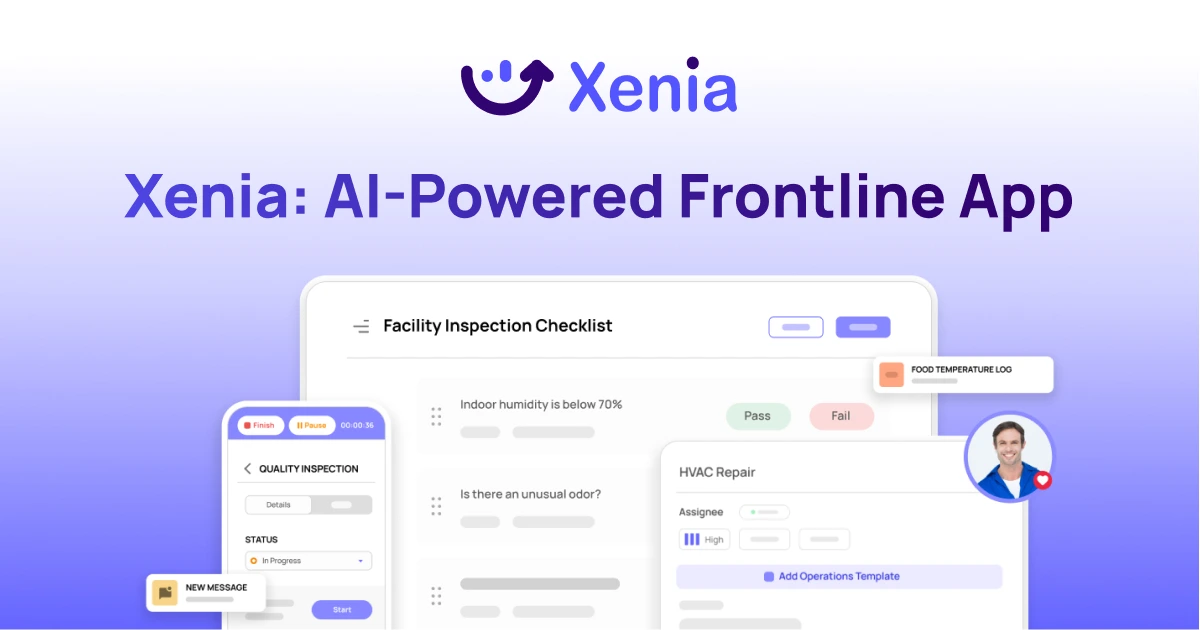
A Modern, AI-Powered Platform Built Specifically for Frontline Operations
Xenia brings daily operations, maintenance, audits, and compliance into one mobile-first platform. Frontline teams execute work consistently across locations while leadership gets real-time visibility.
Why Multi-Location Operators Choose Xenia:
🤖 AI-Powered Operations, Create digital checklists instantly or convert paper forms with AI. Verify compliance automatically with photo analysis and get instant answers from your operational data.
✅ Daily Operations & Maintenance, Assign work across hundreds of locations in minutes. Report and route issues instantly. Schedule preventive maintenance to catch problems before downtime.
📊 Real-Time Visibility, Track completion, work orders, and performance across all locations through dashboards. Filter by site or asset to spot trends and take action.
Manage operations, maintenance, and compliance across all your locations from one platform

.svg)
.webp)
%201%20(1).webp)

.svg)
%201%20(2).webp)