
.webp)
Post Summary
Here's something that happens more than you think.
A fryer at one of your locations had been running hot for two weeks. The cooks knew about it. The shift supervisor noticed too. But nobody wrote anything down. No report. No maintenance request. Just a quick mention between shifts that nobody followed up on.
Then one afternoon, an employee gets burned badly enough to need a hospital visit.
Now you're dealing with an OSHA 300 log entry, a possible fine, and a request for records you're not sure you even have.
Here's the thing. That wasn't a safety problem. That was a paperwork and process problem. And it's the kind of situation that gets EHS managers fired.
Quick check before we get into it:
- Are inspections happening on time at every location?
- Do near-misses get logged or just talked about?
- Can you pull up recent audit scores in under a minute?
- Are last inspection's action items actually closed out?
- Are your records OSHA-ready right now?
If you hesitated on any of those, this guide will help.
In this guide, we cover what EHS compliance means in practice, what a solid program looks like, how to run inspections the right way, and how to stay on top of it all when you're managing more than one location.
.webp)
.svg)

Priced on per user or per location basis
Available on iOS, Android and Web


What Is EHS Compliance?
EHS stands for Environmental, Health, and Safety.
In plain terms, it is everything your business needs to do to keep workers safe, prevent accidents, and stay on the right side of the law.
The Three Parts of EHS
**
Part, What It Covers, Real Example
Environmental, Waste-chemicals-fuel and anything that affects the surrounding environment, C-store fuel tanks-restaurant grease disposal
Health, Protecting workers from long-term harm like chemical exposure or repetitive injuries, Retail staff lifting heavy boxes
Safety, Preventing slips-equipment failures-fires and knowing what to do when something goes wrong, Kitchen burns-stockroom ladder falls-amusement park ride failures
**
All three parts have rules attached to them. Ignore any one of them and you are opening yourself up to fines, legal trouble, or worse.
Why Running Multiple Locations Makes EHS Compliance Harder
Running multiple locations makes this harder than it sounds.
Every location has its own team making safety calls every day. Some get it right. Some do not. And you usually find out which is which only after something goes wrong.
Ten locations where one is compliant, and nine are not, is not mostly fine. It is nine problems waiting to happen.
Most teams know the rules. The hard part is following them the same way every day across every location.
Who Sets the Rules?
There is more than one rulebook you need to follow.
- OSHA covers workplace safety. Most frontline businesses deal with OSHA the most.
- EPA covers waste, chemicals, and air quality. More relevant for fuel stations and facilities.
- State and local agencies add their own rules on top. These vary by location.
- Industry bodies cover specific areas. ASTM handles amusement rides. FDA covers food safety. State liquor boards cover hospitality.
Knowing which rules apply to you is step one. Following all of them consistently across every location is the harder part.
The Core Parts of an EHS Compliance Program
Most people treat EHS compliance like a checklist they pull out when an inspector shows up. That is not what it is. It is a system that runs every day, whether or not anyone is paying attention. Here is what it needs to cover.
1. Finding and Tracking Hazards
The first step is knowing where the risks are. Walk every area of your location on a regular basis. The kitchen, the stockroom, the back office, the parking lot. Note down anything that could cause harm.
And do not just do this once a year.
Equipment breaks. New staff pick up bad habits. A retail stockroom that looked fine six months ago might already have three new problems nobody has flagged yet.
Here's what a real hazard list looks like:
- A written list of every hazard, reviewed every three months
- A score for each hazard based on how likely it is to cause harm and how bad that harm would be
- A note on what's being done to prevent it
- A real person's name next to each one, not just "the safety team"
That last part is the one most programs skip. If nobody specific owns a hazard, nobody fixes it.
2. Reporting Incidents and Near-Misses
The numbers here are hard to ignore. For every single workplace death, roughly 600 near-misses lead up to it. Most go unreported.
Why not?
- Filing a report takes too long
- Workers are worried they'll get in trouble
- Nothing bad actually happened, so what's the point
That last reason is the most costly one. Something almost went wrong. The risk is still there. Next time it might not be a near-miss.
A reporting system that works does three things:
**
What It Does, Why It Matters
Takes under 2 minutes on a phone to file a report, If it's easy-people actually do it
Goes to the safety team-not the shift manager, People won't report if they fear getting in trouble
Shows workers what changed because of their report, If nothing happens-people stop reporting
**
That last one is the piece most programs miss. You have to close the loop. When someone files a report and sees something actually get fixed because of it, they file the next one too.
3. Training and Keeping Records of It
Training isn't just something you do on the first day of work. It's ongoing. And the records of that training matter just as much as the training itself.
Here's why. If a worker gets hurt and you can't prove they were trained on how to do that task safely, OSHA doesn't care what actually happened. They treat it as a training failure. You get cited.
Your training records need to show:
- Who was trained
- What they were trained on
- When it happened
- Who delivered the training
- How you checked that they actually understood it
Training should be there when workers need it most. A c-store worker dealing with a fuel spill late at night cannot rely on memory. They need the procedure on their phone right then. If they cannot find it in seconds, the training did not really work.
4. Keeping the Right Records
OSHA has specific records they can ask for at any time. If you don't have them, you get fined. Even if your workplace is perfectly safe.
Here's what you need to keep:
**
Document, What It Is, How Long to Keep It
OSHA 300 Log, A running list of every work injury or illness, 5 years
OSHA 301 Incident Report, A detailed report for each injury or illness, 5 years
OSHA 300A Summary, A yearly summary you post at work from Feb 1 to Apr 30, 5 years
**
Most people don't realize that bad recordkeeping is its own violation. It's separate from whatever caused the injury in the first place.
OSHA inspectors look at your records before they even walk through your building. A safe workplace with messy records is still a workplace that gets cited.
5. Emergency Plans
Every location needs a plan for emergencies. Fire, medical emergencies, bad weather, chemical spills. All of it needs to be covered.
That plan needs to be written down, posted somewhere people can see it, and actually practiced. Including by part-time staff who only show up on weekends.
The most common problem isn't having a plan. It's having a plan that's out of date.
The person listed as the emergency contact left six months ago. The exit routes changed when you renovated. The fire extinguisher has not been checked in over a year. An outdated plan is not protection. It is just paper.
Go through your emergency plans at least once a year. And update them any time something significant changes at a location.
See how Xenia helps with safety and compliance management across multiple locations.
What Is an EHS Audit Checklist and What Should It Include?
An EHS audit checklist is how you verify that a location is actually meeting its safety and environmental obligations. A lot of people think this is the same as a regular safety inspection. It is not. Here is how the two compare.
**
Aspect, Regular Safety Inspection, EHS Audit
How often, Daily or weekly, Monthly or every few months
What it's for, Catching obvious problems as they come up, Checking whether you're actually meeting all the rules
What you write down, Quick notes, A formal scored report with follow-up tasks
What comes out of it, Problems get fixed on the spot, A record you can use as evidence-plus a plan to fix what failed
Does it matter legally, Not much, Yes-it shows you're doing your due diligence
**
If you've been calling your weekly walkthrough an audit, you probably have gaps in your documentation that you don't know about yet.
What to Include in Your EHS Audit Checklist
.webp)
What to Focus on by Industry
**
Industry, What to Pay Most Attention To
Restaurants, Kitchen equipment (fryers/slicers)-hood maintenance-wet floors-allergen labels-chemicals near food prep areas
Retail, Ladders in the stockroom-how high products are stacked-access to electrical panels-parking lot lights-emergency exits
C-Stores, Fuel system condition-spill kits-underground tank rules-refrigeration systems-safety during cash handling
Amusement Parks, Ride inspection logs-how crowds are managed-chemical levels in water attractions-staff to guest ratios
Hospitality, Pool chemical storage-kitchen fire suppression-elevator inspection records-how cleaning carts are stored
**
How Scoring Works
Not all checklist items are equal. A weighted scoring system gives higher scores to more serious risks. Here is a simple way to think about it.
**
Risk Level, Example, Points, What Needs to Happen
Critical, Fire suppression system is down, 10, Stop operations immediately
High, Chemical containers have no labels, 7, Fix within 48 hours
Medium, PPE needs to be replaced, 4, Fix within 2 weeks
Low, Safety poster is out of date, 1, Fix at the next review
**
When you score consistently across every location, you can actually compare results. When everyone scores things differently, the numbers don't mean anything.
Before you send a new checklist out to all your locations, have two people independently audit the same site and compare their scores. Wherever the scores don't match, your checklist wording isn't clear enough.
How to Run an EHS Inspection Step by Step
There is a big difference between walking through a building and running a proper inspection. Here is how to do it right.
Step 1: Prepare Before You Show Up
Look at the last inspection report first.
What failed last time? Were those issues actually fixed and confirmed? If the same thing has failed twice in a row, that's a pattern. Patterns need to be investigated, not just noted again.
Give the location enough notice.
The goal is not to catch people off guard. It is to see how the location actually operates day to day. Give enough notice so you see the real picture, not a one day tidy up.
Know exactly what you're checking before you get there.
Is this a full audit of everything or are you focusing on one area like chemical storage or kitchen safety? Be clear on this upfront. A full audit at a busy restaurant location takes three to four hours if you do it properly. Trying to rush it means missing things.
Step 2: What to Do During the Inspection
Document everything. Don't fix anything yet.
See a problem? Write it down and keep moving.
Fixing things mid-inspection means missing other issues and ending up with a report that does not show what things actually looked like when you arrived.
Document everything first. Fix things after.
Take a photo of everything that fails.
A note saying "blocked fire exit" can be disputed. A photo with a timestamp can't. Take photos of every problem you find, not just the big ones. Minor-looking issues sometimes turn out to be the most important ones in a legal situation.
Make your checklist ask follow-up questions.
When something important fails, your checklist shouldn't just move on to the next item. It should ask what happens next. Does this equipment get taken out of service? Does a manager get called right now? Does someone file an incident report?
A flat yes or no checklist is not enough. Your checklist should ask follow up questions based on what you find.
Before you mark something as non-compliant, understand why it failed.
Non-compliant is the conclusion. You need to understand what caused it. Here's why that matters:
**
What Failed, Why It Failed, What the Fix Should Be
Chemical containers not labeled, New hire-never trained on GHS labeling, Training for that worker-plus check others at the site
Fire exit blocked, No process for keeping the stockroom clear, New rule plus someone accountable for it
PPE is worn out, Nobody set up a replacement schedule, Create a restocking schedule
**
Fix the surface problem without understanding the cause, and the same thing will show up in your next inspection.
Step 3: What to Do After the Inspection
This is the part most programs get wrong. The inspection itself is actually the easy bit.
Create all follow-up tasks before you leave.
Before you leave the site, create a task for every problem you found. Each one needs an owner, a deadline, and a priority level. Do not plan to do this later. Later usually means never.
Give each task a clear deadline based on how serious it is:
**
Priority, When It Needs to Be Fixed, What Falls in This Category
Immediate, Same day, Blocked exits-chemical leaks-electrical hazards
High, Within 48 to 72 hours, Equipment that's close to failing-missing key safety gear
Normal, Within 2 weeks, Missing paperwork-outdated labels-minor housekeeping
**
Don't let someone close a task just because they say they fixed it.
A task should only be marked done after a supervisor has physically checked the fix. For anything involving equipment or building changes, require a photo before the task gets closed.
Check closure rates every month, by location.
If a location is only closing 40% of its tasks, that's not a problem with inspections. That's a management problem. Someone at that location isn't being held accountable, and that needs to be addressed by whoever manages that location.
Closure rate is one of the best measures of whether your program is actually working. High closure rate means problems are getting fixed. Low closure rate means you're just writing things down.
Managing EHS Compliance Across Multiple Locations
Running compliance at one location is hard enough. At 10, 20, or 50 locations, the problems multiply.
The checklist stays the same. The people, buildings, equipment, and local rules don't.
Keep the Standards the Same, Even if the Checklists Aren't Identical
Your goal is consistent standards, not a one-size-fits-all checklist.
A c-store with a car wash needs to check things a restaurant never would. A standalone retail store has different storage risks than one inside a shopping mall.
Here's what works at scale:
- A core checklist that every location uses
- Extra sections that only appear for locations with specific risks, like fuel handling or pool chemicals
- Logic built into your audit tool so each location only sees the sections that apply to them
The thing you're trying to avoid is called audit drift. That's when each location slowly starts doing things their own way until no two sites are running the same program anymore. Your standards should be fixed. How they're applied can vary slightly based on real differences between locations.
The Numbers That Actually Tell You How You're Doing
Most companies track whether inspections happened and call that good enough. It's not.
Here's what you should actually be tracking:
**
What to Track, What It Tells You
Did every location complete their inspection on schedule, Are audits actually happening
Average score per location and per region, Which areas are falling behind
What percentage of follow-up tasks got completed, Are problems actually getting fixed
How many of the same issues keep coming up, Are you fixing root causes or just symptoms
How long it takes to close high-priority tasks, Is your follow-up process working
**
The last two tell you the most.
If the same problem keeps showing up in the same location across multiple audits, the follow-up process failed, not the inspection. And if high-priority tasks are regularly taking more than three days to close across your whole operation, that's a program-wide problem that needs to be fixed at the top.
How to Use Inspection Results to Fix Training Gaps
Here's something most programs completely miss.
When the same safety problem keeps showing up at multiple locations in the same region, that's usually not a safety equipment problem. It's a training problem.
When fire safety issues keep popping up at locations that recently hired new staff, that's an onboarding gap. When chemical labeling fails at every location that switched suppliers, that's a change management failure.
To see these patterns, you need to track not just what failed but why.
**
What Failed, What It Looked Like, What Was Actually Wrong
Chemical labeling, Containers not labeled, New hires never trained on labeling rules
Emergency exits, Exit sign not lit, No process for replacing bulbs
PPE, Gloves missing at food prep station, Nobody restocked after inventory ran low
**
When you track causes, you start to see the real problems. When you only track what failed, you keep fixing the same things over and over.
Seeing What's Happening Without Being There
A district manager with 12 locations can't be in every building. They need to be able to see what's going on across all of them without waiting for a weekly report that's already two days old.
That means having dashboards that show inspection status in real time, alerts that go out when a task goes overdue, and the ability to see trends across regions without manually pulling data together.
Without that kind of visibility, multi-location EHS management runs on assumptions. The most dangerous one is that no news means everything is fine.
Common EHS Compliance Problems and How to Fix Them
These aren't edge cases. These are the things that come up over and over for safety managers running multi-location programs.
Problem 1: Two Auditors Score the Same Location Completely Differently
What's happening: Your auditors are filling in the same checklist but coming up with very different scores for the same location.
This isn't about the auditors. It's about the checklist.
"Adequate lighting" means different things to different people. "At least 50 foot-candles in food prep areas, measured with a light meter" doesn't. The more specific your checklist language is, the less room there is for different interpretations.
How to fix it: Before you send a new checklist to all your locations, have two people independently audit the same building with it. Compare their scores. Wherever they disagree, the checklist wording needs to be more specific.
Problem 2: Paper Records That Fall Apart When You Need Them
What's happening: You're managing compliance paperwork in binders, spreadsheets, or email threads.
At three locations, you can just about manage this. At 15, it falls apart. Papers get lost. Spreadsheets get saved in the wrong folder. When OSHA asks for five years of incident records and three years of training records, you need to be able to pull them up immediately, not spend two days looking for them.
How to fix it: Paper records are not defensible at scale. Digital records are timestamped, can't be accidentally thrown away, and can be pulled up in seconds. The move from paper to digital isn't about being modern. It's about being protected.
Problem 3: Near-Misses That Nobody Reports Until Something Actually Happens
What's happening: Frontline workers are not filing near-miss reports regularly. You have no idea how many close calls are happening until one of them turns into a real injury.
OSHA has noted that near-miss incidents are heavily underreported across all industries. In frontline environments like restaurants, retail, and c-stores, it's especially bad. Workers don't report because it takes too long, they're worried about getting in trouble, or nothing ever seems to happen when they do report.
How to fix it: You need three changes, not a motivational poster about safety culture.
- Make it possible to file a report in under two minutes on a phone
- Send reports to the safety function, not the worker's direct manager
- Every time a report leads to a change, tell the team what changed and why
Do all three consistently for about 60 days and you'll see a real difference in how often people report.
Problem 4: Follow-Up Tasks That Never Get Done
What's happening: You run inspections. Problems get documented. Tasks get assigned. Then the next inspection comes around and the same problems are there again.
This is the most common failure in EHS programs. It's not about the inspection process. It's about what happens after.
When tasks live in email threads or shared spreadsheets, nobody is really accountable for them. There's no reminder system, no escalation when they go overdue, no clear process for confirming the fix actually happened.
How to fix it: A task that doesn't have a named owner, a firm deadline, and a step where someone physically verifies the fix isn't really a task. It's just a note. Your follow-up process needs to be as structured as your inspection process. Reminders go out automatically. Overdue tasks get escalated. Nothing gets marked done without a supervisor signing off.
EHS Related Resources
- Best EHS Inspection Software for Multi-Location Teams
- EHS Insight Alternatives: Comparing Top Platforms
- Safety and Compliance Management Software
- Free EHS Audit Checklist Template
- EHS Incident Reporting Checklist
Conclusion
EHS compliance is not a once-a-year audit. It either runs every day or it does not.
Near-misses get logged, or they don't. Follow-up tasks get done or they don't. Records are ready when someone asks or they aren't.
If things keep breaking down between finding a problem and fixing it, that is an accountability gap. It is fixable.
EHS managers at multi-location businesses use Xenia to run digital inspections, auto-create follow-up tasks, and keep everything audit-ready across every location.
Book a demo and see how it works.
Frequently Asked Questions
Got a question? Find our FAQs here. If your question hasn't been answered here, contact us.
What is an EHS management system?

A formal framework for managing all your safety and environmental responsibilities consistently. ISO 45001 covers workplace safety. ISO 14001 covers environmental management. Having either certification shows your program runs on process, not guesswork.
Does EHS compliance apply to remote or hybrid workers?
For frontline operations, mostly no since your team is on-site. It does apply to field workers and technicians working at locations they do not control.
How much can OSHA fine a business for violations?
As of 2024, it was reported that serious violations can result in fines up to $16,131. Willful or repeat violations go up to $161,323 each. One problem across 10 locations is not one fine. It can be 10.
What happens during an OSHA inspection?
An inspector reviews your records first, injury logs, training files, and safety programs. Then they walk the facility. If violations are found, citations and fines follow. You have 15 working days to contest them.
Can small businesses be cited by OSHA?
Yes. OSHA applies to almost all private employers regardless of size. Restaurants, retail stores, and c-stores are not exempt and get cited regularly.
What is the difference between EHS compliance and EHS management?
Compliance means meeting the minimum legal requirements. EHS management means actively making things safer beyond what the law requires. One keeps you out of trouble. The other keeps people from getting hurt.
Who is responsible for EHS compliance in a company?
Everyone plays a role but someone needs to own it. Usually an EHS manager sets the standards and location managers carry them out daily. When neither level owns it clearly, things get missed.
What is the difference between EHS and HSE?
Same thing, different order. EHS is the standard term in the USA. HSE is more common in the UK and oil and gas. Both stand for Environmental, Health, and Safety.

A Modern, AI-Powered Platform Built for Facility Operations
Xenia connects maintenance, safety, inspections, and daily operations into one mobile-first platform. Facility teams respond faster, prevent downtime, and maintain compliance, while leadership tracks performance across all buildings in real time.
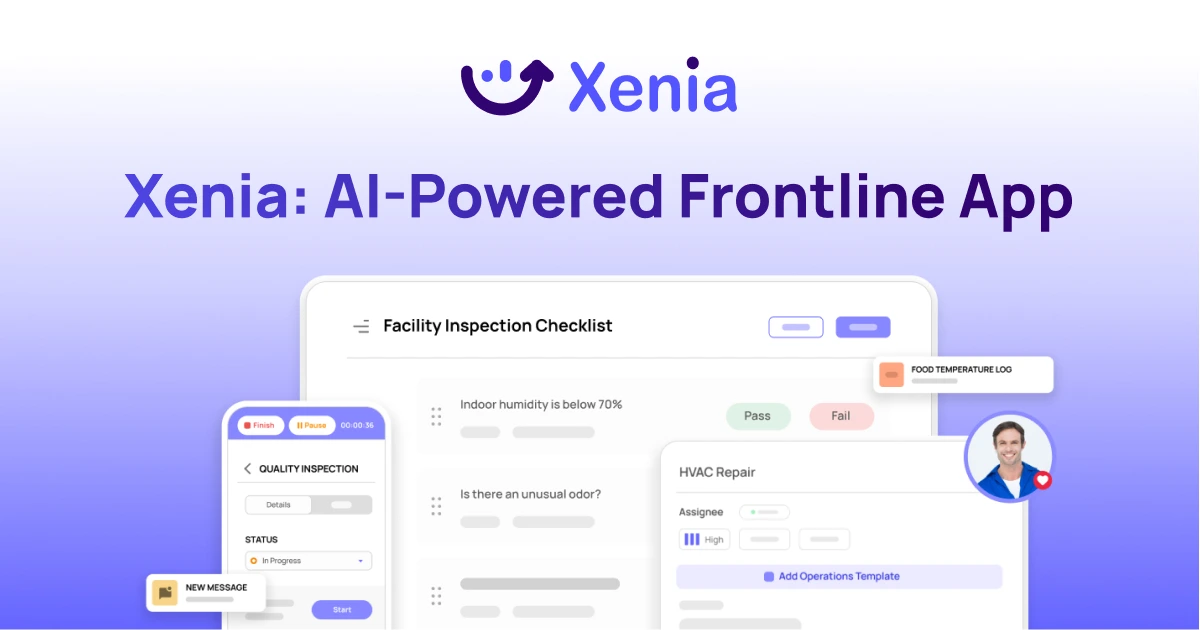
Why Facility Managers Choose Xenia:
🤖 AI-Powered Inspections, Verify safety equipment and compliance automatically with AI photo analysis. Surface critical maintenance issues instantly with AI-powered summaries.
🛠️ Work Orders & Maintenance, Report issues via mobile or QR codes. Route requests to teams or vendors. Schedule preventive maintenance for HVAC, elevators, and emergency systems to reduce downtime.
📊 Safety & Visibility, Deploy fire safety and hazard inspection workflows. Monitor work order resolution times and asset health across all facilities.
Manage work orders, maintenance, and safety inspections across all facilities from one platform.

.svg)
.webp)
%201%20(1).webp)

.svg)
%201%20(2).webp)