

Summary
What proactive maintenance actually means (and how it differs from preventive)
Proactive maintenance is a strategy that fixes the root causes of equipment failure before a breakdown happens, instead of repairing equipment after it fails. It is an umbrella term. Preventive maintenance, condition-based maintenance, and predictive maintenance all sit underneath it. Reactive maintenance is the opposite: you fix it after it breaks, and that costs the most per event.
The proactive vs reactive maintenance split is the distinction that matters most to a multi-unit operator. Here is the full picture, defined on first mention:
- Reactive maintenance: run-to-failure. Fix it after it breaks. Most expensive per event.
- Preventive maintenance: scheduled work on a fixed calendar or usage interval (filter every 90 days, fryer boil-out every week). A type of proactive maintenance, not a separate category.
- Condition-based maintenance (CBM): triggered when a sensor reading crosses a threshold, such as a cooler temp drifting or vibration spiking.
- Predictive maintenance (PdM): uses data to forecast a failure before it happens.
- Proactive maintenance: the parent category covering all three planned approaches, with an added emphasis on eliminating the root cause of recurring failures, not just servicing on schedule.
This answers the question operators search most: preventive vs proactive maintenance is not an either/or. Preventive is a subset of proactive. A weekly fryer boil-out is preventive and proactive at the same time. The proactive layer is what you add on top. When the same fryer fails twice in a quarter, you stop re-scheduling the boil-out and start fixing why it keeps drifting out of range.
| Type | When work happens | Best for | Cost per event |
|---|---|---|---|
| Reactive | After failure | Low-value, non-critical assets | Highest |
| Preventive | Fixed calendar or usage interval | Predictable wear items (filters, belts) | Low |
| Condition-based | Sensor crosses a threshold | High-value assets with monitoring | Low to medium |
| Predictive | Forecasted from data | Critical, sensor-rich assets | Lowest over time |
For the multi-location operator, the win is consistency. A single proactive maintenance program enforced the same way at every store turns "the fixture has been broken for three weeks" into a tracked task with an owner. Pair the schedule with a preventive maintenance cadence that maps each asset to a service frequency and you have the backbone of the program. The examples below show what that backbone looks like in each vertical.
Proactive maintenance examples in QSR: fryers, walk-ins, HVAC
In a quick-service restaurant, proactive maintenance means scheduled service on the equipment that takes down food production or fails a health inspection. That is the fryers, walk-in coolers and freezers, hot-holding units, ice machines, and rooftop HVAC, serviced before the failure costs you a service period.
Here are the QSR proactive maintenance examples that earn their place on a cadence:
- Fryer: scheduled boil-out and oil filtration on a fixed cadence, plus a gas valve and thermostat calibration check. A fryer that drifts out of temp range is both a food-safety and a throughput failure.
- Walk-in cooler and freezer: monthly gasket inspection, condenser coil cleaning, and door-seal checks. A failing gasket runs the compressor hot and pushes the box out of safe temp, which is a violation, not just a repair bill.
- Ice machine: quarterly descaling and sanitizing. This is a food-safety item too, not just an equipment one.
- Hot-holding and steam table: thermostat verification so hot-holds stay above the danger zone.
- Rooftop HVAC: filter replacement and coil cleaning on a seasonal cadence. A dirty coil is the single most common driver of a summer HVAC failure during peak dining.
- Grease trap and exhaust hood: scheduled cleaning to stay ahead of fire-marshal inspection and the equipment and cleaning rules in the FDA Food Code.
The kitchen team already runs a line check every shift. Proactive maintenance is the same habit, extended to the assets behind the line. A proactive temp-monitoring cadence is where a broken cooler gets caught before the health inspector finds it. When a walk-in does fail a temp check, the kitchen manager scans the QR code on the unit and submits a work request with no login. The form auto-populates the asset, location, and category. The manager approves and routes it in the app. That no-login QR-code work request flow is the bridge between the proactive check and the fix. Tie the cooler checks into a walk-in cooler temperature log and the proof sits in one place for the inspector. For the full vertical picture, see the restaurant task management hub.
Retail examples: refrigeration, lighting, POS hardware
In retail, proactive maintenance protects the things that stop a store from selling. That is refrigeration in grocery and food-adjacent retail, the lighting that makes the sales floor shoppable, POS hardware, HVAC, and the fixtures and doors customers touch all day.
Retail proactive maintenance examples that belong on a cadence:
- Refrigeration (grocery and specialty food retail): condenser cleaning, gasket and door-seal checks, and defrost-cycle verification. A failed reach-in means dumped product and lost sales.
- Lighting: scheduled relamping and ballast or driver checks, plus emergency and exit-light testing. Exit-light testing is a code item under OSHA exit-route requirements, not optional.
- POS hardware: scheduled cleaning of scanners, printers, and card readers, plus battery checks on mobile POS. A dead lane at peak is direct lost revenue.
- HVAC: seasonal filter and coil service. An over-warm sales floor drives customers out faster than almost anything else.
- Automatic doors and entry hardware: sensor and closer inspection, a safety and customer-experience item.
- Fixtures and shelving: scheduled inspection of high-traffic fixtures and locking hardware.
The DM walk is where retail proactive maintenance lives or dies. A proactive cadence turns a broken fixture from a verbal note into a scheduled, tracked work order with a deadline. When the associate finds a broken fixture mid-shift, the same QR-code submission flow that QSR uses applies here. Scan, describe, photo, submit, and the request routes to maintenance by location and priority. The DM does not have to remember it. The system does. Route the urgent ones with severity levels and SLA-based work order prioritization so a dead refrigeration unit does not sit in the same queue as a wobbly shelf. The retail operations software hub covers the store-walk and visual-audit side that pairs with this.
.svg)

Priced on per user or per location basis
Available on iOS, Android and Web


C-store examples: tap systems, fuel dispensers, coolers
In a convenience store, proactive maintenance protects fuel revenue and food-service revenue at the same time. That is fuel dispensers and forecourt equipment, walk-in and reach-in coolers, tap and dispensed-beverage systems, and the HVAC and lighting that keep a 24-hour store running.
C-store proactive maintenance examples grounded in the forecourt:
- Fuel dispensers and forecourt: scheduled filter changes, nozzle and hose inspection, dispenser calibration checks, and leak-detection verification on tank monitors. A pump down at a rural stop is lost fuel margin and lost in-store traffic.
- Walk-in and reach-in coolers: gasket, coil, and temp-monitoring checks. This protects food safety and the beer and beverage inventory at the same time.
- Tap, frozen-beverage, and coffee systems: scheduled cleaning and line sanitizing. Note the conditional reality here. Not every store has a tap system, which is exactly the kind of format variation that a tap-system vs fuel-only c-store audit template handles without penalizing the stores that do not have one.
- Coffee and foodservice equipment: descaling, calibration, and a scheduled deep-clean.
- HVAC and lighting: 24/7 runtime means a more aggressive proactive cadence than a 12-hour retail store.
Refuel is the c-store proof point. Refuel runs more than 200 c-stores, including rural fuel stops with intermittent connectivity. Their switching drivers were offline mode, work orders, and a retained third-party Service Channel integration. The offline mode matters for a proactive program at remote sites. The closing attendant completes the proactive check or work request on a tablet at a rural stop with no signal, and it syncs when connectivity returns. That is the difference between a maintenance program that works everywhere and one that only works where there is good WiFi. The convenience store operations software hub goes deeper on the c-store fit.
The proactive maintenance program rollout playbook
Building a proactive maintenance program across multiple locations comes down to six steps. The goal is a program that survives staff turnover and works the same way at every store, not a binder that sits in the back office.
- Inventory and tag your critical assets. Start with the equipment whose failure stops revenue or fails an inspection: walk-ins, fryers, fuel dispensers, HVAC, laundry. Give each one an asset tag, a label that ties the physical unit to its service history.
- Map each asset to a maintenance cadence. Assign every asset a frequency and a maintenance type, a preventive interval or a condition-based trigger. The highest-risk assets get the tightest cadence.
- Assign by role, not by name. Tie recurring PM tasks to the role (kitchen manager, area tech, housekeeping) so the program survives turnover. When someone leaves, the task stays attached to the seat.
- Require verified completion. Photo proof and timestamps on every PM task, so "done" is provable, not assumed. Xenia's daily-ops checklists capture photo and timestamp completion on every recurring task, which is the verified-completion layer this step needs.
- Route failures the moment they are found. When a proactive check finds a problem, it becomes a tracked work order with an owner, a deadline, and escalation, not a note on a clipboard. The dispatch-to-resolution work order workflow is where the corrective routing happens.
- Review by location, not just in aggregate. A 90% portfolio-wide planned ratio can still hide one store running 100% reactive. Review the planned-vs-reactive ratio per location.
Here is the workflow in plain terms, from proactive check to resolution:
- A scheduled proactive check (a daily ops checklist or PM task) flags a problem: a walk-in gasket failing, a fuel dispenser leaking, a PTAC unit dead.
- The staff member scans the QR code on the asset. The work request form opens with no login, pre-populated with asset ID, location, and category.
- The staff member adds a description and a photo, then submits.
- The manager approves in the Xenia app, and the request auto-routes by region, priority, and skill to the right tech or vendor.
- The task is tracked to closure with a deadline. It escalates to the DM or regional if the deadline passes.
- The closed work order joins the asset's service history, feeding the MTBF and planned-vs-reactive numbers.
Industry guidance puts a mature proactive program at 80% or more planned work, with sub-50% meaning a site is mostly reacting (Oxmaint maintenance metrics guide). Use that as the benchmark for step 6, reviewed per location. For broader facilities operations standards, IFMA's operations and maintenance resources are a useful reference.
KPIs: mean time between failure, planned-vs-reactive ratio, cost-per-fix
Three KPIs prove a proactive maintenance program is working: mean time between failure, planned maintenance percentage, and cost-per-fix. Track these per location, not just across the portfolio, or one failing store hides inside a healthy average.
- MTBF (mean time between failure): total operating time divided by the number of failures. Rising MTBF means the proactive program is working. An asset that used to fail every month and now runs three months between failures is the signal you want.
- Planned maintenance percentage (PMP), or the planned-vs-reactive ratio: the single most sensitive leading indicator. The industry benchmark for a mature program is 80% or more planned work, and below 50% means a site is mostly reacting. When reactive work drops below 20%, MTBF, MTTR, and maintenance cost-per-unit all improve together (Oxmaint maintenance metrics guide).
- MTTR (mean time to repair): the average time to close a repair. It falls as planning improves, because the parts and the workflow are ready before the failure.
- Cost-per-fix: reactive repairs run 3 to 5 times more per event than the same work done as planned maintenance.
The bigger picture backs the per-event math. Siemens found unscheduled downtime now costs the world's 500 biggest companies about $1.4 trillion a year, roughly 11% of revenue, up from $864 billion in 2019 to 2020 (Siemens, The True Cost of Downtime 2024). Deloitte reports that predictive maintenance can cut maintenance planning time 20 to 50%, raise equipment uptime 10 to 20%, and reduce overall maintenance costs 5 to 10% (Deloitte, predictive technologies for asset maintenance).
This is the review layer where Xenia fits the multi-location operator. The custom dashboards surface what is coming up as a problem, open corrective actions and high-risk locations, by location, not just a completion percentage. The Analytical Agent lets an ops director ask "which locations have the most open work orders this month?" in plain language and get the answer with the data behind it. One note on honesty: Xenia is a frontline work-order submission and routing tool, not a full CMMS. It does not match a depth CMMS like Limble for parts inventory, depreciation tracking, or deep vendor invoicing, and Xenia does not do predictive failure forecasting. Many operators run both, pairing Xenia with a depth CMMS like Limble. Start at the work order management hub to see how the frontline layer fits your stack.
Hospitality examples: laundry equipment, HVAC, elevators
In hospitality, proactive maintenance protects guest experience and room availability. That is the laundry equipment that turns rooms, the HVAC and PTAC units in every guest room, elevators, pool and spa systems, and the back-of-house kitchen and laundry.
Hospitality proactive maintenance examples that keep rooms sellable:
- Commercial laundry (washers, dryers, ironers): belt, bearing, lint-system, and steam-valve inspection. Laundry down means rooms cannot turn, which directly hits turn time and availability.
- Guest-room HVAC and PTAC units: filter cleaning and coil service on a rotating room schedule. A dead AC unit is a guest complaint and a comp.
- Elevators: the contracted PM most operators rely on a vendor for, covering lubrication, cable, and door-sensor inspection. A stuck elevator at peak check-in is a guest-experience failure.
- Pool and spa systems: pump, filter, and chemical-feed inspection, which is also a code and safety item.
- Kitchen and banquet equipment: for properties with food and beverage, the same fryer, walk-in, and hot-hold cadence as QSR applies.
- Life-safety: fire extinguisher, alarm, and emergency-lighting testing on a fixed schedule.
Hospitality is also where the complementary-buy model shows up clearly. Multi-property operators often digitize off paper and run Xenia for daily ops alongside a depth CMMS like Limble for asset depth and an HRIS like Workday. That is the textbook story for hospitality facilities. Xenia handles the frontline submission and routing, and the depth CMMS handles parts inventory and depreciation. The other half of the story is third-party vendors submitting work requests via QR code with no login. When the elevator vendor or the laundry tech finds a problem on site, they scan and submit without an account. That vendor work request without a login keeps outside contractors inside your system of record. See the hotel maintenance and housekeeping platform hub for the full hospitality fit.
Frequently Asked Questions
Got a question? Find our FAQs here. If your question hasn't been answered here, contact us.
What is proactive maintenance?

What's the difference between proactive and preventive maintenance?
How does proactive maintenance reduce reactive work orders?
What KPIs measure a proactive maintenance program?
How do you start a proactive maintenance program?
What software supports multi-location proactive maintenance?

A Modern, AI-Powered Platform Built for Facility Operations
Xenia connects maintenance, safety, inspections, and daily operations into one mobile-first platform. Facility teams respond faster, prevent downtime, and maintain compliance, while leadership tracks performance across all buildings in real time.
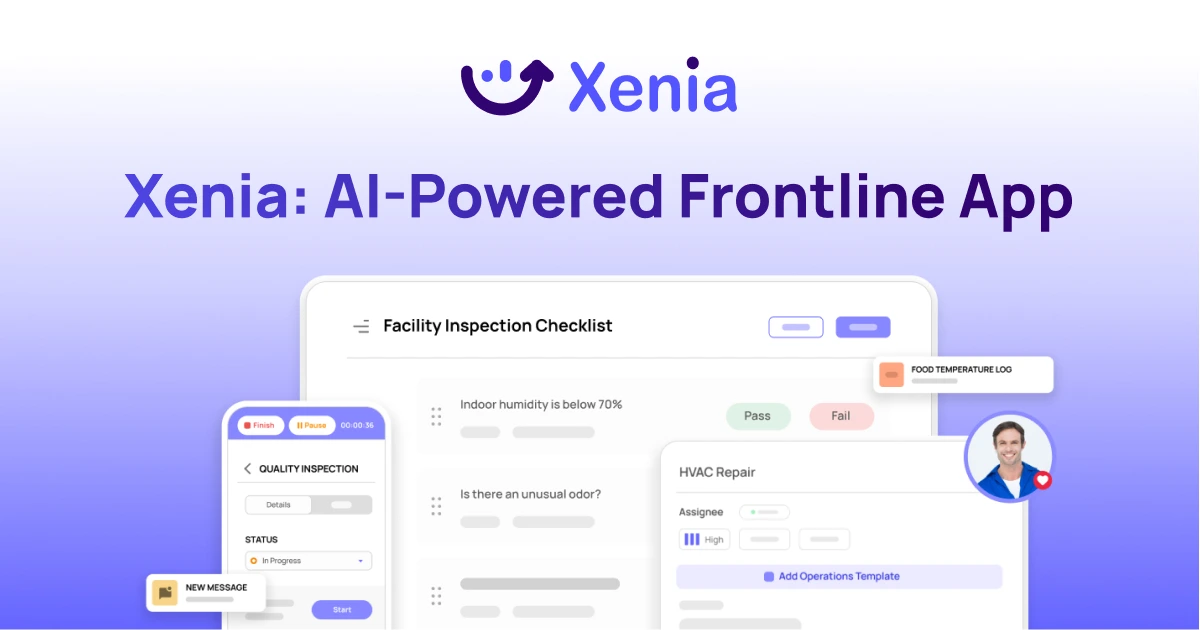
Why Facility Managers Choose Xenia:
🤖 AI-Powered Inspections, Verify safety equipment and compliance automatically with AI photo analysis. Surface critical maintenance issues instantly with AI-powered summaries.
🛠️ Work Orders & Maintenance, Report issues via mobile or QR codes. Route requests to teams or vendors. Schedule preventive maintenance for HVAC, elevators, and emergency systems to reduce downtime.
📊 Safety & Visibility, Deploy fire safety and hazard inspection workflows. Monitor work order resolution times and asset health across all facilities.
Manage work orders, maintenance, and safety inspections across all facilities from one platform.

.svg)
.webp)
%201%20(1).webp)

.svg)
%201%20(2).webp)


