
Post Summary
You are managing 15 restaurant locations. Location A consistently earns perfect health inspections. Location B is working to get there.
Same brand. Same training materials. Same procedures on paper.
So what makes the difference?
Operational excellence.
Understanding operational excellence meaning starts here.
If you run multiple locations, operational excellence isn't some corporate buzzword. It's what lets customers get the same great experience at every store while your teams execute with confidence.
.webp)
.svg)

Priced on per user or per location basis
Available on iOS, Android and Web


What Operational Excellence Actually Means
So what is operational excellence in business? Here's the simple version: operational excellence is when your business runs the same way across all locations. Tasks get done correctly every time. Teams catch opportunities for improvement quickly. Everyone knows what to do without waiting for direction.
Let's define operational excellence for frontline operations specifically.
The textbook definition talks about "continuous improvement" and "value flow to customers." That came from factories and Six Sigma programs.
But you are not running a factory with controlled conditions and stable staffing.
You are managing locations where:
- Teams are constantly learning and growing
- Equipment needs proactive maintenance
- Health inspectors visit regularly
- Brand reputation gets built one customer interaction at a time
The old factory definitions don't fully capture what frontline businesses need. Modern operational excellence means your teams execute consistently while adapting to dynamic conditions.
What changed between the old approach and today:
**
Then (Old Way), Now (Modern Operations)
Paper checklists stored in filing cabinets, Mobile apps with step-by-step photo guides
Weekly reports compiled days after issues happened, Real-time dashboards showing what’s broken right now
Playing phone tag to get status updates, Automated alerts when critical tasks get missed
Waiting for approvals while problems get worse, Empowered managers who fix issues immediately
**
This evolution reshaped the operational excellence definition for modern multi-unit businesses.
Operational Excellence vs Operational Efficiency
People confuse these constantly. Here's the actual difference:
Operational efficiency = doing things faster with fewer resources
Operational excellence = doing things right every single time
Example: A restaurant can be efficient. Fast ticket times. Lean labor. Meals going out quickly.
Excellence builds on that efficiency by adding consistent quality, strong safety protocols, and tracked customer feedback.
**
Operational Efficiency, Operational Excellence
How fast can we do this?, How do we do this right every time?
Optimize costs and speed, Maintain quality while improving
Short-term gains, Long-term brand building
Metrics: speed - labor cost, Metrics: consistency - compliance - satisfaction
**
Excellence includes efficiency. But it adds the quality and consistency that strengthen your brand.
Saving $200 on labor matters more when you maintain the standards that keep your highest-revenue location thriving.
The 4 Pillars That Make Operational Excellence Work
.webp)
These four pillars work together to create consistent execution.
Pillar 1: Leadership That Creates Visibility
Strong leadership means your district managers can see what's happening across all locations right now. Not when the reports get compiled three days later.
It also means frontline staff feel confident reporting opportunities for improvement. A maintenance need. A process question. Knowing their input drives better outcomes.
What this actually looks like:
- Store managers log observations from their phones in 30 seconds
- District managers see task completion rates across all locations on one dashboard
- Regional leaders spot patterns (like five locations excelling at the same practice)
- Teams get recognized when they maintain high standards
Pillar 2: Processes That People Actually Follow
Standardization doesn't mean complicated 40-page manuals.
It means your opening checklist is identical everywhere. Your cleaning procedures stay consistent regardless of who's working. Your food safety protocols maintain the same high bar whether it's Tuesday morning or Saturday night.
The key: make processes simple and accessible. A PDF buried in a filing cabinet doesn't support teams. A mobile checklist with photos does.
Good standardization includes:
- Mobile checklists with step-by-step photos
- Same training process at every location
- Automatic reminders that support task completion
- Clear instructions anyone can follow (even new hires on day three)
For restaurants, this means standardized opening procedures that maintain food safety. Cleaning protocols that support health scores. Maintenance schedules that keep equipment running during peak hours.
Pillar 3: Teams Who Know What to Do and Why
Frontline operations welcome new team members regularly. That's part of growth.
Operational excellence means new hires get up to speed fast with clear guidance from your systems rather than requiring constant support from busy managers.
It also means experienced employees understand why tasks matter. Someone who knows that accurate inventory counts prevent stockouts and support sales will approach that task with care and attention.
Training that actually works:
- Visual guides for every procedure
- Same onboarding checklist everywhere
- Real-time feedback that supports growth
- Recognition when teams execute well
Pillar 4: Technology That Makes Life Easier
Most programs add complexity by introducing multiple systems.
You end up with one platform for maintenance requests. Another for inspections. A third for task management. A fourth for reporting. That creates extra work during busy shifts.
Xenia consolidates everything into one mobile app. Teams manage work orders, complete inspections, and track tasks all in the same app. Leadership gets real-time visibility across every location without making phone calls for updates.
.webp)
That integration matters because operations are interconnected. Maintenance affects safety. Safety impacts customer experience. When everything lives in one system, you can see patterns and optimize before small issues need escalation.
For retail operators, this means store managers log maintenance requests, complete opening checklists, and track team tasks from one app. No switching between platforms. No paper forms to manage.
Together, these pillars form your operational excellence system, each supporting the others to drive results.
How to Actually Achieve Operational Excellence
Building an operational excellence strategy follows a clear path.
Start with visibility. Understanding current performance lets you identify improvement opportunities. Get a dashboard that shows task completion rates, compliance status and maintenance progress across all locations in real-time.
Build simple processes. Your procedures need to work during dinner rush or Black Friday. Test them with real teams before rolling out company-wide. If it works when you are busy, it works.
Empower location managers. Give your location managers the authority and tools to fix problems on the spot, while keeping leadership in the loop.
Use one system, not five. Every additional platform creates friction. Find technology that consolidates multiple tools into a unified experience.
Measure what matters. Track compliance rates. Task completion. Time to resolve maintenance requests. Customer satisfaction. These metrics drive real improvement.
Operational Excellence in the Age of AI
In 2026, operational excellence means using AI to help your teams make better decisions and execute more consistently.
It's not about replacing people. It's about giving them better information faster.
AI helps by:
- Analyzing inspection photos to identify maintenance opportunities before scheduled reviews
- Predicting which equipment needs proactive service based on usage patterns
- Automatically routing tasks to the right people based on priority and availability
- Spotting patterns across locations that drive best practice sharing
This shifts operational excellence from reactive to proactive. From addressing issues as they arise to preventing them before customers are affected.
Real scenario: Your freezer sensor detects rising temperatures at 2 am. The system automatically creates a work order, alerts the on-call technician and notifies the manager. The team takes preventive action. Food stays safe. Operations stay smooth. Customers get the same great experience.
That's modern operational excellence powered by AI and automation.
How Operational Excellence Strengthens Your Brand
Consistent execution across all locations builds customer trust and brand loyalty.
Operational excellence helps you maintain high standards before customers ever notice a gap.
Real scenario 1: A retail chain sees through its dashboard that multiple locations are excelling at cleanliness audits, while a few need support. Leadership identifies the gap immediately. Shares best practices from top performers to all stores. Verifies adoption through photos. Tracks improvement in real-time. The entire chain elevated in days, not months.
Real scenario 2: A restaurant group uses temperature sensors with automated alerts. When a walk-in cooler shows early signs of temperature drift, the system creates a work order and alerts the technician proactively. Equipment gets serviced before any impact. Food stays safe. Standards stay high. Customers stay happy.
This approach goes beyond individual situations. Operational excellence systems like Xenia identify patterns. Equipment that benefits from more frequent service. Training opportunities that support better performance. Seasonal trends that help you prepare operations.
You optimize proactively instead of reacting to urgent situations.
For multi-unit operations, this means building brand consistency across every location while maintaining the high standards that attract loyal customers.
FAQs
What are the 4 pillars of operational excellence for a modern frontline business?
The four pillars of operational excellence are Leadership, Process Standardization, People, and Technology. Leadership gives visibility and accountability. Standardized processes keep work consistent. People development trains and engages teams. Technology gives the tools to get work done efficiently. Together, they help your business improve and run smoothly across all locations.
How is operational excellence defined in the age of AI and digital transformation?
Modern operational excellence uses AI and digital tools to help people make better decisions. It uses real-time data, predictive insights, and automated workflows so teams can keep standards high. Leaders get clear visibility to spot patterns and improve all locations continuously.
What is the difference between operational efficiency and operational excellence?
Operational efficiency is about working faster and using fewer resources. Operational excellence is about doing things right every time. It keeps quality consistent, makes customers happy, and helps build your brand over time.
What are the roles and responsibilities of an OpEx leader in a restaurant or retail chain?
OpEx leaders look at performance across locations to spot patterns and find opportunities. They create processes that actually work on the ground. They coach managers to execute consistently and give teams the right tools. Using real-time dashboards, they track compliance and improvements while supporting each location.
Conclusion
Operational excellence is not a one-time project. It's how your multi-unit operation runs every single day.
The businesses winning in 2026 are not the ones with high-end technology or huge budgets. They are the ones where Location A executes exactly like Location B. Where teams catch improvement opportunities early. Where leadership spots patterns across 50 locations and shares best practices in hours, not weeks.
You do not need unlimited resources. You need the right approach, simple processes, empowered teams, and technology that makes their jobs easier.
Start small. Pick one pillar. Get visibility through better reporting. Standardize processes with digital checklists. Empower teams with mobile task management. Build from there.
Your customers expect consistency. Your teams want clarity. Your leadership needs visibility.
Operational excellence gives you all three.
Operational excellence gives you all three. Explore Xenia to see how multi-unit operators are achieving consistency and protecting their brands across every location.
Frequently Asked Questions
Got a question? Find our FAQs here. If your question hasn't been answered here, contact us.

Looks like there's no data available in our FAQ section at the moment.

A Modern, AI-Powered Platform Built Specifically for Frontline Operations
Xenia brings daily operations, maintenance, audits, and compliance into one mobile-first platform. Frontline teams execute work consistently across locations while leadership gets real-time visibility.
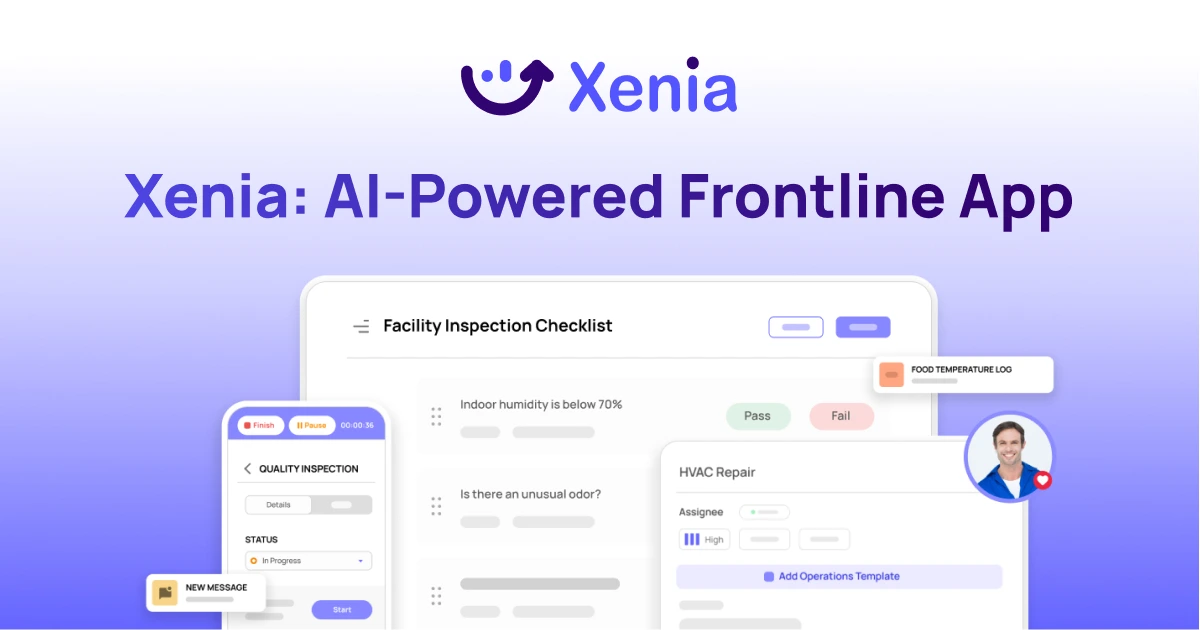
Why Multi-Location Operators Choose Xenia:
🤖 AI-Powered Operations, Create digital checklists instantly or convert paper forms with AI. Verify compliance automatically with photo analysis and get instant answers from your operational data.
✅ Daily Operations & Maintenance, Assign work across hundreds of locations in minutes. Report and route issues instantly. Schedule preventive maintenance to catch problems before downtime.
📊 Real-Time Visibility, Track completion, work orders, and performance across all locations through dashboards. Filter by site or asset to spot trends and take action.
Manage operations, maintenance, and compliance across all your locations from one platform

.svg)
.webp)
%201%20(1).webp)

.svg)
%201%20(2).webp)