
.webp)
Post Summary
Multi-location retail operations generate massive amounts of data every single day.
Customer traffic. Sales conversions. Inventory levels. Employee schedules. Compliance audits. Equipment maintenance. Safety incidents.
Here's the problem: Most retail analytics tools just show you what happened. They tell you last week's numbers. They give you reports on yesterday's performance.
What you actually need? AI that tells you what's about to happen. And then takes action to fix it before it becomes a problem.
That's what AI retail analytics software do in 2026.
The right AI retail analytics solution uses predictive alerts to warn you about issues before they cost you money. It automates compliance monitoring so you're not manually reviewing hundreds of audit photos. And it gives executives instant answers to complex questions across all locations.
This guide breaks down 9 AI retail analytics platforms that work in 2026. You'll see what each one does, how AI actually helps, and which retail operations problems they solve.
9 Best AI Retail Analytics Platforms in 2026
**
Rank, Platform, Focus, AI Capability, Best For
#1, Xenia, Complete Operations + AI Analytics, Conversational dashboards - predictive alerts - automated compliance, Multi-location retail operations
#2, ReBiz, Sales Performance, Supervised AI with human audits, Customer traffic and conversion tracking
#3, Placer.ai, Foot Traffic Intelligence, Location analytics and predictive modeling, Foot traffic and location insights
#4, ThoughtSpot, Self-Service Analytics, Natural language search with SpotIQ, Teams needing instant insights
#5, RetailNext, Shopper Behavior, Video analytics and people counting, In-store customer behavior
#6, SiteZeus, Site Selection, AI-driven location intelligence, Store expansion planning
#7, Buxton, Customer Segmentation, Consumer behavior modeling, Trade area analysis
#8, Sensormatic IQ, Loss Prevention, Traffic and shrinkage analytics, Theft reduction and inventory
#9, Qlik Cloud Analytics, Data Integration, Predictive analytics engine, Multi-source data unification
**
.svg)

1. Xenia - Best AI Retail Analytics Platform for Multi-Location Operations
- What it's for: Complete retail operations with AI analytics, predictive alerts, conversational dashboards
- G2 rating: 4.9/5
- Who uses it: Adidas, Power Market, Tempstop
- What makes it different: Only platform that combines AI retail analytics with complete operations execution

Xenia is the best AI retail analytics platform for multi-location operations, managing anywhere from 5-100+ stores.
Here's why.
Most retail analytics software just show you data. Dashboards. Charts. Reports.
Xenia does something different. It turns raw operational data into AI-powered insights that automatically trigger actions across your stores.
Your stores generate massive amounts of data every day. Audit logs. Temperature checks. Photos from inspections. Task completion rates. Maintenance records. Incident reports.
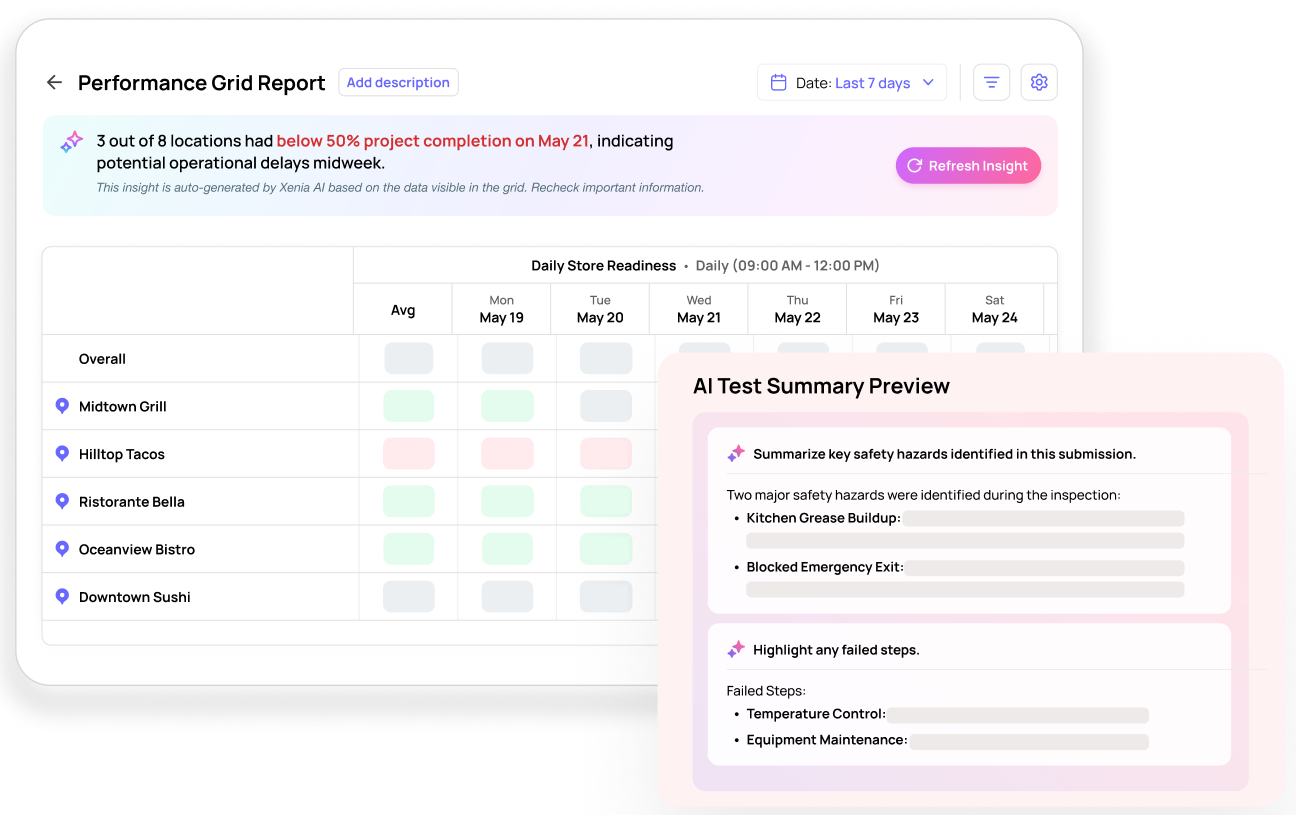
Xenia's AI transforms all that raw data into executive summaries you can actually use.
How Xenia's AI Works for Retail
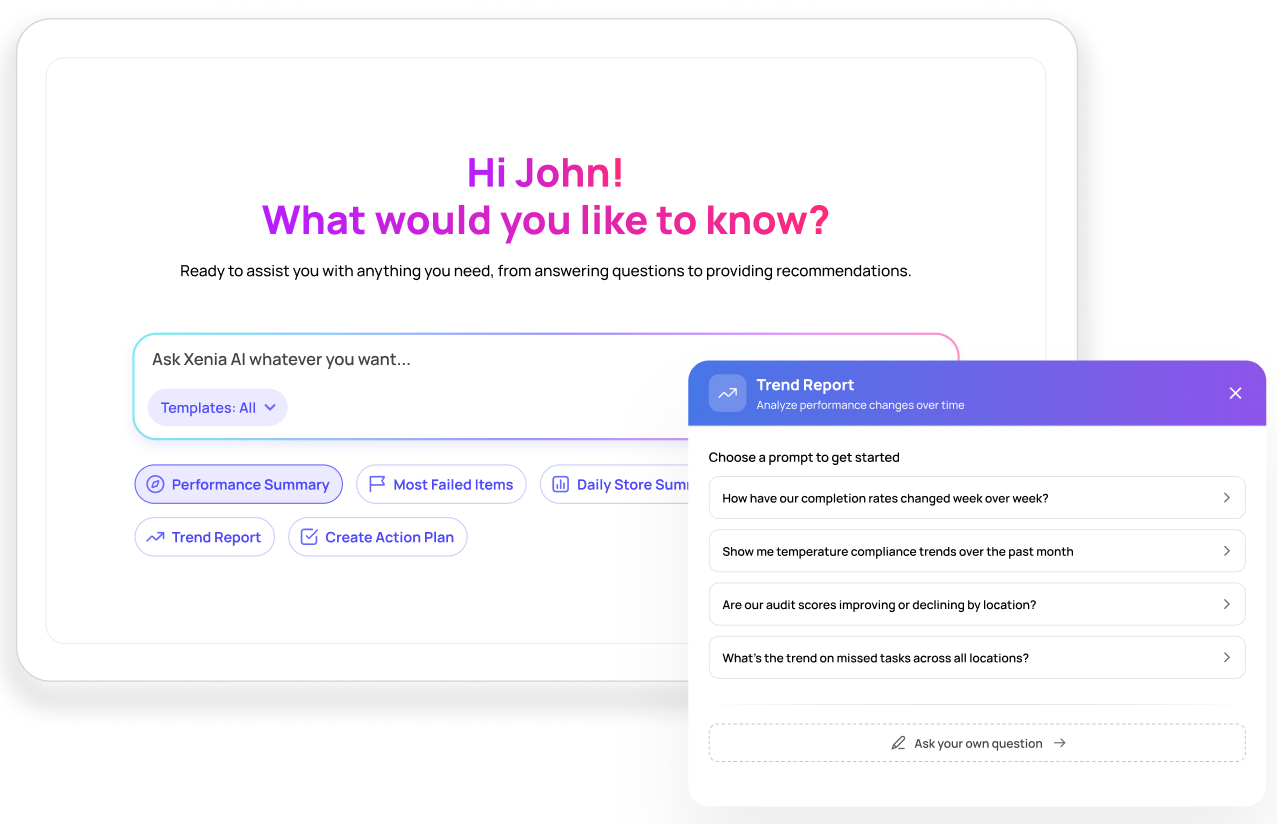
Conversational Dashboard (Analytical Agent): Type questions in plain English. Get instant visual reports.
"Which of my 10 stores had the most safety violations last month?"
The Analytical Agent instantly shows you exactly which locations have issues, what violations occurred, and prescribes specific action plans to fix them.
"Show me merchandising compliance scores across my Northeast region."
You get a visual report comparing all stores. See which locations need attention. Drill down into specific issues at each store.
"What equipment requires the most maintenance?"
The AI analyzes maintenance history across all locations and tells you which assets are problematic and recommends replacement schedules.
This is AI retail analytics that actually answers your questions instead of making you build custom reports making Xenia the best retail analytics software.

AI-Powered Executive Summaries: Every morning, executives get a narrative summary of what's happening across all locations.
AI-Powered Summaries highlight critical issues automatically:
- Stores with recurring safety violations
- Locations showing declining task completion
- Equipment trending toward failure
- Compliance gaps across regions
The AI prioritizes issues by severity. It identifies patterns you'd miss looking at individual store reports.
You know exactly where to focus attention. No more drowning in data.
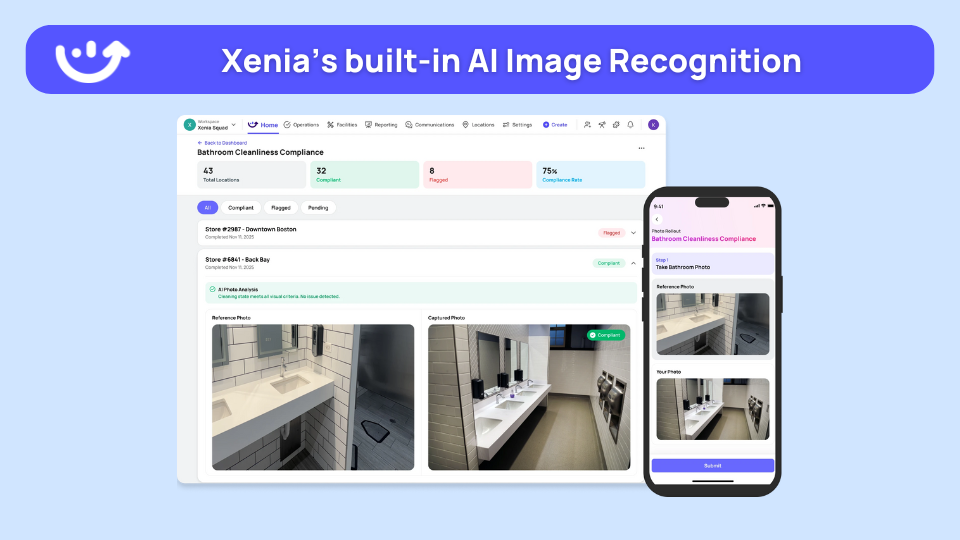
Automated Compliance Monitoring: District managers used to spend hours reviewing photos from store audits.
Now AI Photo Analysis does it automatically.
Take a photo of your merchandising display. The AI verifies it against your planogram instantly. It tells you if products are placed correctly, if signage matches brand standards, if there are any issues.
Found a problem? The AI automatically creates a corrective action task, assigns it to the right person, and tracks it until completion.
Zero manual review needed. Instant compliance verification.
Predictive Analytics That Take Action: This is where Xenia goes beyond traditional retail analytics software.
The AI identifies patterns and predicts issues before they cost you money:
- Equipment showing degradation patterns? AI flags it for preventive maintenance before it breaks down.
- Store showing declining performance? AI suggests specific coaching interventions based on what worked at your best-performing locations.
- High-risk periods for theft predicted? AI automatically increases monitoring and sends alerts to loss prevention teams.
And here's the key: The AI doesn't just alert you. It creates work orders, assigns tasks, and tracks everything through resolution.
That's agentic AI. It executes based on what it learns.
How Xenia Compares to Other AI Retail Analytics Platforms
Most retail analytics providers give you dashboards and charts.
Xenia gives you AI that actually takes action.
**
What You Need, Xenia, Analytics-Only Platforms
Best for, Complete retail operations + AI analytics, Just analytics and dashboards
AI capabilities, Conversational dashboards - predictive alerts - automated compliance - agentic AI, Varies by platform
Asking questions, Natural language queries get instant answers, Pre-built reports only
Taking action, AI creates tasks and work orders automatically, You handle it manually
Compliance monitoring, Automated AI photo verification, Manual review or limited automation
Operations integration, Audits - tasks - maintenance - all connected, Separate systems required
Mobile execution, Full offline capability for stores, Varies
**
Bottom line: Xenia is the only AI retail analytics software that combines analytics with complete operations execution.

Priced on per user or per location basis
Available on iOS, Android and Web


2. ReBiz
Best for: Customer traffic and rep-level conversion tracking
Main AI thing: Supervised AI (computer vision + human audits)
ReBiz uses computer vision to analyze in-store camera feeds and track customer-only traffic (filtering out employees and delivery drivers).
Key features:
- Verified customer-only traffic counts
- Rep-level sales conversion tracking
- Daily operations compliance monitoring
- Loss prevention insights
- Schedule optimization based on traffic patterns
Good if: You need granular sales performance data by employee and want to optimize staffing based on actual customer traffic patterns.
Not good if: You need complete operations management beyond traffic and conversion analytics.
3. Placer.ai

- Best for: Foot traffic and location intelligence
- Main AI thing: Location analytics and predictive modeling
Placer.ai leverages anonymized location data to provide real-time foot traffic insights, trade area analysis, and consumer behavior patterns for retailers.
Key features:
- Real-time foot traffic analysis
- Trade area and cross-shopping insights
- Competitive intelligence
- Predictive analytics for site selection
- Custom reporting and data visualization
Good if: You want to optimize store locations, understand visitor trends, and benchmark performance against competitors.
Not good if: You focus solely on in-store operations without needing external mobility data.
4. ThoughtSpot

- Best for: Teams needing instant insights without data analysts
- Main AI thing: Natural language search with SpotIQ anomaly detection
ThoughtSpot lets you query sales, inventory, and customer data using plain English for instant AI-powered visualizations.
Key features:
- Natural language search interface
- SpotIQ for automatic trend detection
- Interactive Liveboards dashboards
- Embedded analytics capabilities
- Sentiment analysis tools
Good if: Your team needs fast, collaborative insights without requiring data expertise.
Not good if: You need geospatial analysis or computer vision for retail execution.
5. RetailNext
- Best for: Understanding customer behavior in physical stores
- Main AI thing: Video analytics and people counting
RetailNext integrates video, POS, and traffic data to map shopper paths, occupancy, and staff effectiveness.
Key features:
- Shopper journey tracking
- Store occupancy monitoring
- Staff effectiveness analysis
- Dynamic labor scheduling
- Product placement impact measurement
Good if: You want to optimize in-store layouts and labor based on customer behavior.
Not good if: Your focus is ecommerce rather than physical store operations.
6. SiteZeus
- Best for: Store expansion and portfolio optimization
- Main AI thing: AI-driven location intelligence
SiteZeus uses big data and machine learning to forecast market potential and evaluate store sites.
Key features:
- Location scoring and forecasting
- Customer trend prediction
- Portfolio performance analysis
- Market potential insights
- Expansion planning tools
Good if: You're expanding your store network or assessing existing locations.
Not good if: You need daily operational metrics more than strategic site planning.
7. Buxton

- Best for: Understanding trade areas and customer profiles
- Main AI thing: Consumer behavior modeling
Buxton identifies true trade areas and customer profiles based on actual visit data.
Key features:
- Trade area definition
- Customer profiling
- Cross-shopping pattern analysis
- Market trend tracking
- Localized marketing insights
Good if: You need precise audience targeting and competition mapping.
Not good if: Real-time operational data is more important than strategic planning.
8. Sensormatic IQ

Best for: Inventory accuracy and theft reduction
Main AI thing: Traffic and shrinkage analytics
Sensormatic IQ combines traffic data with inventory management to detect fraud and optimize stock.
Key features:
- Shopper flow analysis
- Dwell time tracking
- Shrinkage reduction tools
- Fraud detection
- Store layout optimization
Good if: Theft prevention and inventory accuracy are your biggest challenges.
Not good if: Sales conversion tracking matters more than security analytics.
9. Qlik Cloud Analytics

- Best for: Integrating multiple retail data sources
- Main AI thing: Predictive analytics engine
Qlik integrates sales, inventory, and customer data for real-time AI-driven dashboards.
Key features:
- Multi-source data unification
- Predictive forecasting
- Conversational analytics
- Self-service dashboards
- Cloud scalability
Good if: You handle diverse data sources that need quick unification.
Not good if: You need specialized tools for visual merchandising or location intelligence.
FAQs
Which AI retail analytics platform offers the best automated compliance monitoring?
Xenia AI retail analytic software offers the most comprehensive automated compliance monitoring for multi-location retail.
The AI Photo Analysis automatically verifies merchandising against planograms, checks safety equipment placement, and validates brand standards without manual review.
When issues are found, the system automatically creates corrective action tasks and tracks them through resolution. District managers get AI-generated summaries highlighting compliance gaps across all locations.
Most importantly? Xenia combines compliance monitoring with complete operations execution.
How does AI in retail analytics reduce time spent on manual audit cycles?
AI eliminates manual review completely.
- Old way: District managers spend hours reviewing photos from store audits. They manually check if merchandising matches standards. They create tasks to fix issues. They follow up to verify completion.
- New way with Xenia's AI: Take a photo. AI verifies it instantly. If there's an issue, AI automatically creates a task and assigns it. Done.
The Analytical Agent also answers questions instantly instead of requiring custom report building. Ask "Which stores failed safety audits this week?" Get an answer in seconds.
That's how AI in retail analytics actually saves time.
What are the core features of a future-proof AI retail analytics tools?
A future-proof AI retail analytics platform has these capabilities:
- Conversational Dashboards: Ask questions in plain English. Get instant visual answers. No custom report building.
- Predictive Alerts: AI predicts problems before they happen. Equipment failures. Compliance gaps. Performance declines.
- Automated Compliance: AI verifies photos against standards automatically. Creates corrective actions. Tracks resolution.
- Agentic AI: The platform doesn't just alert you. It takes action. Creates tasks. Assigns work orders. Executes based on what it learns.
- Complete Integration: Analytics connect with operations, maintenance, tasks, and communication. Everything in one platform.
- Continuous Learning: The AI gets better over time. It learns patterns in your operations and improves recommendations.
Xenia has all of these. Most platforms have one or two.
What's the difference between traditional retail analytics and AI retail analytics platforms?
Traditional retail analytics tell you what happened. Historical data. Last week's sales. Yesterday's traffic.
AI retail analytics platforms predict what's going to happen and take action to fix issues before they cost you money.
- Traditional: "Your Store #5 had low sales last week."
- AI: "Store #5 sales are trending down. Based on patterns at your other locations, the issue is likely insufficient staffing during peak hours. I've created a schedule optimization task for the manager and flagged this location for coaching."
That's the difference. Traditional analytics require you to figure out the "why" and the "what to do." AI tells you both and helps you execute.
Can retail analytics software integrate with POS and other systems?
Yes. Modern retail analytics platforms integrate with POS, HRIS, inventory management, and other retail systems.
Xenia integrates with major HRIS systems (Workday, ADP, Paycom), POS platforms, inventory management tools, and business intelligence platforms like Power BI and Tableau.
Integration is crucial. Your AI can't provide meaningful insights if it only sees data from one system. It needs the complete picture across sales, operations, staffing, and inventory.
How quickly do retailers see results from AI retail analytics?
With Xenia AI retail analytics, you see immediate results in visibility and accountability.
Data clarity starts on day one. You immediately see which stores have compliance issues, which locations need attention, and where your operations gaps are.
Conclusion
Here's the bottom line.
Most retail analytics platforms just show you data. Charts. Dashboards. Historical reports.
The best AI retail analytics software in 2026 do three things:
- Predict problems before they happen
- Automate compliance verification completely
- Take action automatically based on what they learn
For multi-location retail operations? Xenia retail ai software combines all three with complete retail operations execution.
You get conversational dashboards that answer questions instantly. AI that verifies compliance automatically. Predictive alerts that flag issues before they cost you money. And agentic AI that creates tasks and tracks resolution.
Plus everything else you need to run retail operations: audits, tasks, maintenance, inventory, and communication. All in one mobile-first platform.
It deploys in 1-2 weeks. You can start for free.
See how it works for your retail operations.
Frequently Asked Questions
Got a question? Find our FAQs here. If your question hasn't been answered here, contact us.

Looks like there's no data available in our FAQ section at the moment.

A Modern, AI-Powered Platform Built for Retail Operations
Xenia brings store operations, merchandising, audits, and loss prevention into one mobile-first platform. Store teams execute daily work consistently, maintain brand standards, and resolve issues faster, while regional and corporate leadership get real-time visibility across all locations.
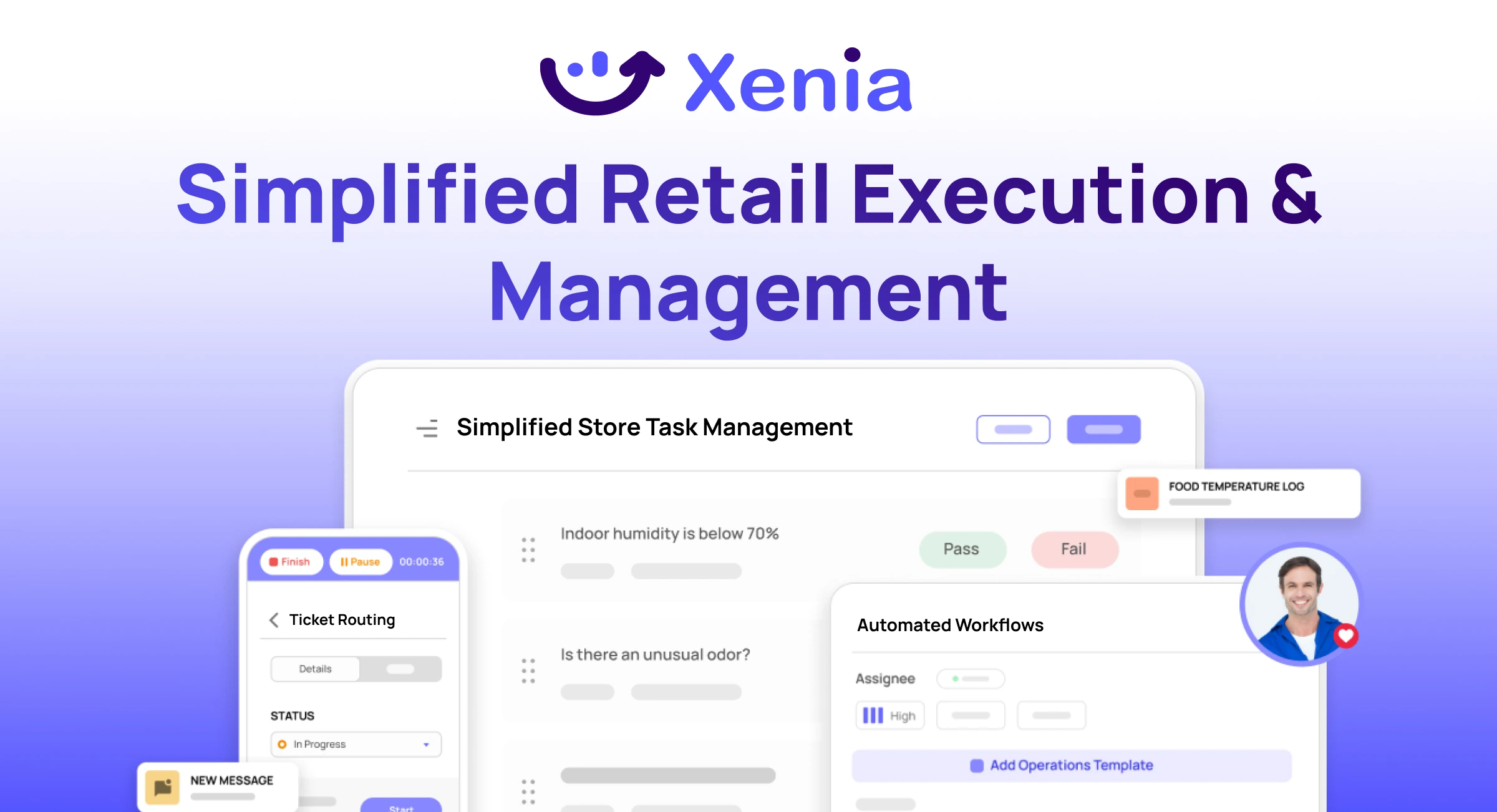
Why Retail Operators Choose Xenia:
🤖 AI-Powered Merchandising, Verify planograms, displays, and brand standards automatically with AI photo analysis. Build digital checklists instantly or convert existing merchandising guides.
🏬 Operations & Loss Prevention, Assign opening procedures, store walks, and resets across locations. Track theft, cash discrepancies, and security incidents with evidence and approval workflows.
📊 Real-Time Visibility, Compare audit scores and task completion across stores. Identify top and underperforming locations. Export reports for leadership reviews.
One platform for operations, merchandising compliance, and loss prevention across all locations.

.svg)
.webp)
%201%20(1).webp)

.svg)
%201%20(2).webp)