
.webp)
Post Summary
Running multiple locations? Then you already know the problem.
Every day is a stream of decisions. How much food to prep? How many people to schedule? What inventory to order? Which locations need your attention right now?
Traditional forecasting? It’s just educated guessing.
You look at last week’s sales. Maybe last year’s numbers. You build a spreadsheet. And hope you got it right.
Here's what's changed in 2026: AI-powered demand forecasting tools take the guesswork out.
The right AI forecasting software analyzes years of operational data in seconds. It factors in weather, school calendars, local events, and traffic patterns. It predicts exactly what you will need and adjusts automatically as conditions change.
This guide breaks down 6 AI-based forecasting tools that work for multi-unit operations.
Top 6 AI Forecasting Tools for Operations
**
Rank, Platform, Focus, AI Capability, Best For
#1, Xenia, Complete Operations + Predictive Analytics, Operational forecasting integrated with execution, Multi-location operations (restaurants/retail/C stores)
#2, Forecast.app, Restaurant Demand, AI demand forecasting for food service, Restaurant chains
#3, 7shifts, Labor Forecasting, AI-powered scheduling, Restaurant and retail labor
#4, MarginEdge, Food Cost Forecasting, AI invoice processing + predictions, Restaurant cost control
#5, Blue Yonder, Enterprise Supply Chain, End-to-end AI forecasting, Large retailers and manufacturers
#6, o9 Solutions, Integrated Planning, AI for supply chain and operations, Enterprise multi-unit operations
**
.svg)

1. Xenia - Best AI Forecasting for Multi-Unit Operations
- What it's for: Complete operations platform with AI predictive analytics for restaurants, retail, hospitality and multi-location businesses
- G2 rating: 4.9/5
- Who uses it: Demos Restaurants, Power Market, Slim Chickens, Domino's, and other multi-unit operations
- What makes it different: Only platform combining AI forecasting with complete operations execution
Xenia is the best AI forecasting software for multi-unit operations that need more than just predictions; they need execution.
Here's the thing about most forecasting tools: They give you a number. Then you are on your own to actually execute based on that forecast.
Xenia connects AI for forecasting with the operational execution that makes forecasts useful.
How Xenia's AI Forecasting Works
Predictive Operational Analytics: The AI Analytical Agent analyzes patterns across all your operational data:
- Task completion rates by location and time
- Audit scores and compliance trends
- Equipment maintenance patterns
- Inventory usage and waste patterns
- Labor efficiency by location
It does not just predict demand. It predicts operational needs.
"Which locations will need equipment maintenance next week?"
"Where are we likely to see compliance issues?"
"What locations are trending toward higher waste?"
You get proactive insights instead of reactive firefighting.
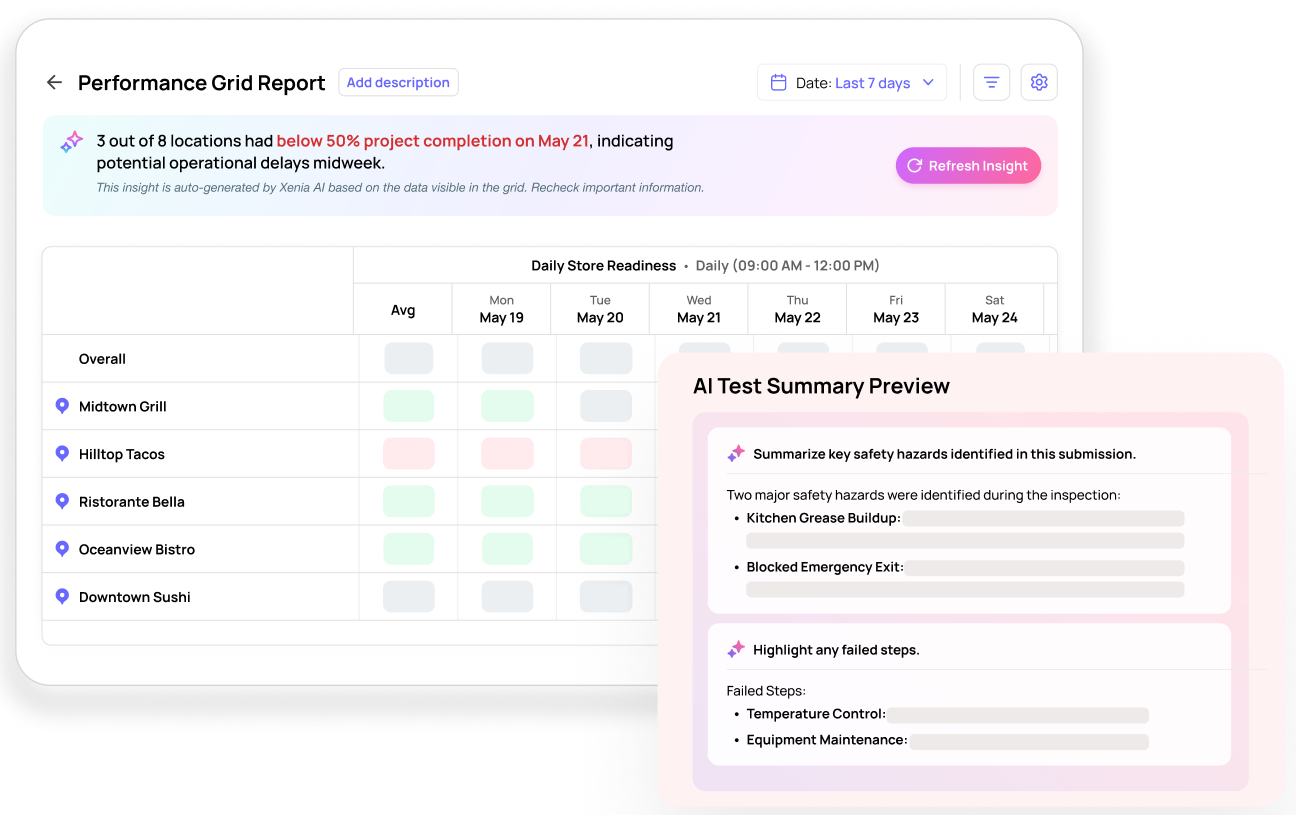
AI-Powered Summaries for Operations Leaders: Every morning, executives get AI-generated summaries highlighting:
- Locations likely to face stockouts based on current inventory + predicted demand
- Labor schedules that don't match predicted traffic patterns
- Equipment showing failure patterns before breakdowns occur
- Compliance gaps that predict health inspection issues
The AI prioritizes what needs attention. You focus on high-impact issues instead of drowning in data.
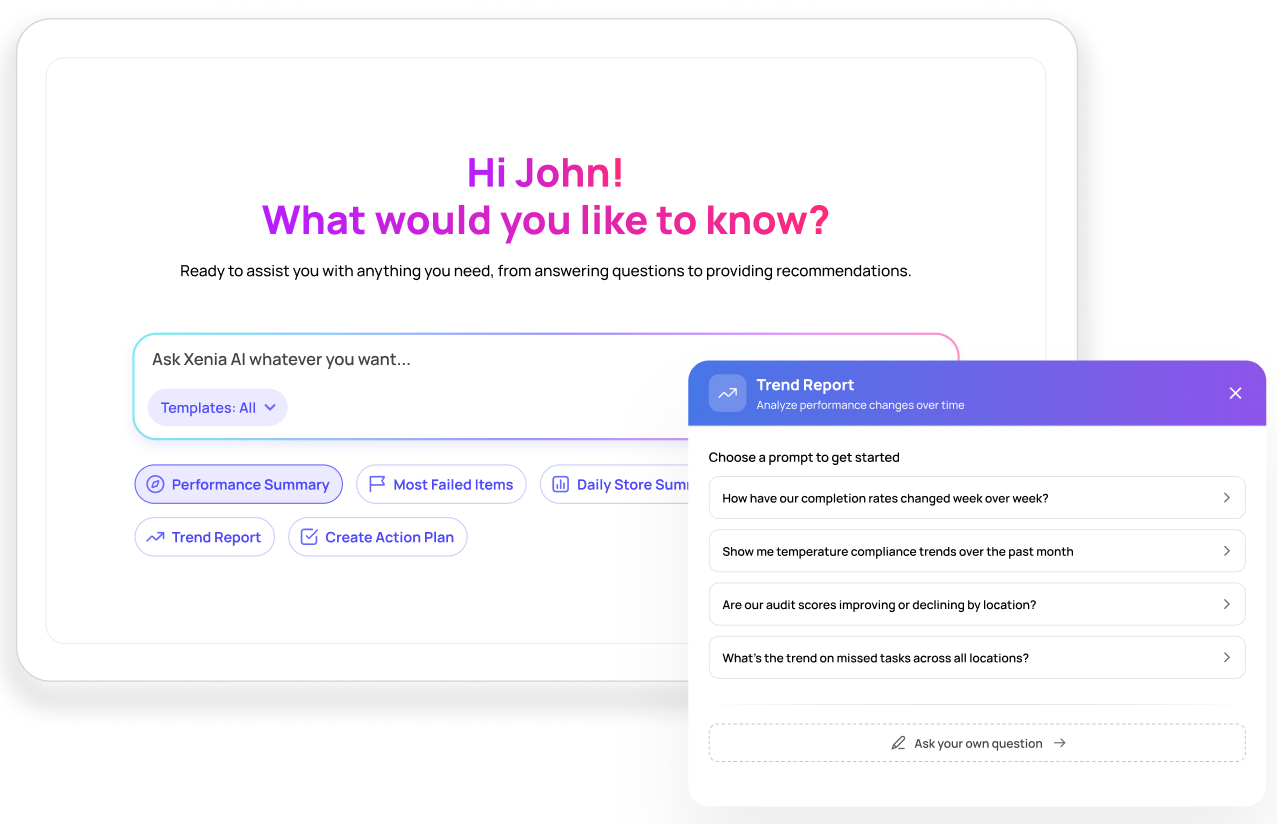
Automated Execution Based on Predictions: This is where Xenia differs from pure forecasting tools.
The AI does not just predict. It takes action:
- Creates work orders for equipment predicted to fail
- Assigns corrective action tasks when patterns indicate issues
- Flags inventory levels that don't match predicted demand
- Suggests labor schedule adjustments based on traffic forecasts
You get predictions + automatic execution.
Operational Forecasting Integrated with Execution: Most forecasting tools are standalone. They give you predictions. Then you manually update schedules, create tasks, adjust orders.
Xenia integrates forecasting with retail execution.
When the AI predicts something, the platform helps you act on it immediately.
Learning from Your Operations: The AI learns patterns specific to your business:
- How weather affects each location differently
- Which days of week are busiest at specific stores
- Seasonal patterns unique to your regions
- Equipment failure patterns by asset type and age
The more you use it, the more accurate it gets for your specific operations.
How Xenia Compares to Forecasting-Only Tools
**
What You Need, Xenia, Forecasting-Only Tools
Best for, Complete operations + AI forecasting, Just demand predictions
What it predicts, Demand - maintenance - compliance - waste - labor needs, Usually just sales/demand
Execution, Integrated tasks - work orders - audits, You handle it separately
Operations management, Full platform, Need separate tools
Industry focus, Multi-unit frontline operations, Varies
Mobile execution, Full offline capability, Varies
**
Bottom line: Xenia is the only platform where AI forecasting drives automatic operational execution across restaurant operations, retail, hospitality and convenience stores.
See it yourself: Xenia AI Forecasting Software

Priced on per user or per location basis
Available on iOS, Android and Web


2. Forecast.app

- Best for: Restaurant chains needing detailed cover forecasting
- Main AI thing: Demand prediction by meal period and day part
Forecast.app specializes in predicting restaurant covers (number of guests) by breaking down demand by meal period, day of week and historical patterns.
Key features:
- Meal period forecasting (breakfast, lunch, dinner)
- Weather impact analysis
- Event-based adjustments
- Historical pattern recognition
Good if: You are a restaurant chain that needs granular covers prediction to drive prep and labor decisions.
Not good if: You need operational execution tools beyond just forecasting.
3. 7shifts
.webp)
- Best for: Restaurant and retail labor forecasting and scheduling
- Main AI thing: Predicts labor needs based on sales forecasts
7shifts uses AI to predict how many staff you need by role and by hour, then builds schedules automatically.
Key features:
- Sales-based labor forecasting
- Automatic schedule generation
- Labor cost optimization
- Employee availability management
Good if: Labor scheduling is your primary pain point and you already have other tools for inventory and operations.
Not good if: You need forecasting beyond labor or complete operations management.
4. MarginEdge
.webp)
- Best for: Restaurant cost control and invoice management
- Main AI thing: Predicts food costs and catches pricing errors
MarginEdge uses AI to process invoices automatically and predict food cost trends.
Key features:
- AI invoice processing
- Food cost prediction
- Price variance alerts
- Vendor pricing tracking
Good if: Food cost control is your top priority and you need automated invoice processing.
Not good if: You need demand forecasting or complete operations management.
5. Blue Yonder

- Best for: Large enterprises with complex supply chains
- Main AI thing: End-to-end supply chain optimization
Blue Yonder (formerly JDA) provides enterprise supply chain planning with AI forecasting.
Key features:
- Demand sensing and shaping
- Supply chain optimization
- Inventory optimization
- Transportation planning
Good if: You are a Fortune 500 company with complex supply chain needs.
Not good if: You are a mid-market multi-unit operator. Too complex and expensive.
6. o9 Solutions

- Best for: Enterprise operations and supply chain planning
- Main AI thing: AI across supply chain, demand and operations
o9 provides integrated planning with AI forecasting across multiple business functions.
Key features:
- Demand planning
- Supply planning
- Scenario modeling
- Enterprise-wide optimization
Good if: You need enterprise planning capabilities across departments.
Not good if: You are looking for simple operational forecasting for multi-unit operations.
Conclusion
Here's the reality.
Most AI-powered demand forecasting tools are built for finance teams. CFOs. FP&A. Strategic planning.
If you are an operations leader dealing with daily execution, prepping food, scheduling staff, and ordering inventory, you need different tools.
You need AI for forecasting that predicts operational needs. Not just financial projections.
You need predictions that drive execution. Not forecasts that sit in dashboards while you figure out what to do with them.
For multi-unit restaurant operations, retail, hospitality and convenience stores, Xenia combines AI forecasting with complete operations execution.
The AI predicts what you will need. The platform helps you execute on those predictions. Everything connected in one system.
See how it works for your operations.
Frequently Asked Questions
Got a question? Find our FAQs here. If your question hasn't been answered here, contact us.
Do I still need humans if AI handles forecasting?

Yes. Always. AI for forecasting works best with human oversight, not as a replacement.
The AI handles the math, analyzing thousands of variables you could not process manually. Humans provide judgment, local knowledge and context.
Example: AI predicts high demand. Manager confirms and uses that to staff appropriately.
Can AI forecasting software handle external factors like weather and events?
Yes, but not all platforms do this equally well.
Basic AI forecasting just looks at your historical sales. Advanced AI predictive analytics incorporates external data:
- Weather forecasts and impact on traffic
- School calendars (breaks, holidays, in-service days)
- Local events (concerts, sports, festivals)
- Traffic patterns and construction
- Seasonal trends
How does AI demand forecasting reduce waste in restaurants?
Traditional approach: Prep based on par levels or last week's usage. Hope you do not run out. Throw away what's left.
AI demand forecasting predicts exactly what you'll sell by meal period, accounting for weather, events, day of week and historical patterns.
What's the difference between AI forecasting for operations vs finance?
Financial forecasting predicts revenue, expenses and budgets for strategic planning. Operations forecasting predicts what you need to run locations daily, inventory, labor, maintenance.
AI for forecasting in operations focuses on actionable predictions: How much food to prep today. How many staff to schedule tomorrow. What equipment will fail next week.
Most financial AI tools are built for CFOs and FP&A teams. Operations AI tools like Xenia are built for operations managers dealing with daily execution.

A Modern, AI-Powered Platform Built Specifically for Frontline Operations
Xenia brings daily operations, maintenance, audits, and compliance into one mobile-first platform. Frontline teams execute work consistently across locations while leadership gets real-time visibility.
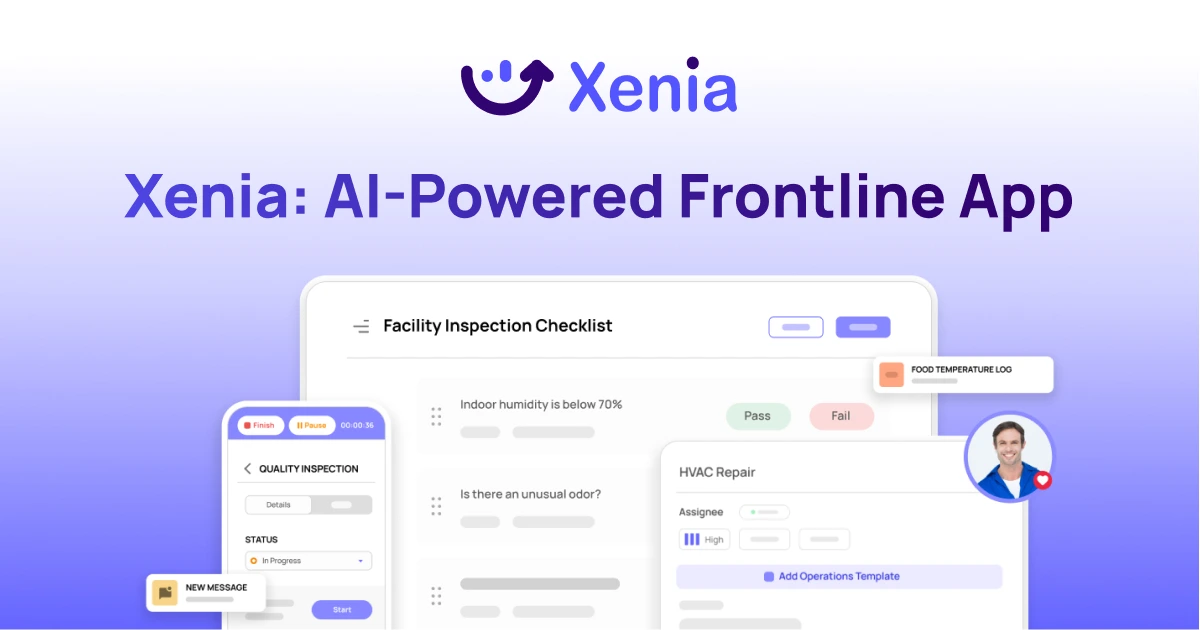
Why Multi-Location Operators Choose Xenia:
🤖 AI-Powered Operations, Create digital checklists instantly or convert paper forms with AI. Verify compliance automatically with photo analysis and get instant answers from your operational data.
✅ Daily Operations & Maintenance, Assign work across hundreds of locations in minutes. Report and route issues instantly. Schedule preventive maintenance to catch problems before downtime.
📊 Real-Time Visibility, Track completion, work orders, and performance across all locations through dashboards. Filter by site or asset to spot trends and take action.
Manage operations, maintenance, and compliance across all your locations from one platform

.svg)
.webp)
%201%20(1).webp)

.svg)
%201%20(2).webp)