
Post Summary
The platform launched on a Tuesday. By week four, adoption sat at 60 percent.
Not because the software was bad. Not because the rollout plan was wrong. Because the announcement went out via WhatsApp. The same WhatsApp group where shift schedules, urgent callouts, and vendor complaints all compete for the same eyeballs. Nobody read it. Or they read it and forgot. Or they read it, did not know what to do next, and kept doing what they were already doing.
This is how most operations platform rollouts die. Not in a dramatic failure. In a slow fade where nobody formally gives up. They just quietly keep using the old tools.
Change management for technology adoption in multi-unit frontline operations has a specific structure.
This article maps it. It explains why the communication problem is both the reason you need a new platform and the biggest obstacle to launching it, and shows what a rollout that actually reaches frontline teams looks like in practice.

.svg)

Priced on per user or per location basis
Available on iOS, Android and Web


Related Resources
- How deskless worker communication breaks down across multi-location operations
- Strategies for effective frontline employee communication
- How multi-unit restaurant groups manage operations execution
- Restaurant operations tool consolidation: building the case for a single platform
- How frontline employee training connects to platform adoption
Why do multi-unit platform rollouts fail before they start?
The failure usually begins before a single employee logs in.
Here is what typically happens. The ops team selects a platform. They run demos. They sign the contract. Then they announce the rollout through the same fragmented channels they are trying to replace. WhatsApp message to the GMs. Email to the district managers. Maybe a PDF.
The GMs forward the WhatsApp to their team groups. A few people see it. Most do not. The ones who see it do not know what it means for their daily routine. Nobody explains what changes on Monday.
Four weeks later, the platform shows 60 percent adoption and nobody can explain why 40 percent of the frontline team never logged in.
Ops leaders at multi-brand franchisee groups describe the same pattern. They post an update. They hope people saw it. They find out weeks later that half the team never got the message. Not because the information was unclear. Because there was no mechanism to confirm it was received.
That is the real issue. Frontline staff are not resistant to technology. The announcement just never reached them in a way that required a response. No read receipt. No acknowledgment. No feedback loop. The rollout happened to them, not with them. And no, Just a thumps up on the notification is not enough.
The silent failure is the worst kind. Nobody escalates because adoption metrics look acceptable on paper. The platform is technically live. Most people are technically using it. The 40 percent who are not become invisible until someone asks the wrong question in the wrong meeting.
What is the communication overload problem your platform is supposed to solve?
Here is the paradox almost every multi-unit ops rollout runs into.
The reason you need a new platform is that frontline communication is fragmented across WhatsApp, email, Teams, and Slack, with high-priority updates buried under routine messages and no way to confirm anyone actually read what they needed to read.
The reason your rollout is at risk is exactly the same thing. You are announcing your solution in the channels it is designed to replace. The announcement competes with everything else. It gets buried. It does not reach the right people. It generates no confirmation.
Here is what fragmented deskless worker communication looks like in most multi-unit operations:
**
Channel, What it gets used for, The problem
WhatsApp group, Everything, High-priority lost in noise
Email, Corporate announcements, Frontline staff rarely check it
Team group chat, Shift coordination, No targeting-no read receipts
Verbal handoff, Critical updates, No record-breaks at every level
Printed notices, Policy changes, Ignored-lost-outdated
**
Across 40 locations, that fragmentation means 40 separate chat groups with no unified view. A critical food safety update goes to 40 WhatsApp groups. Whether it was read in each one depends entirely on whether the GM happened to see it and forward it before the relevant shift started.
No read receipts. No role-based targeting. No confirmation.
The frontline worker communication app problem is not a technology gap. It is a structural one. Your change management plan for software implementation has to account for this. You cannot use broken channels to fix broken channels. The rollout needs a different communication path.
Understanding how deskless workers actually receive and act on communications is the foundation of any rollout that sticks.
How do you sequence a frontline operations platform rollout?
Operators who get adoption right do not launch everywhere at once. They build momentum in a sequence that produces visible proof before asking the rest of the organization to change.
Phase 1: Pilot at two to three locations with GM champions
Choose locations where the GMs are engaged and willing to give real feedback. The goal of the pilot is not perfection. It is a concrete data point you can show the rest of the organization. When a GM at a pilot location tells their peers that the platform reduced the number of WhatsApp messages they deal with each day, that lands harder than any case study.
Decide on your metrics before the pilot starts.
**
Metric, What it measures
Weekly active users, Platform engagement by location
Task completion rate, Ops execution consistency by shift
Message read rate, Communication channel effectiveness
Login frequency, Whether habit formation is happening
**
Phase 2: Comms migration, replace WhatsApp with the platform channel
This is the step most rollouts skip, and it is why adoption stalls. If the platform becomes an additional channel on top of WhatsApp, GMs and frontline staff keep using WhatsApp because everyone else is still there.
The migration has to be deliberate. The platform channel becomes the channel for ops communications. WhatsApp stays for personal use. That boundary gets communicated clearly, enforced consistently, and modeled by district managers first.
The framing that works with frontline teams is not "we are launching a new platform." It is "we are getting rid of the thing that makes your job harder."
Operators who have done this successfully position the rollout as a removal, not an addition. You are taking away the fragmented chat groups, the PDF guides nobody reads, the follow-up calls asking whether someone completed a task.
The platform is what replaces all of that. That message lands differently than a corporate mandate.
Phase 3: Full rollout with in-app training
By the time you reach full rollout, pilot locations are demonstrating adoption. The comms migration has started. Training happens inside the platform, not in a PDF attached to an email nobody opens.
Adoption targets for week 8:
**
Metric, Target
Weekly active users, Above 80% of total users
Task completion rate, Above 90% of assigned tasks
Message read rate, Above 85% per announcement
Login frequency, Daily for frontline-multiple times daily for GMs
**
What does frontline team resistance actually look like, and what addresses it?
Resistance in frontline teams is rarely philosophical. Nobody is opposed to a better tool in principle. The resistance is practical and specific.
"This is another app on top of everything else." This objection is legitimate when the platform gets added to an existing stack. It disappears when the platform replaces something. The rollout framing matters. You are not giving frontline teams another thing to manage. You are removing the thing already making their work harder.
GM skepticism about the value. GMs are the critical middle layer in any frontline platform rollout. If they are skeptical, their teams will be too. The fastest way to address this is to show GMs a specific reduction in their own admin load. Fewer follow-up calls to check whether a task got done. Fewer WhatsApp messages asking whether someone read the update. When a GM sees that in week two of the pilot, skepticism tends to go away.
Silent non-adoption that is invisible until it is a problem. Staff log in once, find the platform confusing, and quietly revert to old habits. Nobody flags it. Location-level adoption tracking surfaces these non-adopters in week two rather than week eight. That is the difference between a fixable problem and a permanent one.
For a broader view of how task accountability connects to this, how multi-unit restaurants manage task completion across locations shows what that visibility makes possible at scale.
Frontline confusion about what to do. Most rollout training comes through emails, PDF guides, or a one-time session half the team misses. None of that works for deskless workers. Training that lives inside the platform, attached to the first tasks people need to complete, works because it meets them where they already are.
What does successful platform adoption look like at week 8?
Week eight is a useful benchmark. Long enough for habit formation, short enough to course-correct if adoption is behind.
Successful frontline platform adoption at week eight looks like this:
- GMs use the platform channel for ops communications instead of their personal phones
- The WhatsApp group for operational updates is archived, not supplemented
- When a district manager needs to confirm a food safety update reached every location, they check the read receipt dashboard instead of calling five GMs
- Frontline staff complete tasks without reminder calls, and completion data is consistent across shifts, not just on days when the GM is present
- The district manager sees adoption rates by location without asking anyone
This is what multi-unit platform launch success looks like in practice. Not a launch event. A behavior change that holds at week eight and beyond. The operational side of what that consistency enables is covered in detail in how multi-unit operations execution works across locations.
How does Xenia support frontline communications and platform adoption?
Xenia is built specifically for this rollout problem.
The dedicated ops communication channel replaces WhatsApp for operational updates. Every announcement shows read receipts by person and location. Role-based targeting means kitchen managers get food safety updates, not every message sent across the org.
Rollout launch comms go through the platform itself. Staff see the announcement at first login. It does not compete with personal messages for attention.
The admin dashboard tracks adoption by location in real time. Silent non-adoption surfaces in week two, not week eight. In-app training attaches to the first tasks new users need to complete. Nobody falls through because they missed a session.
Book a demo with your rollout timeline in mind and see how Xenia handles the communication problem and the adoption problem at the same time.

Conclusion
Most operations platform rollouts do not fail because the technology is wrong. They fail because the announcement got buried, nobody confirmed receipt, and frontline staff had no reason to change a habit that already worked.
The communication problem is the adoption problem. They are the same thing.
Fix the channel. Announce through the platform. Track adoption by location. Show GMs what gets easier for them in week two. Replace the fragmented channels instead of adding to them.
Xenia is built for that rollout. Read receipts, role-based targeting, in-app training, and location-level adoption tracking so you know what is working before it is too late to fix it.
See how Xenia handles the rollout and the communication problem at the same time.
Frequently Asked Questions
Got a question? Find our FAQs here. If your question hasn't been answered here, contact us.
How does change management for software implementation differ across restaurant, retail, and c-store teams?

The mechanics are the same. The timing and content differ. Restaurants have high turnover and shift-heavy schedules. Retail tends to have more locations. C-stores run leaner with overnight exposure. Adjust your pilot selection and training content accordingly, but the core problem is identical across all three.
What role does role-based message targeting play in frontline adoption?
A significant one. When frontline staff receive every message sent to every role, they stop reading. Noise kills engagement. A kitchen manager should get food safety updates, not facilities alerts. Relevance drives read rates.
How do you stop managers from running two systems in parallel during the transition?
Set a hard cutoff date when the old channel stops being used for ops communications. The parallel period is where rollouts go to die. If both systems work, people stay with the one they already know.
What is the right pilot size before a full multi-unit platform launch?
Two to three locations. Pick ones with engaged GMs who will give honest feedback, not your best-performing stores. You want real data, not a showcase.
How do you roll out a new platform to staff who work rotating shifts?
Build the rollout around the platform, not a meeting. In-app announcements at login, training attached to the first tasks assigned, and completion tracking by user mean the rollout reaches people shift by shift without requiring everyone in the same room.


A Modern, AI-Powered Platform Built Specifically for Frontline Operations
Xenia brings daily operations, maintenance, audits, and compliance into one mobile-first platform. Frontline teams execute work consistently across locations while leadership gets real-time visibility.
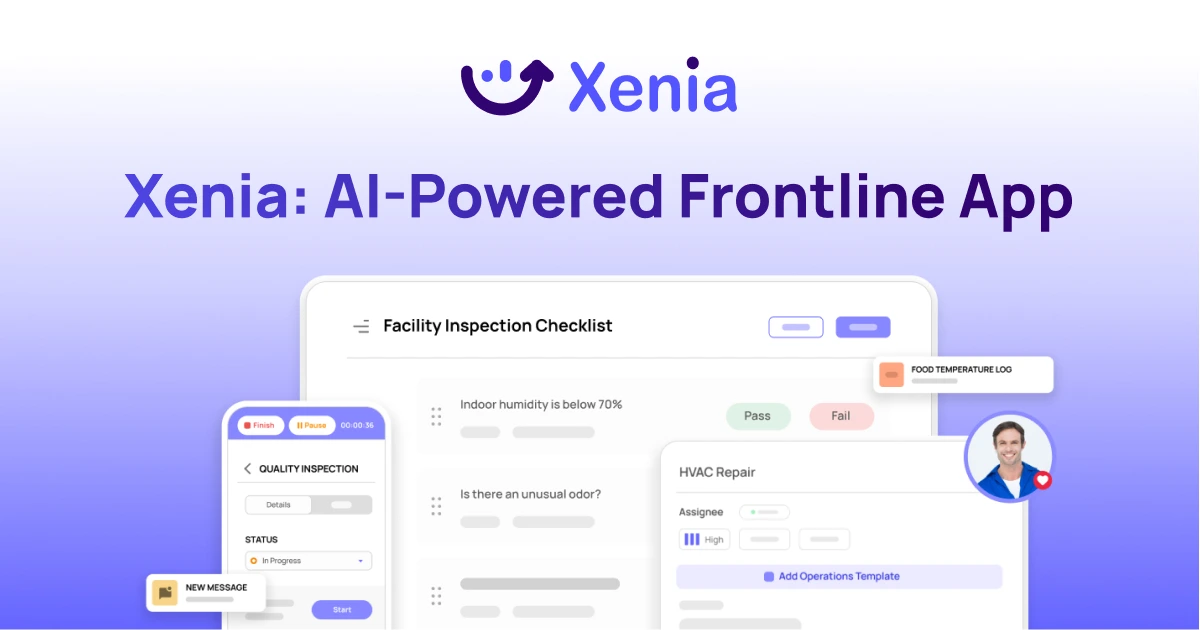
Why Multi-Location Operators Choose Xenia:
🤖 AI-Powered Operations, Create digital checklists instantly or convert paper forms with AI. Verify compliance automatically with photo analysis and get instant answers from your operational data.
✅ Daily Operations & Maintenance, Assign work across hundreds of locations in minutes. Report and route issues instantly. Schedule preventive maintenance to catch problems before downtime.
📊 Real-Time Visibility, Track completion, work orders, and performance across all locations through dashboards. Filter by site or asset to spot trends and take action.
Manage operations, maintenance, and compliance across all your locations from one platform

.svg)
.webp)
%201%20(1).webp)

.svg)
%201%20(2).webp)