

.webp)
Post Summary
Payroll runs on a Friday. Three locations come in over budget.
Nobody flagged it during the week.
Two employees hit overtime. One crossed the ACA 30-hour threshold and is now benefits-eligible. The business did not plan for either. All of it was sitting in timesheets that went unreviewed for two weeks.
This happens more than most operators realize. One location, it is a minor variance. Fifty locations, it is a payroll problem that compounds every single pay period until someone finally runs the numbers.
This guide covers what a timesheet is, the types every multi-unit operator needs to know, what goes in one, how the approval process works, and where most timesheet systems break down when you are running teams across multiple locations.
.webp)
.svg)

Priced on per user or per location basis
Available on iOS, Android and Web


What is a timesheet?
A timesheet is a record of the hours an employee worked during a specific period. It captures when work started, when it ended, how long breaks ran, and who signed off before the data went to payroll.
That last part matters. A timesheet without an approval is not a reviewed document. It is just a form that exists.
For frontline operators specifically, timesheets are not an HR formality. They are the data source that answers four questions payroll depends on:
- Were the hours right?
- Was overtime authorized?
- Did anyone cross the ACA 30-hour threshold?
- Is break compliance documented if a labor complaint comes up?
Get those four questions wrong and the cost shows up in payroll, in compliance risk, or in benefits you did not budget for.
Timesheet vs time card: what is the difference?
People use these terms interchangeably. They are not the same thing.
A time card records clock-in and clock-out for a single shift. A timesheet aggregates shift data across a full pay period and produces the total hours summary that payroll acts on.
Think of it this way. A time card is a single entry. A timesheet is the complete record.
What does a timesheet track?
**
What timesheets track, What that data is used for
Shift start and end times, Gross pay calculation
Break duration, Overtime identification
Total hours per day, ACA threshold monitoring
Total hours per pay period, Break compliance documentation
Location worked, FLSA recordkeeping
Manager approval status, Payroll authorization
**
If you need to calculate weekly hours, overtime, and gross pay from timesheet data, use the free timesheet calculator.
Types of employee timesheets
Not every format works for every operation. The right type depends on how your workforce is scheduled and how your payroll cycles run.
Here are the five types of employee timesheets every operator needs to know.
Daily timesheet
A daily timesheet captures one employee's hours for a single day. It works well for operations that need to review labor costs shift by shift. High-volume restaurants tracking covers per labor hour, for example.
The tradeoff is volume. Approving a daily timesheet for every employee across 20 locations adds up fast. For most multi-unit operators, daily timesheets make sense as a supplemental record, not the primary format.
.webp)
Weekly timesheet
This is the most common format for hourly frontline teams.
A weekly timesheet covers a standard Monday-to-Sunday workweek and totals all shift hours across that period. It aligns with the FLSA's workweek definition, which makes overtime tracking clean. Any employee who breaks 40 hours owes overtime, and the weekly total makes that visible before payroll runs.
For most restaurant, retail, and c-store operators, this is the default format.
.webp)
Biweekly timesheet
A biweekly timesheet covers two consecutive workweeks. Common when payroll runs every other week.
One thing operators get wrong with this format: overtime is calculated per workweek, not per pay period. A biweekly timesheet showing 75 total hours tells you nothing about whether overtime was hit in week one, week two, or both. You still need to review the weekly breakdown separately.
.webp)
Monthly timesheet
Monthly timesheets rarely work for frontline hourly teams. They are more common for salaried exempt employees or contract workers.
For an operator running 300 hourly employees across 40 locations, a monthly format creates too long a gap between when shifts happened and when a manager reviews them. A problem from week one does not surface until week four.
.webp)
Shift-based timesheet
This is the format that actually matches how frontline operations run. It is also the one most timesheet guides completely ignore because they are written for agencies and freelancers, not floor teams.
A shift-based timesheet records clock-in, clock-out, and break time for a single shift. No task codes, no project billing, no client allocations. Just time on the floor, time on break, and total hours worked.
For multi-unit operators, this format matters for three specific reasons:
- Overtime tracking at both the shift level and the weekly level
- ACA threshold monitoring for variable-hour employees whose weekly hours fluctuate
- Break compliance documentation in the 21 states that mandate meal and rest periods
There is one more thing the shift-based format handles that a weekly summary cannot. When an employee picks up shifts at two different locations in the same pay period, every shift is tied to the right store. That is how you allocate labor costs accurately.
The weekly format tells you an employee worked 44 hours. The shift-based format tells you they hit 44 hours across six shifts at two locations, with one shift that ran 10 hours. That detail changes how a manager responds. Approving a number is very different from understanding what produced it.
For more on how to build schedules that track these patterns before they become payroll problems, our workforce scheduling guide shows how to catch labor cost issues in real time.
.webp)
Timesheet types at a glance
**
Type, Period covered, Best for, Main limitation
Daily, One day, High-volume single-unit operations, High approval volume at scale
Weekly, 7 days (Mon-Sun), Most hourly frontline teams, None for most operators
Biweekly, 14 days, Operations with biweekly payroll, Requires separate weekly OT review
Monthly, 30 days, Salaried or contract workers, Too slow for frontline hourly teams
Shift-based, Per shift, Multi-unit frontline operators, Needs aggregation for payroll totals
**
Paper vs digital vs automated timesheets
The format you use determines how much visibility you actually have.
**
Format, How it works, Best for, Key risk
Paper, Handwritten entries-physical signature, Single-location with simple schedules, No visibility between submission and payroll. Errors go undetected
Digital (spreadsheet), Employee fills in a template-emailed to manager, Small teams-early-stage operations, Version control breaks across locations. No automated alerts
Automated, Time captured at clock-in/out. Approval workflows triggered automatically, Multi-unit operators at scale, Requires upfront system setup and employee onboarding
**
Paper and spreadsheet timesheets are fine for one location. The problem is structural.
When you have 50 locations, each with 8 to 15 hourly employees, there is no system alerting you when a manager misses the approval window. No flag when someone crosses 30 hours. No audit trail proving approval actually happened. You find out when payroll runs.
Automated timesheets fix this by capturing time at the source. The approval workflow is built into the process. The manager does not need to remember to review. The system surfaces what needs attention and escalates what goes unaddressed.
For a VP of HR or Operations Director running labor compliance across a portfolio, that is the actual difference between catching overtime before payroll closes and reconciling it after.
Electronic and digital timesheets sit in the middle. They reduce transcription errors and automate hour totals. But they still depend on a person remembering to send, review, and flag issues on time.
What should an employee timesheet include?
A frontline operator timesheet needs seven fields to be useful for payroll and compliance.
**
Field, Why it matters
Employee name and ID, Ties hours to the right person in payroll
Location worked, Essential for multi-unit cost allocation
Shift date, Establishes which workweek hours fall into
Clock-in and clock-out times, Required for FLSA recordkeeping
Break duration (unpaid), Documents compliance in states that mandate breaks
Total hours worked, The number payroll acts on
Manager approval status, Proof the record was reviewed before processing
**
Two fields that generic templates almost always miss: location worked and manager approval status.
The location field is redundant at a single store. At 30 stores, it is critical. An employee who works across two locations in the same pay period needs each shift tied to the right store for cost allocation, scheduling visibility, and daily overtime tracking in states like California.
Manager approval status is the other one. A timesheet without a documented approval has not been reviewed. It just exists. Those two things are not the same.
How the timesheet approval process works
The process has three steps. The problems happen between them.
Step 1: Employee submission
The employee submits their timesheet at the end of the shift or pay period. In a well-run system, this happens within 24 hours of the last shift. Late submissions are the first place the process breaks down. Without a hard deadline the system enforces, submissions drift.
Step 2: Manager review and approval
The manager reviews each entry before approving. That means checking clock-in and clock-out times, confirming break time is recorded, and verifying total hours match what was scheduled.
Approval is not a rubber stamp. It is the last checkpoint before labor data becomes payroll data.
Step 3: Payroll processing
Once approved, timesheets move to payroll. The data determines gross pay, overtime premiums, and applicable deductions. Errors caught here are expensive. Payroll corrections, potential manual payments, sometimes amended tax filings.
Where timesheet approvals break down at scale
The three-step process looks clean. Here is where it fails across dozens of locations.
Employees submit late or not at all. Without a hard system deadline, submissions drift. A manager chasing five late timesheets on payroll day is not reviewing them carefully.
Managers approve without reviewing individual entries. Processing approvals for 12 employees at the end of a long shift, bulk approval is the path of least resistance. Nobody checks the individual entries.
No escalation path when a manager misses the window. If a store manager is out sick on approval day and nobody else has authority to approve, the timesheets sit. Payroll either runs late or runs without them.
No visibility at district or corporate level until payroll has run. The variance shows up in the budget review, two weeks after the week someone should have caught it.
Timesheet compliance: what employers are required to track
FLSA overtime recordkeeping
The Fair Labor Standards Act requires accurate records of hours worked for all non-exempt employees. That includes:
- Start and end times for each workday
- Total hours per workday
- Total hours per workweek
Records must be retained for at least two years. The FLSA does not require a specific format, but records must be complete and accurate.
In a Department of Labor investigation, the employer bears the burden of proving accurate records were kept. Missing or incomplete timesheets shift that burden. Not in the employer's favor.
ACA 30-hour threshold
Under the Affordable Care Act, employees averaging 30 or more hours per week are considered full-time for benefits eligibility. For operators using variable-hour scheduling, common across restaurants, retail, and c-stores, timesheets are the only real-time data source for monitoring who is approaching that line.
The ACA uses a measurement period of three to twelve months to determine full-time status. That means weekly timesheet data needs to be tracked over time, reviewed at every payroll cycle. Catching an employee at 28 hours is a scheduling decision. Finding out they averaged 32 hours over the measurement period is a benefits obligation that was missed, and retroactive corrections are expensive.
For more details on how overtime classifications and exemptions work across different employee types, see our salary vs hourly pay guide that breaks down the federal tests and common misclassification risks.
Break compliance
21 states mandate meal breaks for hourly employees. California requires a 30-minute unpaid meal break for shifts over five hours. Several states require additional paid rest breaks on top of that.
The break duration field on a timesheet is the audit trail. If a labor complaint surfaces or a Department of Labor inquiry comes in, that field is how you document compliance. Without it, the burden of proof shifts to the employer.
This section is for operational awareness. Always consult employment counsel for guidance specific to your states of operation.
Timesheet best practices for multi-location teams
Running timesheets across a portfolio is a different problem than running them at one store. These five practices apply at scale.
Standardize the format across all locations.
One format everywhere is the baseline for any real visibility. If every store runs a different spreadsheet version, you cannot compare data across the portfolio. During audits, when a regulator asks for records from 12 locations, you want consistency, not 12 different interpretations of what a timesheet should look like.
Set submission deadlines with automated reminders.
Employees need to know when timesheets are due. Managers need a notification when a submission is late. A Friday 5 PM cutoff backed by an automated Thursday reminder produces far fewer last-minute problems than a soft deadline everyone assumes someone else is managing.
Require manager approval before payroll closes.
No approval, no payroll processing. That sequencing has to be built into the workflow. The stores where this slips are predictably the stores with the most recurring payroll variances.
Build overtime and ACA alerts into the review step.
By approval time, the manager should already see a flag if an employee is approaching 40 hours or 30 hours for the week. Catching it at approval is early enough to act. Catching it at payroll is not. Variable-hour employees are the most likely to cross thresholds without anyone noticing.
Audit timesheet data quarterly for patterns.
Chronic late submissions at one location signal a process problem. High overtime clusters point to scheduling issues. Employees consistently approaching the 30-hour line without crossing it may be actively managed, or they may not be tracked at all. Quarterly reviews surface these things before they become budget or compliance problems.
Best practices summary
**
Practice, What it prevents
Standardize format across locations, Inconsistent data-audit risk
Set hard submission deadlines, Late submissions-rushed approvals
Require manager approval before payroll, Unreviewed timesheets reaching payroll
Build OT and ACA alerts into approval, Missed thresholds-unplanned labor costs
Quarterly pattern audits, Chronic issues going undetected
**
Related Resources
- HR Workflows Software
- Operations Management Software
- Task Management for Frontline Teams
- Enterprise Workforce Management Guide
- Staff Management Checklist App
Conclusion
Timesheets are the data layer that determines whether payroll is right, whether overtime was caught before it ran, and whether compliance holds up if it is ever questioned.
Most operators already have some form of timesheet process. The problem is rarely that one does not exist. The problem is that it creates paperwork instead of visibility. Timesheets sit unreviewed. Approvals happen in bulk. Thresholds get crossed without a flag.
Xenia gives multi-unit operators the HR workflow infrastructure to manage timesheet tracking, approval routing, and labor visibility across every location in one place. If your current process depends on managers remembering to check and no one catching what they miss, see how Xenia handles it.
Frequently Asked Questions
Got a question? Find our FAQs here. If your question hasn't been answered here, contact us.
What is a shift-based timesheet?

A shift-based timesheet records clock-in, clock-out, and break time for a single shift. It is the most practical format for frontline hourly teams because it captures per-shift detail, including which location the shift was worked at. That makes it the right format for overtime tracking, ACA monitoring, and break compliance documentation across multiple locations.
What is an automated timesheet?
An automated timesheet captures time data at clock-in and clock-out and triggers approval workflows automatically. Unlike paper or spreadsheet timesheets, it does not depend on manual submission or a manager remembering to review. For multi-unit operators, automated timesheets provide real-time visibility into hours across every location before payroll runs.
Are employers legally required to keep timesheet records?
Yes. The FLSA requires accurate records of hours worked for all non-exempt employees, retained for at least two years. No specific format is required, but records must be complete and accurate. Many states add recordkeeping requirements on top of the federal baseline.
How does the timesheet approval process work?
The employee submits after the shift or pay period ends. The manager reviews each entry and approves before payroll closes. Payroll processes the approved data. The most common failure points are late submissions, bulk approvals without individual review, and no escalation path when a manager misses the deadline.
What should be included in an employee timesheet?
At minimum: employee name and ID, location worked, shift date, clock-in and clock-out times, break duration, total hours worked, and manager approval status. The location field is most important for employees who work across multiple sites in the same pay period.
What is the difference between a timesheet and a time card?
A time card records clock-in and clock-out for a single shift. A timesheet aggregates that data across a full pay period and produces the total hours summary payroll uses to calculate wages.
What is the purpose of a timesheet?
A timesheet records hours worked during a pay period. For employers it does three things: calculates gross pay accurately, documents hours for FLSA compliance, and tracks overtime and ACA threshold data before payroll runs.

A Modern, AI-Powered Platform Built Specifically for Frontline Operations
Xenia brings daily operations, maintenance, audits, and compliance into one mobile-first platform. Frontline teams execute work consistently across locations while leadership gets real-time visibility.
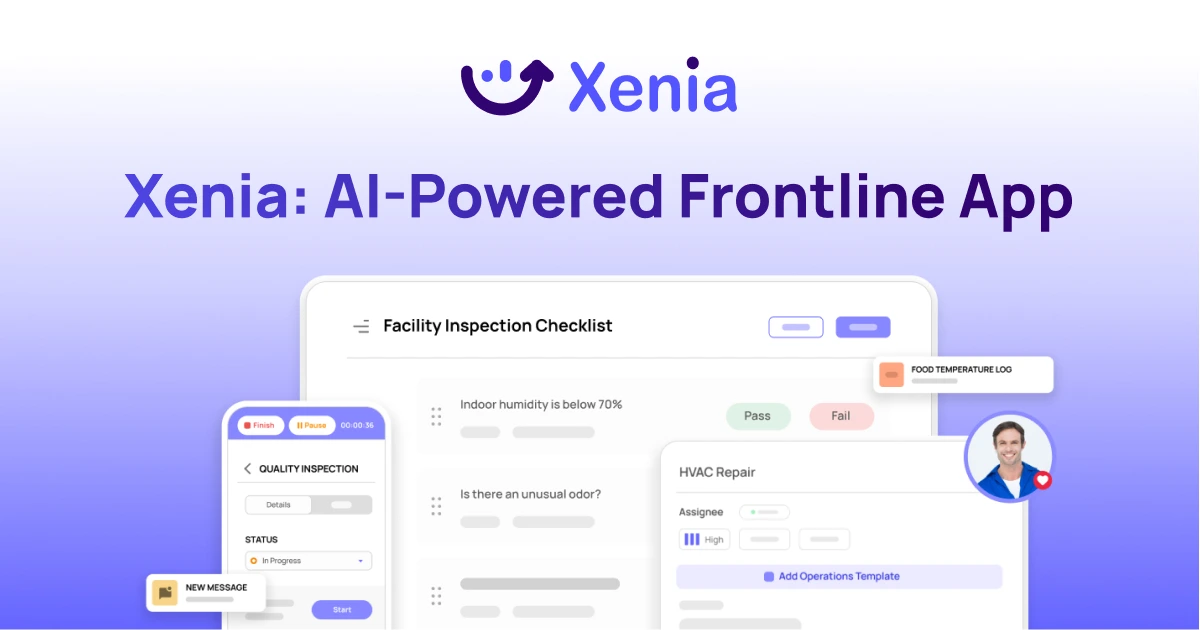
Why Multi-Location Operators Choose Xenia:
🤖 AI-Powered Operations, Create digital checklists instantly or convert paper forms with AI. Verify compliance automatically with photo analysis and get instant answers from your operational data.
✅ Daily Operations & Maintenance, Assign work across hundreds of locations in minutes. Report and route issues instantly. Schedule preventive maintenance to catch problems before downtime.
📊 Real-Time Visibility, Track completion, work orders, and performance across all locations through dashboards. Filter by site or asset to spot trends and take action.
Manage operations, maintenance, and compliance across all your locations from one platform

.svg)
.webp)
%201%20(1).webp)

.svg)
%201%20(2).webp)