

Post Summary
Audits used to feel like punishment. Clipboards. Checklists. Someone pointing out what went wrong last month.
That model is dead.
In 2026, operational audits aren’t about catching mistakes after damage is done. They’re about finding friction before it slows growth. They act less like police and more like diagnostics, showing where execution breaks down, where teams struggle, and where margins quietly leak.
The fastest-growing multi-unit businesses don’t audit to control people. They audit to scale operations without chaos.
This guide explains what operational audits are, why they matter now, the different types of operational audits, and how AI transformed operations auditing from a periodic task into continuous assurance.
.svg)

Priced on per user or per location basis
Available on iOS, Android and Web


What Is an Operational Audit?
An operational audit evaluates how effectively a business executes its day-to-day processes.
Not finances. Not compliance alone. The complete operations.
An operations audit asks practical questions:
- Are teams following standard processes?
- Where do delays, errors, or waste occur?
- Which steps slow service, reduce quality, or increase cost?
- Are systems supporting execution or getting in the way?
Operational audits definition (2026):
A structured evaluation of business processes, people, and systems to identify inefficiencies, execution gaps, and improvement opportunities in real time.
Operational auditing focuses on how work actually happens, not how it’s supposed to happen on paper.
What Is the Operational Audit Purpose?
The purpose of an operational audit is to improve performance, not to assign blame.
Specifically, operational audits help businesses:
- Identify process bottlenecks before customers feel them
- Reduce waste (time, labor, inventory, food)
- Standardize execution across locations
- Improve training effectiveness
- Protect margins as scale increases
In multi-unit operations, small inconsistencies compound fast. One skipped step. One unclear handoff. One workaround that becomes a habit.
Operations auditing makes those invisible problems visible, early.
Operational Audits vs Financial Audits
These are often confused. They serve different purposes.
Financial audits verify the accuracy of financial records.
They answer: Are the numbers correct?
Operational audits verify execution quality.
They answer: Are we operating the right way to achieve results?
**
Financial Audit, Operational Audit
Historical, Ongoing
Backward-looking, Forward-looking
Compliance-focused, Performance-focused
Finance-led, Operations-led
Annual or quarterly, Daily or continuous
**
A business can pass a financial audit and still struggle operationally. That’s why growth stalls even when revenue looks healthy.
The 7 Types of Operational Audit Examples
Most businesses don’t fail because of one big mistake. They fail because of small execution gaps repeated thousands of times.
That’s why mature operators don’t run a single operational audit. They run multiple audit types, each designed to expose a specific kind of operational risk.
Each type answers a different question:
- Are teams following the process?
- Is the process even workable?
- Are systems helping or slowing execution?
- Is performance improving or just being reported?
Below are the seven most common types of operational audits used by high-performing businesses in 2026, and what each one actually uncovers.
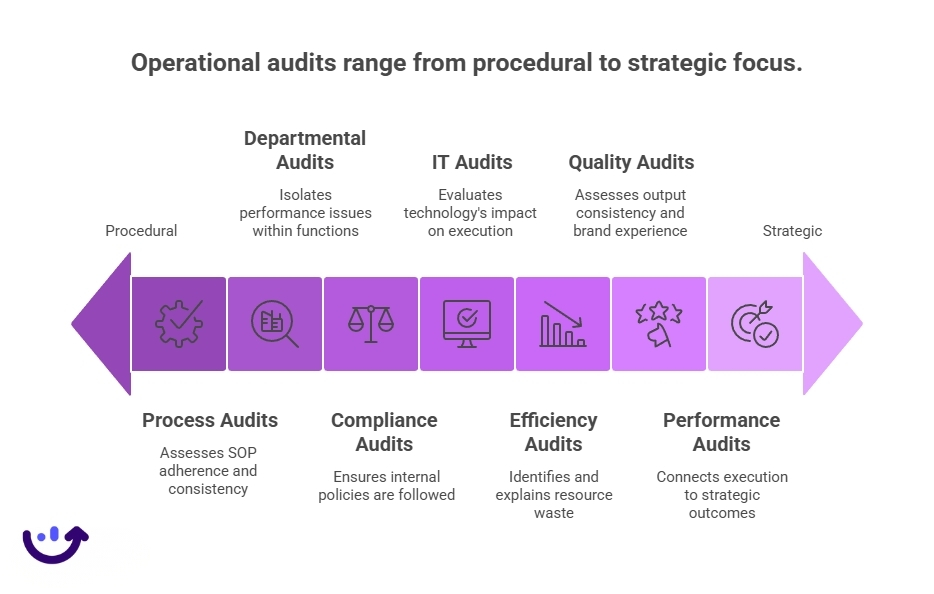
1. Process Audits
What process audits evaluate
Process audits assess whether standard operating procedures (SOPs) are followed consistently and in the correct sequence.
This isn’t about whether a task was completed.
It’s about how it was completed.
Typical questions process audits answer
- Are steps skipped when stores are busy?
- Are teams improvising because SOPs don’t match reality?
- Are shortcuts becoming informal standards?
Example of a process audit
Opening and closing routines across 42 locations show a 95% completion rate. But time-stamp analysis reveals that key prep steps are often completed after customer-facing tasks begin, creating downstream delays.
What process audits usually uncover
- Steps that exist on paper but not in practice
- Workarounds that indicate broken processes
- Overly complex procedures that teams can’t realistically follow
Process audits are often the first place execution drift appears.
2. Departmental Audits
What departmental audits evaluate
Departmental audits focus on execution within a specific function, rather than across the entire operation.
They isolate where performance breaks down by role, team, or responsibility.
Common departmental audits
- Kitchen or production operations
- Front-of-house or customer service
- Warehouse picking and packing
- Store replenishment and inventory handling
Why departmental audits matter
Overall store performance can look fine while one department silently underperforms. Departmental audits surface those blind spots.
Example of departmental audit
A store consistently misses service-time targets. A departmental audit reveals the issue isn’t front-of-house staffing; it’s prep delays inside the kitchen during peak delivery windows.
Departmental audits turn vague performance issues into specific, fixable problems.
3. Compliance Audits (Operational Scope)
What compliance audits evaluate
Operational compliance audits ensure internal policies are followed, not just legal or regulatory requirements.
This includes rules designed to reduce risk, loss, or inconsistency.
Typical focus areas
- Return authorization procedures
- Manager approval thresholds
- Cash handling and till management
- Equipment inspection routines
Why this matters
Most operational risk doesn’t come from rule-breaking. It comes from inconsistent rule-following.
Example
Returns over $50 require manager approval. Audit data shows approval is skipped 18% of the time during peak hours, increasing refund errors and fraud exposure.
This is where operational audits overlap with loss prevention and risk management, often before issues show up financially.
4. IT and Systems Audits
What they evaluate
IT and systems audits assess whether technology supports execution or quietly undermines it.
They answer a critical question:
Are we expecting people to work around our systems?
Common focus areas
- POS uptime and transaction failures
- Mobile app adoption and usage patterns
- Task completion delays tied to system friction
Example of IT and system audits
Audit data shows tasks assigned during peak hours are completed late, not due to staff behavior, but because the task interface requires multiple logins on shared devices.
Key insight
When audits flag “people problems,” systems audits often reveal the real cause.
Bad tools create bad behavior.
5. Operational Efficiency Audits
What operational efficiency audits evaluate
Operational efficiency audits focus on time, motion, and waste, where resources are lost during normal execution.
They directly connect audits to profitability.
Typical efficiency audit findings
- Food waste during prep or holding
- Labor spikes during poorly scheduled shifts
- Idle time caused by uneven task distribution
Example
An efficiency audit reveals prep overproduction during early shifts, leading to end-of-day waste. Adjusting batch sizes reduces food cost without affecting service speed.
Efficiency audits don’t just identify waste. They explain why it happens.
6. Quality Audits
What quality audits evaluate
Quality audits assess the consistency of output, not just task completion.
They protect brand experience at scale.
Common quality audit areas
- Product presentation and assembly
- Service steps and customer interaction
- Order accuracy and packaging
- Brand standards execution
Why they matter
Customers don’t experience your SOPs.
They experience the output.
Quality audits ensure execution translates into a consistent customer experience, especially across multiple locations.
7. Operational Performance Audits
What they evaluate
Operational performance audits connect execution to outcomes.
They answer the hardest questions:
- Why do some locations follow the process and still underperform?
- Which shortcuts actually hurt results?
- Which training interventions change behavior long-term?
Example of operational performance audit
Two stores follow identical procedures. One outperforms the other. Performance audits reveal differences in task timing and manager intervention, not compliance.
This is where operational audits become strategic, not procedural.
How to Build a Modern Operational Audit Program
High-performing operational audit programs don’t succeed because they audit more. They succeed because they audit with intent, structure, and feedback loops.
Modern operational auditing is a system, not a checklist. Each step builds on the previous one. If any layer is weak, the entire program degrades into box-ticking.
Here’s how mature organizations build audit programs that actually improve execution.
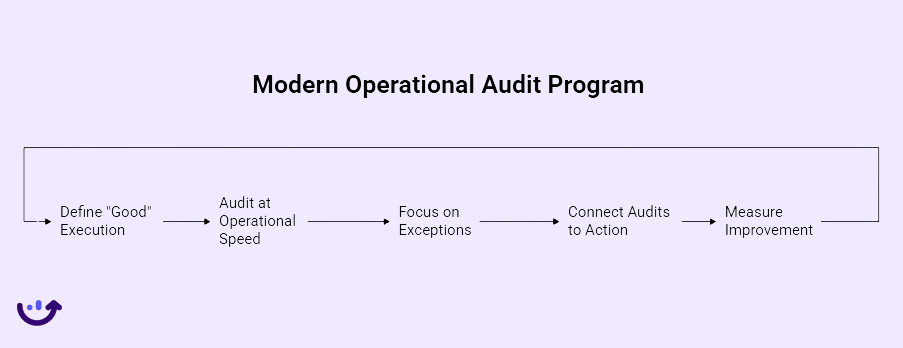
Step 1: Define What “Good” Looks Like
Every operational audit begins with a definition problem.
If “good execution” isn’t precisely defined, audits become subjective. Managers interpret standards differently. Scores vary by location. And audit results lose credibility.
What defining “good” really means
- Clear process outcomes, not vague instructions
- Unambiguous pass/fail criteria
- Visual or time-based standards where possible
- Alignment between corporate intent and frontline reality
Example
“Prep completed on time” is vague.
“Prep completed by 10:30 AM with all ingredients logged and stored at target temperature” is auditable.
If two managers can look at the same execution and disagree on whether it passed, the audit design, not the team, is broken.
To make these standards repeatable at scale, many teams rely on an operational audit checklist. A well-designed checklist translates “good execution” into clear, observable steps, so audits stay consistent across locations, shifts, and managers.
Step 2: Audit at Operational Speed (Daily, Not Occasionally)
Operations happen every day. Audits that run weekly or monthly observe history, not execution.
In modern environments, operational audits must move at the same cadence as the work itself.
Why daily auditing matters
- Issues are investigated while context is fresh
- Video, transaction, and system data are still available
- Teams remember what actually happened
- Corrections can occur before habits form
Waiting a week turns a fixable miss into normalized behavior.
Daily auditing doesn’t mean more manager workload. It means smarter filtering, which is where automation and AI matter.
Step 3: Focus on Exceptions, Not Exhaustion
Most execution goes right most of the time.
Traditional audits fail because they treat all checklist items as equally important. That creates audit fatigue and dilutes attention.
Modern operational audit systems work differently.
Exception-focused auditing means
- Routine compliance is cleared automatically
- Attention is directed only to deviations
- Patterns are prioritized over one-off misses
- Managers investigate what actually poses risk
Example
A task missed once is logged. The same task missed three times in five days triggers an investigation.
This approach preserves the manager's focus while improving signal quality.
Step 4: Connect Audits Directly to Action
An audit that ends in documentation is operational noise.
For audits to improve performance, findings must trigger immediate, visible action.
Modern operational auditing systems automatically connect findings to:
- Corrective tasks with deadlines
- Targeted training assignments
- Escalations based on severity or repetition
- Process updates when standards don’t reflect reality
Example
If an audit flags repeated cash handling errors:
- A corrective task is created
- The relevant employee is assigned refresher training
- The manager receives an escalation if the behavior persists
This closes the loop between observation and improvement.
Step 5: Measure Improvement, Not Completion
Completion rates are easy to measure and mostly meaningless.
A 100% completed audit program can still allow execution to deteriorate.
Modern audit programs measure behavioral and operational outcomes, not just activity.
What to measure instead
- Repeat deviation rates
- Time to resolution after an audit finding
- Performance improvement after training
- Reduction in waste, errors, or rework
- Correlation between audit trends and business KPIs
The goal isn’t to prove audits happened. The goal is to prove they changed execution.
Why Operational Audits Changed in 2026
Before 2026, operational audits were periodic and manual.
Manager completes a checklist once a week. The district manager reviews it two weeks later. Corporate sees trends at month-end.
By then, the damage is done.
AI changed everything. How?
Before AI: Auditors reviewed completed checklists.
After AI: Audits watch operations happen in real time.
What AI does differently?
- Analyzes completion patterns, not just completion status
- Detects deviations from normal behavior
- Flags risk before thresholds are crossed
- Learns what “good” looks like for each location
Instead of asking managers to review 100 checklist items, AI surfaces the five that actually need attention today.
That’s the shift from auditing to assurance.
Where Technology Fits
Manual audits cannot scale with multi-unit operations, daily execution, and increasing complexity.
Modern teams rely on real-time operational audit software to serve as the execution layer between standards and outcomes.
Modern audit platforms enable:
- Automated data collection
Audit data flows directly from systems, tasks, and frontline inputs, without manual consolidation. - Pattern detection across locations
AI compares execution behavior across stores, shifts, and roles to surface systemic issues. - Instant corrective actions
Findings automatically generate tasks, training, or escalations based on severity and repetition. - Closed-loop accountability
Every issue is tracked from detection to resolution, with learning captured for future prevention.
When audits are integrated with workflows, training, and analytics, they stop being reports and start becoming operational control systems.
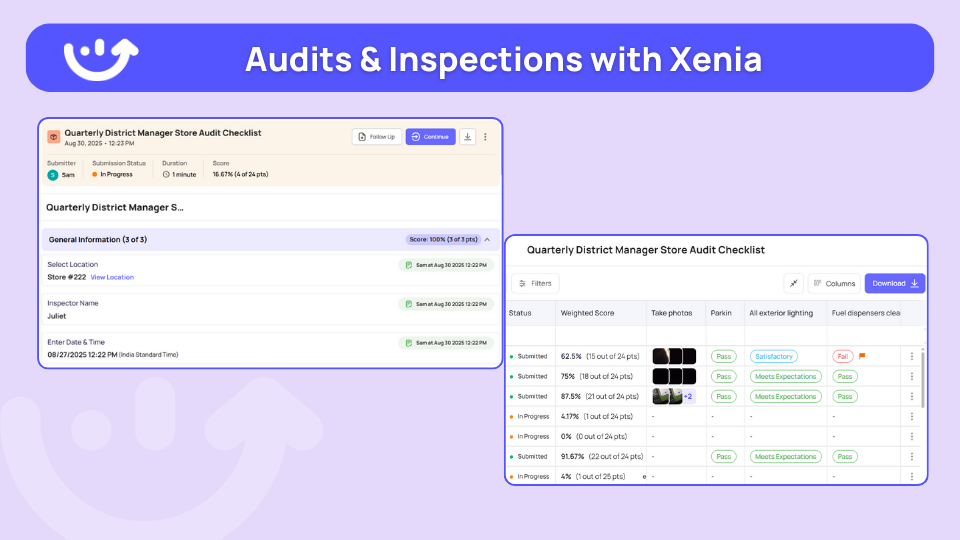
Platforms like Xenia combine real-time audits, automated corrective actions, and AI-driven analytics in a single mobile-first platform, ensuring that operational audits don’t just document problems, but actively prevent them.
FAQs
What are operational audits?
The operational audit meaning is about understanding how well a business runs its day-to-day operations. Operational audits look at efficiency, consistency, and performance across people, systems, and workflows, rather than focusing on financial numbers.
What is the difference between an operational audit and a financial audit?
A financial audit checks if the numbers are correct. An operational audit checks if the work is being done the right way. Financial audits look back at results, while operational audits focus on what’s happening on the floor, every day.
How do operational audits help identify bottlenecks and waste?
They show where processes break down in real life, steps that get skipped, tasks that take too long, or resources that get wasted. Because these audits run regularly, problems show up early, before they turn into higher costs or customer issues.
How is AI changing operational audits in 2026?
AI makes audits faster and more focused. Instead of reviewing long checklists, managers see only the issues that need attention. Patterns, exceptions, and risks are flagged automatically, so teams can fix problems while work is still happening.
How do operational audits for business growth help companies scale?
Operational audits for business growth help companies scale by making execution visible. They show where processes slow down, where teams struggle, and where small inefficiencies add up. By fixing these issues early, businesses can grow without losing consistency, control, or profitability.
What does an operations auditor do?
An operations auditor looks at how work is done day to day. They check if teams are following the right processes, spot inefficiencies, and help fix issues that slow teams down or affect performance.
How does an operational audit checklist support modern audits?
An operational audit checklist helps standardize what teams review while still allowing audits to focus on real risk. When connected to real-time data and actions, checklists guide audits without turning them into paperwork.
Conclusion
Operational audits in 2026 aren’t about filling out checklists or pointing out past mistakes. They’re about making sure the business runs the way it’s supposed to, every day, as it grows.
When teams don’t have visibility into execution, small problems turn into habits, and habits turn into lost time, wasted money, and inconsistent customer experiences.
That’s why many operators are moving away from manual, periodic audits. They need audits that run alongside daily operations, highlight what actually needs attention, and help managers act while issues are still easy to fix.
Tools like Xenia support this shift by bringing audits, tasks, training, and follow-up into one place. Instead of audits ending as reports, issues turn into actions, and actions turn into better execution. Managers spend less time reviewing checklists and more time fixing what matters.
For multi-unit teams, operational audits aren’t optional anymore. The real difference is whether audits slow teams down or help them scale with control and consistency.
Try Xenia and see how operational audits become easier to run and harder to ignore.
Frequently Asked Questions
Got a question? Find our FAQs here. If your question hasn't been answered here, contact us.

Looks like there's no data available in our FAQ section at the moment.

A Modern, AI-Powered Platform Built Specifically for Frontline Operations
Xenia brings daily operations, maintenance, audits, and compliance into one mobile-first platform. Frontline teams execute work consistently across locations while leadership gets real-time visibility.
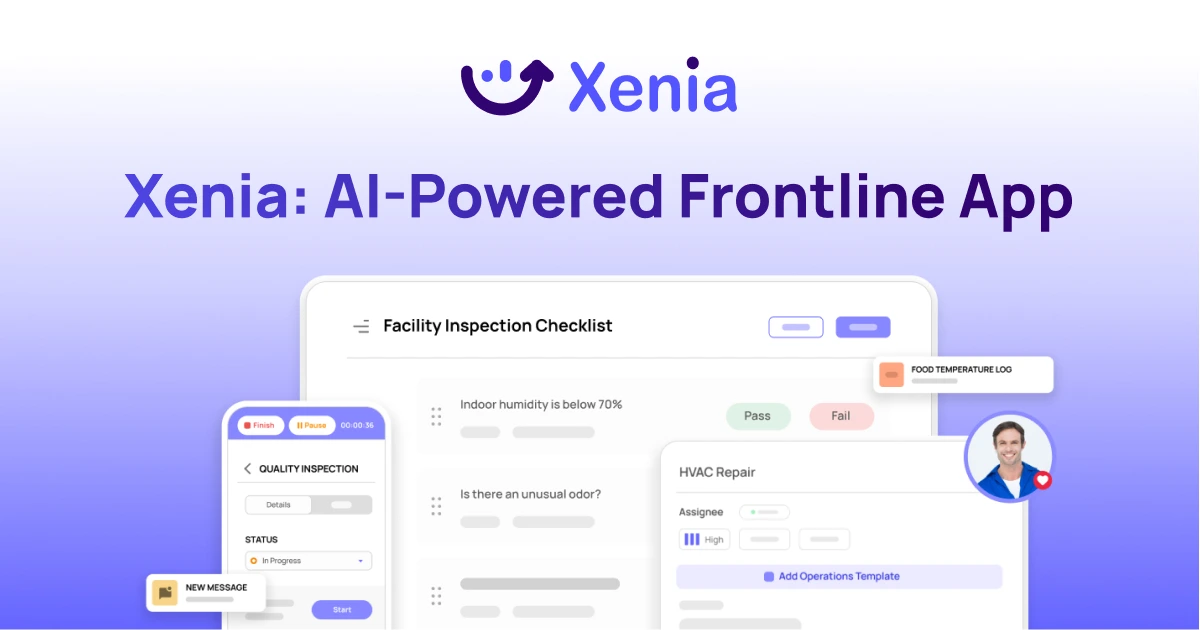
Why Multi-Location Operators Choose Xenia:
🤖 AI-Powered Operations, Create digital checklists instantly or convert paper forms with AI. Verify compliance automatically with photo analysis and get instant answers from your operational data.
✅ Daily Operations & Maintenance, Assign work across hundreds of locations in minutes. Report and route issues instantly. Schedule preventive maintenance to catch problems before downtime.
📊 Real-Time Visibility, Track completion, work orders, and performance across all locations through dashboards. Filter by site or asset to spot trends and take action.
Manage operations, maintenance, and compliance across all your locations from one platform

.svg)
.webp)
%201%20(1).webp)

.svg)
%201%20(2).webp)