
.webp)
Post Summary
A payroll manager at a 20-location restaurant group spends the last two days of every pay period chasing missing timesheets, fixing punch errors, and reconciling hours from four formats.
The work is done by hand. The errors are discovered after the fact. The same problems repeat every cycle.
This is not a people problem. It is a process problem. And it compounds with every location you add.
This article covers what automated timesheets are, how they work in frontline environments, what the shift from manual to digital looks like, and what the ROI looks like. If you need foundational context first, see what a timesheet is before reading further.
.webp)
.svg)

Priced on per user or per location basis
Available on iOS, Android and Web


What is an automated timesheet?
An automated timesheet captures employee time data without manual entry by the employee or manager.
Clock-ins, clock-outs, breaks, and shift assignments are recorded as work happens. The system compiles them into payroll-ready records automatically. No one needs to type anything in.
This is different from a digital timesheet that still requires someone to enter hours manually. Automation means the data flows in without a human touch. The clock event is the timesheet entry.
How the four main timesheet types compare:
**
Timesheet type, How hours get recorded, Manual input required, Error risk at entry
Paper timesheet, Employee writes hours by hand, Yes-employee and manager, High-at every step
Digital spreadsheet, Employee or manager types hours, Yes-manual entry, High-at entry
Digital timesheet app, Employee enters hours in an app, Yes-still manual, Medium-at entry
Automated timesheet, System records clock events automatically, No, Low-exceptions only
**
Three things automated systems capture:
- Clock events: exact time-in and time-out at the location
- Shift assignment data: which employee, which role, which site
- Break tracking: when breaks start, how long they run, and whether they meet compliance requirements
Automated timesheets do more than process payroll. They create an operational record of when employees were present, where, and for how long. That record has value beyond the pay period.
How manual timesheets break down at scale
Manual timesheet processes have four failure modes. They are manageable at one location. They compound across ten. And they become a full-time problem at twenty.
Submission delays hold up payroll
When managers submit timesheets on different schedules, payroll cannot start until the last one arrives.
In multi-unit operations, one late location delays the entire payroll run. The cost goes beyond wasted time. Rushed corrections after payroll closes are more expensive and more error-prone than clean submissions made on schedule.
Manual entry errors compound across locations
Transposed digits, missing punches, incorrect break deductions. Small errors individually.
Across 20 locations and 300 employees, they represent a consistent overpayment or underpayment problem that surfaces in audits, employee complaints, and labor cost overruns. Each correction requires time from both payroll and the manager who made the original error. The same errors, fixed the same way, every pay period.
No visibility until after the pay period closes
Manual processes give managers no view of hours accumulating in real time. By the time a manager sees the overage, the pay period is closed and the overtime is already owed.
Use a timesheet calculator to work through manual hour calculations. But the real fix is visibility before the period closes, not after.
Inconsistent formats across locations
Without a standardized system, each location manager develops their own format. Spreadsheet. Paper form. App screenshot. Text message.
Aggregating these into a single payroll input requires manual normalization every cycle. The formats change. The people change. The problem stays.
Where manual timesheets break down at scale:
**
Failure mode, Direct cost, How it compounds
Submission delays, Delayed payroll runs, One late location delays everyone
Entry errors, Overpayments-underpayments-corrections, Error rate multiplies by location count
No real-time visibility, Overtime discovered after it is worked, Every location is a blind spot
Inconsistent formats, Manual normalization every cycle, More locations = more formats to reconcile
**
How automated timesheets work for frontline teams
Here is how automation actually functions in a frontline hourly environment. Three capture methods, each described at the operational level. No technical jargon.
Mobile clock-in with location verification
Employees clock in and out on a mobile device with a GPS stamp or geofence that verifies physical presence. Their own phone or a shared tablet.
The system records the exact time and location automatically. No manager input required. No paper form to collect. The clock event is the timesheet entry.
This is the most common method for frontline teams across multiple sites. Simple for the employee. Automatic for the record.
QR scan-to-start for shift tasks
In operations that track task completion alongside time, a QR code scan at a workstation triggers both task start and time capture simultaneously.
The employee is marked present, their shift clock starts, and the task is assigned. All from a single scan.
For c-store and hospitality operations, this method closes the gap between attendance tracking and execution tracking. Employee accountability records that capture both time and task completion give managers a complete operational picture, beyond a basic clock-in log.
HRIS integration for automatic schedule matching
When the automated timesheet system connects to the scheduling tool and HRIS, scheduled hours and actual hours are matched automatically.
The system flags discrepancies instead of passing them through to payroll:
- An employee who clocked in 45 minutes early
- A shift that ran 2 hours over schedule
- A location where three employees clocked out before their scheduled end time
Managers review exceptions. They do not review every record. That is the operational shift that matters most at scale.
Use HR workflows that connect scheduling, time capture, and payroll so the data moves without manual intervention between systems.
For operations leaders managing clock-in systems across locations, understanding how location verification prevents time theft is essential. Our clock in clock out systems guide covers geo-fencing and mobile verification that creates audit-ready records automatically.
The shift from paper and spreadsheets to digital
What actually changes, what does not, and where operators get stuck.
What changes for employees
Instead of signing a paper timesheet or submitting hours via text, employees clock in on a mobile device or shared kiosk.
The behavior change is small. It is still a clock-in, just captured digitally. The adjustment period is short for frontline teams once the process is demonstrated once.
The main benefit for employees: they can see their own hours in real time. Discrepancies get flagged immediately instead of discovered on payday when nothing can be done.
What changes for managers
Managers stop collecting, compiling, and submitting timesheet data manually. Their role shifts from data entry to exception review:
- Review flagged discrepancies
- Approve adjustments
- Confirm hours rather than building the record from scratch
This is the biggest time-savings benefit at the manager level. The adjustment is behavioral as much as technical. Managers who are used to controlling the timesheet process sometimes resist the loss of that manual control. That resistance fades fast once they see how much time they get back.
What changes for payroll and operations
Payroll receives clean, structured data instead of a mix of formats requiring normalization. Hours are aggregated by location, by employee, and by role automatically.
Labor cost as a percentage of sales becomes visible in real time rather than retroactively. Frontline reporting that surfaces labor data in real time gives operations leaders the visibility to act before a cost problem becomes a payroll problem.
What changes at each level:
**
Who, Before automation, After automation
Employee, Fills in paper or app manually, Clocks in digitally-sees hours in real time
Manager, Collects-compiles-submits data, Reviews exceptions-approves adjustments
Payroll, Normalizes varied formats, Receives clean structured export
Operations leader, Sees labor cost after pay period closes, Sees labor cost in real time-by location
**
The ROI of automated timesheets for multi-unit operations
Four dimensions of return. The case for any VP of Operations or HR Director who needs to justify the investment internally.
Payroll processing time reduction
The most immediate return. When hours compile automatically and payroll receives a structured export rather than a stack of varied submissions, processing time drops measurably.
The reduction scales with location count. The more locations, the more time was being lost to collection and normalization. The more time is recovered.
Error-related cost recovery
Manual timesheet errors produce overpayments and underpayments. Overpayments are difficult to recover from employees. Underpayments create compliance exposure.
Automated capture eliminates entry errors at the source. Clock events are recorded at the moment they happen, not reconstructed from memory or paper hours later.
Overtime visibility before it happens
Automated systems show hours accumulating in real time. A manager who sees on Wednesday that three employees are already at 32 hours can adjust Thursday and Friday scheduling before overtime is triggered.
Manual processes make this impossible. By the time the hours are compiled, the overtime has already been worked and cannot be undone.
Compliance documentation at no additional cost
An automated timesheet system creates a timestamped, auditable record of every clock event as a byproduct of normal operation.
When a labor audit happens or an employee disputes their hours, the record exists and is retrievable. Manual systems require this documentation to be reconstructed, which is both expensive and unreliable.
ROI summary for multi-unit operators:
**
ROI dimension, Manual process cost, Automated process outcome
Processing time, Hours of collection and normalization per cycle, Structured export-no collection required
Error correction, Repeated corrections every pay period, Errors caught at entry-exceptions flagged
Overtime exposure, Discovered after pay period closes, Visible in real time-preventable
Compliance documentation, Reconstructed when needed-unreliable, Auto-generated as byproduct of normal operation
**
For district and regional leaders running payroll across locations, understanding how timesheets connect to overtime tracking is critical. Our timesheet guide covers documentation standards and approval workflows that create defensible audit trails.
Related resources
Conclusion
The last two days of every pay period do not have to be a recovery operation.
When hours compile automatically and payroll receives clean data instead of varied submissions, the cycle becomes a review process rather than a data collection exercise.
For multi-unit operators, that difference scales. 20 locations managed manually is a full-time problem. 20 locations on automated timesheets is a dashboard check.
The ROI is in the hours recovered, the errors eliminated, and the overtime caught before it is worked.
HR workflows that connect time capture, scheduling, and payroll eliminate the manual steps between systems. See how Xenia works to bring automated time tracking, accountability, and frontline reporting together in one place.
Frequently Asked Questions
Got a question? Find our FAQs here. If your question hasn't been answered here, contact us.
What is the difference between automated timesheets and time and attendance software?

Time and attendance is the broader category. It covers scheduling, time capture, absence tracking, and reporting. An automated timesheet is specifically the time capture component. Some platforms bundle both. Others focus on time capture alone.
How do they handle employees working at multiple locations?
Hours are tracked at the employee level, not per site. Both locations aggregate toward the weekly total. This is the correct approach under FLSA, which requires hours to be combined across all locations owned by the same employer.
What if an employee forgets to clock in or out?
The system flags the missing punch for manager review. The manager confirms the actual hours and approves a correction. The correction is logged. Faster and more accurate than reconstructing hours from memory.
Are automated timesheets legally compliant?
They support compliance by creating timestamped records and applying overtime rules automatically. The legal obligation still sits with the employer. Multi-state operators should verify that state-specific rules apply per location, not a single national standard.
Do automated timesheets work with ADP or QuickBooks?
Yes. Most systems connect directly with ADP, Workday, Paycom, QuickBooks, and Paylocity. Hours flow from time capture to payroll without anyone touching the data.

A Modern, AI-Powered Platform Built Specifically for Frontline Operations
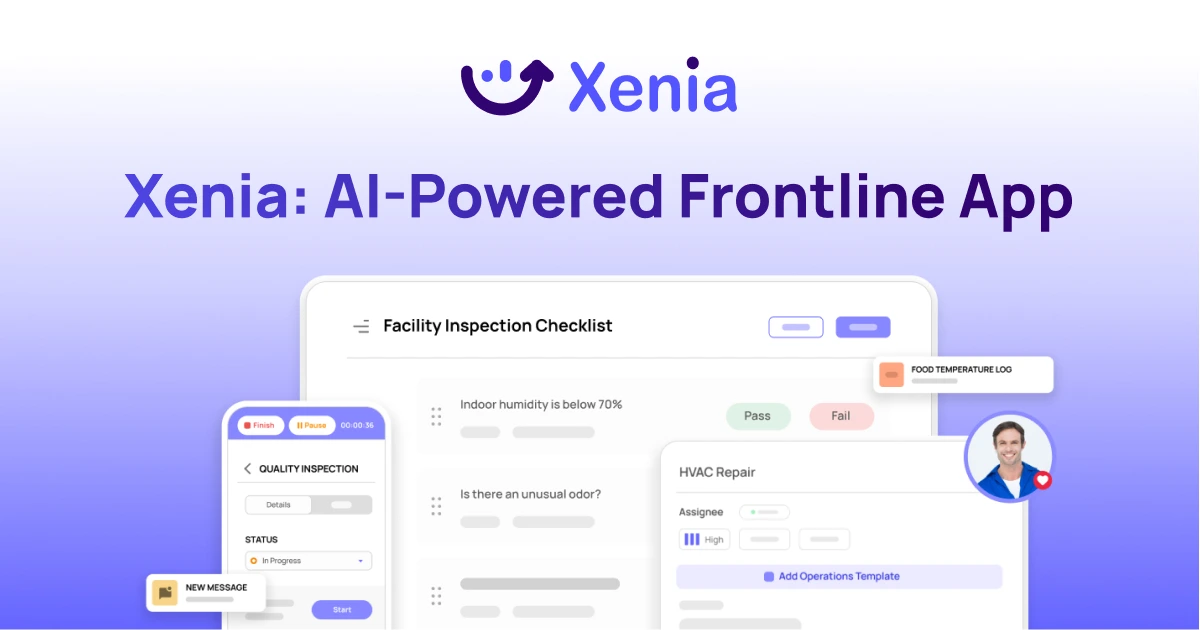
Xenia brings daily operations, maintenance, audits, and compliance into one mobile-first platform. Frontline teams execute work consistently across locations while leadership gets real-time visibility.
Why Multi-Location Operators Choose Xenia:
🤖 AI-Powered Operations, Create digital checklists instantly or convert paper forms with AI. Verify compliance automatically with photo analysis and get instant answers from your operational data.
✅ Daily Operations & Maintenance, Assign work across hundreds of locations in minutes. Report and route issues instantly. Schedule preventive maintenance to catch problems before downtime.
📊 Real-Time Visibility, Track completion, work orders, and performance across all locations through dashboards. Filter by site or asset to spot trends and take action.
Manage operations, maintenance, and compliance across all your locations from one platform

.svg)
.webp)
%201%20(1).webp)

.svg)
%201%20(2).webp)