
.webp)
Post Summary
The manager pulls up payroll on Monday morning. Everyone punched in on time.
Three locations ran short-staffed during peak hours. Someone clocked in from the parking lot. Two shifts had no supervisor on the floor for the first 45 minutes.
The time clock said everything was fine.
That is the gap. The punch gets recorded. What happens after the punch does not. For one location, that gap is manageable. For an operator running 30 or 50 locations, it is where labor costs and operational accountability quietly fall apart.
This guide covers what a clock in clock out system is, the five types every operator needs to know, how to set one up across multiple locations, where these systems break down at scale, and what the punch actually tells you versus what it does not.
.webp)
.svg)

Priced on per user or per location basis
Available on iOS, Android and Web


What is a clock in clock out system?
A clock in clock out system records when employees start and end work. That data feeds payroll, tracks attendance, and satisfies FLSA recordkeeping requirements for hourly workers.
The basic version is a punch clock on the wall. The modern version is a mobile app, a geo-fenced PIN entry, or a QR code scan tied to a specific station.
The difference that matters: a basic punch clock records presence. A modern employee clock in system can verify it. That gap is where buddy punching, remote clock-ins, and missed punches live.
Most employees clock in by entering a PIN, tapping a badge, scanning a QR code, or opening an app. The method you choose determines how much you can trust the record.
Types of clock in and out systems
The right system depends on your workforce, your locations, and how much verification you actually need.
**
System type, How it works, Best for, Main risk
Physical punch clock, Hardware terminal-location-fixed, Single sites with stable staff, No central visibility at scale
PIN or password-based, Employee enters a code at terminal or app, Restaurants-retail-fixed stations, Buddy punching. Anyone can enter someone else's PIN
Mobile clock in app, Employee punches in from their phone, Field teams-multi-site operators, Remote clock-ins without GPS
GPS and geo-fenced, Employee must be on-site to punch in, Multi-location operators, Requires smartphone and data access
Biometric or QR code, Fingerprint-face scan or station scan, High-turnover frontline environments, Higher setup cost
**
How to set up a clock in clock out system for frontline teams
Most articles on this topic list apps. This section covers what actually matters at portfolio scale: the setup decisions that hold when you are running dozens of locations.
Step 1: Choose the right method for your environment
Match the system to how your workforce actually operates.
**
Workforce type, Best clock in method
Field teams moving between sites, Mobile app with GPS verification
Fixed-site-predictable schedules, Geo-fenced PIN or QR
High-turnover with buddy punching risk, Biometric or QR scan-to-start
Single location-simple schedule, Physical punch clock or PIN
**
The mistake most operators make is choosing based on cost alone. A free clock in app that allows remote punches costs more in payroll errors than a verified system does upfront.
Step 2: standardize across every location
One system. One policy. Applied identically across all sites.
This is the step most operators skip when scaling. Location A uses a hardware terminal. Location B uses a staff clock in app. Location C still runs a paper sign-in sheet that gets transferred manually. When payroll runs, the data formats do not match and someone is reconciling by hand every week.
Inconsistent setups create payroll discrepancies and compliance gaps. Standardization is not optional at scale. It is the baseline for any real visibility across your portfolio.
If you're managing time tracking across a large multi-unit operation, our timesheet guide shows how to structure approval workflows that catch payroll errors before they reach processing.
Step 3: Set clear clock in and out policies
Your system is only as good as the rules around it. Every employee and every manager needs to know three things:
- How many minutes before shift start an employee is allowed to clock in
- What to do when they forget to clock out
- Who has authority to edit a punch and under what conditions
The "forgot to clock out" scenario is one of the most common payroll errors in frontline operations. Without a defined policy, managers guess at the out time, leave the punch open, or edit it without documentation.
Any of those creates a compliance risk. The policy needs to exist in writing and apply the same way at every location.
Step 4: Assign manager accountability for punch review
Clock in data is only as good as the review process behind it.
Missed punches and duplicate entries do not fix themselves. The manager at each location needs to review and approve punches before payroll closes, not after. That review step needs a hard deadline and a clear escalation path when the deadline is missed.
If a manager is out sick on punch review day and nobody else has approval authority, that location's payroll runs with errors or runs late. Define the backup before you need it.
Step 5: integrate with payroll
Manual transfer of time clock data into payroll is where errors compound the fastest. An employee's hours get entered by hand, a decimal gets misread, rounding rules get applied inconsistently across locations. By the time payroll closes, the original clock in record and the payroll entry no longer match.
Direct integration eliminates the manual step. The data moves cleanly. Rounding rules apply consistently. The audit trail stays intact.
For operators building scalable workforce systems, our workforce management best practices guide covers scheduling, time tracking, and labor cost control in one place.
Step 6: audit regularly for patterns
Run a monthly audit. Look for:
- Chronic late clock-ins at specific locations
- High missed punch rates at specific stores
- Employees clocking in from outside the geo-fence
- Locations where manager punch review is consistently late or missing
These are operational signals. A location with a 20% missed punch rate every pay period does not have an employee problem. It has a process problem that nobody caught because nobody was looking.
**
Audit finding, What it signals
Chronic late clock-ins at one location, Scheduling or management issue
High missed punch rate, Manager not reviewing daily
Clock-ins outside the geo-fence, Remote punching-needs GPS enforcement
Late manager approvals, No escalation path-needs policy fix
**
Where clock in clock out systems break down at scale
The system is usually fine. The process around it is where things fall apart.
PIN systems at high-turnover locations are structurally vulnerable to buddy punching. One employee shares their PIN, a coworker clocks them in, and payroll pays a full shift for someone who never showed. The system logged it. Nobody caught it.
Mobile systems without GPS have the same exposure. A clock in and out app without geo-fencing is an attendance honor system. The employee says they are at work. The system records it. Nobody verifies it. A district manager overseeing 15 locations has no way of knowing how many punches came from a car or a couch.
Missed punches compound fastest at locations where managers do not review daily. By payroll week, there are open punches with no verified out times. The manager estimates. Payroll runs on guesses.
The failure that goes unnoticed the longest is the one at the top. District managers have no live view into punch activity across their portfolio. They find out about chronic problems the same way everyone else does: when payroll comes in over budget.
What a clock in tells you and what it does not
A clock in tells you one thing: someone was there at that moment.
That is it.
It does not tell you what happened next. The supervisor who clocked in at 7:00 AM and sat in the back office for 45 minutes. The opening checklist nobody completed. The location that hit its labor hours but missed its opening procedures three times.
The time clock said everyone showed up. The operation still fell short.
Did they clock in? Yes. Did they do the work? That is a different question. A punch only answers one of them.
**
What a clock in captures, What a clock in does not capture
Employee arrived on-site, Whether they started work on time
Shift start time, Whether tasks were completed
Total hours on record, Whether a supervisor was on the floor
FLSA-required attendance data, Whether break compliance was documented
Location of punch, Whether opening procedures ran correctly
**
Attendance and accountability are not the same thing. A clock in record closes the attendance question. It does not touch accountability. That gap is where most multi-unit operators are flying blind. Employee accountability software is built to close it.
How multi-unit operators build accountability beyond the punch
A time clock records arrival. What happens after arrival is where operational accountability actually lives.
Geo-stamped task submissions are the first layer. When an employee completes a task and submits it with a GPS-verified timestamp, that confirms a specific task was done at a specific location at a specific time. That is a different record than a punch, and a more useful one for an operator trying to understand what actually happened on the floor.
QR code scan-to-start workflows tie the punch to actual work. An employee scans a QR code at a specific station to begin a task. The scan confirms physical location. Task completion confirms execution. For opening procedures, safety checks, and shift handovers, this is the layer a time clock alone cannot provide.
Duration-based reporting catches what neither of the above close. When tasks are time-stamped from start to finish, you can see how long things actually took versus how long they were scheduled to take. A 15-minute opening checklist that consistently takes 45 minutes is a training problem. One that takes 5 minutes is a skipping problem. Neither shows up in a clock in record.
These are not replacements for a time clock. They are the layer that answers what happened between clock-in and clock-out. For operators building this infrastructure, task management and frontline team tools are where it lives.
For restaurant operators specifically, understanding how time tracking connects to shift execution and task completion is critical. Our restaurant task management page breaks down how leading brands build accountability layer by layer.
Similarly, retail operations face unique challenges around opening procedures, cash handling, and store readiness. The clock in is one data point. Store execution is the full picture.
Related Resources
- Employee Accountability Software
- Task Management for Frontline Teams
- Frontline Teams Software
- Xenia Mobile App
- Staff Management Checklist App
- Enterprise Workforce Management Guide
Conclusion
A time clock tells you someone punched in. It does not tell you what they did next.
For one location, that gap is manageable. For a multi-unit operator running dozens of locations, it is where labor costs run over, accountability breaks down, and problems surface two weeks too late.
The clock in system is the foundation. Geo-fencing verifies presence. Payroll integration eliminates manual errors. Manager punch review catches missed records. But whether the work actually got done requires a layer beyond the punch.
Xenia sits alongside your time clock system: geo-stamped task execution, QR scan-to-start workflows, and real-time operational visibility across every location. It answers who clocked in and whether the work got done. See how employee accountability works in Xenia.
Frequently Asked Questions
Got a question? Find our FAQs here. If your question hasn't been answered here, contact us.
Do clock in clock out systems prevent buddy punching?

PIN-based systems do not. Biometric systems do. QR code scan-to-start workflows reduce the risk by tying the punch to a physical location or station rather than a shared code. For high-turnover frontline environments where PIN sharing is common, the system choice is the real intervention, not the policy alone.
Can employees clock in from their phones?
Yes. Most modern clock in apps support mobile punch-in. The key variable is whether the app includes GPS verification. Without geo-fencing, employees can punch in from anywhere. With geo-fencing, they must be within a defined boundary around the worksite. For multi-unit operators, geo-fencing is what separates a verified attendance record from an unverified one.
What happens if an employee forgets to clock out?
No policy means managers guess the out time, leave the punch open, or edit it with no record of why. All of that creates payroll errors. You need a written rule that says who can fix a missed punch, when, and how. Same rule at every location. That is what keeps audits clean.
What is the best way for employees to clock in and out?
It depends on the operation. For multi-unit frontline teams, a GPS-verified mobile clock in app or geo-fenced system gives the best combination of flexibility and verified attendance.
Fixed-site operations with high turnover benefit from QR code or biometric systems that eliminate buddy punching. PIN-based systems are the most common but the most vulnerable to shared credentials and remote clock-ins.

A Modern, AI-Powered Platform Built Specifically for Frontline Operations
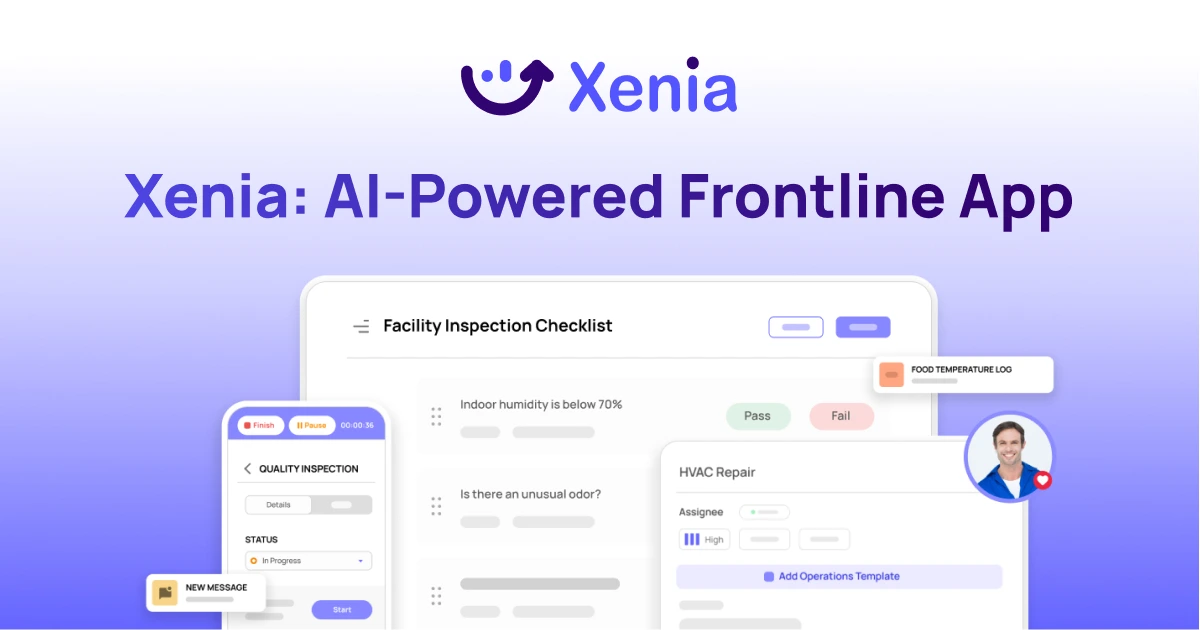
Xenia brings daily operations, maintenance, audits, and compliance into one mobile-first platform. Frontline teams execute work consistently across locations while leadership gets real-time visibility.
Why Multi-Location Operators Choose Xenia:
🤖 AI-Powered Operations, Create digital checklists instantly or convert paper forms with AI. Verify compliance automatically with photo analysis and get instant answers from your operational data.
✅ Daily Operations & Maintenance, Assign work across hundreds of locations in minutes. Report and route issues instantly. Schedule preventive maintenance to catch problems before downtime.
📊 Real-Time Visibility, Track completion, work orders, and performance across all locations through dashboards. Filter by site or asset to spot trends and take action.
Manage operations, maintenance, and compliance across all your locations from one platform

.svg)
.webp)
%201%20(1).webp)

.svg)
%201%20(2).webp)