

.webp)
Post Summary
A retail operations manager at a multi-location chain is losing good store associates to a competitor down the street.
The competitor offers four 10-hour days and every Friday off. The manager has never offered that schedule. Not because it does not work. Because nobody has done the work to figure out whether it does.
This article does that work.
What a 4x10 schedule is, where it performs well, where it creates problems, and what a manager needs to get right before rolling it out. For a broader look at schedule formats, see types of work shifts before choosing a model.
.webp)
.svg)

Priced on per user or per location basis
Available on iOS, Android and Web


What is a 4x10 work schedule?
A 4x10 work schedule is four workdays of 10 hours each, totaling 40 hours per week, with three consecutive days off.
It is a compressed schedule. Not reduced hours. The employee still works 40 hours, just across four days instead of five. That distinction matters for overtime calculations and for how you communicate it to employees.
**
Schedule type, Days worked, Hours per day, Weekly hours, Days off
Standard 5-day, 5, 8, 40, 2
4x10 compressed, 4, 10, 40, 3
Part-time, 3-4, 6-8, 24-32, 3-4
9/80 compressed, 9 days per fortnight, Varies, 80 per 2 weeks, Every other Friday
**
The most common version gives employees Friday, Saturday, and Sunday off. But the days off vary by operation and coverage needs.
The three-day weekend is the primary appeal. That is what makes employees in surveys choose it over a pay raise. And that is what makes it worth evaluating seriously before your competitor gets there first.
Where a 4x10 schedule works in frontline operations
A 4x10 schedule is not right for every operation. Here are the four contexts where it is a structural advantage, and why.
Fixed-location retail with predictable traffic windows
When traffic concentrates in specific windows, 10-hour shifts can cover the full peak period without a mid-shift handover.
- One crew covers the full morning rush or weekend afternoon
- No transition in the middle of the busiest window
- Fewer handover failures during peak periods
Stores with predictable patterns and enough staff to rotate the four-day block get the efficiency benefit without the coverage gap risk. This works because the schedule follows the demand, not the other way around.
Operations that struggle to hire and retain
The three-day weekend is a real recruitment lever in competitive labor markets. For operations competing for the same hourly workers, a 4x10 schedule can be a differentiator that costs nothing extra in labor hours.
The benefit is only real if the schedule is published reliably. An unreliable 4x10 loses the retention value immediately. Employees will leave for the competitor who actually delivers the promise.
Roles that benefit from continuity within a shift
Some frontline roles benefit from fewer handoff points:
- Kitchen prep and full resets
- Store resets and planogram changes
- Facilities maintenance and deep cleaning
A 10-hour block means fewer transitions mid-task and more time to complete complex work within a single shift. A kitchen team doing a full reset has more runway in 10 hours than 8. This is a productivity argument for specific role types, not a universal one.
Locations with limited weekday traffic
Some retail and hospitality locations are measurably slower Monday through Wednesday. A 4x10 block concentrated on Thursday through Sunday, or Tuesday through Friday, matches the schedule to actual demand more precisely than a standard 5-day spread.
Less labor during slow periods. Better coverage when it counts.
Where a 4x10 schedule creates problems
These are design considerations to plan around. Not reasons to avoid the schedule entirely.
Coverage gaps on the three off days
If the entire team runs the same 4x10 block with the same days off, Friday through Sunday may have no qualified staff at all.
A 4x10 only works for coverage if multiple rotation groups stagger their days off. A single-block implementation in a location that needs 7-day coverage creates predictable weekly gaps. Every single week. Without exception.
Fatigue in physical or high-compliance roles
10-hour shifts in physically demanding roles like kitchen, warehouse, and floor retail carry a higher fatigue load than 8-hour shifts. Performance and compliance discipline in the final two hours can degrade.
For operations where food safety, cash handling, or security compliance are required throughout the shift, this is a real design consideration. The question is whether the rotation and rest patterns are designed to manage the fatigue load.
Overtime exposure in California and daily-overtime states
Federal law triggers overtime at 40 weekly hours. Several states, including California, require overtime pay for hours worked beyond 8 in a single day.
A 4x10 schedule in California triggers 2 hours of daily overtime per shift per employee, every single day they work:
- 4 days of work
- 4 daily overtime triggers
- 8 hours of overtime pay per employee per week, every week
This changes the labor cost calculation entirely. See overtime rules for the full state-by-state picture. Operators with California locations must run this calculation before offering a 4x10 schedule.
Scheduling complexity across multiple locations
When employees work across sites, 4x10 schedules create weekly hour tracking complexity. An employee working at Location A who picks up a shift at Location B may hit 40 hours before the week ends.
Overtime tracking must account for hours across all locations within the same workweek. Not per site in isolation.
Where a 4x10 works vs where it creates problems:
**
Situation, 4x10 works well, 4x10 creates problems
Predictable peak traffic windows, Yes: 10-hour block covers full rush, No issue
7-day coverage requirement, Only with staggered rotation groups, Yes: single block leaves 3-day gap
Competitive labor market, Yes: three-day weekend is a differentiator, No issue
California locations, Possible with higher labor budget, Yes: daily OT adds 8hrs/week per employee
Physically demanding roles, Short-term yes, Long-term fatigue risk in final 2 hours
Multi-location workforce, Manageable with total-hours tracking, Complexity if hours not tracked across sites
**
How a 4x10 schedule affects overtime calculations
In standard federal FLSA states
Overtime triggers at 40 hours per workweek. A 4x10 produces exactly 40 hours. No federal overtime obligation, as long as the employee works no additional hours that week.
The schedule sits precisely at the federal threshold. If an employee picks up any additional time in the same workweek, overtime kicks in immediately. There is no buffer.
In California and daily-overtime states
Daily overtime requirements mean each 10-hour shift produces 2 hours of overtime pay regardless of the weekly total.
The math is unforgiving:
- $16/hour base rate
- 2 hours daily OT per shift at 1.5x = $8 per shift
- 4 shifts per week = $32 extra per employee per week
- Team of 10 = $320 per week in unbudgeted overtime cost
- Annualized = $16,640 in overtime that nobody planned for
**
State type, Overtime trigger, 4x10 weekly impact, Additional cost per employee
Federal FLSA states, 40 hrs/week, 0 hours overtime, $0
California, 8 hrs/day + 40 hrs/week, 8 hours overtime per week, Real weekly premium cost
Alaska, 8 hrs/day + 40 hrs/week, 8 hours overtime per week, Real weekly premium cost
Nevada, 8 hrs/day (if over $6.50/hr), 8 hours overtime per week, Real weekly premium cost
**
Operators must verify which states in their portfolio have daily overtime rules before implementing. Use HR workflows that track compliance requirements by location to avoid applying a single national standard where state rules differ.
How to implement a 4x10 schedule in a multi-location operation
Five steps. In sequence. What a manager or ops leader actually does before rolling this out.
Step 1: run the compliance check for every market first
Before announcing anything, verify overtime rules for each state where the schedule would apply. California, Alaska, Nevada, and other states have daily overtime requirements.
The compliance check comes before the rollout plan. Not after. A 4x10 that looks like a zero-cost retention tool in Texas becomes a real labor cost increase in California.
Step 2: map coverage requirements before building rotation groups
Identify which days and shift windows need coverage at each affected location. Then build rotation groups that stagger days off to maintain coverage across all seven days.
Coverage requirements come first. Employee preference comes second. Coverage gaps in the design phase create operational problems that are expensive to fix after launch.
Step 3: run a pilot before full rollout
Start with one location or one team. Then measure:
- Actual versus scheduled hours
- Compliance flags in the final shift hours
- Employee feedback at 30 and 60 days
A pilot surfaces problems at a scale that is fixable. A portfolio-wide rollout with an undetected design flaw is a much harder problem to unwind.
Step 4: communicate the schedule change clearly and early
Employees need advance notice to reorganize childcare, transportation, and personal commitments. In predictive scheduling markets, early notice may also be a legal requirement.
Last-minute communication about a schedule change affecting three days of someone's life is a fast path to turnover. The exact problem the 4x10 was supposed to prevent.
Step 5: track labor cost per location in the first 90 days
Labor cost as a percentage of sales may shift when 10-hour shifts change the relationship between hours scheduled and revenue by window. Monitor this by location during the first quarter.
Adjustments to shift windows or rotation groups are easier to make in the first 90 days than after the schedule is embedded. Use employee accountability systems that track hours, shift windows, and labor cost against revenue so problems surface before they become patterns.
For district and regional leaders rolling out schedule changes across locations, you need systems that actually work at scale. Our workforce scheduling guide shows you how to build the visibility and structure that makes compressed schedules work across your entire portfolio.
Related resources
- Types of Work Shifts
- Overtime Laws Explained
- Workforce Scheduling Guide
- Predictive Scheduling Laws
- Employee Scheduling Guide
Conclusion
The competitor's three-day weekend is a real recruitment advantage. And it does not have to cost more in labor hours.
Copying the schedule without the compliance check, staggered rotation groups, and coverage mapping first turns a retention tool into a compliance problem. The very problems it was supposed to solve.
Done right, a 4x10 schedule is one of the lowest-cost ways to differentiate as an employer in a competitive labor market. Done wrong, it creates weekly overtime liability and shifts nobody is covering.
See how Xenia works to manage schedule compliance, track labor cost by location, and give your team the visibility they need before a scheduling decision becomes a payroll problem.
Frequently Asked Questions
Got a question? Find our FAQs here. If your question hasn't been answered here, contact us.
Does a 4x10 schedule change how payroll works?

Minimal impact. Employees are paid for hours worked at their regular rate. The only consideration is overtime tracking in daily-overtime states, where each 10-hour shift generates 2 hours of overtime every pay period.
Can a 4x10 schedule be temporary or seasonal?
Yes. Just disclose it upfront. Employees who build their lives around a three-day weekend and have it removed without warning are a turnover risk.
What is the difference between a 4x10 and a 9/80 schedule?
A 4x10 gives three days off every week. A 9/80 gives every other Friday off across two weeks. Both total 80 hours per fortnight. The 4x10 is simpler to run and easier to explain to frontline teams.
Does a 4x10 schedule affect benefits or PTO?
Hours-based benefits are unaffected. A 4x10 employee still works 40 hours and qualifies as full-time. Check your PTO policy, if it accrues per day, confirm whether a 10-hour day counts the same as an 8-hour day.
Who decides if a company offers a 4x10 schedule?
The employer decides. Employees cannot expect it unless a written policy allows it. In predictive scheduling markets, changing an established schedule may also require employee consent.

A Modern, AI-Powered Platform Built Specifically for Frontline Operations
Xenia brings daily operations, maintenance, audits, and compliance into one mobile-first platform. Frontline teams execute work consistently across locations while leadership gets real-time visibility.
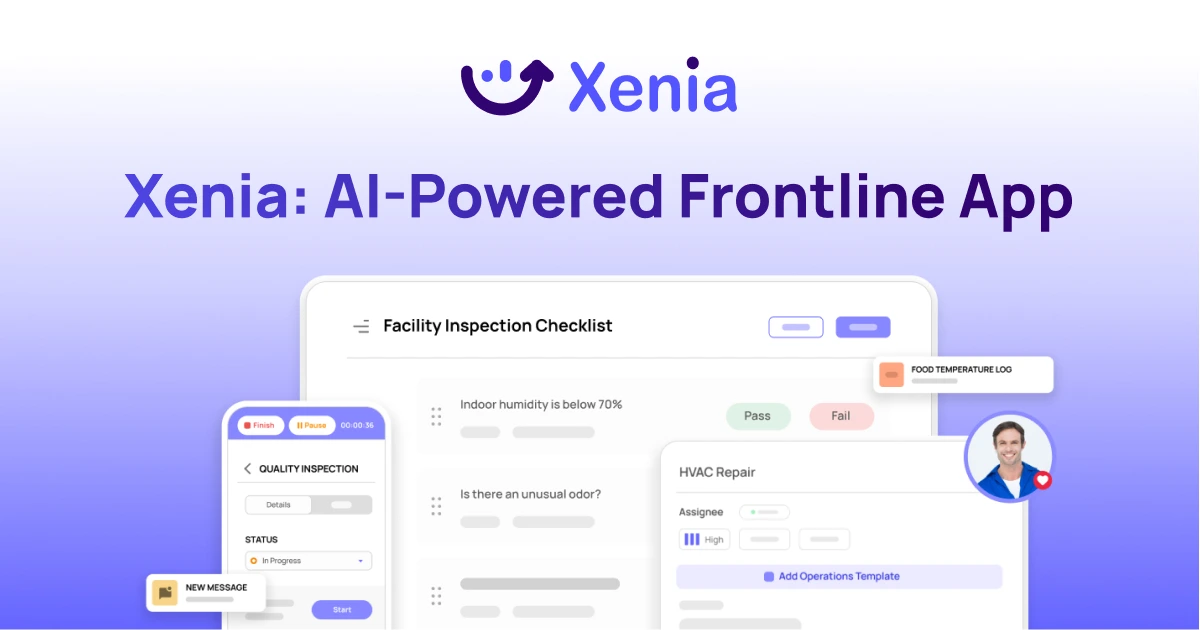
Why Multi-Location Operators Choose Xenia:
🤖 AI-Powered Operations, Create digital checklists instantly or convert paper forms with AI. Verify compliance automatically with photo analysis and get instant answers from your operational data.
✅ Daily Operations & Maintenance, Assign work across hundreds of locations in minutes. Report and route issues instantly. Schedule preventive maintenance to catch problems before downtime.
📊 Real-Time Visibility, Track completion, work orders, and performance across all locations through dashboards. Filter by site or asset to spot trends and take action.
Manage operations, maintenance, and compliance across all your locations from one platform

.svg)
.webp)
%201%20(1).webp)

.svg)
%201%20(2).webp)